Skip to content
DevMeme
7453 of 7506
Moore's Law Now Scales Price, Not Access

Moore's Law Now Scales Price, Not Access

Why is this Hardware meme funny?

Level 1: The Shrinking Toy Store

Imagine a toy shop that used to put twice as many building blocks in the same box every few years without making the box much more expensive. Now the shop announces a new tradition: the box costs twice as much, so only half as many children can buy one. The joke is that invention was supposed to make powerful things easier for everyone to get, but this “new law” makes progress feel like a fancier window display with fewer people allowed through the door.

Level 2: Smaller Parts, Bigger Bills

A transistor is a microscopic electronic switch. Modern processors contain huge numbers of them, arranged to perform calculations and store or move information. An integrated circuit, commonly called a chip, builds those switches and their connections on a piece of semiconductor material.

Moore’s law is the historical observation that engineers repeatedly managed to fit roughly twice as many transistors on a chip over a period commonly described as about two years. It was never a government rule or a guarantee from nature. It became a planning target: chip designers, equipment makers, and software companies coordinated around an expectation of rapidly increasing computing capacity.

More transistors can enable faster processors, larger caches, additional cores, or specialized accelerators. But transistor count is not the same as retail value. A buyer pays for an entire product, including several layers of work:

  1. Engineers design and verify the circuit.
  2. A fabrication plant, or fab, prints many chip patterns onto a silicon wafer.
  3. Working dies are cut out, tested, packaged, and sometimes connected to memory or other dies.
  4. A board, cooling system, power supply, software stack, distribution chain, and seller margin complete the product.

If a process packs in more transistors but those other costs rise, the final device need not become cheaper. Chiplets—smaller dies connected inside one package—can improve manufacturing yield and let designers mix technologies, but the sophisticated packaging also costs money. Engineering is trade-offs all the way down, followed by an invoice.

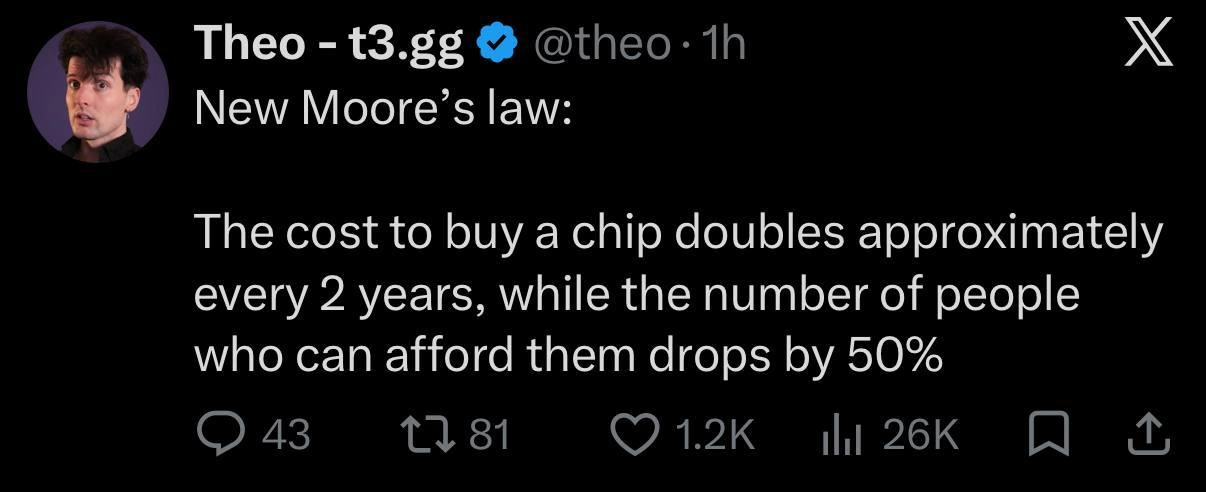
The visible X post calls its claim a “law” because the original phrase is famous and sounds authoritative. Replacing “more transistors” with “higher cost,” then pairing doubling with a 50% drop in buyers, makes the new version feel grimly inevitable. The likes, replies, reposts, and views retained in the screenshot frame it as a shared industry complaint: many people recognize the emotion even though the statement is obviously too broad to be a real pricing model.

Level 3: Economics Lost the Shrink

“New Moore’s law: The cost to buy a chip doubles approximately every 2 years, while the number of people who can afford them drops by 50%”

The post works by preserving the cadence and exponential shape of Moore’s law while reversing its social consequence. The familiar popular version says transistor counts on an integrated circuit roughly double every two years with little corresponding rise in cost. Historically, that meant more capability at a similar product price and a steep fall in cost per transistor. Theo’s “new” law keeps the doubling interval but applies it to the buyer’s bill, then makes affordability decay at the matching rate. Progress no longer spreads computing power; it concentrates access to it.

The symmetry is mathematically neat. If the chip price after n two-year periods is $P_n=P_0 2^n$ and the number of potential buyers is $B_n=B_0 2^{-n}$, then $P_nB_n=P_0B_0$. Under the deliberately silly assumptions that every remaining buyer purchases one chip and nothing else changes, total spending stays constant while the market becomes exponentially more exclusive. The meme is not reporting a dataset or making a defensible forecast. It is constructing a dark mirror: every gain on the price axis is canceled by a loss on the people axis.

That reversal cuts deeper because Moore’s original observation was always partly economic, not a law of physics. Gordon Moore examined how many components could be placed economically on an integrated circuit; the commonly repeated two-year formulation came later. For decades, smaller transistors let manufacturers place more functionality on a die, often lowering the cost of a unit of computation. The flywheel depended on enormous volumes paying for fabrication plants, design tools, masks, process research, and the occasional sacrifice to the yield gods.

At leading-edge nodes, several parts of that bargain have become harder:

  • Fabrication requires exceptionally expensive equipment and increasingly complex process steps.
  • Design costs rise because verification, physical layout, and mask preparation become more demanding.
  • Large dies lose more saleable units to defects, making yield a major part of effective cost.
  • High-end accelerators add costly high-bandwidth memory, substrates, advanced packaging, networking, power delivery, and cooling; “the chip” is often only one component of the bill.
  • AI infrastructure buyers can justify prices that ordinary developers cannot, encouraging scarce capacity to flow toward high-margin data-center products.

Those pressures do not prove the literal claim that all chips double in price. “Chip” can mean a tiny microcontroller, a phone system-on-chip, a desktop CPU, or a packaged AI accelerator, and their economics differ dramatically. Mature-node components can remain cheap; consumer performance per dollar can improve even when the flagship part grows more expensive; renting shared compute can widen access despite eye-watering purchase prices. The joke intentionally erases those distinctions because “some frontier systems have complicated total-cost curves” would struggle as a viral post.

The June 2026 timing could make the line feel like a response to contemporaneous reports of higher advanced-node manufacturing prices and persistent AI-driven demand, but the screenshot names no foundry, product, or news item. Its strongest target is therefore the broader industry mood: silicon roadmaps still promise astonishing density, while the most celebrated hardware increasingly arrives as racks, clusters, and capital expenditure. The developer who once upgraded a workstation now receives a cloud invoice for briefly meeting someone else’s accelerator.

There is also a historical echo of Rock’s law, the observation that semiconductor fabrication plants become dramatically more expensive over time. Moore-style density improvements and rising factory costs have long coexisted; mass production and cheaper transistors made the economics work. The satire imagines that cost escalation finally escaping the factory and chasing the individual buyer all the way to checkout. Transistor density may still scale, but purchasing power has apparently hit thermal throttling.

Description

A dark-mode X screenshot shows the verified account "Theo - t3.gg" (@theo, "1h") introducing "New Moore's law." The centered post reads, "The cost to buy a chip doubles approximately every 2 years, while the number of people who can afford them drops by 50%," with 43 replies, 81 reposts, 1.2K likes, and 26K views shown below. The joke reverses the familiar observation that transistor counts historically doubled on roughly a two-year cadence without equivalent cost growth, replacing technological democratization with exponential price inflation and shrinking access. In its June 2026 setting, it also reads as satire of AI-era demand, scarce advanced silicon and memory, and hardware prices increasingly aimed at data-center budgets rather than individual developers.

Comments

1
Anonymous ★ Top Pick Transistor density still scales; purchasing power hit thermal throttling.
  1. Anonymous ★ Top Pick

    Transistor density still scales; purchasing power hit thermal throttling.

Use J and K for navigation