Choosing six hours of debugging over five minutes of docs, as usual
Why is this Debugging Troubleshooting meme funny?
Level 1: Skipping Instructions
Imagine you got a big box of LEGO with a cool spaceship to build. It comes with a little booklet that shows you exactly how to put all the pieces together – that’s the instructions (just like documentation in coding). But you’re so excited (or maybe a bit impatient) that you decide, “Nah, I don’t need the instructions, I can do this myself!” You start snapping bricks together, building away for a long time. After hours of working, your spaceship looks weird and keeps falling apart. You feel totally confused and frustrated because something is clearly wrong. Finally, you pick up that instruction booklet and read it for just a few minutes. Aha! You realize you used a bunch of pieces in the wrong places and missed a crucial step early on. You rebuild the ship following the booklet and everything fits perfectly now, done in no time.
The meme is funny for the same reason this story is funny (and a bit silly) – it’s showing how people sometimes avoid the easy help (reading instructions or documentation) and end up doing things the hard way. In the picture, a hero character (He-Man) jokingly tells us, “Remember, spending 6 hours trying to fix a problem is better than taking 5 minutes to read how to fix it!” Of course, that advice is upside-down. It really means a little reading can save a lot of trouble. We laugh at it because we’ve all been like that kid who doesn’t read the instructions: we skip the boring guide, struggle and get frustrated, then later discover that the answer was written clearly in front of us. It’s a friendly tease, reminding us that sometimes the smartest move is to slow down for a moment and read the directions, even if we think we don’t need to. The joke hits home because it’s a nod to an experience many of us have had, and it makes us chuckle and think, “Oops, I do that sometimes!”
Level 2: Documentation vs Debugging
Let’s break down the joke in simpler terms. The meme is highlighting the contrast between reading documentation and debugging code, two activities every programmer is familiar with. Documentation is any written guide or reference that explains how software works – think of user manuals, README files on GitHub, or official docs websites. If you’ve ever used a new library or tool, the documentation is usually the first place to learn how to set it up and use it correctly. It contains important details like functions available, correct configurations, and common pitfalls. Debugging, on the other hand, is what you do when your code isn’t working as expected – you investigate and try to find the cause of errors or bugs. This often means running the program to see where it breaks, printing out values, using a debugger tool to step through code line by line, or looking at error messages and stack traces. Debugging can be time-consuming, especially if you’re not sure what you’re looking for. It’s a bit like detective work in your code.
Now, the text in the meme says: “6 hours of debugging can save you 5 minutes of reading documentation.” It’s written in a big bold Impact font caption, the classic meme text style, to emphasize the message in a humorous way. This sentence is sarcasm – it means the opposite of what it literally says. Of course, spending six hours trying to debug a problem is not really saving you time compared to spending five minutes reading instructions. But unfortunately, many developers (especially when we’re eager or in a rush) do exactly that! We often jump straight into trying to fix a problem by poking around in the code, without taking a short pause to read the docs or manual that might have the answer. The result? We might eventually fix the bug after many hours, only to discover that if we had taken a few minutes to read the documentation first, we would have solved it almost immediately. The meme is making fun of this common habit. It’s a form of DocumentationHumor: joking about how people avoid reading docs. You could call it DebuggingFrustration turned into a joke – we’re basically laughing at our own silly mistake of ignoring helpful information and choosing the more painful route.
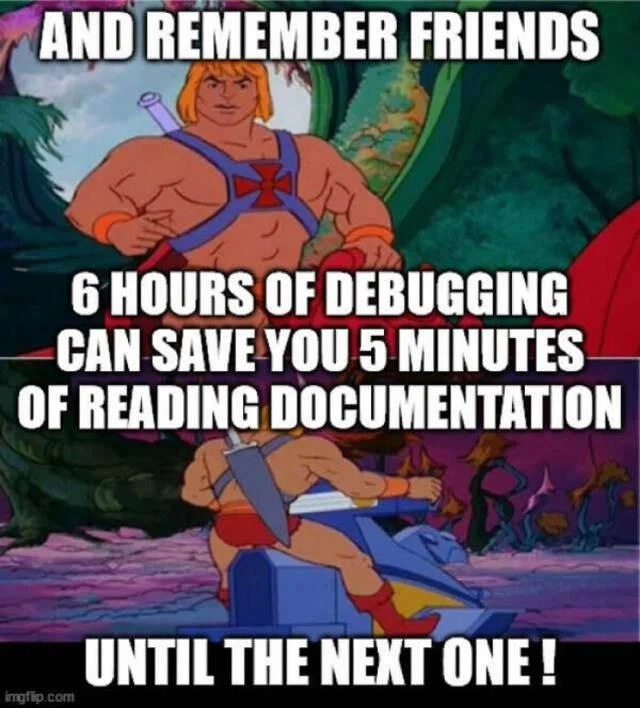
In the meme image, the character speaking is He-Man, a famous animated hero from the 1980s cartoon “He-Man and the Masters of the Universe.” In the original show, He-Man would sometimes address the audience with a friendly lesson or moral at the end of an episode, starting with phrases like “And remember, friends...” The meme mimics that format. In the top panel, He-Man is pointing at the viewer and saying “AND REMEMBER FRIENDS,” as if he’s about to impart great wisdom. Then the “wisdom” he gives is the backwards advice that not reading docs is somehow good for you – which is the joke. It’s using He-Man’s wholesome educational tone to deliver a punchline that sounds insightful but is actually poking fun at developers’ bad habits. The bottom panel shows He-Man riding away on a saddle (his vehicle or perhaps his armored tiger named Battle Cat), with the subtitle “UNTIL THE NEXT ONE!” implying “until the next time we do this again.” In other words, we might say we’ve learned our lesson this time, but chances are high that when the next bug comes around, we’ll repeat the same mistake: skip the docs, dive into the code head-first, and only later realize reading the manual would have helped. It’s a cycle that many of us recognize.
For a junior developer or someone new to coding, the meme’s advice might sound confusing at first because it deliberately contradicts logical behavior. To clarify: reading the docs first is actually the smarter move, and the meme is joking about people doing the opposite. It’s like when you get a new gadget or assemble furniture – there’s that instruction manual (documentation) that could guide you, but some folks toss it aside and struggle to put things together on their own for hours (debugging). Only when they’re completely stuck do they finally read the manual and realize the solution was written plainly there. The humor comes from recognizing this very human tendency in ourselves and others. For developers, it’s a gentle poke: “Hey, we know you hate reading those boring docs, but look how much time you waste when you don’t!” It’s also a shared wink among programmers because even though we know we should “RTFM” (a tech slang meaning “Read The Manual”), many of us still skip it and then pay the price in debugging time. This meme lives under categories like Debugging_Troubleshooting and Documentation for good reason – it’s about the trade-off between spending time reading versus time troubleshooting. And in terms of DeveloperProductivity, it humorously points out a very unproductive pattern that we fall into.
In summary, the “lesson” He-Man gives here isn’t meant to be followed literally – it’s a sarcastic way to say “Please, save yourself the trouble and read the documentation for five minutes instead of suffering through six hours of bug hunting.” The image and text resonate with developers because it exaggerates a real scenario to highlight why reading documentation is important (and how silly we can be when we avoid it). So the next time you’re stuck on a coding problem, remember the meme and consider cracking open the docs before you spend the whole day tweaking and debugging your code. It might feel like an annoying extra step, but it could spare you a lot of frustration!
Level 3: Working Harder, Not Smarter
In this He-Man themed meme, the muscular 80s hero breaks the fourth wall to deliver a hilariously ironic coding lesson. The bold white Impact font text proclaims: “6 hours of debugging can save you 5 minutes of reading documentation.” This is a tongue-in-cheek inversion of common sense. Normally, we say reading the docs for 5 minutes can save hours of debugging, but here the phrase is flipped to mock our self-defeating habits. Seasoned developers chuckle (or groan) because they’ve all been there: diving into a marathon debugging session while the answer was sitting in the manual the whole time. It’s a classic case of documentation aversion in action, a form of technical masochism that trades a quick read for an extended battle with the code.
Why do smart engineers fall into this trap? Chalk it up to overconfidence, tight deadlines, or the illusion that “digging through the code” is faster than checking the docs. By the time you’ve instrumented logs, stepped through with a debugger, and scoured Stack Overflow, you realize that the official documentation (or a simple README) spelled out the solution from the start. The humor stings because it’s true: skipping the documentation is a false economy. We convince ourselves we’re saving time by jumping straight into code triage, but it often costs far more hours in the end. As the meme implies, six hours of debugging heroics are frequently the “preferred” alternative to five minutes of calm reading. It’s like a developer version of procrastination: we avoid the boring part (reading docs) by doing the fun-but-frustrating part (tinkering and troubleshooting), and then act surprised when we’ve lost half a day.
This scenario is DeveloperHumor 101 and a source of shared DebuggingFrustration. The meme’s format itself adds to the comedic punch. It uses the classic impact font caption style (bold, all-caps text with a black outline) which meme veterans recognize instantly. And the choice of He-Man, a heroic cartoon figure known for dispensing wholesome advice at the end of episodes, is the icing on the cake. In the original show, He-Man might say, “Knowing is half the battle,” or give kids a life lesson. Here, he cheerfully delivers a sardonic twist on that trope, effectively saying “Remember, kids: working harder (endless debugging) is much more effective than working smarter (reading the docs)… until next time!” It’s an absurd lesson that no one should follow, which is exactly why it’s funny. The bottom panel, showing He-Man riding away on his trusty steed (or Battle Cat), with the caption “UNTIL THE NEXT ONE!”, drives home the punchline: we never learn. Today’s vow to read the documentation next time is forgotten as soon as the next bug hunt begins. This “until the next one” is a wink to every developer’s cycle of regret. We laugh (perhaps a bit bitterly) because we recognize this pattern in ourselves or our teammates – a kind of nerdy Groundhog Day of making the same mistake over and over.
On a serious note, this meme points to a real productivity pitfall. Documentation exists for a reason: it often contains setup steps, gotchas, and examples that prevent misuse. By ignoring it, developers can miss critical details – maybe a required configuration flag, an initialization call, or an environment variable – and then spend hours chasing a “bug” that’s not a bug at all. For example, imagine integrating a new library and your code keeps throwing an error:
// Developer dives into using a new API without reading its guide:
MagicAPI api = new MagicAPI();
api.doTheThing(); // This keeps failing mysteriously...
// ...Many frustrating hours later...
// The documentation reveals: "Remember to call api.initialize() before using the API."
In hindsight, the fix was one line in the docs that would have saved a night of debugging pain. This pattern is so common it’s an industry running joke – hence the meme. Debugging itself is already a skill that tests patience, and doing it without background info is like navigating a maze blindfolded. The meme hyperbolically suggests we choose this hardship over a quick peek at guidance, highlighting the ridiculousness. It resonates deeply with anyone who’s ever had that facepalm moment after finally reading the manual. In the world of software development, there’s even an acronyms and slang for this dynamic: RTFM stands for “Read The Fine Manual” – a salty reminder from grizzled veterans that many problems have already been solved in the documentation. There’s also TL;DR (“Too Long; Didn’t Read”), poking fun at our tendency to skip text and then suffer the consequences.
From a senior engineer’s perspective, the meme is a humorous critique of DeveloperProductivity mismanagement. It hints at the cognitive bias where we undervalue preparatory reading and overvalue active debugging work. Culturally, many coders prefer hands-on exploration to reading theory – call it hacker ethos or just impatience. But when deadlines loom, that quick 5-minute doc skim can be the smartest move you make. Still, it’s almost a rite of passage to ignore that wisdom and learn the hard way at 3 AM, stepping through code or combing logs while the docs webpage sits ignored in another tab. The shared suffering is what generates the knowing laughs: we’ve all wasted time this way, and we’ll likely do it again “until the next one!”. The meme uses humor to say, “Admit it, you do this. We all do.” It’s a gentle roast of our DebuggingPain and an inside joke among developers.
Description
Two - panel He-Man cartoon meme. Top panel: the muscular, blond animated hero points at the viewer while bold white impact text with black outline reads “AND REMEMBER FRIENDS”. Middle overlay continues in the same font: “6 HOURS OF DEBUGGING CAN SAVE YOU 5 MINUTES OF READING DOCUMENTATION”. Bottom panel shows He-Man climbing onto his saddle, riding away; caption underneath says “UNTIL THE NEXT ONE !”. The joke highlights a common developer habit - diving straight into lengthy debugging sessions instead of skimming the documentation that would have revealed the root cause instantly, poking fun at productivity trade-offs and documentation aversion

Comments
6Comment deleted
After six hours single-stepping through twelve microservices and one rogue COBOL job, I finally opened the docs - only to find my own note from 2012: “Future me, read this first.”
The same senior engineer who refuses to read the AWS IAM docs is now teaching a junior about "first principles thinking" and "understanding the fundamentals."
This meme perfectly captures the senior engineer's paradox: we've all spent an entire sprint debugging a race condition in a distributed system, only to discover the solution was documented in a three-line comment in the library's migration guide. The real kicker? We'll do it again next quarter with a different service, because reading documentation feels like admitting defeat, while debugging for six hours feels like 'real engineering work.' The cycle continues until we become the ones writing the documentation that nobody reads - achieving full circle in the developer's journey from stubborn debugger to resigned documenter
Senior dev wisdom: undocumented APIs evolve faster via runtime panics than any README ever could
Six hours of debugging beats five minutes of docs - those describe the system we intended; prod runs the one we accidentally built
Docs are O(1); debugging is O(n) where n equals your wrong assumptions per hour - guess which one scales with on-call caffeine