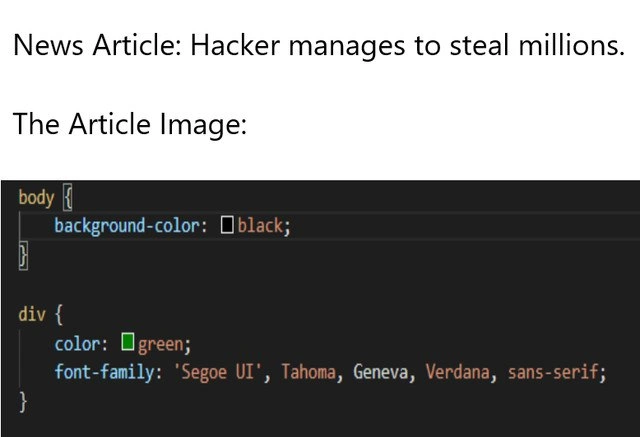
Media depicts million-dollar hack using a basic CSS snippet screenshot
Why is this Security meme funny?
Level 1: Looks Techy, Isn’t Scary
Imagine you hear a news story that says, “A clever thief used high-tech magic to steal millions of dollars!” 😮 That sounds really intense and mysterious. But then, picture that the news shows a photo alongside this story – and the photo is just someone painting a wall black and green. Huh? That seems odd, right? Painting a wall in fancy colors doesn’t sound like a way to rob a bank! It might look cool or “techy,” but it definitely doesn’t open any vaults.
That’s exactly the joke here. The news headline is talking about a big, serious computer break-in (a hacker stealing a lot of money). But the picture they used (the code snippet) is like the painting — it’s something simple that just changes colors on a screen. In real life, changing colors on a screen won’t let you steal anything. It’s as harmless as decorating your room. So the news basically used a totally wrong picture for the story, probably because they thought it looked geeky and “hacker-ish.” People who know about computers find this funny because it’s such a mismatch: the story is scary, but the picture is not. It’s like if a story about a dragon attacking a castle was illustrated with a picture of a cute little lizard 🦎. The lizard is real, but it’s not the dragon – it just looks a bit like what someone thinks a dragon might be. In the same way, that green and black code looks a bit like what some folks think “hacking” looks like, but it’s not dangerous at all. That contrast – between what looks serious and what actually is ordinary – is why we laugh. It shows the news didn’t really understand the “magic trick,” and used a random pretty picture of code instead, and we’re in on the joke.
Level 2: Just Styling, Not Stealing
Let’s break down what’s going on here in simpler terms. The image in the meme shows a bit of CSS code (Cascading Style Sheets) being used as a visual for a hacking story. Now, CSS is a language used in web development to make websites look nice. It controls the colors, layouts, and fonts on a webpage – basically the style and appearance of the site. Importantly, CSS is not a programming language for logic and definitely not a hacking tool; it’s all about presentation. If a website were a house, HTML would be the structure (walls and rooms), JavaScript might be the interactive appliances or doors that open, and CSS would be the paint and decor – the color of the walls, the style of the furniture. You can imagine that painting a wall or choosing furniture doesn't let you break into someone else's house. In the same way, writing CSS doesn't let you break into websites or steal data; it just changes how things look on the screen.
Now, the CSS snippet shown in the article image is extremely basic. Let’s explain what each part of that code does, because it’s actually quite innocent:
body { background-color: black; }– In a webpage, “body” is the main container for all content. This line simply says: make the page’s background color black. It’s like turning on a dark theme or painting the page black. 🎨 It doesn’t do anything harmful; it just changes the background color.div { color: green; font-family: 'Segoe UI', Tahoma, Geneva, Verdana, sans-serif; }– A “div” is just a generic container element in HTML (kind of like a box to group other content). This rule says: any text inside a<div>should be displayed in green, and use the font family Segoe UI (or Tahoma, or Verdana, etc., which are common clean fonts). So this is specifying text color and font style for those sections. Result? The text on the page appears green and in a standard sans-serif font. Again, totally harmless – it’s like deciding all the text in your document will be green and in a certain handwriting style.
That’s it! The whole code is just two style rules. There’s no secret commands, no database queries, no network calls. Nothing about it can steal anything or perform any action beyond cosmetics. It’s the kind of snippet a beginner might write when learning web design: “Let’s make a cool hacker-themed webpage with a black background and green text!” In fact, that style – green text on black – is a classic aesthetic used to evoke “hacker vibes” because of old terminals and movies like The Matrix, but in reality it’s purely visual. So seeing it in a news article image for a millionaire hacker story is comical to developers. CSS is not malware; it can’t hold data hostage or infiltrate a server by itself. It’s just instructions for a web browser on how to paint the page.
Now, compare this to what actual hacking involves. Real hacking (to “steal millions” as the headline says) typically requires finding a weakness in a system – this could mean writing a clever program or script to exploit a bug, injecting malicious code into a database, tricking someone into giving away passwords (phishing), or other cybersecurity exploits. For example, a real attack might use something like an SQL injection (where a hacker inputs special commands into a login field to get secret data from a database). An SQL injection might look like gibberish to the untrained eye – something like '; DROP TABLE users;-- – which is a sneaky way to tell a database to delete data. That’s the kind of code that actually does damage. Or an attacker might write a Python script to scan for vulnerabilities on a network, or use a tool to execute a cross-site scripting (XSS) attack (not to be confused with CSS!). The key is, those real attack methods don’t result in a pretty, color-highlighted snippet that’s easy to screenshot for a news article. They might be raw text commands, or binary exploits, or simply not visual at all. And often, the frontend code (HTML/CSS) of a site isn’t even involved in the breach except maybe as a delivery mechanism for something else. So using a front-end styling snippet as the face of a hacking story is like using a picture of a HTML form to represent a bank robbery – it misses the mark by a mile.
It’s likely that whoever chose the image for that article didn’t know this. They probably searched a library of images or asked someone for “something techy” to go with the hacker news. Since code is mysterious-looking to many people, just about any code screenshot can be mistaken as “hacker code”. This is a classic case of MisunderstandingTechnology by non-developers. In the world of journalism (especially general news), editors aren’t expected to be coders or security experts. They just wanted a picture that communicates “computers” or “hacking” to readers. And what fits that bill better than a dark screen with green text and curly braces? It’s an easy visual shorthand for “some computer wizardry is happening here.” Unfortunately, to those who do know technology, it ends up looking a bit silly. It’s like labeling a picture of a door lock as “sophisticated break-in tool” simply because it’s related to entry; the context is all wrong.
For a junior developer or someone new to tech, this meme is a gentle introduction to the idea that mainstream tech reporting can be quite superficial. You might remember the first time you wrote code and showed it to friends or family – maybe you were just making a simple website with HTML/CSS or writing a small Python script – and someone quipped, “Wow, are you hacking into the Pentagon there?” 😅 They see a black terminal or brackets and text, and it looks like those hacking montages from TV. This meme is basically that joke on a bigger scale. The news article is like that friend who can’t tell the difference between you running npm start and you launching a cyber attack. As you grow in your tech career, you’ll encounter a lot of these misconceptions. Part of becoming experienced is learning to translate between what something looks like and what it really is. Here, what looks like “hacker code” to a layperson is really just web development code.
Also, notice the context: FrontendHumor and WebDevelopment angles are at play. Front-end developers (who specialize in HTML/CSS/JavaScript) find this extra funny because CSS is their daily bread and butter. They know its power and its limits. CSS can do cool visual tricks, sure – make an element blink, create animations, style a button – but it’s not going to hack anything. In fact, front-end folks often joke about how insignificant CSS is considered in the security realm; if you report a CSS bug in a security bug bounty, you’d probably get a blank stare. So seeing CSS used as an example of “hacking”? That’s peak irony. It’d be like if a cooking magazine illustrated a recipe for a complex dish with a photo of just salt and pepper. Right idea (seasoning is used in cooking), but completely missing the substance of the actual recipe.
In short, this level clarifies the key technical point: CSS is for styling web pages, not for stealing money or data. The meme exploits that contrast. By understanding what CSS does (and doesn’t do), even a newcomer can appreciate why the news article image is laughably inappropriate. It’s a reminder not to take every “tech image” at face value, especially in media. Sometimes, the truth behind a cyber incident is far more complex and less visible than what the pictures show. As a junior dev, you might even feel a bit of insider pride catching this mistake: you’ve learned enough to know the emperor (or the hacker in this case) has no clothes – or rather, he just has a dark theme on!
Level 3: Security Theater in CSS
At first glance, this meme highlights a major disconnect between cybersecurity reality and media portrayal. We have a dramatic headline about a multimillion-dollar hack, but the accompanying image is a screenshot from a code editor (it looks like Visual Studio Code in dark theme) showing a completely innocent CSS file. The code snippet in the image is something like:
body { background-color: black; }
div { color: green; font-family: 'Segoe UI', Tahoma, Verdana, sans-serif; }
To any experienced developer or security engineer, this is hilarious because that snippet is utterly benign. It’s just styling rules changing a webpage’s background to black and text to green. In other words, the article’s image is literally front-end design code, not some elite exploit or malware. It’s as if the news is saying, “A hacker stole millions!” but illustrates it with a screenshot that effectively says, “they set the site to dark mode and made text green.” This absurd mismatch is the core of the humor. It reveals how mainstream media often resorts to stock code images and hacker clichés (green text on black background, anyone?) for any cybersecurity story, even when those visuals have no actual connection to the hack being reported. The result is a form of security theater – it looks technical and ominous to a layperson, but to those in the know, it’s pure fluff.
Why does this combination of elements make tech folks smirk and facepalm? Because it satirizes a well-known industry pattern: news_headline_vs_reality. In reality, a hacker capable of stealing millions isn’t doing it with a .css file that changes font colors. They might be exploiting a buffer overflow in C, deploying ransomware, or phishing an executive – none of which produce a sexy, color-coded screenshot that a newspaper can easily splash under a headline. But media outlets often struggle to visually represent “hacking” or cybersecurity breaches. There’s no convenient dramatic photo of the exploit itself (it’s all abstract code or clandestine actions), so editors grab anything that looks code-ish. That usually means gibberish text, command lines, or – in this case – a random code snippet with curly braces and syntax highlighting. It doesn’t matter if it’s CSS, HTML, or even pseudo-code – as long as it has that “scary code” aesthetic with a black background and neon text, it screams “hacker!” to the general public. It’s the same reason so many articles use images of a person in a hoodie hunched over a keyboard or a stock photo of a green padlock over binary code. It’s cybersecurity storytelling by aesthetics rather than accuracy.
This meme pokes fun at the media_hacker_stock_images phenomenon that industry veterans know all too well. Seasoned developers have seen countless examples of this misunderstanding of technology. For instance, a serious news piece on a data breach might show a screenshot of generic open-source code that has nothing to do with the attack. It’s both funny and frustrating. On one hand, it’s comical to imagine the non-tech editor Googling “computer code” and pasting the first result (in this case, basic CSS) to symbolize a complex hack. On the other hand, it perpetuates a sort of security hype without substance, potentially misleading the public about how hacking works. Insiders call this Security Theater: all show, no real insight. It’s similar to airport security theatrics – lots of spectacle to make you feel like something serious is happening, but often missing the point. Here, the spectacle is a code screenshot that looks intimidating to the untrained eye but does absolutely nothing related to the crime. In fact, there’s a delicious irony in the specific CSS shown: it literally sets a black background with green text, mimicking the stereotypical “hacker UI” from Hollywood movies (think The Matrix cascade or old-school terminals). The news basically styled their article’s image to look hacker-ish using CSS, while inadvertently showing actual CSS code. It’s a perfect loop of irony: using CSS to appear more “hacky” while reporting on a hack!
From a senior perspective, there’s also a bit of collective “we’ve been here before” groaning behind the laughter. This kind of TechIndustrySatire reflects shared experiences. Many of us have had to explain to non-technical colleagues or PR teams why their chosen graphic for a security story makes no sense. (“No, Karen, that JavaScript snippet from our website isn’t evidence of a breach, it’s our Google Analytics code.”) We’ve seen HackerCulture misrepresented time and again: e.g. movie scenes where attackers furiously pound keys while 3D file systems zoom by, or news segments where a green code waterfall is projected on someone’s face. So when this meme shows a headline about a million-dollar cyber-heist next to a frontend style sheet, it’s tapping into that shared exasperation and amusement. It’s basically the dev community saying, “Look, the media did it again – they have no idea what they’re showing!” and having a laugh.
There’s also an underlying commentary about how IndustryTrends_Hype can distort reality. Cybersecurity is a hot topic, and news outlets know it draws eyeballs. But they often emphasize the mystique of hacking rather than the nuts and bolts. A headline like that promises a tale of cunning hackers, but the image selection betrays a lack of depth – it’s all hype with a sprinkling of CSS confetti. For seasoned security pros, this can be mildly infuriating. Imagine working hard to educate people on real threats (like unpatched systems, phishing emails, SQL injection vulnerabilities) and then seeing the public conversation derailed by glossy but meaningless imagery. It’s TechIndustryIrony at its finest: the tools and languages we use every day (like CSS for web design) are being misconstrued as the keys to a bank heist. You can’t help but chuckle and roll your eyes.
In summary, the meme’s humor thrives on the absurd juxtaposition of serious cybersecurity news with harmless frontend code. It’s a wink to all developers and infosec folks: “See this? They think our styling sheet is some hacker’s secret weapon. LOL.” It highlights a real gap between how technology is understood inside the tech community versus how it’s often portrayed outside. And that gap – full of green text, black backgrounds, and misunderstanding – is where the satire lives.
Description
The meme starts on a white background with black text that reads, “News Article: Hacker manages to steal millions.” After a blank line it continues, “The Article Image:”. Beneath the caption sits a dark-themed code-editor screenshot (looks like Visual Studio Code) showing a perfectly innocent CSS file: “body { background-color: black; }” followed by “div { color: green; font-family: 'Segoe UI', Tahoma, Geneva, Verdana, sans-serif; }”. Nothing in the snippet relates to hacking, exploits, or security. The humor comes from how mainstream news outlets routinely illustrate high-stakes cybersecurity stories with any random code screenshot, revealing a gap between real security work and the public portrayal of “hackers.”
Comments
6Comment deleted
Journalist threat model: set `body { background:black; color:green; }` and you’re apparently exfiltrating millions on the dark web - meanwhile the real breach was an unrotated SSH key from 2009
The real vulnerability was using Verdana as a fallback font - that's how they knew it was an inside job
Ah yes, the infamous 'background-color: black' exploit - a zero-day vulnerability in the CSS specification that's been hiding in plain sight since 1996. The attacker clearly leveraged the Segoe UI font stack to establish persistence across Windows systems, while the green text color provided perfect camouflage in terminal environments. Security researchers estimate this sophisticated attack vector has a CVSS score of 0.0, making it virtually undetectable by traditional security tools. The real breach here is in journalism's understanding of what constitutes a 'hacker image' - apparently any code on a dark background qualifies, regardless of whether it's styling a button or draining bank accounts
Somewhere a SOC lead is screaming that if your breach ‘evidence’ is CSS, the only compromised asset was the editor’s understanding of the stack
Real hackers bypass WAFs with polyglots; news hackers just !important their way past the body selector
Newsroom hack detection: if it’s green text on black, it’s hacking; and if the font stack includes “Geneva,” the money’s already offshore