Skip to content
DevMeme
4253 of 7435
Swinging from imposter-syndrome doom to unstoppable dev confidence
MentalHealth Post #4648, on Jul 6, 2022 in TG

Swinging from imposter-syndrome doom to unstoppable dev confidence

Why is this MentalHealth meme funny?

Level 1: Emotional Rollercoaster

Imagine riding a rollercoaster that goes really low then really high, over and over – that’s what a developer’s feelings are like in this meme. One moment the person feels terrible, like a kid who keeps messing up a difficult puzzle and thinks, “I’m just no good at this at all.” In the next moment, the same person feels on top of the world, like when you finally finish that puzzle all by yourself and shout, “I’m the best, nothing can stop me!” The meme shows these two opposite feelings back-to-back, which is silly and funny because of how extreme it is. It’s saying that being a programmer can sometimes feel like you’re either completely failing or absolutely winning, with not much in between. We laugh at the cartoon because we’ve all felt those ups and downs. Just like a real rollercoaster, the low part feels scary and the high part feels thrilling – and the truth is the ride will keep going, and you’re going to be okay through it all.

Level 2: Imposter Syndrome 101

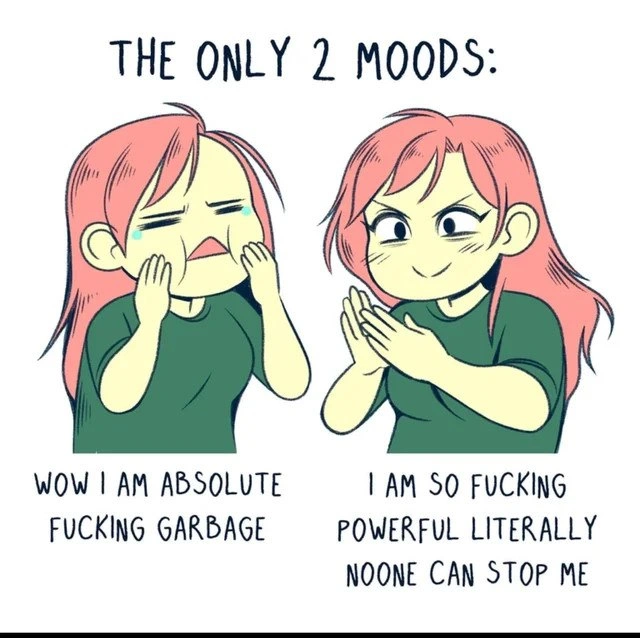
Let’s break down what’s happening in this meme in simpler terms. We have two drawings of the same developer character, and they represent two extreme moods that many developers experience. The first mood: "Wow, I am absolute freaking garbage." This is the voice of imposter syndrome – a common feeling in tech where you’re convinced you’re not good enough at your job, even when you actually are. It’s like an unwarranted fear that you’re an imposter or fraud among real developers. In the cartoon, the character is crying and covering her face, clearly overwhelmed by self-doubt. ImposterSyndrome often hits when a developer encounters a tough problem or makes a mistake; suddenly they feel utterly unqualified. This part of the meme nails that familiar, sinking feeling of "I have no idea what I’m doing... I bet everyone’s going to find out I’m clueless." That’s the doom side of the swing.

Now, the second mood: "I am so freaking powerful, literally no one can stop me." This is the complete opposite feeling – a surge of developer confidence. In the image, the same character now has a scheming grin, eyes narrowed in mischievous confidence, and hands clasped like a mastermind who just conquered the world. We’ve all had moments like this too! For example, when you finally solve a bug that had you stumped all day, or you finish a project and everything works perfectly, you feel on top of the world. It’s that "YES! I’m a coding wizard!" sensation. In developer lingo, some might jokingly call this going into “God mode” or feeling like a "10x engineer" (a mythical super-productive developer). It’s an intoxicating high where you believe “I’m actually really good at this, what was I ever worried about?”

This meme exaggerates the contrast for relatable humor, and that’s why it’s so funny to people in software. It’s portraying a common developer experience (DX): emotional_whiplash – rapidly switching from frustration and low self-esteem to excitement and high self-esteem. Most developers, from newbies to veterans, recognize these two states. Early in your career, it might be especially intense: maybe you feel like a fraud when you struggle with a new programming concept or when your code doesn’t work. Then perhaps you have a day where everything clicks – you fix a complicated bug or your code finally runs – and suddenly you’re feeling unstoppable. This swing of confidence can even happen in the same day (or hour!). One moment you’re banging your head on the desk because nothing works; the next moment your program finally compiles and you’re doing a little happy dance thinking, "I am a genius!"

Let’s clarify some terms and why they matter:

  • Imposter Syndrome: That’s the key term here. It means feeling like you’re not as competent as others think you are, and fearing you’ll be exposed as a “fraud.” In tech, lots of developers have this feeling because tech is a huge field – no one knows everything, but it’s easy to feel like you should know all the things. When the left panel text says “I am absolute garbage,” it’s a blunt (and comedic) way of expressing imposter syndrome. Of course, in reality the person isn’t garbage at all – it’s just a harsh inner critic voice that many of us have.

  • Confidence Swing: This isn’t a formal term, but here we use it to describe how rapidly your self-confidence can swing back and forth. Solve one thing, confidence goes up; hit a roadblock, confidence plummets. Developers often joke about having only two modes or only two moods for this reason. There’s rarely an in-between calm feeling on a tough coding day – it’s either “I know nothing” or “I am unstoppable.” The meme turns this into a punchline.

  • Developer Self-Deprecation: Developers often use self-deprecating humor – meaning we make fun of ourselves – as a way to cope with stress. Saying “I’m garbage” in a joking way is an example. It sounds harsh, but in context it’s a shared joke: we don’t truly think we’re garbage (hopefully), but we do recognize that feeling in ourselves and laugh at it to take away its power. This kind of humor is part of MentalHealthInTech culture where acknowledging your anxieties out loud can actually make them less scary and more communal.

So basically, the meme is showing a relatable internal dialogue that a lot of programmers have. It’s common for someone working in tech to feel super insecure at times and super confident at others. Maybe your code fails all the tests today – you’ll go home feeling like you’re bad at this job. But then tomorrow you solve a big problem and everyone’s thanking you, and suddenly you feel like a rockstar. Neither extreme sticks around forever. The reality is you’re never as terrible as you feel at your lowest, and you’re not actually an all-powerful wizard at your highest – you’re a regular (competent!) person who has good days and bad days. But inside our own heads, it often doesn’t feel that way, especially in a field as challenging and fast-paced as software development. That’s why this meme hits home: it’s portraying that developer emotional rollercoaster in a way that’s funny and easy to instantly recognize.

Level 3: Binary Self-Esteem

In the developer world, it's disturbingly common to oscillate between two extreme self-assessments, much like a binary value flipping from 0 to 1. This meme nails that developer reality: one moment you believe "WOW, I AM ABSOLUTE FING** GARBAGE"* (complete imposter syndrome meltdown), and the next moment you're convinced "I AM SO FING** POWERFUL, LITERALLY NO ONE CAN STOP ME"* (total code-conquering euphoria). The cartoon captures this emotional whiplash perfectly: same character, two opposite moods, reflecting how a day in a developer’s life can swing wildly. It's a humorous exaggeration of the only_two_moods many of us secretly recognize.

Why is this so relatable? Because dev work often provides intense highs and lows. Squashing a nasty production bug at 3 AM can make you feel like an unstoppable mastermind who just saved the day (hello, adrenaline-fueled ship-it energy). But the very next morning, struggling to center a <div> in CSS or misconfigure a database can plunge you into "I'm not cut out for this" despair. We tend to internalize success and failure in outsized ways. In tech culture, where imposter syndrome runs rampant, even senior engineers know the cycle: crushing self-doubt followed by bouts of 10x engineer confidence. It's practically a rite of passage in DeveloperExperience_DX and a darkly comic element of MentalHealthInTech.

This developer humor stems from real cognitive dissonance. You review someone else’s elegant code and suddenly feel unqualified (self_perception_in_tech takes a hit). Later, you write a clever script to automate a tedious task, and for a moment you feel like Tony Stark in the coding cave. The mind swings like a pendulum. The industry even has names for these states: "impostor syndrome" when you feel like a fraud, and "rockstar dev mode" when you're in the zone. The stark juxtaposition in the meme highlights how ridiculous yet real these extremes are. We laugh because it’s a coping mechanism – a shared inside joke that says “Yep, been there!”

Consider a few everyday scenarios that flip this mood bit from 0 to 1 and back:

When a Dev Thinks "I'm garbage" When a Dev Thinks "I'm unstoppable"
Deploys code that immediately crashes production 😭 Deploys a new feature that works on first try 🎉
Spends half a day on a bug caused by a missing semicolon Solves a complex issue that no one else could debug
Feels lost reading their own legacy code from last year Refactors a messy module and everything still works
Sees a teammate's solution and feels inferior Mentors a colleague and realizes how much they know

It’s funny because both columns are DeveloperReality. Neither feeling is fully accurate, but in the moment each can feel 100% true. The meme’s character shifts from tearful self-deprecation to almost villainous glee – an excellent visual metaphor for our inner dialogue. In a field that evolves daily, even experienced devs carry a baseline anxiety that they're one trivial bug away from being “found out.” And yet, those same devs will have days where they code god-mode style and think, "Why did I ever doubt myself? I got this." This cartoonish swinging pendulum is painfully recognizable and thus hilarious.

Importantly, the humor here also highlights a mental health concern in tech: constantly riding this roller coaster of self-worth isn’t sustainable. The meme format is comedic, but it points to a common emotional pattern. As seasoned engineers, we’ve learned to expect these ups and downs – perhaps even joke that this emotional rollercoaster is just part of the job description. It's a tongue-in-cheek acknowledgment that building software is as much a mental game as a technical one. In short, the meme resonates because it captures a candid truth of developer life with a laugh: we’re all just one merged PR away from feeling invincible, and one failed deploy away from questioning our entire career.

Description

Cartoon-style two-panel meme on a white background. Top center text reads “THE ONLY 2 MOODS:”. Left panel shows a pink-haired character in a green T-shirt, eyes shut and crying with one tear on each cheek, hands to face, captioned “WOW I AM ABSOLUTE FUCKING GARBAGE.” Right panel shows the same character grinning with narrowed eyes, hands clasped together in scheming confidence, captioned “I AM SO FUCKING POWERFUL LITERALLY NOONE CAN STOP ME.” The juxtaposition humorously captures the whiplash developers often feel between debilitating imposter syndrome and moments of hyper-productivity or ship-it energy, a common oscillation in software engineering culture
Comments

6
Anonymous ★ Top Pick Dev mood swing: 1) “I’m absolute garbage” - stumbling across the 2005 Perl CGI I wrote that’s somehow still powering billing; 2) “I’m unstoppable” - replacing it with a 6-line Lambda, demoing it to execs, and immediately being asked to draft the company’s ‘serverless strategy.’
  1. Anonymous ★ Top Pick

    Dev mood swing: 1) “I’m absolute garbage” - stumbling across the 2005 Perl CGI I wrote that’s somehow still powering billing; 2) “I’m unstoppable” - replacing it with a 6-line Lambda, demoing it to execs, and immediately being asked to draft the company’s ‘serverless strategy.’

  2. Anonymous

    The left panel is debugging a race condition in production; the right panel is successfully adding a race condition to production

  3. Anonymous

    Senior engineers exist in a quantum superposition of 'I'm a fraud who somehow fooled everyone' and 'I could rebuild this entire system in a weekend with my eyes closed' - and the waveform collapses randomly throughout the day, usually triggered by a junior asking a basic question you suddenly can't answer, or successfully debugging a production issue in 30 seconds that stumped the entire team

  4. Anonymous

    Two engineer moods: “I’m the root cause” when a “safe refactor” trips every circuit breaker, and “I’m unstoppable” when deleting one line cuts p95 latency in half

  5. Anonymous

    My self‑esteem is eventual consistency - red CI sets it to null, a single LGTM elects a leader and I’m 10x… until PagerDuty induces split‑brain

  6. Anonymous

    CAP theorem violations leave you garbage; one clever saga pattern later, you're the distributed systems deity no outage can touch

Use J and K for navigation