Skip to content
DevMeme
2512 of 7435
The Programmer, Not the Code, Is the Real Bug
Debugging Troubleshooting Post #2786, on Feb 23, 2021 in TG

The Programmer, Not the Code, Is the Real Bug

Why is this Debugging Troubleshooting meme funny?

Level 1: Following Orders

Imagine you’re telling a friend how to get to your house, and by mistake you say "turn left at the second traffic light" when you really meant the third light. Your friend, being very literal and trying to follow your directions exactly, turns left at the second light and ends up in the wrong place. Is your friend broken? No, of course not. They were just following the instructions you gave. In this scenario, you gave a wrong instruction, so you got an unwanted result.

Coding works the same way. The computer is like that very literal friend: it will do exactly what you tell it to do. If you accidentally tell it the wrong thing, it will still do that wrong thing perfectly. The meme joke is funny because it reminds us of this simple fact. When a program does something silly or wrong, it's often because we, the programmers, accidentally told it to do that. In other words, the "mistake" lives in our instructions, not in the computer's ability to carry them out.

So the tweet is a tongue-in-cheek way of saying, "Hey, if your code isn't doing what you wanted, take a look in the mirror – maybe the instructions you gave it were a bit off." It’s poking fun at programmers (in a friendly way) by basically saying the code itself isn’t broken; the error was in the person who wrote it. We laugh at this because every programmer, even the best ones, has had that moment of realization: "Oops, the computer was right... it was me who goofed up the instructions!"

Level 2: Computers Are Literal

If you're new to coding, it helps to understand what a bug really is. A bug is just a mistake or flaw in your code that makes the program do something wrong or unexpected. Debugging is the act of finding and fixing that mistake. It's a part of troubleshooting problems in software. When your program isn't working correctly, debugging is like detective work: you inspect the code, test things out, and figure out where it went off the rails.

The tweet in this meme bluntly says the programmer is broken, not the code. In simple terms, that means the code itself isn't magically bad or "against you"; rather, there's likely an error in the instructions you gave to the computer. Computers are extremely literal machines. They will do exactly what your code tells them to do, even if the code has a mistake in it. They can't guess what you intended to do — they only know exactly what you did (in code). This literal nature is often why beginners feel frustration: the computer isn't doing what they want, it's doing what they said. That's the core of DebuggingFrustration: realizing the computer isn't thinking, it's just executing line by line.

Let's break it down with a simple example. Suppose you want to calculate the area of a square (which should be side_length × side_length). But you accidentally wrote the code to add the side to itself instead of multiplying. The computer will happily run this code without any error, but the result will be wrong:

# Intended: area of a square = side * side
# Mistake: using + instead of *
def area_of_square(side):
    return side + side  # BUG: this adds the side to itself, should multiply

print(area_of_square(5))  # Output: 10, but the correct area of a 5x5 square is 25!

In this snippet, the program runs fine — it doesn't crash, and it gives an output. However, the output 10 is not the correct area of a 5×5 square. Why did that happen? Because the code did exactly what it was told to do: it added the number to itself (5 + 5) since the programmer mistakenly wrote + instead of *. The computer isn't going to know that you meant multiplication. It only knows what the code says. So the bug (the wrong result) here came from the programmer writing the wrong formula. The code isn’t “thinking” it's doing addition; it is literally doing addition because that's what we told it to do.

This is exactly what the tweet is humorously pointing out. When we're debugging, especially as beginners, we might feel like "Ugh, this code is broken!" as if the code had a mind of its own. But really, the code is just a mirror of our instructions. If those instructions have a flaw, the mirror reflects that flaw. The phrase "the code did exactly what you wrote it to do" is a key lesson in programming: the computer isn't being stubborn or creative, it's just following commands to the letter. If those commands (the code) are off, the outcome will be off.

During the troubleshooting process, beginners sometimes blame the programming language or the computer: "Maybe Python is broken" or "My machine is acting up." In reality, languages like Python or JavaScript are very reliable; it's the code we write in them that can have mistakes. A big moment in learning to code is when you realize the computer is almost never "at fault" on its own. It’s doing what we asked, so we have to check how we asked it. This ties into code quality: writing clear and correct code. Part of code quality is making sure our instructions are unambiguous and tested, so that the computer can do the right thing.

A classic technique to help with this realization is called rubber duck debugging. It sounds a bit funny, but the idea is to explain your code, line by line, to a rubber duck (or any inanimate object). For example, you'd say: "First, I take the side length, then I add the side to side..." and as you're verbalizing it, you might suddenly catch the mistake: "Oh! I'm adding instead of multiplying!" Explaining the code forces you to see exactly what you told the computer to do. Often, the moment you articulate it, you realize where you gave a wrong instruction. The duck isn't giving you answers (it’s just a duck), but you're effectively debugging your own thinking. This reinforces the meme's point: the computer was doing exactly what you said, so to find the bug, you have to examine what you actually told it.

In summary, at this level: the meme is teaching new developers a fundamental truth about coding and debugging. When your program misbehaves or gives an unexpected result, don't assume the computer just "did it wrong." Instead, double-check what you told the computer to do. Chances are, there's a mistake in those directions. The computer itself is a faithful servant – it will follow your instructions to the letter. That means if there's an error, it traces back to those instructions. Understanding this will save you a lot of frustration and help you become a better programmer. It shifts the mindset from "Why is the computer messing up my program?" to "Where did I mess up my instructions?".

Level 3: The Code Is Innocent

For experienced developers, the humor of this tweet lies in its frank honesty. We've all encountered software bugs where our first reaction is, "It can't be my code, something else must be wrong!" Yet time and time again, the root cause ends up being a mistake we made. The code wasn't broken at all — it was running perfectly, just following bad instructions. This is a shared, hard-earned lesson in debugging and troubleshooting: the fastest way to find a bug is often to assume you made the mistake and then methodically prove yourself right or wrong. The tweet hits home because it’s essentially saying “Check the mirror, developer – the bug might be you.”

Seasoned engineers learn to suspect their own code first rather than blaming tools or platforms. It's almost a rite of passage in programming. Junior devs might exclaim, "Maybe the compiler has a bug!" or "The database is messed up!" when something goes wrong. Meanwhile, seniors who have been through this drill will smile knowingly, because compilers rarely miscompile and databases usually don't randomly corrupt data. The code is usually innocent; it's the usage or logic that's faulty. The tweet's statement, "The code did exactly what you wrote it to do," captures that humbling gut-punch when you realize the bug was your own logic all along. In IT lingo, it's a PEBKAC situation ("Problem Exists Between Keyboard And Chair") — except here the "user error" is committed by the programmer themselves. :sweat_smile:

To make this concrete, here are a few scenarios every developer eventually recognizes:

Blame Game Reality Check
"The compiler/runtime is buggy!" We misused a language feature (e.g. used = instead of ==, causing an unintended assignment).
"The server must be down." Our code sent the wrong request or didn't handle the response correctly.
"This library function is broken." We misunderstood the API or passed incorrect parameters to it.

In each case, the pattern is the same: we point fingers at external factors, only to discover the mistake was on our side. Debugging often becomes a process of eliminating these external culprits until you're left with your own code as the prime suspect. The meme delivers this punchline, and it's funny because it's true — it's a form of developer self-deprecation. Instead of cursing out the computer, experienced devs often end up laughing at themselves with a groan: "Of course it was my fault; the code is logically flawless at doing the wrong thing I told it to do."

There's also an aspect of code quality and process here. Practices like code reviews and unit testing exist largely to catch these human mistakes before they cause trouble in production. A peer reviewing your code might spot that you wrote the wrong condition or missed a crucial step. A suite of tests might fail and point directly to the function that isn't doing what's expected. These practices are essentially ways of saying "let’s double-check that the code does what we meant it to do." When those checks fail, they echo the meme's lesson (albeit in a less sassy tone): something in what we wrote isn't matching what we intended.

Ultimately, the senior perspective is that a computer program is like a mirror held up to the programmer's thought process. If the reflection (program output) looks wrong or monstrous, the bug is in what was written, not in the mirror. It's a sobering truth that every developer eventually comes to accept. Embracing this mindset makes you a better programmer: you stop fighting the computer or feeling betrayed by "stubborn code" and instead trace problems back to their real origin. More often than not, that origin is an oversight in your own logic or assumptions. The meme’s brutal honesty earns a wry smile because any experienced coder has been there, muttering at 3 AM, "What was I thinking when I wrote this?".

Level 4: Bugs by Design

At the most theoretical level, this meme hints at the concept that program execution is a deterministic interpretation of the code's formal semantics. Computers don't improvise: a given set of instructions (the code) will produce the same result every time for the same input, exactly according to what those instructions describe. In formal computer science terms, we treat code as a precise specification of behavior. If the outcome is wrong, it means the specification (the code) itself was flawed. There's a saying in computing: garbage in, garbage out – if a program is given faulty logic (garbage instructions), it will dutifully output garbage results. Here, the "garbage" came from the programmer's mind, not from a spontaneous glitch in the machine. The tweet’s brutal punchline underscores a kind of specification error: the code is "correct" in doing what was literally specified (or "exactly what you wrote it to do"), but what was specified by the programmer was not what they truly intended to achieve.

This perspective aligns with ideas from formal verification in software engineering. Formal verification involves writing a separate mathematical description of what the program should do (the intended specification) and then proving that the code meets this spec. It's a rigorous way to ensure the program's behavior matches the programmer's intention. Why bring this up? Because it highlights that the only way to guarantee code does what you mean is to explicitly define those meanings and check alignment — otherwise, the computer will simply adhere to the code as written. If there's a discrepancy between the spec and the code, the proof fails, revealing that the code is doing something other than what was intended. In everyday debugging, we go through a similar (if less formal) process: we check the actual behavior of the code against what our mental model expects. When they differ, it's not the computer being clever or malicious; it's our mental model that was incomplete or incorrect. The meme bluntly reminds us that from the computer's point of view, the logic is internally consistent – any "brokenness" is in our logic or assumptions. Essentially, the code is a faithful, if unforgiving, executor of our instructions, and any flaw in those instructions is faithfully carried out.

To put it another way: under the hood, a CPU executes machine code which is a direct translation of our high-level code. Each instruction has a precise, unambiguous effect. There's no room for interpretation or guessing the programmer's intent in this execution model. The meme is a humorous nod to that reality – it points out a fundamental principle of computing: the machine will do exactly what the program tells it to do, nothing more, nothing less. In theoretical terms, the code's semantics (its defined meaning) act like a straitjacket on program behavior, restricting it to exactly what is described. If what is described is wrong, the results will be wrong. The bitter humor here is that sometimes we, as developers, forget this at 2 AM and feel as if the code "betrayed" us, when in truth it was we who inadvertently gave it the wrong marching orders.

Description

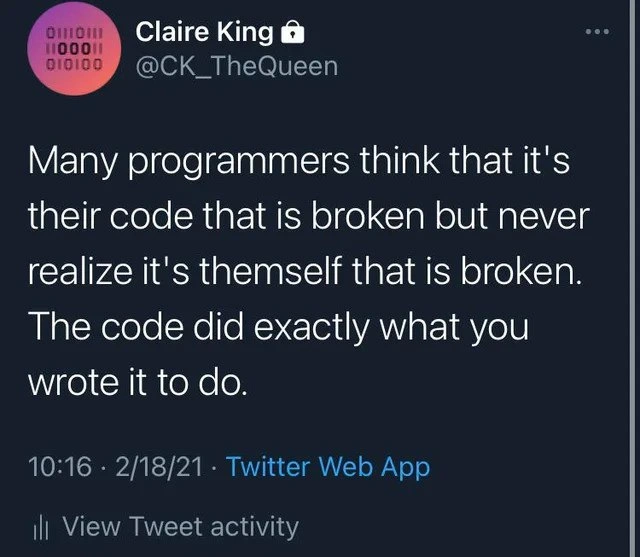
A screenshot of a tweet from user Claire King (@CK_TheQueen) presented in a dark mode interface. The user's avatar is a pink and orange gradient circle containing binary code. The tweet's text reads: 'Many programmers think that it's their code that is broken but never realize it's themself that is broken. The code did exactly what you wrote it to do.' Below the main text, the timestamp '10:16 · 2/18/21' and 'Twitter Web App' are visible. This meme captures a fundamental truth in software development: a computer executes instructions literally. The humor and relatability stem from the common developer experience of spending hours debugging, only to find the error was in their own logic or understanding, not in the tools or the language. For experienced engineers, it's a poignant reminder of the need for humility and rigorous self-correction, as the machine is merely a mirror reflecting the programmer's own flawed instructions

Comments

15
Anonymous ★ Top Pick The most senior-level debugging skill is realizing the bug isn't in the code, the compiler, or the framework; it's a flaw in your own reasoning from three weeks ago
  1. Anonymous ★ Top Pick

    The most senior-level debugging skill is realizing the bug isn't in the code, the compiler, or the framework; it's a flaw in your own reasoning from three weeks ago

  2. Anonymous

    After two decades, my go-to debugging pattern is still `git blame | therapist`, because the silicon keeps proving it’s just executing a perfect transcript of my 3 a.m. brain dump

  3. Anonymous

    After 20 years in the industry, I've learned that the most critical bug fix is often a good night's sleep and a fresh perspective. The code's deterministic behavior is a feature, not a bug - it's our non-deterministic mental state that needs the patch

  4. Anonymous

    This tweet perfectly captures the existential crisis every senior engineer faces at 3 AM during an incident: realizing the production outage isn't because Kubernetes is misbehaving or the database is corrupted - it's because six months ago, you wrote a perfectly functioning piece of code that implements exactly the wrong business logic. The computer is just being brutally honest about executing your flawed mental model with unwavering precision. As we say: 'The code is not wrong; your understanding of the problem space was just... optimistically incomplete.'

  5. Anonymous

    After 20 years, the real refactor is debugging your own flawed mental model before blaming the monolith

  6. Anonymous

    CPUs are obedient sociopaths: they execute instructions, not intentions - encode the spec as tests or enjoy 'works-as-designed' postmortems

  7. Anonymous

    Code is a lossless compression of your misunderstandings; production merely decompressed mine at scale

  8. @bashiordache 5y

    oh yes.

  9. @ceterre 5y

    That's some deep shit

  10. @saniel42 5y

    I wrote something broken and it's broken. This tweet is anti-funny...

  11. @satma0745 5y

    stop bullying me please

  12. @feskow 5y

    I am in this pic and I don't like it

  13. @Zheg_al 5y

    0.1+0.2

  14. @isthistelegram 5y

    doesn't apply when using third party library and something is not working in the that library

    1. Deleted Account 5y

      You should have written it yourself

Use J and K for navigation