Skip to content
DevMeme
2513 of 7435
The Mythical 'Shutdown': A Concept Foreign to Modern Developers
DevOps SRE Post #2787, on Feb 23, 2021 in TG

The Mythical 'Shutdown': A Concept Foreign to Modern Developers

Why is this DevOps SRE meme funny?

Level 1: Power Button? What’s That?

Imagine you’re watching your favorite cartoon on a tablet, and the screen is a bit dirty. A simple thing to do would be to pause the video and turn off the screen, then wipe off the smudges, right? But in this joke, the person doesn’t want to pause or turn off anything at all. They want to keep everything running while they clean, so they wish there was a magic setting that freezes the tablet’s touch so they can wipe it without randomly opening apps or messing things up.

It’s funny because it’s like someone saying: “I know I could just stop for a second to clean this, but I really don’t want to stop!” They’re basically pretending they’ve never even heard of the power button or the idea of turning the device off. We all know pressing the off switch for a moment is the easy solution. The joke is that this person (who is a silly computer-loving character) is over-complicating things. It’s as if they’d rather invent a whole new gadget than do the super obvious thing.

So the humor is really simple: it’s poking fun at someone who refuses to take a break, even for a minute, to do something as simple as cleaning. It’s like trying to wipe a window while someone is still drawing on it, instead of just asking them to pause. The idea of “the computer is what now” is just a goofy way to say “I never turn my computer off, not even for cleaning.” Even a kid can find it silly that a person wouldn’t know about turning something off. The meme makes us laugh at how stubborn people (especially techy people) can be – they want a fancy trick instead of just using the on/off switch that’s right in front of them.

Level 2: Just Turn It Off

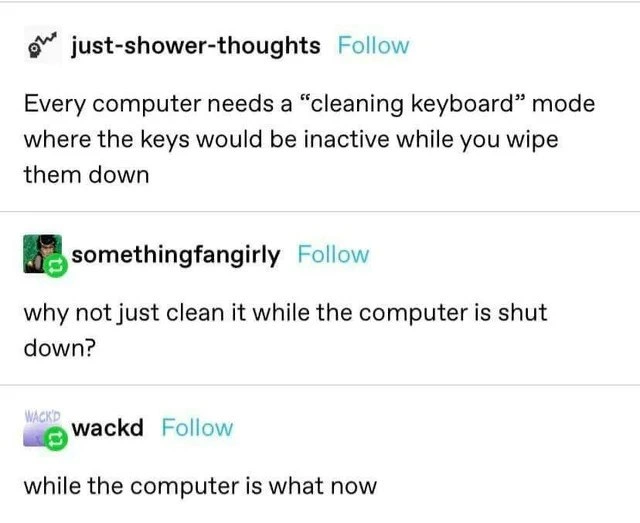
For a newer developer or someone early in their tech journey, let’s break down why this scenario is funny. The image shows a conversation about cleaning a computer keyboard:

  • The first person suggests every computer should have a special “cleaning keyboard mode”. In this mode, pressing keys wouldn’t do anything, so you could wipe the keyboard without worrying about messing up your computer. This is essentially a key inactivity feature dream: a software switch to ignore key presses temporarily.
  • The second person responds very practically: “Why not just clean it while the computer is shut down?” In plain terms, they’re saying, “Why don’t you just turn the computer off first? If it’s off, the keys naturally won’t do anything when you press them.” This is the obvious solution most people would think of.
  • The third person (a developer, implied by the humor) replies: “while the computer is what now”, joking as if they don’t even know what “shut down” or “turned off” means. It implies that this developer never shuts down their computer, so the suggestion sounds almost foreign or absurd to them.

Now, why would a developer react like that? It comes from real developer behavior:

  • Developers often keep their computers on all the time. They might reboot or shut down only when absolutely necessary (like after certain software updates). This is partly habit and partly convenience. If you’ve ever had 20 browser tabs open, a code editor with unsaved work, a development server running, and maybe a simulation in progress, you don’t want to disrupt all that by powering off. It’s common to just put the computer to sleep or lock the screen, rather than do a full shutdown each day.
  • There’s also a bit of pride in having a long uptime. Uptime means how long the computer has been continuously running without a restart. Among tech folks, you’ll hear jokes like “My laptop’s uptime is 42 days” as a weird brag. It’s like saying “Look, it’s been running like a champ for so long!” This is part of the uptime_culture mentioned in the tags. It’s half-joking, half-serious: no downtime, even for personal machines.
  • The meme touches on a Developer Experience (DX) issue: cleaning your keyboard seems simple, but if you do it while the computer is on, you risk hitting keys that trigger things. For example, imagine you’re wiping your keyboard and accidentally press Keyboard Shortcuts like Alt+F4 (which might close a window) or hit the spacebar in a chat window (which could send a bunch of spaces as a message). You could even trigger weird accessibility features or hear annoying beeps if you press certain combos. Every developer has probably done this at least once – you clean a key and suddenly music starts playing or a weird menu pops up because you hit a shortcut by accident. It’s both funny and a little scary (you might think, “Oh no, what did I just do?!”).
  • The straightforward answer to avoid that is indeed, as the second commenter says, to shut down the computer (or at least lock it or put it to sleep). When the system is off, no key presses will register, so you can clean the keyboard safely. That’s common sense to most people.
  • The humor is that the developer in the conversation completely ignores that obvious step. They’d rather have a fancy software feature to do it. This highlights a bit of an inside joke among programmers: sometimes we complicate things or rely on coding solutions instead of simple manual solutions. It’s like the saying, “I’ll just write a quick script to do this”, even for things that might have been faster to do by hand. Here, instead of pressing the power button, the developer imagines a whole system feature for it!

In simpler tech terms:

  • Shut down means turning the computer off completely. All programs quit and the operating system powers down. When it’s off, pressing keys on the keyboard won’t have any effect because the computer isn’t listening.
  • Cleaning keyboard mode would be a special state when the computer is on, but it temporarily ignores the keyboard. Some devices actually have something similar; for instance, some laptops let you disable the touchpad or keyboard input briefly (like when you’re watching a movie or cleaning the screen). But it’s not a standard feature on most PCs.
  • The developer’s response, “the computer is what now,” is them pretending to be clueless about the idea of shutting down. It’s as if “shutting down” is so rare in their life that they joke they don’t understand the phrase. This is an exaggeration, of course – developers do know what shutting down is – but it’s funny because it’s not far from how we act sometimes.

So, to a junior dev or someone not deeply into these habits: the meme is an inside joke about developer workflow. It’s highlighting the gap between a simple fix and a developer’s habit. The tags like never_shutdown_computer and uptime_culture refer to exactly this: devs who keep their computers running constantly. And wipe_keyboard_safely and cleaning_keyboard_mode describe the fanciful feature the first person wants – basically a way to clean the keyboard safely without turning off the machine.

This is also categorized under Hardware because it deals with a physical keyboard and cleaning it, even though the solution proposed is software. And it’s a DeveloperExperience_DX joke because it’s about making the developer’s life easier (cleaning without interrupting work). It’s a bit ironic – wouldn’t it be nice if my PC had a convenience feature like this, so I don’t have to stop what I’m doing? Most devs chuckle because, realistically, we know the easiest way is just to take a short break and turn the computer off or lock it. But we find it amusing that our brain’s first wish is for a high-tech workaround instead.

In summary, the meme is funny to tech insiders because:

  • It jokes about our reluctance to use the simple “off” switch.
  • It exaggerates the idea that a developer would sooner implement a new feature than change their routine.
  • It’s relatable: plenty of us have tried to carefully wipe a keyboard while the screen is on, hoping not to trigger anything, because we’re too impatient to shut down or because we haven’t restarted in ages.

If you’ve ever left your computer on for days (or weeks) or groaned at the thought of rebooting because you have so much open, this meme probably makes you both laugh and cringe a little. It’s saying, “Hey, we know you do this — never turning off your PC — and we’re teasing you for it.”

Level 3: Software Over Shutdown

Experienced developers will smirk at this because it satirizes our tendency to solve hardware problems with software solutions. The Tumblr post suggests a cleaning keyboard mode – essentially a key_inactivity_feature – to disable all keyboard input while wiping it down. Why? Because in developer land, “have you tried turning it off and on again?” is almost an insult. We live in an uptime_culture where shutting down a computer is unthinkable unless flames are literally coming out of it. The humor comes from that stark contrast: a normal user says, “just power it off to wipe the keys,” and the developer reacts like, “Shut... down? The computer is what now?” – as if the concept of turning off a machine after it’s booted is alien. It’s poking fun at how devs will invent a whole new Developer Experience (DX) feature rather than endure a few minutes of downtime.

From a senior dev perspective, this joke hits on multiple real-world pain points:

  • Accidental Shortcuts: Wiping a keyboard while the system’s running can fire off random keyboard shortcuts or send gibberish commands. One wrong swipe and you might trigger a CTRL+Q and quit your IDE, or spam Slack with //////// in a channel. We’ve all seen a cleaning gone wrong where a cloth on the keyboard sends the computer into chaos (opening help menus, beeping with key combos, or worst-case, sending an email mid-wipe!). So the idea of a wipe_keyboard_safely mode is actually appealing – it’s a very DeveloperHumor way to “solve” the problem.
  • Never Shutting Down: The punchline “while the computer is what now” perfectly captures devs’ reluctance to ever power off. Many of us treat our personal machines like production servers requiring 99.999% uptime. We run dozens of browser tabs, development servers, maybe a hefty docker-compose environment, and who knows what else. Rebooting or shutting down would mean interrupting all those processes, losing precious state, or (gasp) applying pending updates. There’s a fierce pride in saying “Yeah, my workstation has a 300-day uptime” – it’s a badge of honor among the initiated. It’s TechHumor rooted in truth: updates get postponed, memory leaks be damned, because “I’ll reboot later, I’m in the middle of something!”
  • Software > Hardware Mindset: The meme highlights a common developer quirk: if something can be fixed by code or a clever feature, we prefer that over a manual solution. Turning off the PC is a simple hardware fix, but that’s too straightforward (and disruptive) for our liking. Instead, we dream up an InsideJoke solution: “What if the OS had a special mode to ignore key presses?” This is funny because it’s over-complicating an obvious task. It’s akin to a programmer spending an entire day scripting an automation to avoid 5 minutes of manual work – we’ve all been there. It’s a form of procrastination wrapped in technical creativity.
  • Constant Uptime Culture: Underneath the joke is a nod to the culture of continuous uptime in tech. In DevOps and server management, downtime is the enemy. That ethos seeps into developer habits: we avoid restarting our dev machines unless absolutely necessary. Maybe we fear that upon reboot our fragile local environment (~/.bash_profile tweaks, environment variables, the precarious node_modules party) might never come back exactly right. The result? We run laptops like long-haul servers. The meme exaggerates this to absurdity – the dev would rather design a whole key_inactivity_feature than hit the shut down button. It’s a playful dig at how turning something off (even to clean it) feels like admitting defeat to a veteran coder.

In essence, this meme is HardwareHumor meets software mentality. It’s funny because it’s true: developers often ignore the “obvious” physical solution in favor of a nerdy workaround. We joke that the power button is “for other people.” The idea of never_shutdown_computer becomes an InsideJoke in engineering circles – we laugh because we recognize ourselves. As seasoned devs, we’ve all had that moment where a non-technical friend asks, “Why not just turn it off?” and we realize our brain didn’t even consider that simple fix. Here, the meme calls us out with a wink and a nod.

To summarize this mentality in a cheeky way:

Problem Normal Person Solution Developer’s Solution
Dirty keyboard Shut down PC and clean it Enable cleaning_keyboard_mode (no shutdown needed)
Computer acting weird Reboot the machine Debug for 2 hours or write a script to avoid reboot
Slow, memory leaking Power off and restart fresh Keep it running, add more swap, blame DeveloperExperience quirks

This table captures why the meme lands so well. The developer approach isn’t necessarily better—it’s often about avoiding what’s obvious because we’re stubborn about uptime. The humor stings a bit because it’s relatable: we’ve turned “never turn it off” into an unwritten rule, and we’ll even engineer features to uphold that rule. The meme exaggerates it perfectly, making us laugh at our own absurd habits.

# A developer's imagined solution to clean the keyboard without shutting down:
def wipe_keyboard_safely():
    enter_cleaning_mode()   # keys become inactive, as if keyboard is unplugged
    physically_wipe_keys()  # do the cleaning work
    exit_cleaning_mode()    # restore keyboard input

# Because pressing the actual power button is apparently off the table...
wipe_keyboard_safely()

In the code above, the cleaning_keyboard_mode acts as a software guardrail: no matter how you mash or wipe the keys, nothing will happen on-screen. This little snippet is a tongue-in-cheek representation of the meme’s premise – we’d rather write a function to wipe_keyboard_safely than deal with the inconvenience of shutting down. It’s a playful jab at our engineering mindset. The senior engineers reading this can chuckle and think, “Yep, that’s exactly the kind of absurd feature request you’d see on an internal wiki from someone who hasn’t rebooted in months.”

The meme perfectly balances DeveloperMemes wit with a real developer experience issue. Accidentally rearranging your desktop icons or closing your apps because you were cleaning the keyboard without a net is a rite of passage. And proposing a high-tech solution instead of doing the obvious? That’s our tribe. It’s a comic reminder that sometimes the simplest tool (the power button) is the one we forget to use, because we’re too busy coding our way around it.

Description

This image is a screenshot of a three-part Tumblr exchange. The first post, from user 'just-shower-thoughts', proposes a useful feature: 'Every computer needs a 'cleaning keyboard' mode where the keys would be inactive while you wipe them down'. The second post, a reply from 'somethingfangirly', offers a seemingly logical solution: 'why not just clean it while the computer is shut down?'. The final, punchline reply from user 'wackd' feigns ignorance and confusion with the phrase: 'while the computer is what now'. The humor stems from the developer and IT professional's reality where computers, especially servers and development machines, are almost never turned off due to continuous processes, running services, and the sheer inconvenience of restarting a complex development environment. The concept of 'shutting down' is treated as an alien or forgotten practice

Comments

16
Anonymous ★ Top Pick I haven't shut down my work laptop since the last kernel panic, which was three years ago. I'm pretty sure my 'node_modules' folder has achieved sentience and is now listed as a co-maintainer on three of my projects
  1. Anonymous ★ Top Pick

    I haven't shut down my work laptop since the last kernel panic, which was three years ago. I'm pretty sure my 'node_modules' folder has achieved sentience and is now listed as a co-maintainer on three of my projects

  2. Anonymous

    Only juniors shut down to wipe crumbs; seniors spin up a Kubernetes ‘KeyCleaner’ sidecar that pipes every keystroke to /dev/null until the isopropyl dries

  3. Anonymous

    The real horror isn't the dirty keyboard - it's explaining to your manager why your 847-day uptime streak ended because you wanted to clean some Cheeto dust off the spacebar. That's what compressed air and prayer are for

  4. Anonymous

    The real feature request here isn't a cleaning mode - it's a keyboard that can withstand being cleaned while you're mid-compilation with 47 browser tabs open, 12 terminal sessions active, and a Docker container that's been running since the last kernel panic. Shutting down? That's what junior devs do when they think 'uptime' is just a monitoring metric, not a personal achievement badge

  5. Anonymous

    My laptop keyboard has five-9s, so we do blue-green cleaning: external keyboard takes traffic while we drain the built-in, wipe, and cut back - SRE says “shutdown” is a SEV-1

  6. Anonymous

    Shutting down? Cute - try detaching from prod Kubernetes first without dropping your debugger session

  7. Anonymous

    Cleaning mode is just redirecting /dev/input/* to /dev/null; if I shut down, I have to resurrect tmux, Docker networks, and three VPNs - uptime wins

  8. @Baksy93 5y

    *reconnecting the keyboard to write this comment*

  9. @VladislavSmolyanoy 5y

    *angry macbook users whose keyboard presses turn the computer on noises*

    1. @deerspangle 5y

      Just pop the battery out.. Oh wait

      1. @prkiso 5y

        Just take it to apple and get them to do it for you

        1. @tokimonatakanimekat 5y

          Cleaning is $300

          1. @fortrest 5y

            After cleansing you reveal that was just "checking and deleting viruses", not keyboard cleansing

      2. @willowfragment 5y

        haha screen go smash

  10. @blackkspydo 5y

    There is an app named keyboardcleantool for mac users. Thank me later 🙂

  11. @Agent1378 5y

    Cant you just lock it with win+L and then type whatever you want?

Use J and K for navigation