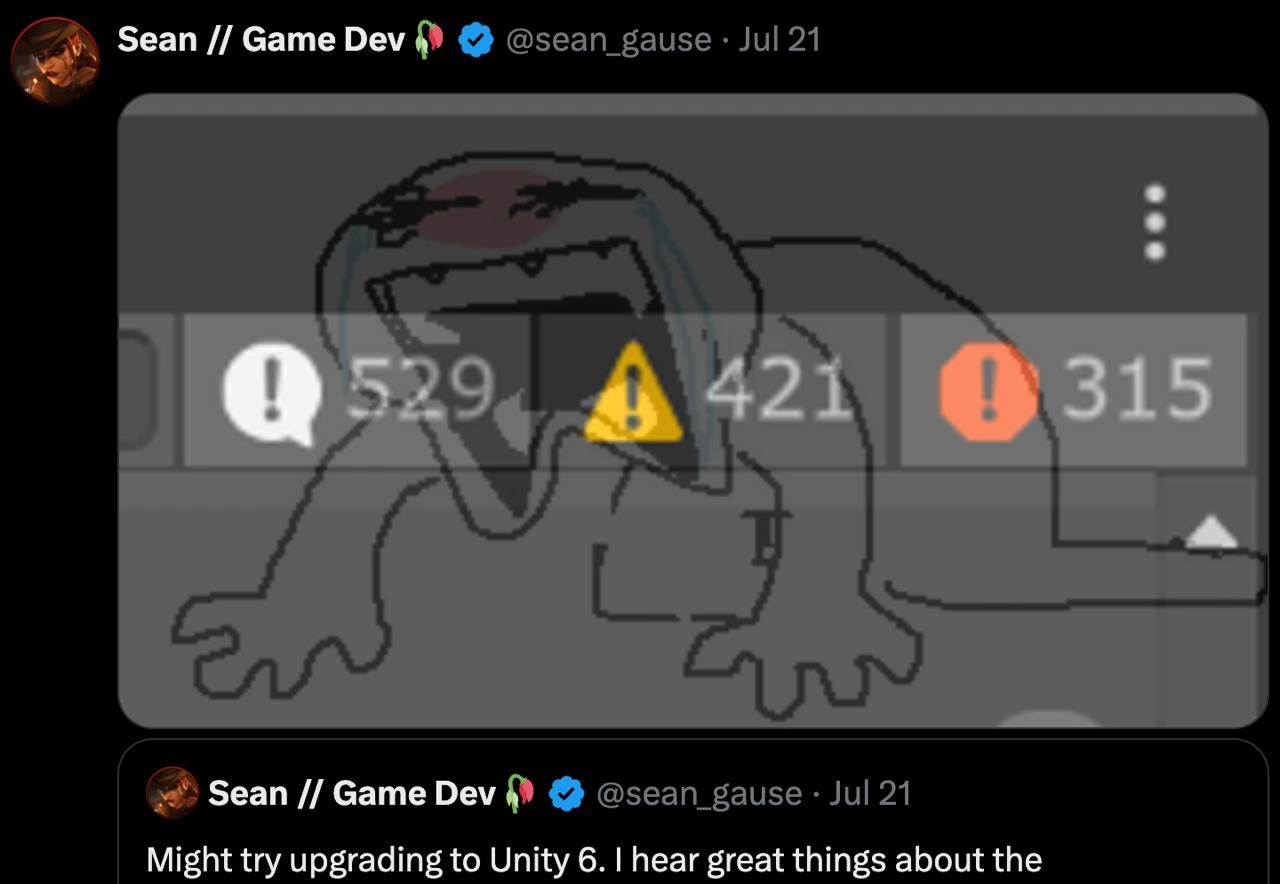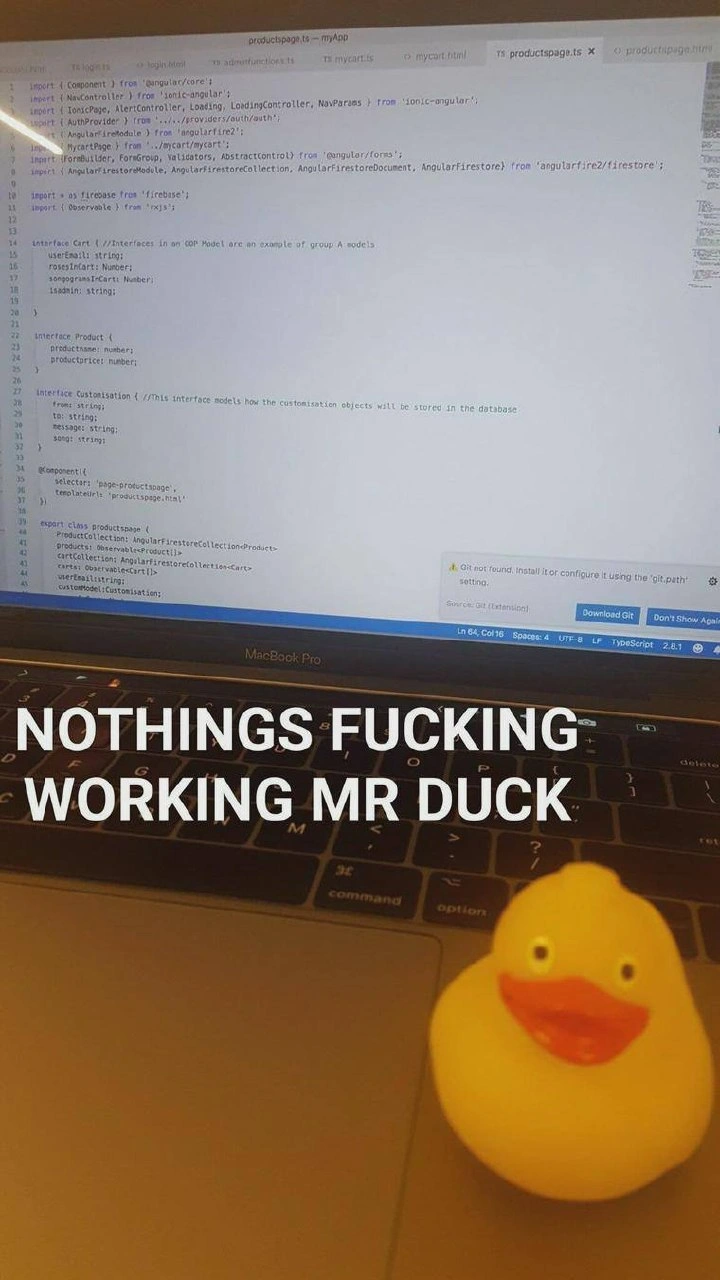
When debugging code feels like firing an experimental weapon with zero certainty
Why is this Debugging Troubleshooting meme funny?
Level 1: Pushing Random Buttons
Imagine you’re trying to fix your TV and it suddenly stops working. You don’t know much about TVs, so what do you do? You start pushing random buttons on the remote, turning the TV off and on, maybe unplugging it and plugging it back in – basically trying anything that might help. Your friend watches you and asks, “Are you sure you know what you’re doing?” You just laugh nervously and say, “Ha, I have no idea!” but you keep trying anyway because you really want the TV to work again.
That’s exactly the feeling this meme is joking about, but with computer code. The code has a problem (it’s “broken” in a way, like the TV), and the person trying to fix it is just testing ideas without being sure they’ll solve it – kind of like pressing all the buttons to see if one of them is the magic fix. It’s funny because we’ve all been in that spot: whether it’s fixing a toy, a gadget, or some software, sometimes you have to experiment and you’re not at all sure things will work. The meme uses a silly scene from a video game – a doctor with a crazy machine and a big guy asking if it’s safe – to show how it feels when you’re debugging. The doctor (like the person trying to fix the problem) cheerfully admits, “I have no idea!” which is a goofy way to say, “I’m just guessing, but let’s see what happens.”
In simple terms: debugging code can feel like trying a bunch of random things with fingers crossed. It’s a mix of hope and uncertainty. We laugh at this meme because it’s a little true for everyone: sometimes, whether you’re a kid or an adult, the only way to solve a problem is to roll up your sleeves, try something (even if you’re not sure it’ll work), and maybe even laugh at yourself while doing it. After all, if it works, you’ll cheer, and if it doesn’t, well, at least you got a funny story out of it!
Level 2: Print and Pray
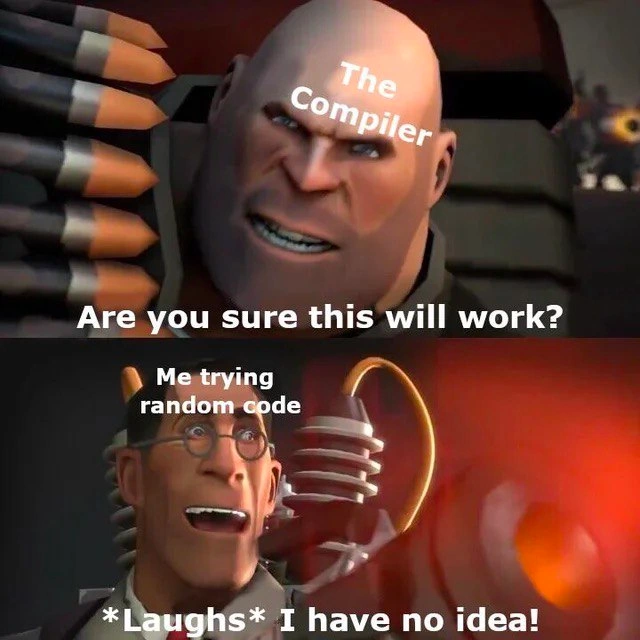
Let’s break down what’s happening in this meme in simpler terms. The images are from the game Team Fortress 2, which is a popular team-based shooter known for its humor and quirky characters. In the first panel, a big character called the Heavy is looking concerned and asks, “Are you sure this will work?” In the second panel, the Medic (a doctor character) has a crazy grin with a sparking gadget behind him and says, “I have no idea!” This quote actually comes from a funny TF2 video where the Medic tries an experimental procedure on the Heavy. In the meme, the text label over the Medic reads “Me trying to debug code.” That means the Medic represents a developer (the person writing/fixing code), and the Heavy represents someone (or even the computer) asking if they’re confident about their solution. Essentially, the meme is comparing debugging a bug to firing off a wild scientific experiment without knowing what’s going to happen.
First off, debugging is the process of finding and fixing errors (called bugs) in your code. A bug is just a mistake or problem that makes a program act in an unintended way. For example, if a calculator app is supposed to add 2+2 and you get 5, that’s a bug. Debugging is like detective work: you have to figure out why you’re getting the wrong result and then correct the code so it behaves properly. Usually, you’d use tools like debuggers (which let you step through code line by line) or you’d read error messages and logs to trace what went wrong.
However, when a bug is really stubborn or confusing, developers sometimes fall back on trial-and-error debugging. This means you try one possible fix or change, run the code to see if the problem is gone, and if it’s not, you try something else. It’s not the most efficient or scientific method, but when you’re not sure what’s wrong, it can be the only way forward. In the meme, the Medic (developer) is at that stage – he’s basically saying “I have no idea if this fix will solve the bug, but I’m going to try it anyway!” The Heavy’s question “Are you sure this will work?” is something you might hear from a teammate, your boss, or even just your own inner voice when you’re about to deploy a questionable fix. It’s that little reality check asking, “Do we really know what we’re doing here?” Often, especially early in your career, the honest answer is “No, not completely.” And that’s okay – debugging is often full of uncertainty.
The phrase “Laughs I have no idea!” is funny because it’s so relatable. Every developer, when debugging, has felt that moment of I’m crossing my fingers and hoping for the best. It’s a mix of nervousness and a bit of humor at your own expense (that’s the DeveloperSelfDeprecation part – we poke fun at ourselves for not knowing everything). This meme exaggerates it by showing the Medic literally laughing like a mad scientist. That’s how it sometimes feels internally when you’re testing a really out-there fix – a kind of crazy, nervous excitement: “Here goes nothing!”
There are some specific terms and tags referenced in this meme that are worth explaining:
“Print statement debugging”: This is a simple debugging technique where you insert print statements (like
console.login JavaScript orprintfin C) into your code to display the values of variables or to mark that certain code was reached. It’s the most basic form of debugging – instead of using a fancy debugger tool, you just print out info to the console and run the program. For example, if you’re not sure a function is being called, you might addprint("Got here!")inside it. In a chaotic debug session, you might sprinkle a bunch of these prints throughout the code to trace what’s happening. It’s quick and dirty, but it often helps. In the context of the meme, think of those print statements as the Medic’s tesla coil sparks – somewhat uncontrolled, but they might shed some light on the problem.“Trial and error debugging” and “experimental fix”: These phrases capture the essence of what the Medic is doing. Instead of a guaranteed solution, an experimental fix is when you just try something that might work. Maybe you don’t fully understand the bug yet, but you noticed, say, a certain variable might be wrong, so you guess a fix for that and test again. It’s a bit like guessing the cure to an illness without being sure of the diagnosis – sometimes it works, sometimes it doesn’t. Trial and error means you keep trying different things until the error (bug) goes away. It’s not the most confident strategy, but when you’re stuck, it’s better than giving up. The meme’s humor is that the developer isn’t sure at all – which is often the reality when you’re debugging something tricky.
Team Fortress 2 Heavy and Medic dynamic: In TF2 lore, the Heavy depends on the Medic to heal him or make him stronger (the Medic can make the Heavy uber-powerful temporarily with an invincibility charge in the game). There’s a playful trust there. The quote “Are you sure this will work?” / “I have no idea!” actually comes from an official animated short where the Medic replaces the Heavy’s lost heart with a baboon’s heart using a lightning-charged machine. The Heavy is basically asking, “Is this procedure going to save me?” and the Medic cheerfully admits he’s not sure at all. In that video it’s funny because the Medic is so enthusiastic despite the uncertainty. The meme takes that exact energy and says: This is me debugging code. The developer (Medic) is enthusiastically trying something crazy to fix the code, and either the computer, a coworker, or just common sense (Heavy) is asking if they’re really sure about it. The answer: nope, we’re winging it! It’s a perfect parallel to chaotic debugging scenarios.
“Panic debug session”: This refers to those times when you’re debugging under high pressure. Say your app or website is down and users are impacted – that’s a panic situation. You’re not calmly experimenting; you’re urgently throwing fixes at the problem to get things working again. It’s when you might bypass some best practices (like thoroughly testing or reviewing your fix) because time is of the essence. In a panic debug session, developers might do things like rollback to an older version, add a quick patch, or as the joke often goes, “commit random code and pray.” This is where the tag DebuggingFrustration and DebuggingHell come in – it’s frustrating and feels like a little hell when nothing makes sense and pressure is mounting.
Think about it this way: Have you ever improvised a solution to something in real life without knowing if it would work? For example, your phone freezes and you start pressing all sorts of buttons or restart it, hoping it fixes the issue. Or maybe you have a broken gadget and you jiggle the wires just to see if it comes back to life. That’s the spirit here. Developers prefer to have a clear plan, but when we’re stumped, we sometimes try a bit of everything, just like anyone would when trying to fix a mysterious problem. The meme gets a laugh because it’s relatable humor – even if you’re new to coding, you probably understand that feeling of “I’m not sure this will do anything, but I’ve got to try.” And if you have started coding, you’ll definitely recognize it the first time you’re debugging and say to yourself, “Well, I’ll change this and see if it helps… fingers crossed!”
To sum it up: Debugging, especially under pressure, can feel like you’re a mad scientist in a lab. You have all these tools and knowledge, but sometimes you’re still not sure if the thing you try will solve the problem or create a new one. The uncertainty can be scary, but it’s also part of the process. The best developers are not those who never have to guess – they’re the ones who guess, test, and then learn from the result. And the reason we can joke about “having no idea” is because ultimately, when the bug is fixed (whether by skill or a bit of luck), it’s a moment of relief and even a little triumph. The meme captures that joking through the pain perfectly. It tells new developers: “Hey, we all feel clueless sometimes – even the pros. Just fire up your experimental fix cannon and give it a shot (ideally not in production on the first go!), and laugh it off when you can.”
Level 3: Mad Science Debugging
Every seasoned developer cracked a grin (or a wince) at this meme because it hits painfully close to home. Debugging a nasty bug can absolutely feel like being a mad scientist throwing the switch on a jerry-rigged contraption, not entirely sure if you’re about to solve the problem or create a bigger one. The humor comes from that mix of adrenaline and uncertainty we’ve all tasted during a 3 AM debugging session. One part of you – call it the cautious engineer or even “The Compiler” in the meme – is like the Heavy asking, “Are you sure this will work?” Meanwhile, the sleep-deprived, desperate part of you – the Medic cackling with a wild idea – just shrugs with a manic grin: “I have no idea!”
This scenario satirizes the very real practice of trial-and-error debugging. In an ideal world, we’d approach bugs methodically: form a hypothesis, instrument the code, and reason our way to the root cause. In the real world, especially under pressure, we often end up trying random fixes or tweaks, hoping one magically makes the problem disappear. It’s the programming equivalent of “spray and pray” – unload a burst of changes and pray one hits the target. We joke about it as “printf debugging” or “prayer-driven development”. The medic in the meme literally has a crackling lightning gun; in real life our weapons are print statements, hotfixes, and maybe a packet of caffeine.
Why is this so relatable? Because every developer – junior or senior – eventually encounters a bug that defies all logic. Logs are useless or nonexistent, stack traces might as well be hieroglyphs, and every sane fix you try doesn’t work. The code is effectively looking at you like that skeptical Heavy: “You sure about this next attempt?” And eventually you sigh, mutter “Not really...”, and deploy the craziest workaround you can think of. The meme is funny because it’s true: we’ve all had that laugh-to-keep-from-crying moment when someone (maybe a teammate or that little voice in your head) asks if you’re confident, and you can only echo, “I have no idea!” while pressing Enter on the deploy.
In practice, this chaotic approach is often born from pressure and complexity. Imagine a critical production outage at midnight: users are screaming, managers are slacking “ETA for fix?” every five minutes. You don’t have the luxury of days to carefully debug. So you enter a panic debug session mode. Maybe you can’t even reproduce the bug on your staging environment – it only happens “in the wild” under specific conditions. So what do you do? You experiment directly in production (with sweaty palms). It’s like being on the battlefield with that experimental weapon: you know it might blow up in your face, but doing nothing is not an option. This is where quick-and-dirty fixes and one-line miracles come into play. Perhaps you add a check like if (bug) return; // TEMP HACK just to see if it stops the bleeding. Or you roll back a recent change blindly, or restart a service as a shot in the dark. We call these “hail Mary” fixes – you throw one up and pray it scores.
The meme labels the Heavy as “The Compiler,” which is a cheeky touch. Compilers are usually strict, methodical tools – they’ll ask you “are you sure?” via warnings like “variable unused” or “type mismatch”. Many of us have been guilty of saying “meh, it’s just a warning” and pushing the code through anyway. It’s as if the compiler itself is raising an eyebrow at our code concoction. The Medic is labeled “Me trying random code,” representing that developer-in-mad-scientist-mode who’s just throwing anything at the wall to see what sticks. When you’re in that state, even the compiler might feel like a skeptical partner: “Uh, this looks dangerous. Confident about this?” And our honest answer: “Nope! But compile and run it anyway.” 😅
Let’s be real, we all have a commit or fix like this in our history. The commit message might as well read, “Attempt #5 – I hope this finally fixes it.” The code changes might be weird: toggling some flag off and on, adding a 2-second sleep in a thread, or wrapping a problematic call in a try-catch that just logs “TODO: figure out actual error”. It’s not pretty, but at 3 AM with an incident clock ticking, you do what you must. A common joke is that bugs are called “bugs” because they have a mind of their own; sometimes you swear there’s a gremlin in the system. You counter gremlins with whatever experimental fix you can devise. It’s a bit of chaotic debugging alchemy: mix one part guesswork, two parts desperation, a dash of luck, and flip the switch! 🔥
Consider a typical late-night debugging adventure that this meme brings to mind:
- Initial Investigation: You methodically check logs and error messages. They’re cryptic or misleading, offering no clear insight. The bug isn’t yielding to normal troubleshooting – a classic start to a DebuggingHell scenario.
- Apply Obvious Fixes: You try the usual suspects (restart the app, clear caches, redeploy last known good build). Nope, the bug persists. Tension rises.
- Off-Script Experiments: Now things get interesting. Add a
console.log("DEBUG: got here")or maybe comment out a suspicious block of code – essentially print statement debugging or brute-force toggling. Suddenly, the bug’s behavior changes! Maybe it disappears, or morphs into a different error. This is equal parts thrilling and bewildering. - Second-Guess Reality: Remove that debug print or put the code back – the original bug comes roaring back. Put the weird change in again – it goes away. At this point you’re staring at the screen like a mad Medic, giggling “Is… is this print statement literally the fix?!”. It’s like finding out that holding your laptop at a weird angle makes the Wi-Fi work – absurd, but you’ll take it.
- The Dubious Victory: Out of time and options, you leave the odd workaround in place. The application is working (as far as you can tell) and the immediate crisis is averted. You ship the fix with a comment like
// TODO: understand why this worksand an apologetic note to your future self. The codebase just got a little stranger, and you collapse like Heavy after surgery, exhausted but relieved.
That sequence may be humorous, but it’s not really exaggeration. Developer humor like this meme is funny because it’s a shared pain: we’ve all had to debug in panic mode and felt that “I have no clue, but let’s try anyway” vibe. It highlights an uncomfortable truth: sometimes even senior engineers are just winging it and crossing their fingers. We prefer to call it “iterative testing” or “experimental debugging” to sound professional, but let’s be honest – it’s throwing spaghetti at the wall to see what sticks. The Medic’s crazy grin is basically a mirror: you might be silently screaming inside, but on the outside you’re in full DeveloperSelfDeprecation mode, joking about your own lack of certainty. It’s a coping mechanism as much as it is a storytelling moment.
And afterwards? Developers gather round and swap war stories: “Remember that time I changed a config by 0.1 and it magically fixed production? I had no idea why, but it worked!” Everyone laughs, not because it was truly funny at the time, but because in hindsight we’re relieved it ended okay. These tales of DebuggingFrustration and triumph through bizarre fixes become part of the team lore. We laugh at the absurdity of it – it’s either that or cry at how fragile our systems can be. The meme distills that sentiment perfectly into two panels. The Heavy’s line “Are you sure this will work?” is basically reality checking us, and the Medic’s gleeful “I have no idea!” is the punchline revealing that beneath our confident exterior, we’re often just making educated (or not-so-educated) guesses.
In a broader sense, this meme pokes at the DeveloperPainPoints around debugging: unpredictability, pressure, and the humbling fact that code doesn’t always behave the way we expect. It also has an element of RelatableHumor because even non-developers can understand the concept of “trying something crazy when you’re out of ideas.” But for those of us in the trenches of software, it’s almost therapeutic to see that struggle turned into a joke. It means we’re not alone in occasionally feeling like the Medic: a mix of panic and “welp, here goes nothing!”. In the end, the experimental weapon (our code fix) either slays the bug or backfires, and we deal with the outcome either way. The fact that we can laugh about it afterwards (and make memes) is what keeps us sane in this field. After all, if you haven’t cackled like a mad scientist during an all-night debug session, are you even a senior engineer? “Laughs I have no idea!”* 😜
Level 4: Heisenbug Uncertainty Principle
At the most fundamental level, debugging chaotic code edges into the realm of theoretical computer science and unpredictable system behavior. There’s even a term for those elusive bugs that seem to vanish when you look for them: a Heisenbug (named after the Heisenberg Uncertainty Principle). Just as observing a particle can change its behavior, observing a Heisenbug (for example, by adding a debug log or running a debugger) can make it mysteriously disappear or change form. This meme’s absurd scenario of firing an experimental weapon with zero certainty reflects the inherent limits of certainty in complex software systems.
In theory, we’d love to guarantee a fix will work before pulling the trigger. But Computer Science reminds us that even deciding if an arbitrary program will behave correctly is, in the general case, an unsolvable problem (hello, Halting Problem 👋). There’s no all-knowing algorithm to predict every bug or verify every fix for every possible input – that’s why debugging exists as an art. Advanced techniques like formal verification can prove correctness for critical code, but applying mathematical proofs to everyday software is painstaking and impractical. For most of us, the codebase is too large, the state space is near-infinite, and time is too short – so we deploy experiments.
Modern applications are essentially chaotic systems with countless interacting variables (user inputs, threads, network calls, hardware interrupts – you name it). A tiny change can have non-deterministic ripple effects. For instance, in concurrent code, a fix that adds a slight delay might accidentally resolve a race condition by changing timing – you’ve cured the symptom without fully understanding the disease. In low-level C/C++ programming, an out-of-bounds memory error invokes undefined behavior, meaning the program can literally do anything: crash, produce strange outputs, or even appear to work fine until it doesn’t. It’s like engineering a device with untested physics – the next run could either solve the problem or detonate spectacularly.
This is why seasoned engineers sometimes laugh nervously and say, “I have no idea if this will work, but let’s try it.” They know they’re grappling with a system so complex that only empirical proof (running the code) will confirm a fix. Even sophisticated debugging tools or techniques (like symbolic execution or model checking) struggle with state explosion – there are too many possible program states to exhaustively analyze. In practice, we narrow down hypotheses and then run experiments on the live system, much like a scientist testing a hypothesis in the lab. The crackling Tesla-coil contraption in the meme is a perfect metaphor: the developer flips the switch on a risky fix because sometimes running the code is the only way to observe reality. Until the code actually executes, the bug’s status is a bit like Schrödinger’s cat – neither truly dead nor alive. Only by firing that shot (deploying the change) do we collapse reality to a result.
None of this is to say engineers act purely on guesswork – we use reasoning, unit tests, and code reviews – but when those fail to pinpoint an issue, we’re forced into trial-and-error experiments. It’s a consequence of software’s inherent complexity and the undecidability of certain problems. So under the hood, this meme highlights a deep truth: even in a field built on logic and binary certainty, there are moments of chaos where the only path forward is to try something and observe what happens. It’s both humbling and darkly humorous that, for all our advanced knowledge, sometimes debugging a stubborn bug really does feel like testing an unstable invention with fingers crossed.
Description
Two-panel Team Fortress 2 meme. Panel 1 shows the Heavy’s torso, bullet belt and partially obscured face; white subtitle text at the bottom reads: "Are you sure this will work?". Panel 2 shows the Medic grinning while a Tesla-coil contraption crackles red behind him; overlay text above his head says "Me trying to debug code" and the bold subtitle at the bottom reads "*Laughs* I have no idea!". The juxtaposition equates the chaotic danger of testing an unproven super-weapon with the trial-and-error process senior engineers confront when stepping through a stubborn bug. It humorously captures the uncertainty, adrenaline, and self-deprecating resignation that accompany late-night debugging sessions in production systems
Comments
6Comment deleted
Attaching a live debugger to the only prod instance is Russian roulette with garbage collection - either the heap stabilizes or the pager starts crackling like a Tesla coil
After 20 years, I've learned the compiler asking "Are you sure?" is just its way of saying "I've seen your git history and I'm concerned for both of us."
This perfectly captures the relationship between developers and compilers: one is a deterministic, unforgiving arbiter of correctness, and the other is frantically trying template metaprogramming patterns they found in a 15-year-old blog post at 2 AM, hoping the linker doesn't expose their complete lack of understanding of move semantics
When the incident commander asks if the hotfix will work, and your plan is kubectl exec into prod plus an ad‑hoc SQL patch, remember CAP: certainty isn’t a supported consistency mode
Compiler enforces the spec you ignored since the last refactor; I counter with semicolon permutations until reality bends
Our Friday “hotfix” is Schrödinger’s release - flip the feature flag and it’s fixed and on fire until Grafana collapses the waveform