Skip to content
DevMeme
617 of 7435
Introducing the new CAT 9 network standard
Networking Post #705, on Sep 26, 2019 in TG

Introducing the new CAT 9 network standard

Why is this Networking meme funny?

Level 1: Kitty Pulled the Plug

Imagine you’re watching your favorite cartoon on TV and your cat comes along, plays with the power cord, and unplugs it. Suddenly, the TV goes off and you’re left staring at a blank screen. This meme is just like that, but with the internet. The cat saw a loose yellow wire (the internet cable) and thought, “Oh fun, a string to play with!” By tugging and rolling with it, the kitty basically pulled the plug on the home internet. It’s funny because the cat has no idea it just stopped its owner’s work or video call – it’s just being playful. The owner looks at the cat, half annoyed and half amused, thinking “you little troublemaker!” But you can’t really be mad; the cat looks up with big innocent eyes as if saying, “I was just playing, human!”

So in simple terms: the pet cat treated an important cord (that gives computer access to online work and meetings) like a toy. The result? The internet stopped working for a bit, causing a mini oops! moment in the household. It’s a silly mix-up of a pet’s world and a person’s work world. We laugh because we all know how pets can accidentally cause trouble while doing something completely normal for them. The kitty didn’t mean to cause a problem – and that’s why the scenario is cute and humorous. It’s basically the tech version of “the dog ate my homework,” except here “the cat unplugged my internet!”

Level 2: The Cat 9 Standard

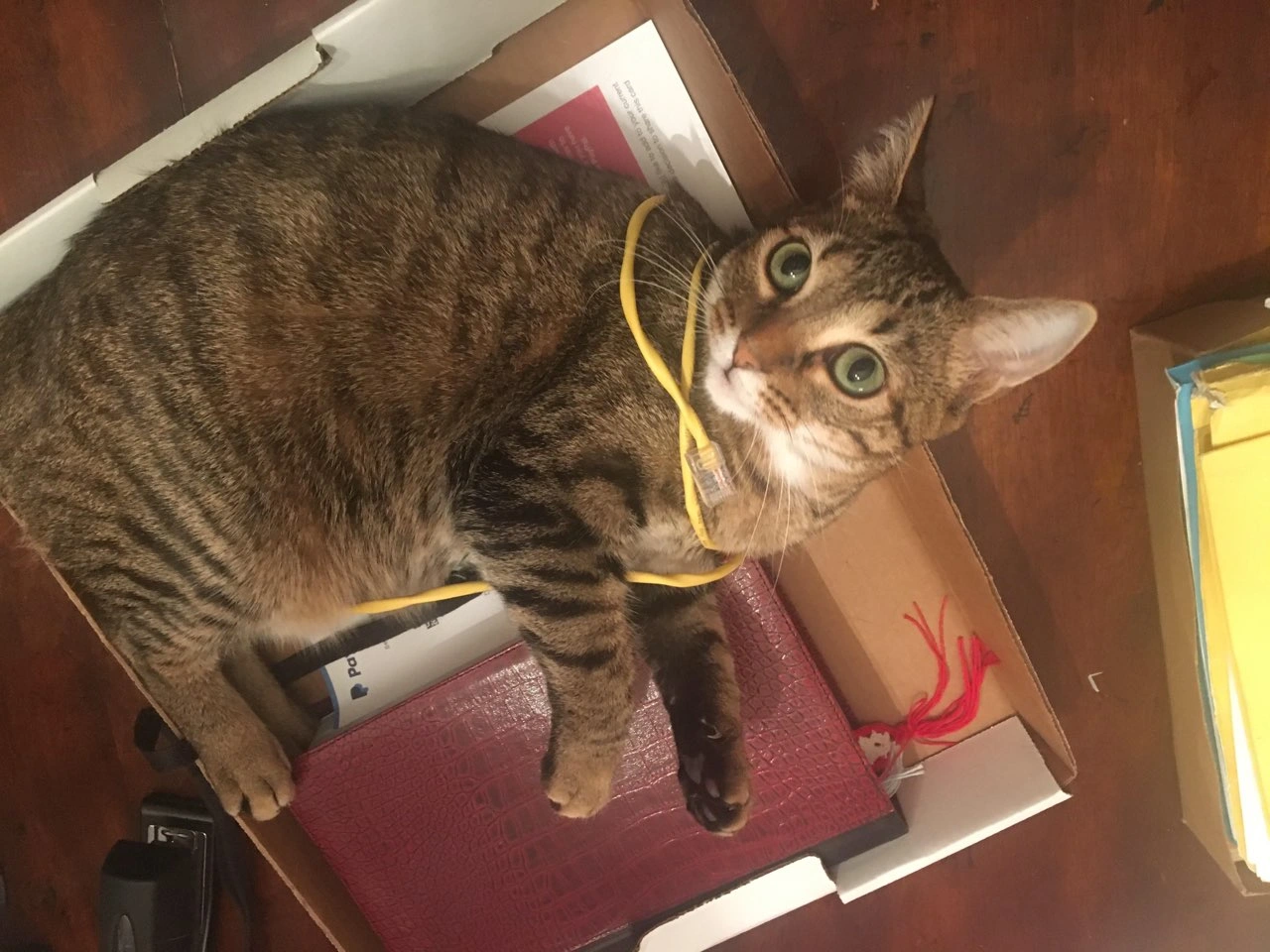
In this meme, a cat has literally gotten tangled up with a piece of networking equipment, and we’re turning that into a tech joke. Let’s break down what’s happening. The cat in the photo is lying in a cardboard box on a desk full of work stuff (notebooks, papers, a stapler, folders), and it has a bright yellow Ethernet cable looped around it like a sash. The plastic end of the cable (an RJ-45 connector) is resting on the cat’s shoulder. An Ethernet cable is basically a special cord that connects your computer to the internet (through a router or modem) using wires. Many people working from home use an Ethernet cable instead of Wi-Fi because wired connections can be faster and more stable. The problem? Cables also attract the attention of cats, who see a dangling string and think, “Toy!” 🧶

The joke in the title says, “When the household SRE decides your Ethernet cable is a cat toy.” SRE stands for Site Reliability Engineer, which is a fancy term for the person (or team) who makes sure websites, servers, and networks stay up and running reliably. In a big tech company, an SRE’s job is to prevent outages and keep things working 24/7. So calling the cat the “household SRE” is tongue-in-cheek. It’s like saying, “In my house, the one in charge of reliability is this cat.” But instead of keeping the network running, our furry SRE has accidentally done the opposite by tugging on the Ethernet cable! It’s a playful way to say that the cat “took down the network.” This resonates with a lot of developers who work from home, because pets often interrupt work in funny ways (stepping on keyboards, knocking over coffee, or in this case, disconnecting cables). It’s a relatable WorkFromHome scenario: your pet doesn’t understand what an Ethernet cable does, just that it’s fun to play with. And a bored cat during your important morning meeting can quickly become a mischievous “engineer,” pulling on wires and causing your video call to freeze.

The post caption adds another layer to the joke: “Have a good morning with new CAT 9 standard.” This line makes a pun out of technical jargon. Ethernet cables come in categories, like Cat5, Cat6, Cat7, etc. “Cat” here is short for Category. For example, Cat5e cable was common for 1 Gbps networks, Cat6 can handle higher speeds with better shielding, and newer ones like Cat7 or Cat8 are even more advanced for very high bandwidth needs. However, there’s no such thing as Cat 9 in real life. By saying Cat 9, the caption humorously implies a new standard that involves an actual cat. Essentially, the kitty has introduced itself into the network cable standards! It’s a wordplay because cat obviously also means the feline animal. So “Cat 9 cable” jokingly means an Ethernet cable with a cat attachment. The bright yellow cable around the kitty’s neck is presumably a Cat5 or Cat6 cable in reality, but since the cat’s now part of it, hey, it’s “Cat-9.” 🐱😅 This kind of pun is classic NetworkHumor among techies – mixing serious tech terms with something absurd.

Let’s clarify a few more things in the image and tags: The cat is contently sitting in that cardboard box deployment (cats love boxes, and developers jokingly say, “It’s not a bug, it’s a feature” when cats sit on our stuff). We see a small red tasseled cat toy in the box too, which is ironic: the actual cat toy is ignored, and the cat prefers the Ethernet cable instead (of course!). The tags mention “rubber_duck_but_furry” which hints at rubber duck debugging. That’s a technique where a programmer explains their code or problem out loud to an inanimate object (often a rubber duck) as a way to find a solution. Many people working from home end up talking to their pets similarly. So our cat might normally serve as a silent fluffy “assistant” to bounce ideas off (a furry rubber duck for debugging), but today it got bored and decided to play. In doing so, it became an unwitting chaos agent in the home office.

From a newbie developer’s perspective, a few lessons (and laughs) emerge. Networking at home can be surprisingly fragile: if that one cable connecting your laptop to the router gets unplugged (say, by a cat rolling around with it), your internet will cut out immediately. This meme is a funny reminder to secure your cables or have backups if possible. Also, it’s a nod to the fact that working remotely means dealing with home distractions. Your kitty doesn’t know what an “internet outage” is – it just sees a string. So, much as an SRE in a company deals with unpredictable failures, you as a developer at home might have to deal with your pet causing unpredictable “failures.” The good part is it’s usually quickly fixable: in this case, simply take the cable back from the cat and plug it in again, and maybe give your feline friend that red tasseled toy to keep it busy instead.

In essence, this meme uses a cute cat moment to highlight a very real aspect of developer life: technology might be advanced, but our daily productivity can still be at the mercy of a pet’s whims. It’s both a cautionary tale (keep your Ethernet cords safe, folks!) and a shared joke among developers who’ve experienced similar “my cat/dog did X to my workstation” stories. The term “household SRE” is just the cherry on top, comically elevating the status of the cat to the person who usually fixes problems, even though here it caused one. Everyone in tech knows or learns that sometimes the simplest explanation is the true one. In this case, the simplest explanation for the network going down wasn’t a complex bug or misconfiguration—it was just the cat. And that contrast between high-tech work and low-tech cause is what makes it so funny.

Level 3: Cat-astrophic Outage

Picture this classic RemoteWork fiasco: It’s a work-from-home morning, you’re about to join the daily stand-up on Zoom, and suddenly your internet connection dies without warning. You look over to your desk and see your tabby household SRE —the cat— proudly sprawled inside a shallow cardboard box on your workspace, big green eyes staring innocently. Around its neck like a golden scarf is your Ethernet cable, the RJ-45 connector dangling like an ID badge. In that instant you realize: the “site reliability engineer” of your household has struck. The very person—er, cat—responsible for maintaining uptime has instead decided that the network cable is the toy of the day. It’s a hilariously literal cat-astrophic outage.

For seasoned developers and SRE veterans, the humor cuts close to the bone. We spend our days designing resilient systems, but here the failure came from outside the system’s design assumptions. The caption quips about a “new CAT 9 standard”, riffing on the naming of Ethernet cables (Cat5, Cat6, Cat7…). There is no actual Cat 9 cable; the meme is merging the idea of “category 5/6 cables” with an actual cat. In essence, the feline has become part of the network infrastructure—an impromptu upgrade to a mythical CAT9 spec that includes a whiskered component in the loop! This pun lands perfectly for anyone who knows that higher Cat numbers usually mean faster, better cables. Here, Cat-9 simply means a regular cable plus a cat, which unsurprisingly doesn’t improve bandwidth… instead it improves the odds of an outage. 🐈💻

From a Developer Experience (DX) standpoint, this scenario is a mix of frustration and comedy gold. Your smooth morning coding session or video call gets rudely interrupted by a fluffy teammate causing a network outage. In the office, you’d seldom find a cat chewing on the Ethernet in the server room (at least we hope not), but working from home, all bets are off. Many experienced developers can share war stories of pets and kids causing “production incidents” at home: the dog that tripped over the power strip, the cat that walked across the keyboard and deployed code, or the toddler who hit the reset button on the router. In this meme’s case, the cat looping itself with the Ethernet cable is the culprit. It’s both adorable and exasperating. The cat essentially carried out a chaos engineering drill on your behalf. A true SRE at a big tech company might schedule a simulated network failure to test redundancy; your furball just did it in real life—no paperwork, all chaos. You’ll be telling this postmortem story later: “Root cause: cat treated Ethernet cable as a toy. Remediation: moved cable out of paw’s reach (and gave cat extra toys). Action items: perhaps invest in Wi-Fi or cable conduits.”

Let’s be honest, the blame here is half-jokingly put on the “household SRE,” but in real SRE culture we’d call it a blameless post-mortem: you can’t really fault a cat for being a cat. Instead, you improve the system. Maybe route cables better or use Wi-Fi if possible (though then the cat might sit on the router next—no one is safe!). The phrase “Have a good morning with new CAT 9 standard” encapsulated in the original post text is delivered with a smirk: it suggests that starting your day with a cat-induced outage is the new normal standard we should all embrace. After all, this cat-in-the-cable scenario is a byproduct of WorkFromHome life where your home and office blend, and furry “coworkers” happily insert themselves into your tasks.

To a senior dev, there’s also a wink here at all the critical outages caused by trivial issues. We’ve seen million-dollar server clusters grind to a halt because one $0.50 connector got loose. In enterprise data centers, cables are meticulously managed—labeled, tied down, often duplicated for redundancy. In contrast, our home setups are laughably fragile. One curious tug from a cat and down goes your VPN, Slack, everything. It’s a gentle reminder not to overlook the basics: when troubleshooting that “mysterious network issue,” sometimes the Physical Layer (Layer 1) is the culprit. (Yes, check that the cable is actually plugged in – and not being pawed at by a kitty!). Seasoned devs jokingly add a new step to the troubleshooting guide:

  1. Is it plugged in?
  2. Is it DNS?
  3. Is the cat playing with it? 🐾

Often, the absurdity of these pet-induced failures is what makes them so relatable. The internet is rife with images of cats sitting on laptops and stories of “my cat deleted my code”. This meme stands out by casting the cat as an SRE injecting a failure. It’s a scenario where developer humor meets reality: an innocent animal inadvertently acting like the world’s furriest network engineer — one who creates chaos instead of preventing it. The comedy comes from that role reversal and the sheer domestic normalcy of the cause. Who needs a high-tech cyberattack or a complicated bug when Mr. Whiskers chewing on an RJ-45 will take you offline just as effectively?

To illustrate the “incident” in log form, it might look something like this:

09:00:00 INFO  Connected to network. Morning stand-up in 5 min.
09:05:23 ERROR Lost connection to server. Attempting to reconnect...
09:05:25 WARN  Network unreachable. Check your internet connection.
09:05:30 DEBUG Investigating physical link... Is the cable loose?
09:05:35 DEBUG Found cat wrapped in Ethernet cable. Root cause identified.
09:05:40 INFO  Reconnected after removing feline from network device. All systems go.

In summary, the meme tickles developers because it merges Networking lingo with everyday WFH reality. The cat has “deployed” itself in a cardboard box (every cat’s favorite domain), commandeered the Ethernet like it’s a new gadget to QA test, and inadvertently caused a mini-disaster. It’s a bit of slapstick in the tech world: the kind of unrehearsable outage that isn’t in any runbook. Yet, you can’t stay mad—after all, the “engineer” responsible is purring and looking impossibly cute. You just give a sigh, maybe snap a funny photo (as someone did here), share it on your dev Slack with a 😹 emoji, and declare: “Our network issue was resolved by shooing away the household SRE. Carry on!”

Level 4: Chaos at Layer 1

At the OSI model’s Layer 1 (the physical layer), even the best engineering practices bow to simple reality: if the cable is yanked out, all higher-level reliability strategies instantly become moot. In large-scale systems, Site Reliability Engineers (SREs) obsess over eliminating single points of failure—using redundant network paths, dual power supplies, and failover protocols—yet in a home office, a lone Ethernet cord draped across a desk is often a Single Point of Failure (SPOF). Here, a playful cat tugging on that bright-yellow lifeline is essentially performing an unscheduled chaos test on your network. This scenario is a real-world twist on chaos engineering: like a feline version of Netflix’s Chaos Monkey, the cat introduces random failure at the most fundamental level (literally pulling the plug). The result? A miniature outage that no amount of load balancing or fancy cloud architecture could prevent, because the physical link was taken down by a paw.

Ironically, networks do have safeguards for accidental loops and wiring mishaps—protocols like Spanning Tree Protocol (STP) detect Ethernet loops and disable one of the paths to prevent broadcast storms. But Ethernet loop detection failure takes on a whole new meaning when the loop in question is the cable wrapped around a cat’s neck! In our case, the “network loop” is purely literal (that yellow cable making a circle around the kitty) and not an electrical loop between switches. No algorithm or protocol can detect “Cat on the Cable” as an error state (at least not until someone writes a very interesting RFC). This highlights a fundamental truth in system design: the universe (and our pets) can always introduce chaos in ways we didn’t anticipate. SREs often joke that outages can be caused by everything from cosmic rays flipping a bit to squirrels chewing through fiber lines. Here we’ve simply moved further up the animal size chart to household felines. The humor comes from seeing a complex failure mode (network down) boil down to an absurdly low-tech cause (curious cat), demonstrating that even in 2019’s era of high-speed Cat6 links and cloud computing, a cat treating your Ethernet cable as a toy can still bring the whole system to its knees. We usually quip “It’s always DNS,” but sometimes it’s literally the cable—and no amount of distributed consensus or five-nines uptime budgets will save you from a cat with an eye for string.

Description

A brown and black tabby cat with large green eyes is sitting comfortably inside a cardboard box, looking directly at the viewer. A bright yellow Ethernet network cable with a visible RJ45 connector is draped playfully around its neck like a collar. The caption reads, "Have a good morning with new CAT 9 standard". The humor comes from a classic pun, conflating the word "cat" (the animal) with "Cat" as in "Category," the designation for Ethernet cable standards like Cat 5, Cat 6, etc. The meme humorously suggests this feline is the next-generation "Cat 9" standard, blending tech terminology with a universally loved internet subject: cats

Comments

7
Anonymous ★ Top Pick Our new CAT 9 standard promises unparalleled agility and 10Gbps purr-formance, but be warned: it occasionally drops packets for no reason and requires frequent naps
  1. Anonymous ★ Top Pick

    Our new CAT 9 standard promises unparalleled agility and 10Gbps purr-formance, but be warned: it occasionally drops packets for no reason and requires frequent naps

  2. Anonymous

    Rolled out CAT9 this morning - supports 100 GbE, PoE, and an undocumented “Spanning Purr-tocol” that drapes itself across the trunk and drops every frame until treat packets arrive

  3. Anonymous

    CAT 9 supports up to 10 Gbps but with unpredictable packet loss whenever you're in a critical deployment window

  4. Anonymous

    This cat has achieved what every DevOps engineer dreams of: a perfectly self-contained, stateless deployment that requires zero configuration, scales horizontally by simply adding more boxes, and somehow always ends up consuming more resources than initially allocated. Unlike our Docker containers, this one actually purrs when it's running smoothly, though it may randomly restart itself at 3 AM for no apparent reason

  5. Anonymous

    Postmortem: packet loss correlated with purring - turns out our CAT‑6 made a literal Layer‑1 loop; mitigation was port‑security and relocating the switch above box level

  6. Anonymous

    RCA readout: 27‑minute L1 outage caused by an unauthorized CAT‑5e trunk - turns out tabbies aren’t IEEE 802.3 compliant; mitigation is fiber (harder to sit on) or a strict Layer‑8 pet policy

  7. Anonymous

    Proof cats invented Docker: 'If it fits, I sits' - no Dockerfile or registry required

Use J and K for navigation