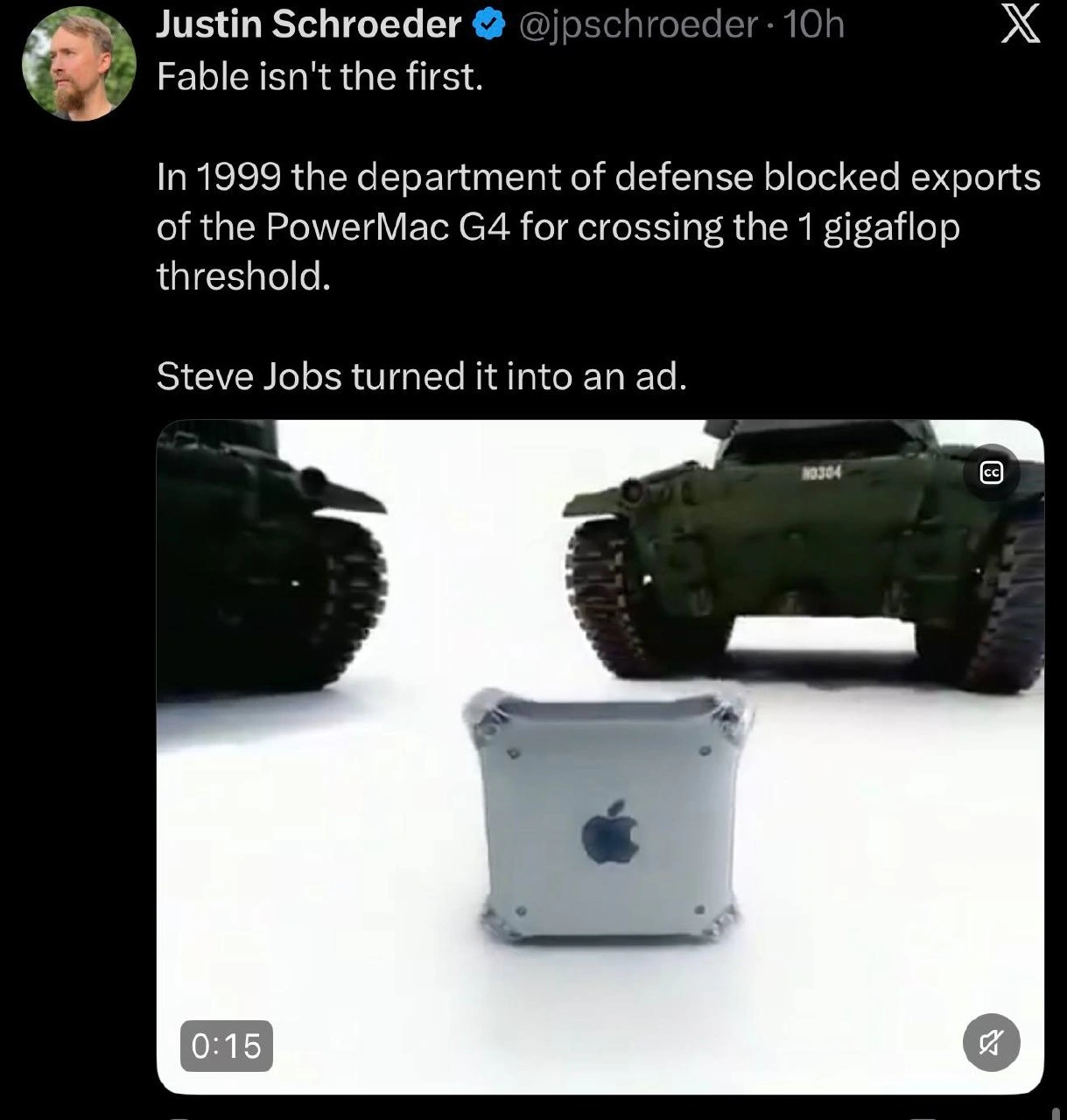
Wide-angle iPhone 11 lens warps banana, devs call it game-changing
Why is this Apple meme funny?
Level 1: Funhouse Mirror Camera
Imagine going to a carnival and looking into one of those funhouse mirrors that makes everything look goofy – maybe it stretches your face or makes your body look super wide. That’s basically what the new iPhone 11’s camera did to a banana in this picture! The iPhone got a new fancy camera that can see more of the world at once (a wide-angle camera). If you hold something like a banana really close to it, the banana looks huge and stretched out, kind of like a magic mirror is making it longer. Meanwhile, the rest of the kitchen and even a little dog in the background look really small and far away. It’s a silly trick of the camera lens, a bit like an optical illusion.
Now, Apple (the company that makes the iPhone) was super excited about this new camera lens. They were basically saying, “Wow, this changes everything! This is a game changer!” – which is a way to say “this is the coolest improvement ever.” The funny part is, when you actually use it, you get this crazy stretched banana effect. So it’s as if someone said “This new camera is amazing, it will change the game!” while we’re looking at a photo that turned a regular banana into a gigantic bent banana. 😂 It’s both cool and funny at the same time. The cool part is you can take really wide photos now. The funny part is sometimes those photos can turn out looking like a cartoon. We laugh because the person in the meme is calling it “game-changing” in a joking way – they’re kind of teasing that hype. In the end, we’re all a little excited (because new camera features are neat) and a little amused (because come on, just look at that banana!). It shows that even the most amazing new gadget can have a playful side-effect that makes us smile.
Level 2: Wide Lens Wonders
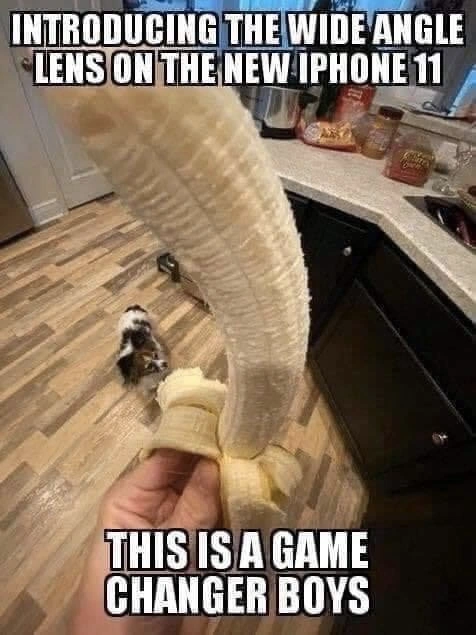
In the image, a person is holding a peeled banana very close to the new iPhone 11 camera. The banana looks absurdly long and curved, almost like a giant boomerang reaching toward the viewer. In the background, you can see a tiny dog on the floor and the kitchen cabinets looking far away and shrunken. Why does it look like this? Because of the iPhone’s new wide-angle lens. A wide-angle lens is a camera lens that captures a very wide field of view – meaning it fits more of the scene into the frame than a normal lens would. The iPhone 11 introduced this ultrawide camera lens for the first time on an Apple phone. The cool thing is you can now photograph, say, an entire room or a big group of friends without stepping back. The not-so-secret quirk is that anything (like our banana) held close to such a lens will look exaggerated in size compared to things in the distance. This effect is called perspective distortion: near things look bigger, far things look smaller. We normally expect that in photos, but a wide lens accentuates it a lot. That’s why the banana in the meme looks huge while the dog in the back looks extra tiny.
Another thing with wide lenses: they can bend straight lines near the edges of photos. If you’ve ever seen a fisheye skateboard video or a GoPro shot, you might recall how the image edges look curved, almost like the picture is bulging outwards. That’s a type of lens distortion. In our banana photo, the banana itself is a bit curved and the scene has a slight warped look because of the lens. It’s almost like an optical illusion; the camera lens is kind of acting like a funhouse mirror at the carnival. This is fun for creative photography, but it means the image isn’t a perfectly faithful representation of reality – it’s stretched and skewed a little.
Now, from a developer’s perspective, this matters for apps. Many mobile apps use the camera for all sorts of cool things: scanning QR codes, measuring objects, applying AR effects, you name it. Augmented Reality (AR) apps, for example, put virtual objects into the real world view on your phone screen. If the camera image is distorted (like with the ultrawide lens), the AR app needs to know that. Otherwise, imagine an AR app trying to, say, put a virtual hat on that little dog in the background – if it doesn’t account for the lens, the hat might look the wrong size or float in the wrong place because the dog appears smaller than expected. Similarly, a computer-vision pipeline (which is just a fancy term for software that processes and analyzes camera images) might misread sizes or shapes in that wide-angle view. For instance, a program that estimates the length of an object from a photo could seriously overestimate the length of our banana if it doesn’t realize the camera was making it look extra long. So developers writing these apps include calibration and correction steps. They use known camera parameters or Apple's frameworks (like ARKit or Vision in iOS) to compensate for the lens effects. In short, when a new camera feature like this comes out, app developers have to update their code so that their apps still work correctly and the UX (user experience) remains solid. If an app’s feature relies on the camera showing things accurately (imagine a furniture placement AR app or a document scanner), the devs have to make sure the wide-angle view won’t throw it off. Sometimes that means fixing the image with software, or simply guiding the user to stick to the normal camera for that task.
Let’s talk about the meme text itself. The text is written in big white all-caps (capital letters) at the top and bottom of the image, which is a classic meme style to deliver a setup and punchline. The top line says “INTRODUCING THE WIDE ANGLE LENS ON THE NEW IPHONE 11” and the bottom line declares “THIS IS A GAME CHANGER BOYS.” This is essentially imitating an excited announcement. Game changer is a phrase that means “something so new and powerful that it changes the way things are done.” Apple’s marketing often uses grand terms like that for new features on their products. So do tech enthusiasts — you’ll hear people call a cool new gadget a “game changer” all the time. Here, the meme is using that phrase in a jokey way. The wide-angle lens is indeed new and cool, but calling a banana that looks like a wonky telescope a “game changer” is poking fun at how overhyped tech announcements can be. The “boys” at the end adds a sense of “hey guys, check this out!” camaraderie, like the person making the meme is talking to their fellow developers or tech friends.
So basically, this meme is showing off the iPhone 11’s new camera trick — the ultrawide view — but humorously. Apple loudly touted this lens as a breakthrough (and it is a neat improvement), and the meme goes, “Yup, game-changing alright... just look at this crazy banana!” It’s a playful reminder that every new tech toy, even one from Apple, can have some unintended funny results. And for developers and engineers, it’s both a cool new thing to utilize and something to be aware of when designing apps or testing features. It definitely made folks in the tech community chuckle and say, “Wide-angle, welcome to the party – we see what you did there to that banana!”
Level 3: Lens Hype vs Reality
Seasoned developers can’t help but smirk at this one. Apple had just launched the iPhone 11 with its fancy new camera setup, and of course they proclaimed the ultrawide lens as something revolutionary. Game-changing, even. The meme captures that exact moment of hype and gives it a hilarious reality check. It’s formatted like a classic announcement:
INTRODUCING THE WIDE ANGLE LENS ON THE NEW IPHONE 11
THIS IS A GAME CHANGER BOYS
This all-caps text mimics the dramatic style of an Apple keynote or a tech blog headline. You can almost hear the excited applause. But instead of showcasing a mind-blowing photography achievement, the image shows a humble banana turned into a comically long, curvy object due to the lens. The punchline? This is the game changer, folks! The meme is using the meme_text_all_caps format to yell out the irony: Apple’s new wide-angle lens can indeed capture more... including more ways to warp reality, apparently.
The phrase "This is a game changer, boys" is deliberately hyperbolic. In developer culture, calling something a game changer has become a bit of an inside joke. We’ve all sat through product launches where every incremental feature is touted as if it will change everything. By phrasing it this way, the meme channels that over-the-top enthusiasm. It reads like an excited Apple fan or evangelist exclaiming to all their buddies on day one. But the context is a banana looking like it’s from a funhouse. This juxtaposition is golden: it’s like saying “Behold, innovation!” while presenting something delightfully absurd. It pokes fun at Apple’s marketing (and tech hype in general) by showing the less glamorous side-effect of the innovation.
For developers, especially those in MobileDevelopment or who tinker with camera tech, the scenario is instantly recognizable. When a new iPhone drops with new mobile_camera_features, there’s genuine excitement: “Cool, what can we build with this?” The iPhone 11’s ultrawide lens was no exception — it opened up new possibilities for photography apps, AR experiences, and just making more dramatic shots. The Apple marketing machine dubbed it revolutionary, and to be fair, it was a big upgrade for an iPhone camera. But experienced devs also immediately think of the caveats: How will this lens handle distortion? Do we need to update our app’s image processing? In other words, while the product managers are shouting "game changer!", the engineers are already debugging the game.
A great real-world example: if you maintained an AR measuring app or a document scanner in 2019, the moment the iPhone 11 came out you had to consider the ultrawide lens. Suppose your app tries to measure objects based on the camera feed — now users might use the wide lens and suddenly a known-size object (like an A4 paper or, heck, a banana) appears larger or more skewed than your algorithms expect. Without an update, your poor app might calculate that banana as six feet long! So developers had to jump in, update camera selection logic or at least warn users. Apple actually provides API hooks for this hardware; on iOS you can explicitly request the ultrawide camera (e.g. using AVCaptureDevice.DeviceType.builtInUltraWideCamera in the AVFoundation framework) or you might auto-switch between lenses. We had to make sure our code didn’t freak out when the focal length changed on the fly or when images came in distorted. It’s a behind-the-scenes challenge that comes with any "game-changing" hardware update: new toys, new edge cases.
Now, from a user and photography perspective, that lens really was fun. The iPhoneography community (enthusiasts who treat iPhone cameras like their DSLR) loved being able to capture creative ultra-wide shots. Interior photos, big group selfies, artsy landscapes – the ultrawide enabled all of that. But those same wide shots come with the goofy distortion the meme highlights. If you’ve ever seen a GoPro action cam video, you know the vibe: the world looks a bit bent; you can strap one to your dog and your dog’s snout looks huge on camera. Same principle here. Devs familiar with GoPros or DSLR wide lenses saw the banana photo and nodded: yep, physics hasn’t changed just because it’s Apple. We get a chuckle because the meme is basically an Apple-flavored replay of something we’ve seen before: new lens, same distortion, now in your pocket.
The “boys” in “This is a game changer, boys” gives it that meme-y camaraderie tone, as if addressing all fellow devs or tech nerds collectively. It’s the kind of phrase you’d see in gamer or hacker culture, maybe an ironic reference to memes like "We did it, boys" celebrating some trivial victory. It sets a lighthearted, slightly sarcastic mood. We’re all in on the joke together.
Historically, the dev community often reacts this way when tech giants unveil something with grandiose claims. Back in late 2019 when this was posted (just days after the iPhone 11 release), our Slack and Reddit feeds were flooded with both genuine “whoa, check out the ultrawide shots!” and tongue-in-cheek posts like this banana meme. It’s practically tradition: big announcement, big marketing adjectives, and then the geeks find the edge-case or the unintended side effect and turn it into a joke. Apple says “think different”; devs say “we will… and we’ll meme it too.”
What makes this meme especially satisfying is that it’s not just random silliness – it’s rooted in a real technical quirk. Any developer who has dealt with camera feeds or perspective_distortion issues knows wide-angle lenses are both awesome and tricky. Awesome, because you really can capture more in one shot (which in some applications is genuinely transformative). Tricky, because you might have to write extra code or algorithms to compensate for the "fishbowl" effect, or at least account for it in your UX. It’s the classic tech story: new feature, new fun, new bugs. Just like how a new JavaScript framework might promise to solve all your problems but introduce new ones, a new camera lens gives us both excitement and new work.
In the end, the senior dev perspective here is a mix of admiration and playful skepticism. We’re impressed with the hardware advancement (we love new gadgets as much as anyone, and many of us were itching to try that ultrawide lens in our own projects), but we also enjoy the humor in seeing its limits cartoonishly displayed. The meme basically says: “Sure, Apple, it’s a ‘game changer’... just maybe not in the way you pitched.” And honestly, that tongue-in-cheek take is healthy. It reminds us not to take marketing at face value and to find a laugh in the technical realities. After all, if a TechHumor meme about a warped banana can make developers both excited and amused, you know you have a true piece of HumorInTech on your hands.
Level 4: Bending Light and Reality
At the deepest level, this meme is highlighting a fundamental interplay of optics and geometry in modern smartphone cameras. The iPhone 11 introduced an ultrawide wide-angle lens that dramatically increases the camera’s field-of-view (FOV), capturing a much wider slice of the scene in one shot. To achieve this, the lens has a very short focal length, which inherently magnifies both perspective distortion and optical distortion in images. In concrete terms, objects extremely close to the lens appear massively larger (relative to distant objects) than they would under a normal lens, and straight lines near the edges of the photo can appear to curve outward (the classic barrel distortion effect). The banana in the meme photo isn't actually growing—it's physics and lens geometry warping the image.
Let’s break down the two distortion phenomena at play here:
Perspective distortion: Because the banana is so close to the camera, it looms incredibly large compared to the background. A wide-angle lens exaggerates the difference in relative size between near and far objects. In the image, the peeled banana (in the foreground just inches from the lens) looks huge, while the small dog and kitchen cabinets in the distant background look tiny and far away. This is normal perspective on overdrive: moving an object closer to any camera makes it appear bigger, but an ultrawide lens encourages you to get very close to fill the frame, so the effect is extreme. It’s the same reason your nose looks bigger than your ears if you take a selfie too close – the near stuff scales up dramatically. Mathematically, in a pinhole camera model we have something like $apparent_size \sim \frac{f}{distance}$; with a tiny $f$ (ultrawide lens) and a tiny distance, the banana’s image can dwarf everything else.
Optical lens distortion: The physical design of ultrawide lenses often introduces radial distortion in the image. Straight lines at the edges may appear curved (bulging outward) because the lens is bending light to capture such a wide field. This is known as barrel distortion. In the meme photo, the banana’s already-curved shape is exaggerated into an almost comical arc, and even the edges of the countertop or floor tiles might not look perfectly straight. Smartphone cameras usually apply software corrections for this (using pre-calibrated distortion coefficients to "bend" the image back). Apple’s camera software knows the lens has a distortion profile and will try to compensate so that, say, your group photos don’t have curved walls. But when you push the lens to its extremes (like sticking a banana right up to it), some fisheye-like warping is inevitable. The sensor is basically grabbing a wider view than a flat plane can naturally show, so something’s gotta give (usually at the edges).
Engineers and computer vision developers deal with these distortions using mathematics and calibration. Each camera lens on a phone has associated intrinsic parameters (focal length, optical center, and distortion coefficients) that can be used to map the curved, wide-angle image back to a more "normal" perspective. For example, a library like OpenCV allows developers to correct an image given those calibration values:
import cv2
# Undistort the ultrawide image using known camera matrix and distortion coefficients
corrected_image = cv2.undistort(distorted_image, camera_matrix, distortion_coeffs)
# After correction, straight lines are straight (and bananas look normal length again!)
Here, camera_matrix and distortion_coeffs would come from a calibration process (often done by photographing a known pattern to deduce how the lens warps light). After such correction, the banana optical illusion would be toned down: the banana would appear more proportionate (no more banana-as-a-sword), and those bending countertop lines would straighten out. However, even with perfect optical correction, the perspective effect remains – that banana is still closer than everything else, so it will look gigantic. No algorithm can change the basic rule that near things look bigger; we can only correct the non-linear warping on top of that.
This has real implications in MobileDevelopment and AR. If you’re building an Augmented Reality app with ARKit (Apple’s AR framework on iOS), you need the correct camera calibration for each lens to place virtual objects convincingly in the real world. The iPhone 11’s ultrawide camera has a different view and distortion profile than the standard camera. Imagine an AR app that lets you place a virtual object (say, a chair) in your room. If the app didn’t know about the ultrawide lens’s properties and the user switched to it, the virtual chair might appear at the wrong size or drift awkwardly as the real camera view warps differently. ARKit avoids this by providing lens-specific data, ensuring that a 1-foot virtual object stays 1-foot in appearance even when you’re using the "funhouse" lens. Similarly, any computer-vision pipeline (like an object recognition algorithm or a 3D scanner app) must account for the lens used: the algorithm might otherwise misinterpret a stretched-out banana as being larger/longer than it truly is. In essence, developers calibrate and correct for the perspective_distortion and lens distortion so that their apps can trust what the camera is showing.
What’s remarkable – and amusing – here is that Apple managed to put such a wide field-of-view lens in a phone at all. It’s a miniaturized optical marvel, bending light nearly to the point of a fisheye lens (which typically gives that unmistakable curved look). From a technical perspective, the ultrawide lens was a major new mobile_camera_feature in 2019, and it's literally bending reality (or light rays at least) to capture more of the scene. The meme exaggerates this effect to comedic heights: it’s a demonstration of physics that looks almost like a parody. To those of us who love the tech, it’s both a "wow" and a "haha" moment – wow, because the hardware is impressive (a tiny lens doing big distortion); haha, because when you exploit it just right, you get a hilariously distorted banana that any optical engineer would immediately recognize as a textbook case of wide-angle projection.
Description
Meme image shot with an extreme wide-angle perspective: a hand holds a peeled banana that appears absurdly long and curved toward the camera, filling most of the frame. A small dog and kitchen cabinets recede dramatically in the distorted background, showcasing the field-of-view stretch typical of ultrawide mobile cameras. White all-caps text across the top reads, "INTRODUCING THE WIDE ANGLE LENS ON THE NEW IPHONE 11" and along the bottom, "THIS IS A GAME CHANGER BOYS." Technically, the joke highlights how new smartphone camera hardware can exaggerate objects near the lens, a quirk mobile developers and hardware-aware engineers must consider when building AR apps, computer-vision pipelines, or UX that relies on image fidelity. It playfully nods to Apple’s marketing hype versus real-world optical distortion that seasoned engineers instantly recognize
Comments
6Comment deleted
Marketing: “Ultrawide is a game changer - look how huge the banana is!” CV team: “Sure, now the k₃ term in the Brown-Conrady model needs its own Jira epic so your fruit doesn’t eclipse the dog in AR.”
After 15 years of fighting barrel distortion in our camera APIs, Apple's marketing team just convinced everyone it's a feature worth $999. Next year's model will include automatic fisheye correction as a 'Pro' feature
Ah yes, the iPhone 11's wide-angle lens - because nothing says 'innovation' like shipping a feature Android had for three years, but with 10x the marketing budget. At least now iOS developers can finally test their responsive layouts on images that look like they were rendered through a fisheye shader with the FOV cranked to 120 degrees. Pro tip: if your product photos start looking like they're experiencing gravitational lensing near a black hole, you might want to dial back that ultra-wide mode
iPhone 11 ultrawide: finally hardware that visualizes scope creep without needing a custom shader
Radial distortion rebranded as 'Ultra Wide' - proof that with the right PM, even your bug can ship GA
Apple’s ultrawide is the PM’s KPI hack: change the FOV and suddenly your banana - and roadmap - looks 10x bigger