The art of debugging user-reported issues
Why is this Debugging Troubleshooting meme funny?
Level 1: Batteries Not Included
Imagine you have a toy car that isn’t moving, and you’re pressing the “go” button over and over. You’re really upset, shouting that the button is broken. But then your parent comes by and simply flips the car’s power switch or puts in a battery – and suddenly the toy car zooms off! The button was never the problem at all. The toy just wasn’t turned on. This meme is joking about that kind of situation. It’s funny because the person was so sure something big was broken (the gas pedal, in the car example) when actually they just forgot a super basic step. It’s like complaining a flashlight doesn’t work when you never put the batteries in. Sometimes we overlook the obvious, and the simplest explanation fixes everything. It’s a little silly and a good reminder: start with the basics before blaming the big stuff.
Level 2: Is It Plugged In?
Let’s break down what’s happening in simpler terms. In the meme, we have a bug report about a car: the user says the gas pedal isn’t working. In software or IT, a “bug report” is when someone tells the developers or support team, “Hey, this thing is broken!” But just like in real tech support calls, the first questions back are super basic: “Is it turned on?” This is the classic first step of troubleshooting any device or program – basically “Is it plugged in and powered up?”. Here, “Is your car turned on?” serves the same purpose as asking if a computer is plugged into the wall or if a router has power. It sounds almost too simple, but you’d be amazed how often the fix for a “broken” device is simply turning on the power or connecting a cable.
The car analogy being used is a brilliant way to illustrate tech problems in everyday terms. Think of the car as the entire software system or product, and the gas pedal as one feature or component of that system. When the user yells “My car’s gas pedal does not work!”, it’s like a user screaming “This app’s button does nothing, fix your app!” Now, if the car isn’t turned on, that’s like the app or server not even running. Of course none of the features (gas pedal or button) will do anything if the whole system is off. The next support question, “Does your car even work?”, goes further: maybe the car has a dead engine – in tech terms, maybe the entire service is down or the computer itself is broken. The user replies “No”, meaning they haven’t verified the car works at all. This is akin to a user reporting a specific software bug without checking if their internet connection is live or if they even have the right app version installed.
We have some tags like root_cause_vs_symptom and blame_the_component, which are fancy ways to say: figure out what’s really wrong vs. what seems wrong. The root cause is the actual underlying problem (here: the car is off or non-functional), whereas the symptom is what you see on the surface (the pedal doesn’t respond). New developers learn quickly that you must distinguish between the two. If you fixate on the symptom (“gas pedal is unresponsive”) without context, you might start taking apart the pedal mechanism (or digging through button code) for no reason. It’s like treating a fever with an ice pack without realizing an infection is causing it – you’re not addressing the real issue. Debugging requires asking those basic questions first to uncover the context. This initial Q&A in the meme is essentially issue triage: prioritizing and diagnosing a report to see where the problem truly lies.
Communication is a big theme here. The meme is tagged Miscommunication and Communication because the way the user reported the problem was misleading. Instead of saying “my car won’t start” (which points to a general problem), they picked one detail and shouted about that. In dev terms, sometimes users or even project managers will insist “Feature X is broken!” when actually the whole system was misused or down. The support/dev team has to gently probe with simple questions to get the full picture. This can be frustrating (DebuggingFrustration is real!) but it’s part of dealing with support tickets and customer reports. Junior devs often learn this the hard way: you might spend hours chasing the wrong thing because the initial bug report sent you on a wild goose chase. For example, a tester might report “The save button is unresponsive,” and you might dive into the button’s code logic. Later you find out the real issue: the test server wasn’t even running, so nothing could save at all! The lesson: always verify the basics. Or as seasoned IT folks joke, “Have you tried turning it off and on again?” – a tongue-in-cheek way of saying, check the power, restart the system, confirm the simple stuff first.
The tags also mention DeveloperPainPoints and StakeholderExpectations. These hint that there’s a human side to this. It’s a pain point for developers to get bug reports that are essentially user error. You don’t want to be rude, but you have to ask questions that might make the reporter feel a bit silly (“Uh, did you actually turn the thing on?”). Stakeholders (like clients or managers) might expect quick fixes when they think a specific component is broken, but the developer has to sometimes diplomatically explain that the entire approach was wrong – the equivalent of, “The gas pedal is fine; you just need to start the car.” Managing these expectations is part of the job. This meme humorously captures that awkward gap in understanding. After all, debugging and troubleshooting in real life often includes a bit of gentle education: teaching users how the system really works, one simple question at a time. And when the user finally realizes “oh, the car was off!”, it’s a lightbulb moment — equal parts embarrassing for them and a relief for the dev who didn’t have to tear down the whole engine.
Level 3: PEBKAC Confirmed
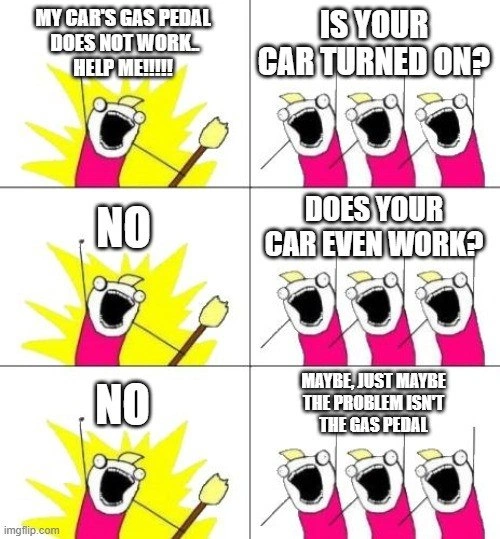
This meme nails a classic debugging & troubleshooting nightmare: a user reports a bug in one component, but the real failure is much more fundamental. Here the frantic user yells, “MY CAR’S GAS PEDAL DOES NOT WORK. HELP ME!!!!!” while the calm (if exasperated) support engineer responds with the most basic diagnostic questions in the book: “Is your car turned on?” and “Does your car even work?”. The user admits “NO” to both, leading the support to a facepalming conclusion: “Maybe, just maybe the problem isn’t the gas pedal.” 🤦♂️
In software terms, the user is fixated on a symptom (the unresponsive gas pedal) and has already blamed that part for the failure. This is like a bug report blaming a specific function or microservice (“the login button is broken!”) when in reality the entire application isn’t even running or the database is down. Experienced developers and IT support folks have seen it all — from servers that won’t respond because they were never started, to “broken features” that were actually misconfigured settings. The humor here comes from that all-too-real disconnect: the user is pointing at the wrong culprit. It’s a textbook case of chasing a red herring in debugging.
In the industry, we often call this a PEBKAC error (Problem Exists Between Keyboard And Chair) or a PICNIC (“Problem In Chair, Not In Computer”). Essentially, it means the “bug” is actually due to user oversight rather than faulty code. The meme’s car analogy makes it obvious: of course pressing the gas pedal won’t do anything if the engine itself isn’t on or the car is broken. It’s a gentle jab at users who jump to conclusions – a scenario every support engineer recognizes with a mix of frustration and dark humor. We see the tags UserError and Miscommunication come to life: the user’s frantic description left out critical context, forcing the support team to play detective. This kind of miscommunication between end-users and developers is a huge DeveloperPainPoint – it wastes time and tests patience.
From a senior dev perspective, the meme highlights the importance of root cause analysis versus focusing on superficial symptoms. Good debugging is like detective work: you don’t immediately trust the initial complaint at face value, especially if it blames a single component without evidence. Instead, you methodically check the fundamentals of the system – just like asking if the car has power. In real life, a dev might ask: Is the server powered on? Is the service running? Are there any error logs? Those basic questions are the “Is your car turned on?” of software triage. Only after ruling out the obvious can we move on to advanced troubleshooting. It’s both comical and sobering that many BugFixing sessions start with something as simple as plugging in a machine or restarting a service.
This meme resonates strongly in dev culture because it satirizes an everyday debugging frustration: the gap between what a user reports and what the actual issue is. The user confidently blames the “gas pedal” (some feature or component), while the seasoned engineer suspects a deeper issue (the whole “car” system). It shines a light on stakeholder expectations too – the user likely expects the dev to “just fix the gas pedal” quickly, but in reality the entire engine might need fixing (or simply turning on!). The support’s quip “Maybe the problem isn’t the gas pedal” is equal parts snark and relief, because they’ve finally uncovered the root_cause_vs_symptom confusion. For veterans, this exact scenario is too real: how many late-night on-call alerts turned out to be someone forgetting to deploy, or configuring a system wrong? Countless. This meme playfully immortalizes that communal experience of issue triage where the true culprit is something basic and obvious in hindsight.
Description
A six-panel comic meme using the 'Hyperbole and a Half' art style, specifically with the 'All the Things' character. The left column shows a single, frantic pink character, while the right column shows a calmer group of three identical characters. The dialogue proceeds as a troubleshooting session: (1) Frantic character: 'MY CAR'S GAS PEDAL DOES NOT WORK... HELP ME!!!!!'. (2) Group: 'IS YOUR CAR TURNED ON?'. (3) Frantic character: 'NO'. (4) Group: 'DOES YOUR CAR EVEN WORK?'. (5) Frantic character: 'NO'. (6) Group: 'MAYBE, JUST MAYBE THE PROBLEM ISN'T THE GAS PEDAL'. This meme is a classic analogy for technical support and debugging, perfectly capturing the frustration of dealing with users who report a very specific symptom while ignoring a fundamental underlying problem. It's the IT equivalent of asking 'Is it plugged in?', resonating with any developer or support engineer who has spent time diagnosing issues based on misleading user reports
Comments
10Comment deleted
A user files a bug report: 'The export-to-PDF button is broken.' The developer discovers the user's hard drive is full. This is why the first step of any good debugging runbook is 'check for signs of intelligent life'
Prod bug report: “Checkout button unresponsive.” Root cause: the entire Kafka cluster was offline - but by all means, let’s rewrite the React hook
After twenty years of debugging production issues, I've learned that users reporting "the submit button doesn't work" is just their way of saying "I haven't noticed the 500 error that's been throwing since our database migration last Tuesday."
Every senior engineer has lived this: the user insists it's a race condition in the message queue when they haven't even checked if the service is running. It's the production equivalent of 'my deployment failed' when kubectl isn't even configured. We've all learned the hard way that the most elegant distributed tracing setup won't help if the container never started - sometimes the real bug is between the chair and the infrastructure-as-code
SRE 101: User's 'API dead' ticket? First grep logs for 'inactive (dead)' - turns out the pod never escaped Pending, just like this car's unignited engine
Senior on-call heuristic: before blaming the throttle microservice, verify the cluster isn't scaled to zero and the feature flag isn't off; power before pedals
Stop rewriting the button - start the service. You’re tuning the gas pedal while the engine’s in CrashLoopBackOff
Quality of memes is inversely proportional with the quantity of memes Comment deleted
У тебя вообще на аватарке какая-то кибернетика непонятная Comment deleted
It is a fixed-point combinator, lambda calculus -> https://en.wikipedia.org/wiki/Fixed-point_combinator Comment deleted