Skip to content
DevMeme
2014 of 7435
The euphoria of closing a difficult bug ticket
Bugs Post #2244, on Nov 6, 2020 in TG

The euphoria of closing a difficult bug ticket

Why is this Bugs meme funny?

Level 1: Finally Fixed It

Imagine you’ve been working on a big puzzle all day, and it just would not fit together. Maybe it’s like trying to build a LEGO set with one piece mysteriously out of place, making the whole thing look wrong. You keep searching and trying different pieces, getting more and more frustrated. Then suddenly – aha! – you find the tiny piece that was causing all the trouble and snap it in where it belongs. The whole toy starts working perfectly. How do you feel at that moment? Super happy and maybe a bit surprised that you actually solved it, right? You might even jump up and do a little victory dance or shout out something silly. That’s exactly what’s happening in this meme. The “bug” is like that wrong puzzle piece or a hidden mistake in a big set of instructions. The programmer finally found the mistake and fixed it, so their program (their toy, in a way) is running correctly now. They’re so excited and relieved that they quote a famous movie line to themselves: “You did it… you crazy son of a gun, you did it!” – which basically means “Wow, I can’t believe I actually pulled it off!” It’s a fun, joking way for the developer to pat themselves on the back. Just like a kid might say “I did it!” after finally beating a hard level in a video game or finishing a tricky puzzle, the programmer is celebrating a big problem solved. The meme is funny because it shows how even grown-up coders can get giddy and talk to themselves when they overcome a really tough challenge. It’s a little moment of triumph, like finally catching that sneaky monster that was causing all the trouble, and saying with a smile, “Hah, gotcha! I fixed it!”

Level 2: Bug Hunt Basics

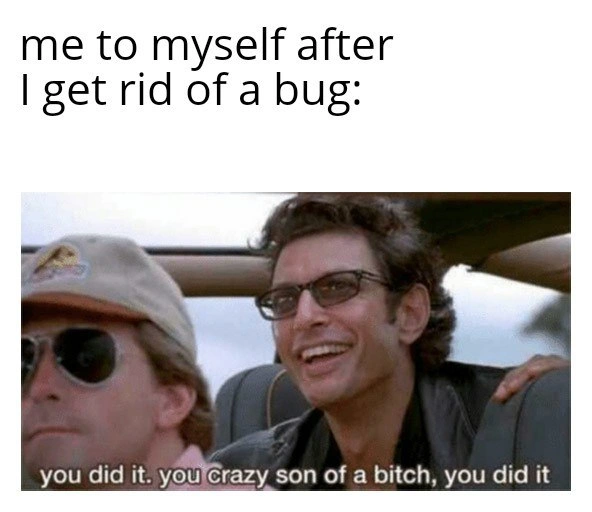
Let’s break down what’s happening in this meme. The phrase “me to myself after I get rid of a bug” means the developer is speaking to themselves, congratulating themselves, right after fixing a bug. In programming, a bug is any mistake or problem in the code that causes things to go wrong – maybe the app was crashing, or a button didn’t work, or numbers were coming out all wrong. Debugging is the process of finding that bug (the error) in the code and fixing it. It’s like a detective investigation, but for computer programs: you follow clues (error messages, logs, weird behavior) to pinpoint what in the code is causing the trouble. The meme’s image is borrowed from the movie Jurassic Park (1993). In that scene, a mathematician named Dr. Ian Malcolm (played by Jeff Goldblum) is so astonished that the park’s creator actually brought dinosaurs back to life that he says, smiling: “You did it… you crazy son of a bitch, you did it.” It’s a mix of admiration and “I can’t believe you pulled that off.” Developers love referencing pop culture, and this quote is a classic for expressing incredulous success. So when a programmer finally squashes a bug (fixes the error) – especially a tricky one that took a long time – they often feel a burst of pride and relief. They might literally say out loud, “I did it, I can’t believe it… it actually works now!” In the meme, the developer humorously imagines themselves as Ian Malcolm praising their own work. It’s self-congratulation in a playful way. The text across the movie still – “you did it… you crazy son of a b, you did it” – is the exact quote from the film, just repurposed for a coding victory. Now, why is this funny or relatable? Because every developer has been there: you spend hours (or days) on a frustrating problem. Maybe the program was throwing a mysterious error with a long stack trace (a list of function calls that shows where the error happened, kind of like a trail leading back to the bug). Or perhaps it was a race condition – a bug that happens only when events occur in the wrong order or timing (imagine two people trying to write on the same piece of paper at the same time; sometimes it’s fine, other times they scribble over each other – those timing bugs are often random and hard to reproduce). You try everything: printing out values (console.log or printf statements) to see where it goes wrong, using a debugger tool to step through code line by line, googling error messages, asking a coworker for a fresh perspective – this process is the essence of Debugging & Troubleshooting. It can be frustrating and time-consuming. So when you finally discover the cause of the bug and fix it, it feels amazing. The code that was broken now works correctly – for a developer, that’s a big success! In that joyful moment, quoting a line like “you crazy son of a b**, you did it” to yourself is a way of saying, “Wow, I actually solved it… I’m kind of proud (and surprised) that I pulled it off!” It’s DeveloperHumor because other coders instantly recognize that emotional rollercoaster: confusion, determination, and then triumph. Even though it’s just a movie quote, it captures the feeling perfectly. The plain white top caption and the movie subtitle style make it clear that this is a meme format: setup text at the top, punchline at the bottom image. The developer is essentially both the hero and the audience here – they accomplished something difficult in code and are giving themselves a dramatic, funny congratulations. It’s a lighthearted peek into the Developer Experience (DX): those little moments of joy that balance out the hair-pulling moments of frustration. After all, writing code isn’t just about typing – a lot of it is debugging errors. And when you finally fix a tough bug, you feel on top of the world, even if nobody’s around to see it. This meme perfectly captures that universally relatable dev experience of hard-won success.

Level 3: Stacktrace Safari

For seasoned developers, this meme triggers flashbacks of epic debugging sessions – the kind where you feel like a park ranger on a wild safari through thousands of lines of logs. The top text, “me to myself after I get rid of a bug,” sets the scene: the developer has been battling a stubborn issue. The image beneath (a famous Jurassic Park jeep scene) and its subtitle – “you did it… you crazy son of a b***, you did it”* – captures that mix of disbelief and triumph when the bug is finally squashed. It’s a perfect metaphor because debugging a nasty bug often does feel like hunting a cunning velociraptor hiding in the brush: you track footprints (stack traces), set traps (breakpoints or logging), and endure jump scares (sudden exceptions crashing your program). By the time you corner the bug, you’re exhausted and amazed that your crazy plan actually worked. This is classic DeveloperHumor drawn from shared pain: every coder has spent late nights with a failing program thinking “this bug might actually be impossible to fix.” Maybe it was a race condition that only happens one in a million runs (like a dinosaur that only comes out at midnight), or a memory leak slowly eating RAM that you needed hours to reproduce. You comb through call stacks, trace stack frames one by one (hence “Stacktrace Safari”), perhaps muttering to yourself in the dark quiet office. Each clue in the logs is like a broken branch or T-Rex footprint – hints of the beast’s path. Often you try wacky ideas out of sheer desperation: what if I restart the server? What if I add a 2-second delay? What if I sacrifice a weekend? — anything to provoke the bug into showing itself. When something finally works, there’s a moment of “Wait... it’s fixed? It’s fixed! It actually worked!” You might lean back in your chair with a Jeff Goldblum grin, wanting to exclaim that famous line at your screen. The humor is in the self-congratulation: quoting a movie to oneself is both nerdy and endearing – we’re poking fun at the fact that, in our developer experience (DX), sometimes the only witness to our victory is ourselves (and maybe a rubber duck on the desk). It also acknowledges a truth: debugging is hard. We feel a surge of pride (and relief) when we succeed, because deep down we half-believed this bug might outsmart us. In an office, a teammate might jokingly say this line to the developer who solved the “unsolvable” bug; in the meme, the dev has to be their own hype-man. It’s a little pat on the back that says, against all odds, the code finally works. And given how often programmers wrestle with Bugs and Troubleshooting, celebrating these wins – even in a tongue-in-cheek, Hollywood way – is our catharsis. After all, if John Hammond “spared no expense” to build Jurassic Park, we developers spare no effort (sleepless nights, gallons of coffee, countless Google searches) to fix our broken code. So when it finally pays off, you better believe we feel like we just saved the day.

Level 4: The Heisenbug Principle

In the realm of software bugs, sometimes fixing one can feel as momentous (and improbable) as resurrecting dinosaurs. This meme unwittingly nods to chaos theory and the unpredictable nature of complex code. In Jurassic Park, Dr. Ian Malcolm is a chaos theorist amazed that an impossible feat (cloning dinosaurs) succeeded. Likewise, modern software systems are so complex and interconnected that a serious bug can seem impossibly tricky to pin down. Ever heard of a Heisenbug? It’s a tongue-in-cheek term for a bug that changes or vanishes when you try to observe it, much like the observer effect in quantum physics. For example, you might add a console.log or run a debugger to catch a bug, only to find that the act of observing changes the timing and the bug mysteriously disappears. Race conditions in concurrent programs are classic breeding grounds for these now-you-see-it-now-you-don’t glitches. The code’s behavior isn’t deterministic – tiny timing differences (a thread running a few microseconds faster, a network packet arriving one moment sooner) can completely alter the outcome. Debugging such issues becomes a battle against entropy: code that should follow rules instead behaves like a chaotic system with emergent surprises. The humor here is that solving a nasty, elusive bug feels like defying the universe’s odds; you’re half-surprised the program works at all. In theory, ensuring a program has zero bugs is as hard as solving the Halting Problem – some things are undecidable without actually running the code. We throw unit tests, static analyzers, and formal proofs at our programs, but at the end of the day, reality (and production) finds a way to break things. So when that “impossible” bug finally yields to your relentless troubleshooting, it’s a near-miraculous event. No wonder the developer is quoting an iconic line of astonishment – you did it; you crazy son of a b***, you did it!* – effectively telling themselves that taming this chaotic codebase was as wild and thrilling as bringing T-Rex back to life.

Description

A two-panel meme that captures the feeling of accomplishment after fixing a tough bug. The top panel has simple black text on a white background that reads, 'me to myself after I get rid of a bug:'. The bottom panel features a famous still image of actor Jeff Goldblum as Dr. Ian Malcolm from the movie Jurassic Park. He is in a car, smiling with a look of awe and disbelief, and the subtitle reads, 'you did it. you crazy son of a bitch, you did it'. The meme perfectly equates the triumphant, almost surreal feeling of finally squashing a persistent or complex bug with witnessing a miraculous, impossible event. It's a universally relatable moment of self-congratulation for software developers

Comments

7
Anonymous ★ Top Pick That feeling lasts exactly until you run the full test suite and discover your 'fix' was just a clever way to introduce three new, more subtle bugs
  1. Anonymous ★ Top Pick

    That feeling lasts exactly until you run the full test suite and discover your 'fix' was just a clever way to introduce three new, more subtle bugs

  2. Anonymous

    After three days spelunking through forty microservices to isolate a nondeterministic race, CI finally turns green and I hear Goldblum: “You did it… you crazy son of a bitch, you did it” - right before the SRE reminds me Chaos Monkey runs at noon

  3. Anonymous

    The only time a senior engineer genuinely believes in their own competence is in that fleeting moment between fixing a bug and discovering they've created three new ones in production

  4. Anonymous

    Ah yes, the classic developer dopamine hit: finally fixing that elusive bug after hours of debugging, only to realize during the next build that you've introduced three new edge cases and broken backward compatibility. But for this glorious moment, before running the test suite, you are a god among mortals - a crazy son of a bitch who actually did it. Enjoy it while it lasts, because production deployment is your Jurassic Park, and those raptors are already testing the fences

  5. Anonymous

    Me after ‘fixing’ the prod bug with one debug log: congrats, you serialized a race with printf - right up until async logging ships

  6. Anonymous

    That rush after nuking a Heisenbug - pure bliss, until staging proves it only manifests under full moon CI runs

  7. Anonymous

    That feeling when the P1 incident ends with a -1 line diff, and you still owe a five-page RCA about how a missing await plus eventual consistency produced a Heisenbug

Use J and K for navigation