A Developer's Unshakeable Loyalty to Stack Overflow
Why is this Debugging Troubleshooting meme funny?
Level 1: Too Many Scoops
Imagine you’re trying to build the tallest ice cream cone ever. 🍦 You keep adding scoop after scoop, making it higher and higher. It’s fun to stack them up, but if you don’t stop at some point, what happens? The cone can only hold so much – eventually the whole thing topples over and you’ve got ice cream all over the floor. Now, picture that you try this every morning, and every morning splat! – ice cream everywhere. You’d be standing there with a sad, empty cone and a big mess, thinking, “Oh no, not again! What did I do wrong this time?”
This is exactly what’s going on in the meme, but with computer code. Stacking too many ice cream scoops is like a function in a program calling itself too many times. The mess on the floor is like the program crashing. It’s funny because the person in the meme (the programmer, like us) keeps making the same mistake and the “stack of scoops” falls down every time. Even the ice-cream shop guy in the meme is looking at us like, “Really? You did it again?” It’s a playful way to show how frustrating – and a bit silly – it feels when you keep breaking your program in the same way before you’ve even had your morning coffee.
Level 2: Base Case or Bust
So what’s actually happening here, and why is it funny (or rather, painfully funny) to programmers? The meme is about a stack_overflow_error, which is a kind of runtime error that occurs when your program tries to use more stack memory than it has available. Let’s break that down. The call stack is like the program’s scratchpad for keeping track of function calls. Every time a function is called, the program pushes a little record (a stack frame) onto this stack with details like local variables and where to resume after the function returns. Think of it like stacking dinner plates: each function call puts a new plate on the stack, and returning from a function pops that plate off. Now, if you keep calling new functions without ever returning (like an endless loop of calls), plates keep piling up. A stack overflow happens when this stack of plates grows so tall that it crashes down – the program runs out of space to put new function-call records. At that point, the system says “No more!” and your program crashes with a stack overflow error.
One very common way to trigger a stack overflow is with infinite recursion. Recursion means a function that calls itself. This is a useful technique – classic examples include functions to calculate factorials, traverse trees, or perform searches, which call themselves on smaller sub-problems. However, there’s a crucial rule in recursion: you need a base case – a condition under which the function stops calling itself. If you forget the base case or if it never gets met, your function will call itself again and again forever… or until the computer runs out of stack memory. It’s like a mirror reflecting itself endlessly. Here’s a super simple example of what not to do:
def countdown(n):
print(n)
countdown(n-1) # Oops! We never tell it when to stop, so this goes on forever (until it crashes)
If you call countdown(5) in the above code, it will print 5, then 4, 3, 2, 1, 0, -1, -2… and so on, running downwards without end. Eventually (pretty quickly, actually) Python will hit its recursion limit and throw a RecursionError. In a language like Java or C#, a similar recursive mistake would throw a StackOverflowError exception. In lower-level C/C++ it might just cause a segmentation fault. Different names, same idea: you blew the call stack by calling a function way too many times without unwinding.
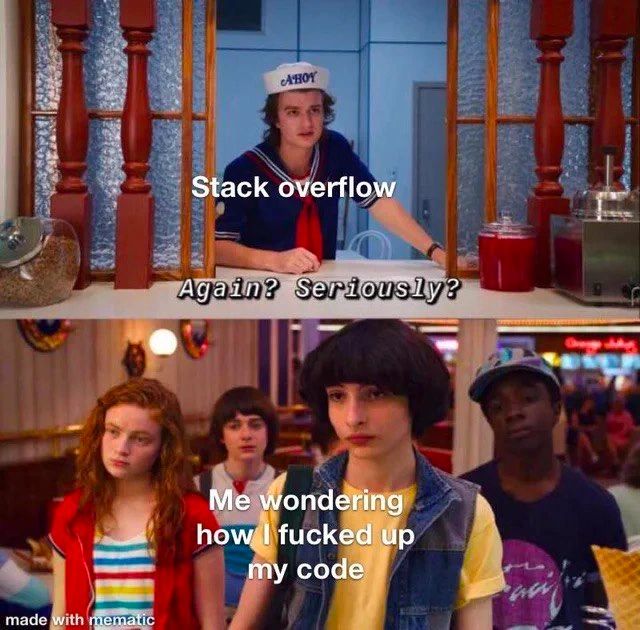
Now, the meme personifies this RuntimeError scenario using a scene from Stranger Things. The top part has the text “Stack overflow – Again? Seriously?”, plastered over a frame of a teen in a sailor uniform behind an ice cream parlor counter. That teen (Steve at Scoops Ahoy) is acting as the StackOverflow error message come to life, looking fed-up as it “greets” the programmer for the umpteenth time. The bottom part shows a few kids (Mike, Max, and Lucas from the show) with a confused, concerned look, labeled as “Me wondering how I fucked up my code”. In simpler terms, you (the developer) are staring at the error message with a puzzled face, thinking “What did I do wrong this time?”.
It’s funny (in a cheeky way) because every developer, even beginners, have experienced that “WTF” moment when their program crashes immediately and they have no clue what went wrong. Debugging_Troubleshooting often starts with that fazed look! Here, the crash is due to a stack overflow from a likely infinite recursion – basically a CodingMistake where you accidentally made your code call itself over and over. The “Again? Seriously?” implies you might have run the program multiple times, and it keeps crashing in the same way. It’s like the error itself is annoyed at you: “Really, you did this again? Haven’t you learned?” Meanwhile, you’re left scratching your head. Maybe you thought you fixed the bug, or you can’t figure out where in your code this endless loop is happening.
Let’s talk about how one “fucks up” their code to cause this, and how to unfuck it. Commonly, it’s a missing or incorrect base case in a recursive function. For instance, suppose you wrote a recursive function to compute the sum of numbers from 1 to N. If you forget to tell it when to stop (e.g., stop when N reaches 0), it will keep going into negative numbers and never stop – boom, stack overflow. Another scenario: two different functions inadvertently calling each other in a cycle (Function A calls B, and B calls A) – that’s called mutual recursion and can also overflow the stack if there’s no termination condition. The fix is usually straightforward: add the proper stopping condition. But the hard part is often finding the bug in the first place. When your program just crashes with a stack overflow, you might only get a massive stack trace as a clue. You have to scroll through and identify the repeating pattern (“aha, processData() calls processHelper() and then somewhere it calls processData() again… there’s the loop!”).
For a newer developer, it’s also worth clarifying: Stack Overflow in this meme is referring to the error, not the famous Q&A website named Stack Overflow. (Fun fact: the site got its name because “stack overflow” is such a notorious error that every programmer recognizes it!). If you’re just starting out, seeing “Stack overflow” pop up might even be confusing – you might think “Did the website spit out an error?” No, it means your program ran out of stack memory. And no online answer will directly fix it; you have to debug the code logic. It’s a classic BugsInSoftware moment that every coder eventually faces. The combination of frustration and comedy in the meme comes from that universal experience: your code blew up, you haven’t had your coffee, and even the error message seems to be sassily judging you. But don’t worry – with a bit of debugging (and caffeine), you’ll find which part of your code is in the vicious loop and be able to correct that subtle bug. Until then, that stack overflow error will keep leaning over the counter like an irritated shop clerk, rolling its eyes and saying “Seriously, fix this already.”
Level 3: Recursion Before Coffee
For a seasoned developer, this meme triggers a very specific memory (or nightmare): that moment when you run your code and boom – StackOverflowError immediately, even before you’ve had a sip of coffee. The meme frames it perfectly: a character (Steve from Stranger Things, dressed in a goofy Scoops Ahoy ice-cream shop uniform) represents the stack overflow error itself, looking at you with exasperation and saying “Again? Seriously?” Meanwhile, the group of kids in the lower panel (the Stranger Things gang) stand in for you, the developer, staring back in bewilderment as you wonder “How on earth did I mess up my code this badly again?”. It’s a scene of DebuggingFrustration that any programmer can relate to: the software equivalent of tripping over the same obstacle repeatedly.
Why is this so relatable? Because infinite recursion bugs are a rite-of-passage and a persistent source of DeveloperFrustration. Even experienced coders occasionally get tangled in a logic loop. Maybe you added a quick recursive call in a rush and didn’t realize you’d never break out of it. Or a seemingly innocent refactor caused two functions to start calling each other in an unintended mutual recursion cycle. Often these bugs hide in plain sight – your code compiles fine, all unit tests pass (perhaps none of them exercised that particular path), and then on the first real run or a unique input… the program blows up with a stack overflow. Cue the facepalm and a dread that maybe you shouldn’t have skipped that second coffee.
The humor is amplified by the again in “Again? Seriously?” because it hints at the repetitive nature of such bugs. A StackOverflow error tends not to be a one-time fluke; it will happen every single run until you fix the code. The meme implies this isn’t the first morning this developer has been greeted by the dreaded call stack explosion. Perhaps yesterday they thought they squashed the bug, only to find out they missed another recursive path. That scenario is painfully funny to anyone who’s tried to patch a bug at 2 AM, only to see it resurface the next day. It’s the Groundhog Day of debugging: CodingMistakes that come back to haunt us on loop.
From an engineering perspective, a stack overflow crash is dramatic and unmistakable. Typically, it prints a stack trace that floods your console or log with dozens (or thousands!) of repeating lines, showing the function calls unwinding. It’s essentially the computer yelling, “I called function A, which called function B, which called A, which called B… and so on until I freaked out!” The stack trace might be so long that you have to scroll way up to find the root cause. That’s the call stack itself “greeting” you – a wall of text detailing every step of the runaway recursion. It’s both helpful and humbling: helpful because it usually points right to the function that’s cycling, humbling because it’s often a function you wrote. SubtleBugs like this can slip past code reviews, especially if the reviewer assumed “surely we have a base case somewhere” or if the problematic call is indirect (spread across different files or through complex object interactions). And if this happens in a production system, it can be a nightmare: the service might crash repeatedly every time it hits the bad code path, possibly waking an on-call engineer at dawn. No wonder the meme’s developer-avatar looks so disheveled and distraught!
Another layer to the joke is the self-deprecating tone (“wondering how I fucked up my code”). Developers often cope with bugs by poking fun at themselves. It’s a coping mechanism for DeveloperSelfDeprecation: we’ve all written something bone-headed that we later stare at and facepalm. By personifying the error as a sassy ice-cream store clerk saying “Seriously?” the meme captures that feeling of embarrassment. It’s like the computer itself is rolling its eyes at you for making such a basic mistake. And honestly, that’s how it feels when you realize you coded an infinite recursion – seriously, how did I manage to do that? Even veteran engineers aren’t immune; you might accidentally create a subtle recursive dependency in a large codebase. The difference is that experience teaches you to quickly recognize the signs. The moment a program crashes immediately with no other output, a senior dev’s mind jumps to “likely a recursion or infinite loop.” We’ve learned (often the hard way) that whenever something fails before anything useful happens, StackOverflowError or its cousin segmentation fault is a prime suspect.
In daily development practice, avoiding these bugs is part of CS_Fundamentals 101: always define a clear base condition for recursion, and be careful of functions that call each other in circles. Teams put guardrails in place: code linters might warn about tail recursion or deep call chains, and good code reviews ask “does this recursion always terminate?” Yet, despite all that, human error and complex requirements ensure that “stack overflow” is a perennial punchline in programming. The meme gets a knowing laugh because it depicts exactly that scenario in a dramatised way – the runtime essentially throwing up its hands and scolding you, and you standing there like those kids in the Scoops Ahoy shop, perplexed and a bit guilty. As any seasoned debugger knows, nothing screams BugsInSoftware quite like seeing the program crash the moment it starts. And if it’s again, well, time to grab that coffee and dive into the debugger… once more.
Level 4: Turtles All The Way Down
At the most granular level, this meme highlights a fundamental computer science pitfall: unbounded recursion exhausting the call stack. In theoretical terms, detecting an infinite recursion in arbitrary code touches on the Halting Problem – we can’t perfectly predict if a function will ever stop calling itself. Because of this, our tools and compilers can’t magically warn us about every potential infinite loop or recursion. We rely on us (the programmers) to include a base case or termination condition. When we slip up, the physics of the machine step in: the call stack is a finite region of memory, and each nested function call pushes a new frame onto that stack like adding another plate to a tall stack. If calls keep coming without returning, eventually the stack memory pointer collides with memory it shouldn’t (a stack overflow). At the hardware level, this usually triggers a segmentation fault or similar memory access violation. High-level runtimes intercept that and throw a StackOverflowError (in Java) or its equivalent, essentially saying, “No more stack space – I can’t go deeper!”.
This is also where language design can make a difference. Some functional languages and optimizing compilers employ tail call optimization – a technique that, in certain cases, reuses a function’s stack frame for recursive calls, effectively flattening recursion into iteration. That means a properly tail-recursive function could, in theory, recurse forever without growing the stack. But tail-call optimization only works for specific patterns (tail calls) and isn’t present in every language (Java, notably, doesn’t guarantee it). Even when it’s available, it merely trades a stack overflow for an infinite loop: your program might not crash, but it will spin its wheels forever until you manually stop it. In other words, the underlying logical bug remains. And if you’re not using a language that eliminates tail calls, runaway recursion will reliably punch through the stack limit every time.
Different environments handle this failure differently. In low-level C or C++, an infinite recursion often just crashes your program (no catchable exception – one moment your program’s running, the next it’s gone, leaving maybe a core dump). In managed languages like Java or C#, the runtime throws a StackOverflowException (or Error) which, by default, is fatal for that thread because the system is in a rather unstable state when the stack is blown. Python takes an interesting approach: it has a recursion depth limit (by default 1000 calls) to stop you before you eat all the C stack – hitting this limit raises a RecursionError (essentially Python’s friendly wrapper around a stack overflow situation). These differences aside, the core issue is the same: you created a function call loop that conceptually would never end, and the finite memory forced it to end in a spectacular way.
Historically, this limitation is why early programmers were cautious with recursion. Back in the day of kilobytes of memory, a naive recursive algorithm could quickly consume all stack space and crash the system. This is also why the Q&A site Stack Overflow chose its name – a tongue-in-cheek reference to one of those quintessential developer blunders that send you running for help. It’s a geeky homage to the idea of being overwhelmed by too much of something (be it function calls or programming questions). In essence, the meme’s scenario – hitting a stack overflow (the error, not the website) first thing in the morning – is a collision of theoretical inevitability and human fallibility. No matter how advanced our tools get, if you accidentally create a circular logic with no escape, the computer will respond with a resounding “stack overflow,” as if saying “You went too deep, my friend.” The humor here is that this fundamental CS truth isn’t picky – it’ll strike whether you’re a newbie or a seasoned engineer low on caffeine.
Description
A two-panel meme from the Netflix series 'Stranger Things'. The top panel features the character Steve Harrington working at the Scoops Ahoy ice cream parlor. He is labeled 'Stack overflow' and is saying, 'Again? Seriously?'. This represents the ubiquitous developer resource, seemingly exasperated by a repeat visitor. The bottom panel shows the younger main characters looking confused and slightly defeated, with the caption 'Me wondering how I fucked up my code'. This personifies the developer who, despite their best efforts, has once again broken their code and must return to Stack Overflow for answers. The meme humorously captures the cyclical and often frustrating reality of debugging, and the developer's heavy reliance on community knowledge to solve problems
Comments
7Comment deleted
My Stack Overflow reputation score is basically a measure of how many developers I've helped without admitting I was just looking up the answer for my own broken code five minutes earlier
Twenty years of preaching tail-call optimization, and the only thing that ever makes it to prod is another StackOverflowError
After 20 years in this industry, I've finally realized Stack Overflow isn't a Q&A site - it's a distributed blame diffusion system where we collectively pretend the problem was always a missing semicolon and not the architectural decisions we made at 3am
The modern developer's workflow: write code, encounter error, Stack Overflow, copy solution, encounter different error, Stack Overflow again, question life choices. It's not cargo cult programming if you understand 40% of what you're copying... right? The real skill isn't avoiding Stack Overflow - it's knowing which answer from 2012 still works in 2024 and won't introduce three CVEs into your production environment
Senior take: if your fix for a stack overflow is bumping -Xss, you’re doing capacity planning for infinite recursion, not engineering
At this point, Stack Overflow is my L2 cache - every cold miss means the bug is an undocumented invariant I left in a 2019 Slack thread
Senior dev life: Stack Overflow answers from 2012 still running prod, but good luck explaining them in your next arch review