Skip to content
DevMeme
581 of 7435
A Developer's First Google Search: A Wholesome Rite of Passage
Juniors Post #665, on Sep 16, 2019 in TG

A Developer's First Google Search: A Wholesome Rite of Passage

Why is this Juniors meme funny?

Level 1: The First Question

Imagine a little kid trying to solve a jigsaw puzzle. They’ve been trying to fit pieces together, and then they get stuck on a tricky piece that just doesn’t seem to go anywhere. After a moment of frustration, the kid picks up the puzzle box to look at the picture on the cover for help. Now picture a friendly adult watching nearby, smiling and saying, “Aww, look at that – they’re checking the picture for the first time. Now they’re really learning how to solve it!”

In this scenario, the puzzle is like the code the beginner was writing, and the tricky piece is the error that popped up. Looking at the picture on the box is just like searching on Google for a solution. The adult being proud is just like that funny FBI agent in the meme feeling proud when the new coder asks their first question online. It’s a heartwarming and funny moment because it shows that everyone needs a little help when they’re learning something new. Just like using the puzzle box picture is a normal part of solving a puzzle, using Google to ask programming questions is a normal part of learning to code. The meme makes us smile because it captures that first time asking for help as a special step – the moment you go from struggling alone to saying, “Hey, I need a hint,” which is exactly how everyone starts and keeps learning.

Level 2: Missing Semicolon, Found Google

In plain terms, this meme shows a beginner programmer encountering a common error and immediately searching for an answer. Let’s break it down:

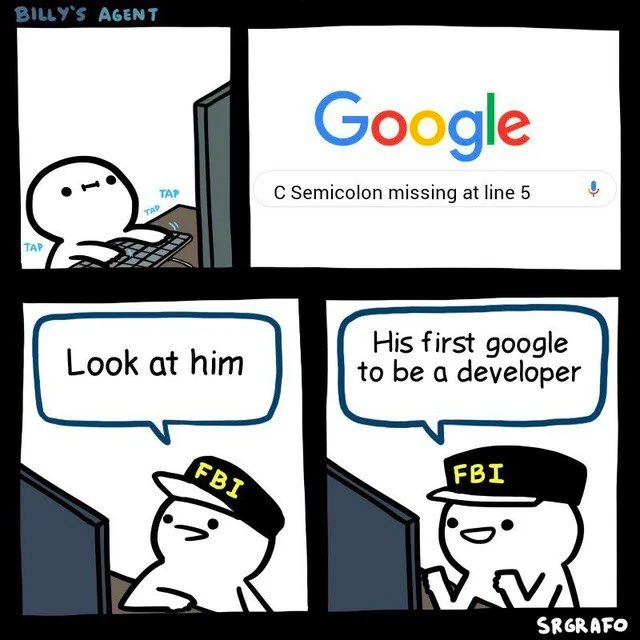
  • The error: The search query in the image is “C semicolon missing at line 5.” This refers to a compile error in the C programming language saying a semicolon is missing on line 5 of the code. In languages like C, every statement must end with a semicolon (;). It’s like how every sentence in English ends with a period – if you forget it, the sentence doesn’t feel complete. Here, the programmer likely wrote a line of code and accidentally left off the ; at the end. The compiler (the program that turns C code into an executable program) caught this mistake and produced an error message pointing it out. A compile error means the code couldn’t even be translated into a running program because something is syntactically wrong. “Semicolon missing” is one of the most straightforward error messages you can get – it literally tells you what character is missing. But if you’re just starting to code, you might not immediately realize how to fix it (or sometimes you might not notice where it’s missing).

  • Googling the error: In the second panel, we see the Google search page with that error typed in. This illustrates the newbie’s reaction: “Huh, it says semicolon missing... let me ask Google what that means.” This is incredibly common! New programmers often copy and paste the entire error message into a search engine to find out how others solved it. In this case, searching C semicolon missing at line 5 would likely bring up results explaining you need to add a ; at the end of the offending line. Usually, the search will lead to forums, documentation, or Q&A sites like Stack Overflow where someone else had the same problem. For instance, Stack Overflow might have a question titled “error: expected ‘;’ before ‘}’ in C? What does this mean?” with answers clarifying that a semicolon was forgotten. Using Google this way is basically a form of debugging/troubleshooting: you have an error and you’re seeking a solution. It’s so prevalent that there’s a tongue-in-cheek saying: “Google is a programmer’s best friend.” In fact, many developers humorously admit that a big part of their job is just knowing what to Google.

  • Code example: To visualize the error, imagine a tiny C program:

    #include <stdio.h>
    int main() {
        printf("Hello, world")  // Oops, forgot the semicolon at the end of this line
        return 0;
    }
    

    If you tried to compile this, the compiler would complain. You might see an output like:

    error: expected ';' before 'return'
    

    This message is saying “I expected a ; before the return statement,” which is another way of indicating that the previous line is missing a semicolon. The fix is easy: add a ; after the printf("Hello, world"). But the habit being depicted is that the newbie doesn’t immediately know that, so they search the error online to find the answer.

  • The FBI agent meme: The bottom two panels introduce a fictional character – an FBI agent watching the programmer. There’s an internet meme that jokes about an “FBI agent in your computer” or phone who monitors everything you do. Of course, this isn’t literally true, but people use it as a funny way to react to their own behavior (“My FBI agent must be laughing at me right now”). In this comic, the FBI agent is shown sitting in front of a monitor, observing what Billy is googling. The agent’s lines are “Look at him” and “His first google to be a developer.” He’s basically talking to someone off-screen (maybe another agent), saying “Aw, look, he’s doing his first Google search as a developer.” It’s portrayed like a proud teacher or parent watching a kid do something for the first time. This is the humor of the situation: searching for error solutions on Google is portrayed as a milestone in becoming a programmer.

  • "First Google to be a developer": This phrase implies that using Google is a fundamental part of being a developer. The agent is implying “He’s finally doing what all developers do – using Google to solve a code problem.” It’s funny because it’s true – practically every developer relies on Google searches, especially early on. The first time you encounter a weird error or don’t know how to do something, you ask the internet. And realistically, you’ll do that hundreds, even thousands of times as you continue coding. So the comic jokingly calls it a “lifelong Google dependency ritual.” The word ritual makes it sound grand and ceremonial, like a rite-of-passage. And in a sense, it is a rite-of-passage: the day you realize that programming isn’t about knowing everything, but knowing how to find answers.

  • Learning to code journey: Every programmer’s learning journey involves lots of questions and looking things up. No one just knows everything from the start. Beginners might feel bad about needing to search for something as simple as a missing semicolon, but it’s completely normal. In fact, figuring out how to search for answers is a crucial skill. Over time, you’ll learn tips for better Google searches – like maybe not including the specific line number (because “line 5” might not be relevant to others) or adding the programming language in the query (which Billy actually did by starting with “C ” in his search). Developers also learn to seek out documentation or use an IDE (Integrated Development Environment) that highlights these mistakes. Still, even with the best tools, you’ll eventually run into errors or problems you haven’t seen before. That’s when the habit kicks in: open browser, type the error message or question. It’s practically muscle memory for developers.

  • Google as a tool: Sometimes people joke about “Google-driven development” or using “Google as your IDE”. This comic plays on that idea. An IDE is a coding application that often helps catch errors and might even suggest fixes. But here, Google is effectively acting as the IDE – Billy writes code in one window and immediately goes to Google in another window when something breaks. For beginners, Google (and sites like Stack Overflow, tutorial blogs, etc.) serve as an on-demand teacher. It’s there 24/7 to answer questions like “What does this error mean?” or “How do I do X in code?” There’s even a popular saying: “Good programmers are not those who know everything, but those who know how to Google things effectively.” The comic exaggerates it to make it funny: an FBI agent monitors this behavior like it’s a known phenomenon, suggesting every programmer does this—because it’s largely true!

  • Junior vs Senior perspective: A junior (new) developer typically uses Google for very basic issues at first, exactly like missing semicolons or syntax errors. A senior developer has years of experience, so they probably don’t search for missing semicolons anymore — they’ve seen that enough times. But that doesn’t mean seniors stop searching altogether! They just move on to googling more complex issues or very specific errors. For example, even a senior might google something like “How to optimize SQL query performance” or “Python memory error large list” or “C# JSON parse library usage”. The difference is that with experience, you start to remember common solutions and you get better at guessing what might be wrong. However, you’ll always come across new challenges that send you back to the search bar. This meme humorously reminds everyone that the first step on that journey is tiny and amusing (googling a missing semicolon), and even though the questions get bigger, the act of seeking help remains a constant.

  • Emotion and humor: The overall feeling this comic evokes is a mix of humor and comfort. It’s funny to imagine an FBI agent character celebrating a programmer’s first Google search. It’s also comforting because it tells new developers: “Don’t worry, everyone does this. Even that imaginary FBI agent knows it’s normal.” The phrase “Look at him” is drawn in a way that suggests the agent might even be showing someone else, like “aww, isn’t that cute?” It’s the tone you’d use for watching a baby’s first steps or someone’s first time riding a bike without training wheels. That’s why the meme’s caption says “lifelong Google dependency ritual” — it jokingly dramatizes something very ordinary (searching an error) as if it’s a ceremonial beginning of a long journey (being dependent on Google for answers throughout your coding life).

In short, this meme depicts a programming first step in a very relatable way. The missing semicolon error is the hurdle, Google is the helping hand, and the FBI agent is the imaginary cheerleader witnessing the milestone. For any developer who’s ever felt a bit embarrassed about searching something “simple,” the meme says: we’ve all been there, and even years later, we still rely on these searches. It’s normal, and it’s how we learn. The humor makes the lesson memorable: that using available resources (books, documentation, or yes, Google) is an essential part of being a coder. So the next time you find yourself googling an error message, you might just smile and think, “somewhere, my FBI agent is nodding approvingly.” 😄

Level 3: Baptism by Google

The meme captures a nearly sacred rite-of-passage in programming: the moment a newbie developer Googles their first error message. In the first panel, we see a novice coder (let's call him Billy) at his computer, typing away – TAP TAP – probably running his code for the first time. And then boom: a compiler error. Panel 2 zooms in to reveal exactly what went wrong: on the screen is the Google homepage with a search query, “C semicolon missing at line 5”. This is a classic C language compile error – forgetting a semicolon (;) at the end of a statement. It’s the kind of simple syntax slip-up every C programmer makes at least once. Rather than immediately spotting the missing ;, Billy does what 99% of developers would instinctively do: he copies the error message into Google.

Now the punchline spans panels 3 and 4, introducing a comedic twist from the over-the-shoulder surveillance joke: an imaginary FBI agent (wearing a hat labeled "FBI") is sitting at a monitor, watching Billy's screen. This agent – dubbed “Billy’s Agent” in the comic – is essentially a stand-in for that feeling that someone, somewhere is witnessing your awkward first steps. The agent says, “Look at him” and then, “His first google to be a developer.” The tone is fond and a bit teasing, as if an experienced guardian is proud of this little milestone. This frames Googling an error not as a failure, but as the moment one truly becomes a developer. It humorously likens that first stackoverflow search to a baby’s first words or first steps. Seasoned programmers find this hilarious because it pokes fun at a universal truth in developer culture: Googling stuff is an integral part of coding.

Why is this so relatable? Because every programmer, from juniors to seniors, has been in Billy’s shoes. The meme calls it a “lifelong Google dependency ritual,” and that wording is painfully accurate. The day you first consult Google for a programming problem is the day you unofficially join the club of developers who solve problems by searching online. It’s practically a baptism by Google. From that day forward, whenever you hit a puzzling error or need a quick example, your instinct is to ask the internet. This ritual repeats ad infinitum throughout your career. Sure, the questions evolve – a beginner might search “missing semicolon in C”, while a senior might search something like “segfault in multithreaded program on Ubuntu 18.04” or “Python list comprehension syntax” – but the act of searching remains constant. In fact, mastering the art of Google-Fu (crafting effective search queries) is as important to a developer’s skill set as understanding algorithms or syntax. Experienced devs often joke that Stack Overflow is their real IDE and that half of their code is basically copy-pasted from Stack Overflow answers. That’s the Developer Experience (DX) in a nutshell: not memorizing everything, but knowing how to quickly find solutions.

The comic is drawn by SRGRAFO in a minimalist, stick-figure style known for techie humor. This simple artwork brilliantly conveys complex developer reality. The “TAP TAP” keystroke sounds in Panel 1 set the scene: an eager newbie hard at work. Panel 2’s Google search bar is instantly recognizable – we've all stared at that exact browser layout while debugging. Then the cut to the smug little FBI agent in Panels 3 and 4 is the absurd yet perfect storytelling device. It leverages a popular FBI agent meme (the running joke that each of us has a personal FBI agent watching our internet activities). By having the agent narrate, “Look at him… His first Google to be a developer,” the comic externalizes the internal mix of embarrassment and pride a newbie might feel. It’s like the programming gods (or a cheeky Big Brother figure) are nodding in approval at your initiation. The humor works on multiple levels: it’s absurd (no, Google searches don’t actually alert the FBI 😅), it’s endearing (we empathize with Billy’s learning moment), and it’s a tiny bit satirical – implying that needing Google is such a known crutch that even your FBI guy sees it coming.

Let’s not overlook the technical specifics: missing a semicolon in C is the quintessential beginner error. In C (and languages inspired by its syntax, like C++ and Java), every statement must end with a semicolon. Omit it, and the compiler gets confused because the grammar of the language is violated. The error message typically spells out the problem (e.g., “error: expected ‘;’ before ‘}’ token” or “missing semicolon” at a specific line). It’s a straightforward fix – just add the semicolon – but the first time you see a red error, it can be scary. Many of us responded exactly like Billy: by pasting the whole error into a search bar. This approach often lands you on forums or Q&A sites where someone has asked the same question. It’s basically using Google as your IDE or documentation lookup. Modern IDEs actually do catch this mistake instantly with red underlines or pop-up hints, but if you’re using a simple text editor or learning environment, Google is the fastest way to troubleshoot. The meme crystallizes that learning process in one scene. It reminds senior engineers of their early days (cue the nostalgia of wrestling with missing semicolons and mysterious error messages) and simultaneously tells newcomers, “Hey, it’s okay – we all Google silly things starting out.”

Another layer here is the dynamic between juniors vs seniors. A junior developer might feel sheepish about searching such a simple error, imagining that “real programmers” magically know these things. The meme gently laughs at that notion. The presence of the FBI agent acting like a mentor figure suggests an almost rite-like progression: today it’s a missing semicolon, tomorrow it’ll be pointer arithmetic, and years later you’ll still be Googling but for different reasons. In reality, senior developers also encounter errors or forget syntax and end up on Stack Overflow or documentation pages. The difference is not that seniors never Google – it’s that they’ve just Googled so many errors by now that they aren’t fazed by it. They’ve developed better search strategies (like quoting error messages or searching by specific keywords), and they might have internalized common fixes, but when they hit an obscure issue, you can bet they’re back to Googling just like the rest of us. In fact, the “lifelong dependency” phrasing hits home: even a CTO with 20 years of experience probably used Google that very morning to check a library’s usage or a configuration detail. The meme’s humor is a nod-and-wink acknowledgment of this reality.

So when the FBI agent in the comic says, “His first google to be a developer,” the seasoned crowd chuckles knowingly. We picture our own imaginary agent facepalming or cheering each time we make those searches. It’s the absurd idea that your very first Google search about a coding error sets you on an irreversible path — you’re now one of us, a developer initiated into the secret that knowing how to find answers is more important than knowing all the answers. The comic resonates because it transforms a tiny, mundane moment (Googling a missing semicolon) into a ceremonious event. That contrast is funny! It’s like throwing a graduation party for a toddler who just learned to tie their shoes. But deep down, it is a little victory: the newbie has learned how to learn, which in programming, often means asking the right questions… and yes, frequently asking them on Google.

Finally, this meme also slyly comments on the modern reality of software development in a hyper-connected age. Decades ago, a programmer might have thumbed through a textbook or a thick language reference manual to figure out a compiler error. Today, the instant reflex is to search the web. The collective knowledge of millions of developers is just a search query away. This LearningToCodeJourney has a strong communal aspect — you’re never truly coding “alone” when you have the internet. The FBI agent’s amusement hints at how predictable this behavior is now; it’s practically expected that the first thing a new dev will do upon hitting an error is consult Google. It’s Debugging 101 in the real world: see error, copy error, find solution online, repeat. And rather than shaming that, the meme celebrates it with a wink. After all, if an omniscient FBI watcher approves, surely there’s no shame in it! The veteran chuckling at this comic knows that behind every polished GitHub repository are countless Google searches and Stack Overflow tabs. We’ve all been Billy, and this comic lets us laugh at that eternal truth while fondly remembering the moment our own Google dependency began.

Description

A four-panel comic by the artist SrGrafo, titled 'Billy's Agent'. In the first panel, a simple white cartoon character is typing at a computer. The second panel shows a Google search bar with the query 'C Semicolon missing at line 5'. The third and fourth panels show another character wearing an FBI hat, presumably monitoring the first character. The FBI agent says, 'Look at him,' and then, with a proud, wholesome smile, 'His first google to be a developer.' The comic humorously and warmly portrays a classic rite of passage for new programmers - encountering a basic syntax error and learning to solve it by searching online. It's a universally shared experience that marks the beginning of a developer's journey

Comments

7
Anonymous ★ Top Pick The FBI agent watching a senior dev just sees a search history of 'regex for ISO 8601 timestamp' every six months and thinks, 'Some things never change.'
  1. Anonymous ★ Top Pick

    The FBI agent watching a senior dev just sees a search history of 'regex for ISO 8601 timestamp' every six months and thinks, 'Some things never change.'

  2. Anonymous

    Little does the rookie know that decades later we’ll still be googling the same missing semicolon - only now it’s hidden in a 3-thousand-line Terraform diff behind a stray trailing comma

  3. Anonymous

    Twenty years later, he's architecting a distributed system where a missing semicolon would be the least of his problems - now it's missing distributed transaction guarantees across 47 microservices, and the FBI is watching him google "how to explain eventual consistency to the board."

  4. Anonymous

    Ah yes, the missing semicolon at line 5 - the compiler's way of saying 'Welcome to C, here's your first 47 cascading errors.' Every senior engineer remembers their first panicked Google search for this, back when they thought the compiler was gaslighting them. Twenty years later, you're still occasionally hunting for that phantom semicolon at 2 AM, except now you know to check line 4 first because the compiler's line numbers are more like 'suggestions' than facts

  5. Anonymous

    Googling the compiler’s “missing semicolon” is the initiation; twenty years later the query is “transient TLS handshake failure via middlebox,” but the ritual stays the same - CTRL+C the error, CTRL+V into Google

  6. Anonymous

    Missing semicolon in C: the true gateway drug to tech debt empires - and FBI dossiers on every architect's origin story

  7. Anonymous

    Your first Google for "missing semicolon" makes you a dev; the rest of your career is the same keystrokes plus site:stackoverflow, a 400-line stack trace, and an incident ticket

Use J and K for navigation