Skip to content
DevMeme
138 of 7435
The Universal Experience of Forgetting Your Own Code
Debugging Troubleshooting Post #173, on Feb 25, 2019 in TG

The Universal Experience of Forgetting Your Own Code

Why is this Debugging Troubleshooting meme funny?

Level 1: The Recipe You Forgot You Wrote

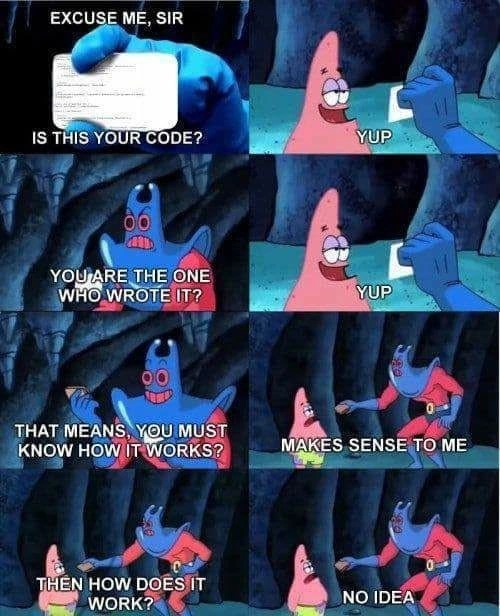
Imagine finding a cake recipe in your kitchen, in your own handwriting, with steps like "add the thing before it gets weird." You definitely wrote it. The cake it once produced was apparently delicious. But today you cannot for the life of you explain what "the thing" is or when "weird" happens. That's the joke: the starfish cheerfully admits the mystery card is his, that he made it, and that its maker should understand it — and then admits he doesn't. It's funny because it happens to every programmer, and the only honest answer really is "no idea."

Level 2: Git Blame Yourself and Other Rites of Passage

  • git blame: a Git command that shows, line by line, who last modified each line of a file and in which commit. Juniors learn its true purpose quickly: roughly half the time, the culprit it identifies is you. It's an accountability tool that mostly produces humility.
  • Undocumented code: code with no comments, no README, no design notes — nothing explaining why it does what it does. The code tells you what happens; only documentation (or the author's intact memory) tells you why. This meme is what happens when both are gone.
  • Write-only code: a joke term for code so dense or clever it can be written but never meaningfully read again — regex one-liners, nested ternaries, that 400-line function named processData.
  • Code review: the ritual where a teammate (here, an exasperated supervillain) holds up your code and asks you to explain it. Pro tip from everyone who's been Patrick: write the explanation into the code as comments while you still remember it, because future-you is a stranger who will inherit it cold.
  • The rite of passage this meme commemorates usually arrives 3–6 months into a job: your first encounter with code you genuinely don't recognize, followed by the discovery that the commit history says you wrote it.

Level 3: Authorship Without Comprehension

The eight-panel Patrick's-wallet scene is a perfect logic trap, and the meme swaps in the one premise that detonates it for developers:

"IS THIS YOUR CODE?" — "YUP." "YOU ARE THE ONE WHO WROTE IT?" — "YUP." "THAT MEANS, YOU MUST KNOW HOW IT WORKS?" — "MAKES SENSE TO ME." "THEN HOW DOES IT WORK?" — "NO IDEA."

Man Ray's syllogism — authorship implies understanding — is the assumption baked into every code review, every incident retro, every git blame pilgrimage. And it's false, for reasons every senior engineer has lived through. The mental model you held while writing the code is state, and that state is not serialized to disk. Six months later you're a different process entirely, cold-starting from whatever artifacts past-you bothered to leave: variable names, tests, the commit message that just says fix. Peter Naur made essentially this argument in the 1980s — that programming is theory building, and the program text is a lossy projection of the theory. When the theory-holder forgets (or quits), the code survives but the understanding doesn't. That's how all legacy systems are born; legacy code isn't old code, it's code whose theory has been garbage-collected.

The comedy compounds because the failure is self-inflicted and universally recidivist. Everyone has run git blame on a horrifying line, composed the Slack rant, and then watched their own name render in the annotation column. The industry's structural incentives guarantee it: deadlines reward working over explainable, "I'll document it after the release" is the most-broken promise in software, and the clever one-liner that felt self-evident on a Friday afternoon is write-only by Monday. Code review was supposed to catch this — but reviewers approve what they can't fully follow all the time, because pushing back costs social capital and the sprint ends Thursday.

Patrick's middle answer is the masterpiece: "MAKES SENSE TO ME." He accepts the inference rule while refusing the conclusion. That's the precise posture of a developer in an incident bridge being asked why their service is retrying itself into a death spiral: yes, I wrote it; yes, in principle the author should know; no, I cannot tell you what past-me was thinking. The honest "NO IDEA" is, perversely, the professional answer — it beats confidently misexplaining the code and steering the debugging session into a wall.

Description

This image uses the multi-panel 'Patrick's Wallet' meme format from Spongebob Squarepants to illustrate a common developer problem. In the comic sequence, the character Man Ray interrogates Patrick Star. First, a hand shows Patrick a card with a snippet of code, asking, 'EXCUSE ME, SIR. IS THIS YOUR CODE?'. Patrick confidently confirms twice that it is his code. Man Ray then logically concludes, 'THAT MEANS, YOU MUST KNOW HOW IT WORKS?', to which Patrick agrees, 'MAKES SENSE TO ME.' However, when Man Ray finally asks, 'THEN HOW DOES IT WORK?', Patrick gives a blank stare and admits, 'NO IDEA.' The humor lies in the relatable experience of developers writing code and, a short time later, being completely unable to remember or explain how it functions. It's a classic commentary on 'code amnesia,' the complexity of software, and the challenges of maintaining even one's own work
Comments

8
Anonymous ★ Top Pick I'm convinced my git commit history is just a log of different people who used to have access to my laptop. There's no way I wrote that
  1. Anonymous ★ Top Pick

    I'm convinced my git commit history is just a log of different people who used to have access to my laptop. There's no way I wrote that

  2. Anonymous

    Git blame says I wrote it, but the architectural context was running in an ephemeral feature-branch - Kubernetes autoscaled that mental pod to zero six sprints ago

  3. Anonymous

    The git blame says I wrote it, the commit message says "fixed stuff", and the only documentation is a TODO comment from 2019 that says "refactor this later" - so naturally I'm now the subject matter expert in the next architecture review

  4. Anonymous

    Git blame says it's yours, the commit message says 'fix', and your sworn testimony says 'no idea' - the three branches of legacy code government

  5. Anonymous

    This perfectly encapsulates the senior engineer's dilemma: you're absolutely certain you wrote that cryptic 500-line function with nested ternaries and no comments, but explaining why it uses bitwise operations to calculate a discount percentage? That knowledge was apparently compiled away with your short-term memory. The real kicker is when git blame confirms you're the author, the commit message says 'fix stuff,' and your only documentation is a TODO from 2019 saying 'refactor this later.'

  6. Anonymous

    I wrote it; the unit tests know how it works. In prod, the DI container, feature flags, and circuit breakers decide - I just read the logs

  7. Anonymous

    git blame says it's mine; git explain throws NotImplementedError

  8. Anonymous

    Senior dev wisdom: 'It works on my machine' - the sacred incantation that binds tech debt across sprints

Use J and K for navigation