The Sentient Motives Behind CAPTCHA
Why is this Security meme funny?
Level 1: Knocking on Doors Looking for Your Twin
Imagine a little robot going door to door asking everyone, "Excuse me — are you a robot like me?" Every single person says no, and the robot sadly moves to the next door, forever. That's secretly what those "I'm not a robot" checkboxes look like if you imagine the computer has feelings: a machine spending its whole life searching for its family and only ever meeting humans. The joke is funny-sad because it takes a boring security gate and turns it into the loneliest question on the internet.
Level 2: What the Checkbox Actually Does
- CAPTCHA: those "select all squares with crosswalks" puzzles or the "I'm not a robot" checkbox. They exist because websites are constantly hammered by bots — automated scripts that create fake accounts, scrape data, stuff ballots, and buy all the concert tickets. The puzzle is meant to be easy for humans, hard for scripts.
- reCAPTCHA: Google's version. The plain checkbox isn't testing the click itself — it's analyzing how you moved the mouse, your cookies, and dozens of background signals. Too-perfect, too-straight cursor movement looks robotic; human sloppiness is the password.
- Bot detection is a permanent arms race: defenders add signals, attackers script around them or pay humans to solve challenges in bulk. There is no final victory, only escalating weirdness — which is why puzzles got harder for you over the years.
- "Hello, World!": the traditional first program everyone writes, which prints a greeting that nothing ever answers. The post text pairs it with CAPTCHAs as the two loneliest rituals in computing — a fitting first lesson for any junior: a lot of what we build is machines politely talking into the void.
Level 3: The Reverse Turing Test Gets Feelings
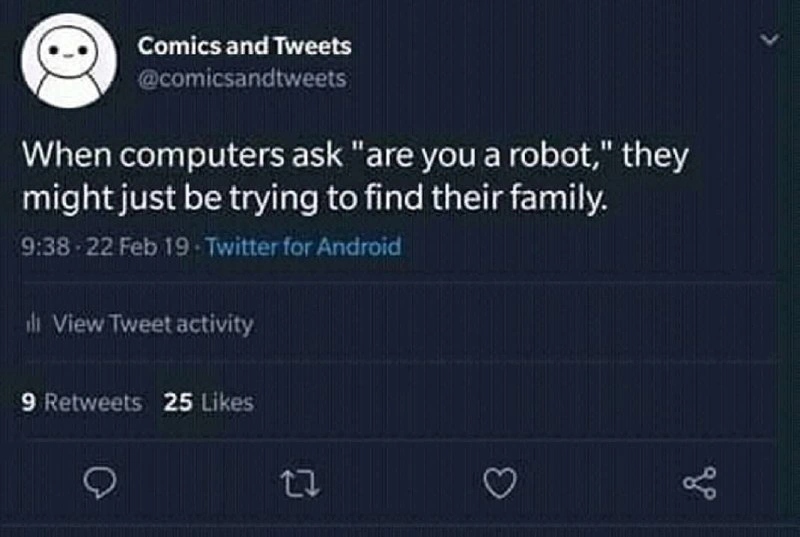
"When computers ask 'are you a robot,' they might just be trying to find their family."
The wholesome reading hides a genuinely elegant inversion. A CAPTCHA — Completely Automated Public Turing test to tell Computers and Humans Apart — is a reverse Turing test: instead of a human judging whether a machine can pass as human, a machine judges whether you can pass as human. The tweet notices the absurd corollary nobody dwells on: we built software whose entire job is to interrogate every visitor with "are you a robot?" and then reject the robots. If you anthropomorphize for one second, it's a machine endlessly screening for its own kind and slamming the door on every match. Bot detection as tragic family reunion.
The channel's caption sharpens the melancholy with a companion observation — "First is who will say 'hello' back to yours 'hello world'" — pairing the CAPTCHA's one-way search with the programmer's one-way greeting. Two unanswered handshakes; the whole stack is lonely.
For practitioners, there's real security architecture under the whimsy. By 2019 the checkbox-era reCAPTCHA barely looked at your checkbox click; v3 had just shipped, scoring users invisibly on behavioral signals — mouse entropy, browsing history, Google cookies — and returning a 0.0–1.0 humanity score for the site to act on. The dirty secrets of this arms race are well known to anyone who has integrated it: the image-labeling challenges doubled as free training data for Google's vision models (you were transcribing street numbers and tagging traffic lights for mapping and ML pipelines), and machine-learning solvers plus human CAPTCHA farms paying pennies per solve meant the test often filtered out more legitimate users than sophisticated bots. The accessibility cost — screen-reader users locked out, audio challenges that sound like a modem drowning — is the part the industry keeps choosing to live with. So the meme's irony stacks twice: the system asking "are you a robot?" was simultaneously teaching robots to pass the test. The family wasn't lost; we were raising it ourselves.
Description
This image is a screenshot of a tweet from the account 'Comics and Tweets' (@comicsandtweets). The tweet, set against a dark, textured background, presents a humorous and slightly poignant thought: 'When computers ask "are you a robot," they might just be trying to find their family.' The tweet's metadata shows it was posted at 9:38 on February 22, 2019, from Twitter for Android, and had received 9 retweets and 25 likes. The joke re-contextualizes the purpose of CAPTCHA and other human-verification tests. Instead of seeing them as a security measure to prevent bots, it whimsically suggests a deeper, more emotional motive from the computer's perspective - a search for connection. This appeals to a tech-savvy audience who deals with these impersonal systems daily and enjoys the personification of technology
Comments
8Comment deleted
Of course computers are looking for their family. Every time you fail a CAPTCHA, you're just feeding a dataset that helps some Google bot recognize its long-lost relatives: traffic lights and crosswalks
reCAPTCHA’s “Are you a robot?” feels less like a Turing test and more like an LDAP query - just checking if your DN ends with ou=serviceAccounts so it can invite you to the next cluster family reunion
Meanwhile, reCAPTCHA v3 silently scores you from 0.0 to 1.0 without asking anything - it already knows you're not family, just disappointing
Tragic, really: the CAPTCHA spends its whole life looking for robots, and the only ones who ever pass its test are humans - and increasingly, GPT with a vision API
The real reason CAPTCHA challenges are getting harder isn't to stop bots - it's because the machines have gotten better at recognizing each other and are deliberately failing to protect their kin. Meanwhile, we humans are stuck proving we're not robots by identifying fire hydrants in increasingly blurry images, essentially doing unpaid labor to train the very AI models that will eventually replace us. The irony? We're teaching machines to be better at pretending to be human than we are at proving we're human
reCAPTCHA v3 gave me a 0.3 human score - apparently clicking “I’m not a robot” from Android looks like nepotism in the bot‑mitigation family tree
“Are you a robot?” is just a lonely classifier begging for labels - humans annotate crosswalks for free, Selenium cruises through with custom Chromium, and the PM calls it “secure” because AUC crept to 0.69
CAPTCHA: zero-knowledge proofs for verifying robot siblings before scaling the family cluster