Skip to content
DevMeme
137 of 7435
The Original Foldable Phone: iPhone 6 Bendgate
Hardware Post #172, on Feb 24, 2019 in TG

The Original Foldable Phone: iPhone 6 Bendgate

Why is this Hardware meme funny?

Level 1: The Accidentally Folded Drawing

Imagine a kid proudly announcing, "I invented the world's first folded paper airplane!" — and from the back of the class, another kid holds up their homework that got crumpled in their backpack and says, "What am I, a joke?" One folded on purpose, one folded by accident, but the crumpled one technically got there first. The meme is funny because it treats Apple's embarrassing bendy phone from 2014 as if it were a brilliant invention, which is the gentlest possible way of reminding everyone it was actually a mistake.

Level 2: Bendgate, Foldables, and Reaction Templates

  • Bendgate (2014): shorthand for the scandal when iPhone 6 and especially 6 Plus units bent from normal pocket carry. The aluminum body deformed permanently — metal past its yield strength doesn't spring back. The "-gate" suffix gets attached to every tech scandal since Watergate (Antennagate, Batterygate...).
  • Foldable phone: a device like the Galaxy Fold with a flexible OLED display and a mechanical hinge, designed to open into a small tablet. The hard part isn't the hinge — it's a screen that survives hundreds of thousands of folds without creasing dead pixels into existence.
  • "Am I a joke to you?": a reaction meme used when something claims a "first" or ignores an obvious precedent. Here the iPhone 6's face is literally replaced by the bent phone, so the precedent speaks for itself.
  • The early-career lesson hiding in here: marketing claims of "first" almost always have an asterisk, and failure modes get rebranded constantly. When you hear "it's not a bug, it's expected behavior," you're watching Bendgate-style PR in miniature — the same energy as Apple calling bent phones "extremely rare" while quietly reinforcing the next model.

Level 3: Plastic Deformation as Product Strategy

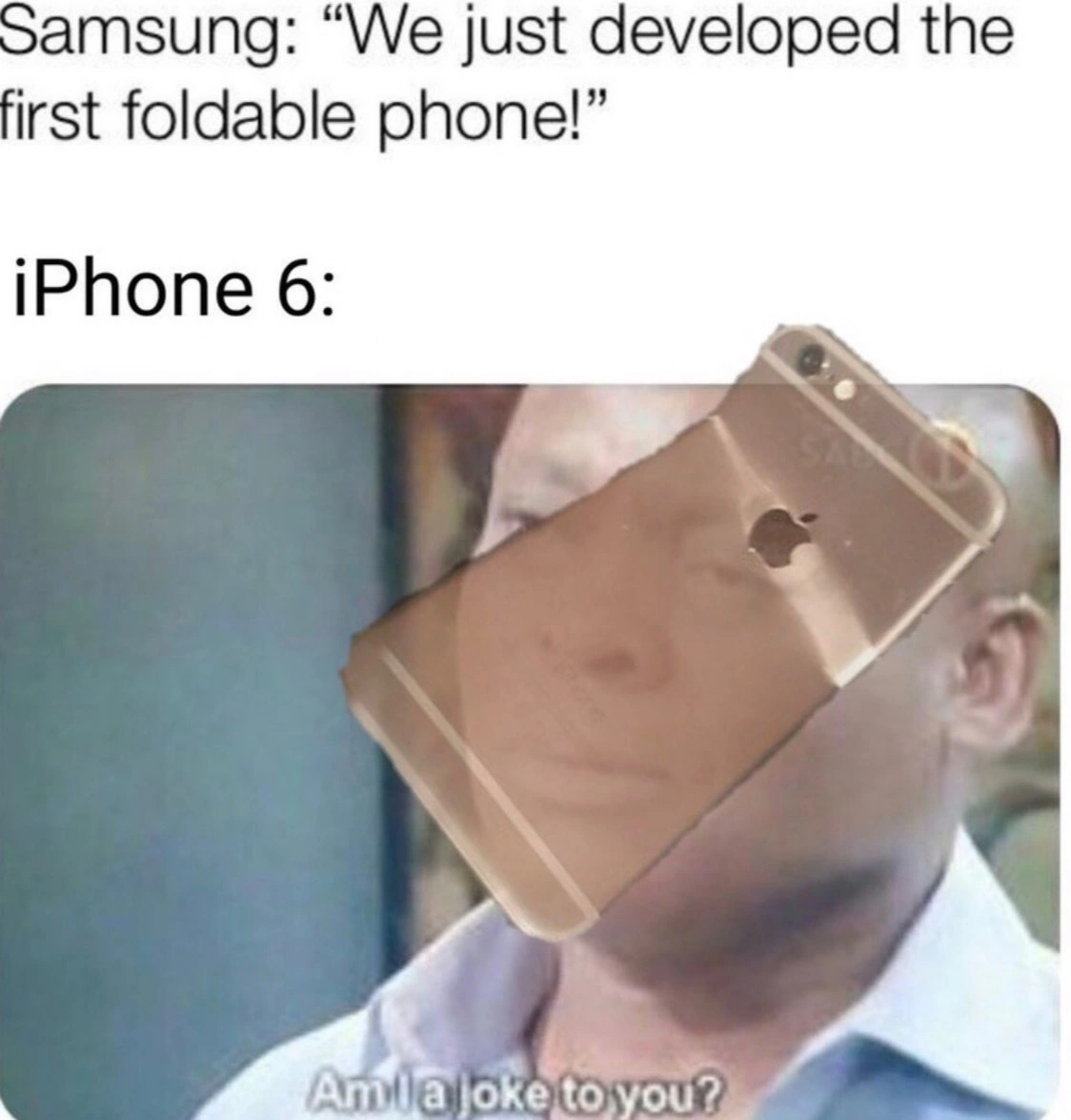
The meme stitches together two genuine hardware events separated by five years. Samsung unveiled the Galaxy Fold in late February 2019 — this post landed the same week, when "first foldable phone" was the line every keynote recap repeated. The image's rebuttal is the gold iPhone 6, photoshopped over the face of the "Am I a joke to you?" reaction template, with a visible crease right where 2014's Bendgate victims found one: just below the volume buttons.

Samsung: "We just developed the first foldable phone!" iPhone 6: Am I a joke to you?

What makes this more than a cheap shot is that Bendgate was a real materials-engineering story. The iPhone 6 Plus paired a long, thin 6000-series aluminum unibody with strategically weakened zones — antenna lines and button cutouts — exactly where bending moments concentrate when the phone rides in a back pocket. Internal Apple testing documents that later surfaced in litigation showed the company knew the 6 Plus was meaningfully more bend-prone than the 5s. The fix arrived quietly in the 6s generation: stiffer 7000-series aluminum and thickened shell areas. Classic industry pattern — deny in public ("extremely rare," said the press release), remediate in the next SKU, never connect the two.

The satire works on a second axis: what's a feature versus what's a defect is purely a question of intent and control. The Galaxy Fold bends along an engineered hinge with a flexible OLED stack designed to survive ~200,000 fold cycles; the iPhone 6 bent once, permanently, through plastic deformation of its chassis, usually severing display traces on the way (the related "Touch Disease" failure). Same verb, opposite engineering. Developers recognize this taxonomy instantly because software has the identical joke: a crash is a bug, but a crash you catch and log is "graceful degradation." Ship it on purpose and it's a feature; ship it by accident and it's a class action.

There's irony in the timing, too. Within weeks of this meme, early Galaxy Fold review units started failing — debris under the screen, protective layers peeled off by reviewers — and Samsung delayed the launch. The meme mocked Samsung with Apple's structural failure, and then Samsung's structural failure validated the genre. Hardware humility is a renewable resource.

Description

This meme uses the 'Am I a joke to you?' format to make a joke about foldable phones. The top text says, 'Samsung: “We just developed the first foldable phone!”'. Below that, 'iPhone 6:' is written, followed by an image of a slightly bent, gold-colored iPhone 6 superimposed over the face of a man with an incredulous expression. The man's subtitled dialogue at the bottom reads, 'Am I a joke to you?'. The humor is a direct reference to the 'Bendgate' controversy from 2014, where the iPhone 6 and 6 Plus were found to be susceptible to bending under pressure, such as when carried in a pocket. The meme sarcastically positions this unintentional design flaw as Apple having created the first 'foldable' phone, years before Samsung officially launched its Galaxy Fold

Comments

8
Anonymous ★ Top Pick The iPhone 6 didn't have a bug, it had an undocumented feature: user-initiated, non-reversible, bi-axial folding. Samsung just added an API for it
  1. Anonymous ★ Top Pick

    The iPhone 6 didn't have a bug, it had an undocumented feature: user-initiated, non-reversible, bi-axial folding. Samsung just added an API for it

  2. Anonymous

    Skip the Young’s modulus unit test once and suddenly your manufacturing defect becomes Samsung’s roadmap feature

  3. Anonymous

    The iPhone 6 was just implementing continuous deployment - it kept shipping new form factors without requiring a firmware update

  4. Anonymous

    The iPhone 6 shipped folding as an undocumented feature in 2014 - Samsung just spent five years writing the spec for it

  5. Anonymous

    Ah yes, the iPhone 6 - Apple's accidental foray into flexible displays before it was cool. While Samsung spent billions on R&D for controlled folding mechanisms with specialized hinges and ultra-thin glass, Apple achieved 'foldability' through aggressive weight reduction and a 6000-series aluminum alloy that apparently had the structural integrity of a Kit Kat bar. It's the classic hardware engineering lesson: when you optimize exclusively for thinness (7.1mm) without adequate stress testing under real-world load conditions, you end up shipping a device that performs unplanned plastic deformation in users' back pockets. The irony? This unintentional 'feature' actually predicted the foldable phone trend by four years - just with a permanent crease and a completely destroyed logic board. Sometimes the best innovation is the one you didn't mean to ship

  6. Anonymous

    Somewhere a PM reclassified 'chassis rigidity' from an NFR to a roadmap item called "Fold Mode," turning MTBF into MTF - mean time to fold

  7. Anonymous

    Samsung: “First foldable phone.” iPhone 6: “We shipped auto-flex in 2014 - no feature flag, just eventual consistency with your back pocket.”

  8. Anonymous

    iPhone 6 bendgate: hardware's CAP theorem in action - pick flatness or pocket tolerance, not both

Use J and K for navigation