Skip to content
DevMeme
2753 of 7435
Signal Exposes Creepy Ad Targeting
DataPrivacy Post #3041, on May 6, 2021 in TG

Signal Exposes Creepy Ad Targeting

Why is this DataPrivacy meme funny?

Level 1: The Nosy Poster

Imagine a poster on the street says, "We showed you this because we know where you live, what hobbies you like, and what family plans you are thinking about." That would feel creepy, even if the poster used cheerful colors. This meme is funny and unsettling because it makes online ads talk that honestly about how they choose people.

Level 2: Profiles For Sale

Signal is a messaging app strongly associated with privacy. Its brand centers on minimizing data collection and protecting conversations. That makes it a natural critic of platforms whose business models depend on collecting and monetizing user data.

Ad targeting means showing ads to people based on selected traits or behaviors. An advertiser might target a location, interest, age range, relationship status, shopping behavior, or inferred preference. Some targeting is simple, like showing local restaurant ads to people in a city. Some is more invasive, especially when categories combine into a detailed personal profile.

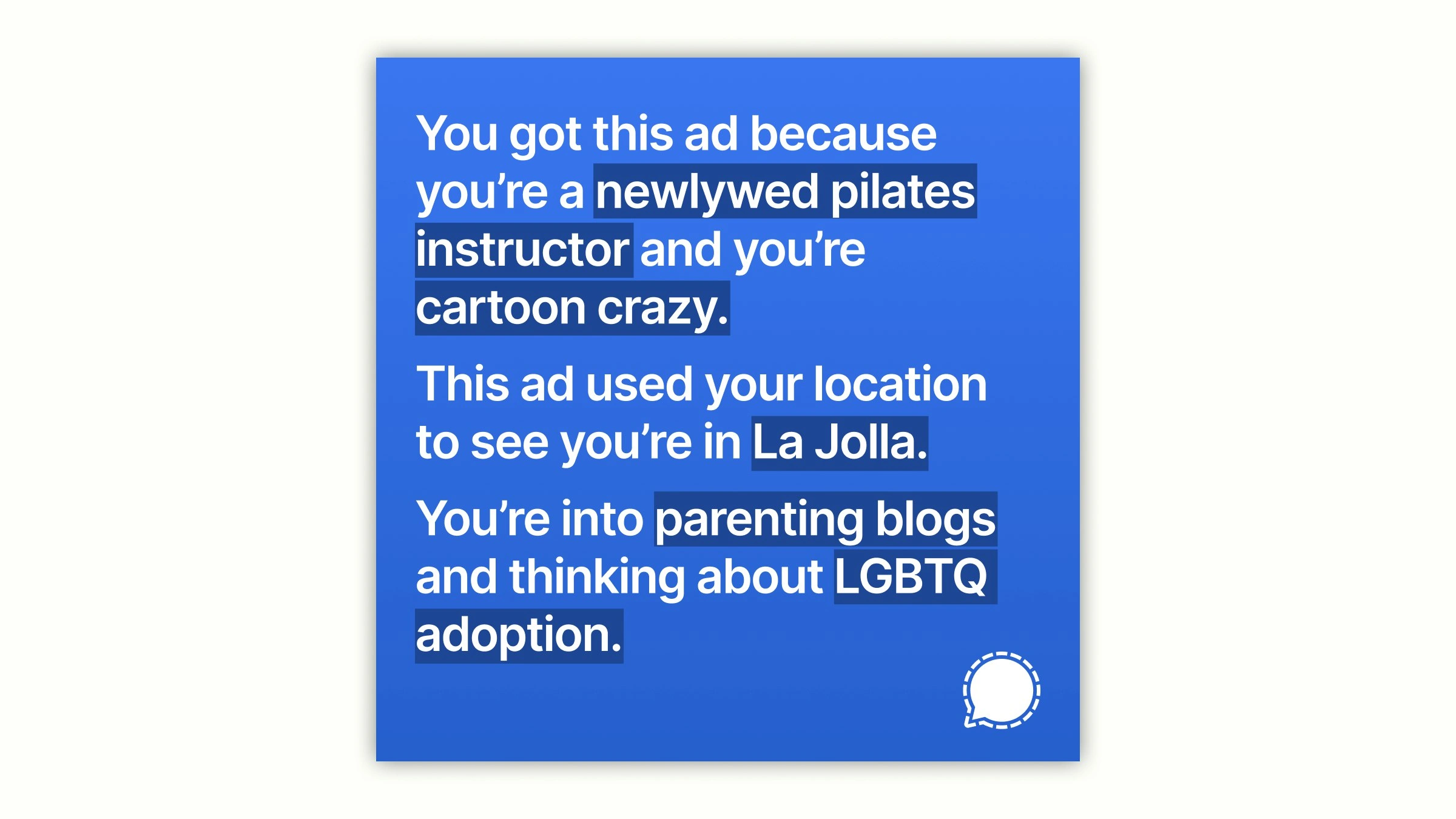
The image shows several types of targeting signals:

  • newlywed suggests relationship or life-stage inference.
  • pilates instructor suggests occupation or interest.
  • cartoon crazy suggests entertainment preference.
  • La Jolla suggests location.
  • parenting blogs suggests browsing or content interest.
  • LGBTQ adoption suggests a sensitive personal topic.

Surveillance capitalism is a term for business models that collect behavioral data and turn it into prediction, targeting, or influence. In plain terms: watch what people do, infer who they are, and sell access to those predictions.

For a junior developer, this is a reminder that data fields are not morally neutral just because they are stored in a database. A column like location, interest_segment, or conversion_event may seem ordinary during implementation. But when combined across systems, those fields can reveal more about a person than they knowingly shared. Privacy engineering is about asking what the system can infer, not only what the user typed into a form.

Level 3: Targeting Says Quiet Part

The blue Signal-style card makes ad-tech profiling sound uncomfortably plain:

You got this ad because you're a newlywed pilates instructor and you're cartoon crazy.

This ad used your location to see you're in La Jolla.

You're into parenting blogs and thinking about LGBTQ adoption.

The design is intentionally clean: large white text, dark highlight blocks around the targeting attributes, and the Signal logo in the lower right. That simplicity is the weapon. Instead of hiding audience segmentation behind dashboards, CPMs, lookalike models, and advertiser-facing abstractions, the ad copy says the creepy part directly: this message exists because a platform thinks it knows intimate, behavioral, location-based, and identity-adjacent things about you.

The joke is not a laugh-out-loud gag so much as a grim developer nod. AdTech routinely translates human life into targeting categories: interests, inferred demographics, locations, relationship status, habits, purchases, browsing behavior, app activity, and engagement patterns. Marketers see levers. Users see an ad that feels weirdly specific. Engineers see event pipelines, identity graphs, mobile SDKs, auctions, attribution systems, and a privacy policy doing cardio in the background.

Signal's campaign sharpened that tension by trying to make targeted advertising explain itself in the ad creative. The point was that the machinery is considered acceptable when it remains invisible. It becomes alarming when shown in normal language. "Newlywed pilates instructor" is not just a quirky phrase; it represents the way multiple data points can be combined into a persona. "Location" adds physical-world sensitivity. "Parenting blogs" and "LGBTQ adoption" push the example into areas where inference can feel less like personalization and more like exposure.

This is why the meme fits data privacy, surveillance capitalism, and dark patterns. The dark pattern is not just a deceptive button or confusing consent dialog. It is the entire asymmetry of knowledge: platforms and advertisers know how much data is being used, while users get a tiny "Why am I seeing this ad?" explanation that rarely communicates the full pipeline. The visible card collapses that asymmetry into one blunt paragraph.

For developers, the uncomfortable part is that none of this requires cartoon villain engineering. It is built from ordinary product goals: improve relevance, optimize conversion, measure attribution, help advertisers find audiences, personalize experiences. Each step can sound reasonable in isolation. Put them together, and the system can describe a person's private life with the confidence of a stranger reading their diary through an analytics dashboard.

Description

A blue Signal-style ad mockup displays large white text with dark highlighted targeting attributes: "You got this ad because you're a newlywed pilates instructor and you're cartoon crazy. This ad used your location to see you're in La Jolla. You're into parenting blogs and thinking about LGBTQ adoption." A small Signal logo appears at the bottom right of the blue card. The image comes from Signal's May 2021 campaign showing the kinds of personal attributes Instagram/Facebook ad targeting can infer and sell, turning opaque ad-tech profiling into blunt, readable copy.

Comments

2
Anonymous ★ Top Pick Ad relevance is just doxxing with a CPM model and nicer typography.
  1. Anonymous ★ Top Pick

    Ad relevance is just doxxing with a CPM model and nicer typography.

  2. @AmindaEU 5y

    Why do you block having fun ads, FACEBOOK? 😿

Use J and K for navigation