The Unsolicited 'AI Stock Prediction' Pitch
Why is this Stakeholders Clients meme funny?
Level 1: Not a Crystal Ball
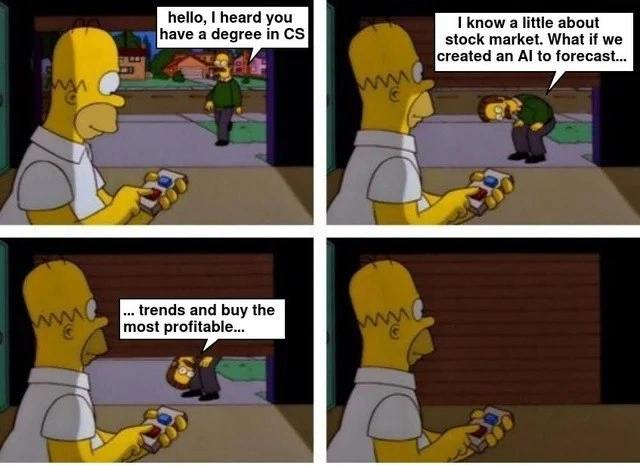
This meme is funny because it’s like a friend asking you to do the impossible and the only thing you can do is literally shut the door on them. Imagine you have a buddy who knows you’re good with computers. They come up to you and say, “Hey, I have a great idea! I kinda know how picking stocks works, so can you build a machine that will always pick the best stocks so we get rich?” This is similar to someone saying, “You’re good at math, so can you predict the winning lottery numbers for me every week?” It sounds silly, right? Because no one can really do that. The heart of the joke is that the friend doesn’t realize they’re asking for a magic trick. And the developer’s reaction – closing the garage door on the friend mid-sentence – is a cartoonish way of saying, “Nope, that’s a crazy ask, and I’m not even going to try explaining why.”
In simple terms, the friend thinks the developer can see the future with computers, but the developer knows that’s not how it works. It’s funny and a little bit true to life: people often have big ideas about AI or technology without understanding the work or the limits behind it. The developer shutting the door is like if someone was trying to sell you a obviously phony get-rich-quick scheme and you just close the door on them to end the conversation. Even a kid can get why that’s funny – the friend believes in a make-believe shortcut, and the other person wisely and comically just walks away. The meme makes us laugh because it exaggerates a real feeling: sometimes the easiest way to deal with a wild request is to just say no – or in Homer Simpson’s style, hit the button and watch the door come down!
Level 2: Not a Weekend Project
For a newer developer (or someone early in their tech career), let’s clarify what’s happening in this meme. The setting is from The Simpsons: Homer is in his garage with a remote-controlled door, and his chatty neighbor Ned Flanders walks up. Ned represents a typical stakeholder or acquaintance with an idea. He says, “Hello, I heard you have a degree in CS.” In other words, “I know you studied computer science, so you can code, right?” To a developer, that line is often a hint that an unrealistic request is coming. Ned continues: “I know a little about stock market. What if we created an AI to forecast… trends and buy the most profitable…” He’s basically asking, “Since you know computers, can you build me a program – using Artificial Intelligence – that predicts stock market trends and automatically buys the best stocks so we can make money?” This falls under the category of AI_ML (artificial intelligence / machine learning) meets FinTech (financial technology). It’s the kind of idea non-technical people might bring up when they hear about AI successes in the news.
Now, why does Homer immediately close the garage door on Ned (literally shutting him out mid-sentence)? Because Homer (the developer) knows this request is far-fetched. Making an AI stock forecasting bot is not a weekend project. It’s not like coding a simple website or a homework assignment; it’s more like trying to build a robot fortune teller for the most chaotic casino in the world. Let’s unpack some terms Ned used in that request:
- AI (Artificial Intelligence): In this context, AI usually means using machine learning – algorithms that learn patterns from data. People often think AI is a magic wand. But actually, an AI needs a lot of examples (data) to learn anything, and even then it has limits.
- Forecast stock market trends: Forecasting means predicting the future. Stocks are the prices of pieces of companies, and they go up and down based on countless factors (news, economy, investors’ feelings). Even experts find it hard to predict these “trends” reliably. It’s a bit like trying to predict the weather – sometimes you can guess tomorrow might rain, but predicting exactly when and how much months in advance is incredibly hard. Now imagine if every time you predicted rain, millions of other people brought umbrellas, potentially changing the outcome – that’s how tricky stocks are!
- Buy the most profitable stocks: This implies automatically choosing the best investments. A trading bot is a program that can buy or sell stocks without a person doing it manually. Big financial companies use trading bots, but these are developed by large teams, tested rigorously, and they still can lose money. The phrase “most profitable” is a red flag – it sounds like someone expecting guaranteed winners, which just isn’t realistic.
For a junior developer, it’s important to realize why Homer reacts so strongly. Often, non-tech folks overestimate what AI can do. There’s a lot of AI hype out there. Yes, machine learning can find patterns, but it needs lots of quality data and the patterns have to actually exist. The stock market isn’t a simple puzzle you can solve with a few lines of code – if it were, everyone would already be doing it and making tons of money (which would actually remove the opportunity, since the secret would be out!). In real life, creating an AI for stock trading would involve: gathering gigantic amounts of past stock data, figuring out what kind of ML model might handle time-series data (data over time) – maybe something like a neural network trained to see patterns – and then testing it with paper money to see if it works. Even after all that, there’s no promise it will succeed; markets can change in a heartbeat.
Another aspect is stakeholder pressure and misaligned expectations. The person with the idea (Ned, in the meme) might think, “You’re a programmer, so this is easy for you, right?” We call this misalignment because what they expect (an easy win) doesn’t match reality (an extremely hard task). They might not understand why it’s difficult, and it can put pressure on the developer to either educate them or, as Homer chose, escape the conversation. A computer science degree teaches you about algorithms and data structures, sure, but it doesn’t grant the power to predict stock prices any more than a math degree lets you predict lottery numbers. Homer’s comedic exit (door shutting) is basically a visual gag for “No, I’m not even going to get into this,” which many developers can relate to when they’re pitched something like this. It’s a form of DeveloperHumor about the disconnect between what people think tech can do and what it actually takes to do it.
So, in summary, this meme is showing a common situation: someone with a big AI idea (and not much clue about the complexity) approaches a developer because “hey, you do tech, so you can make this for me, right?” The developer knows it’s a giant can of worms and humorously “nopes out.” It teaches a subtle lesson: AI isn’t magic, and tech projects – especially in finance – require a lot of careful work and realistic expectations.
Level 3: Magic Money Machine Myth
Every experienced developer immediately recognizes the scenario in this meme: a well-meaning acquaintance or stakeholder hears you’re into tech (especially if you have a CS degree) and excitedly pitches the latest get-rich-quick scheme involving AI. In this four-panel Simpsons scene, Ned Flanders represents that overly eager, non-technical friend: “I know a little about stock market. What if we created an AI to forecast… trends and buy the most profitable…” Meanwhile, Homer (the developer) is already hitting the remote to close the garage door. Why the almost reflexive shutdown? Because seasoned devs know this pitch is a Magic Money Machine myth – a mix of AI hype vs. reality that we’ve heard a thousand times.
Let’s break down the humor that senior engineers are nodding at here. First, the misaligned expectations: our enthusiastic idea person has just enough knowledge to be dangerous (“I know a little about stock market”) and a buzzword — “AI” — that they think can sprinkle magic on that knowledge. This person likely imagines that an AI trading bot is as simple as hooking up some data and letting the computer “figure out the trends”. It’s the classic StakeholderPressure scenario: someone with a grand idea but no clue of the complexity, essentially saying “I have the million-dollar concept, you just do the tech part, okay?” To an experienced developer (especially one who’s been pestered with offers to “split profits 50/50” if they just build the app/bot/etc.), this triggers immediate skepticism. We’re basically hearing: “Hello, I heard you can code. Please conjure infinite money for me using AI.” Sure, because if printing cash were that easy, all developers would be retired on a beach by now. The humor is darkly relatable: instead of arguing, Homer’s response is literally to shut the door mid-pitch – a silent “nope!” that every dev wishes they could do when faced with an AIHypeVsReality situation like this.
Technically speaking, what the requester is asking for is borderline science fiction. Building a successful AI stock trader isn’t a quick freelance project or a weekend hackathon win – it’s an entire career field (quantitative finance) that eats petabytes of data and spits out mostly tears. The meme exaggerates Homer's response, but there’s truth behind the comedy. Anyone who’s dabbled in algorithmic trading or machine learning can tell you that even approaching this problem requires:
- Massive datasets of historical pricing, volumes, indicators, news etc., and the ability to actually clean and make sense of that data (real data is messy!).
- Sophisticated models (think neural networks tuning hundreds of parameters, or ensembles of algorithms) that need careful training and validation. It’s not just clicking an “AI” button; you spend weeks debugging why your model is picking up nonsense signals.
- Computing power – training AI models on years of tick-by-tick stock data can require beefy GPUs or entire clusters. This isn’t Excel and a cup of coffee kind of work.
- Domain expertise – successful trading algorithms often incorporate understanding of finance, economics, and even the quirks of market microstructure. (Your friend’s “little knowledge” of stocks probably isn’t enough.)
- Risk management – even if you build a decent bot, you need guardrails so it doesn’t bet the farm on a glitch. Real trading firms have entire systems to prevent AI from going rogue.
Crucially, experienced devs also know about the AIHype cycle. We’ve seen buzzwords come and go. A few years back it was “just add blockchain AI and money will rain from the sky.” Now, every non-tech person thinks a machine learning model is like a crystal ball for future stock prices. This meme nails that AI humor: the disconnect between what people think AI can do (“surely the computer can predict exactly which stocks will boom, right?”) and the harsh reality (“even the best AI often can’t beat the market average consistently”). It’s TechHumor drawn from real life – many devs have indeed been cornered by a friend or relative with “I have this great idea, you’re a programmer so you can build it, and we’ll both be rich!” The first few times you might politely entertain it, but after hearing variations of unrealistic_ai_requests for years, your patience wears thin. Homer closing the garage is just a cartoonish way to show a very real developer reaction: shutting down the conversation before it wastes any more time.
To illustrate how naive the request sounds to a developer, consider how over-simplified they think this process is. They probably imagine something like:
# Naive pseudo-code for the "magic" AI trading bot
model = MachineLearningModel()
model.train(load_historical_prices("stock_market.csv"))
if model.predict(get_current_market_data()) == "UP":
buy("LOTS_OF_STOCK")
else:
sell("LOTS_OF_STOCK")
# ...and of course, become a millionaire overnight!
In their mind, it’s “just write some code, use that AI stuff, and profit.” The code comments # ...and of course, become a millionaire overnight! capture the sarcasm: real developers know it absolutely does not work this way. In reality, any code attempting this would likely end in losses, not Lamborghinis. The meme’s comedy is universally understood by developers because it caricatures a conversation we’ve all had. It’s DeveloperHumor 101: the absurdly optimistic request meets the brick wall of a techie’s cold, hard realism. MisalignedExpectations? Absolutely. Homer’s smug satisfied look in the final panel says it all: sometimes the most satisfying answer is shutting the door on a doomed project.
Level 4: No Free Lunch, No Easy Money
At the most theoretical level, this meme hints at why a magical “AI trading bot” is more fantasy than reality. In the world of AI/ML and FinTech, building an algorithm that consistently outsmarts the stock market runs up against some fundamental principles. One is the Efficient Market Hypothesis (EMH) – a cornerstone of financial theory which, in plain terms, says “there are no obvious free profits just lying around.” If an AI could reliably predict stock trends and guarantee profit, the market would adapt almost instantly, erasing that edge. It’s a bit like a cat-and-mouse game: the moment someone finds a predictable pattern, other traders and algorithms exploit it, and the pattern disappears. This dynamic turns the stock market into an almost adversarial environment for any predictive model. Your AI isn’t operating in a vacuum; it’s up against millions of other algorithms and humans trying to do the same thing, many with far greater resources.
From a machine learning standpoint, this is a classic case of “no free lunch.” The No Free Lunch Theorem in ML essentially states that there’s no one-size-fits-all algorithm that works best for every problem. An AI good at recognizing cats in images isn’t automatically good at forecasting stock prices. In fact, financial time-series data is notoriously noisy and non-stationary (meaning the statistical patterns change over time). An overly eager neural network might just end up overfitting to past market data – essentially memorizing quirks of yesterday’s trends that don’t generalize to tomorrow’s prices. Academic research is full of clever models (from RNNs and LSTMs to complex reinforcement learning agents) that show promise on historical data but then crumble in real market conditions. There’s also the black swan problem: rare, unpredictable events (a market crash, a viral tweet from a CEO, a pandemic) can throw any model off a cliff. These fundamental limits mean that even with cutting-edge AI, predicting the stock market is an incredibly hard problem – one that hedge funds with PhD quants, supercomputers, and proprietary data have been wrestling with for decades. In short, no clever code or CS degree can defy the reality that there’s no free lunch in algorithmic trading – and certainly no “free money” button waiting to be pressed.
Description
A four-panel meme using the 'Homer Simpson closing the garage door' format. In the first panel, a man approaches Homer, who is holding a remote, and says, 'hello, I heard you have a degree in CS'. In the second panel, the man gets closer and pitches his idea: 'I know a little about stock market. What if we created an AI to forecast...'. In the third panel, Homer starts closing the garage door as the man continues, '... trends and buy the most profitable...'. In the final panel, the garage door is completely shut, leaving Homer alone. This meme humorously captures a scenario painfully familiar to many software developers: being approached by a non-technical person with a grandiose, get-rich-quick scheme that wildly misunderstands and trivializes complex technical challenges. The idea of an AI to perfectly predict the stock market is a classic example of this, and Homer's silent, decisive rejection is a deeply relatable representation of the developer's internal monologue when faced with such naive proposals
Comments
14Comment deleted
Sure, I can build you an AI to predict the stock market. It's a simple script: `if (Math.random() > 0.5) return 'buy'; else return 'sell';`. Now, about my six-figure consulting fee...
Whenever someone pitches me an “AI that prints money,” I just smile and ask for their tick-level data, slippage model, and SEC counsel - the garage door is shut long before they finish muttering “I’ve got a CSV.”
After 20 years in tech, I've learned that the Venn diagram of 'people who think AI can predict the stock market' and 'people who've never heard of the efficient market hypothesis or seen a backtest overfit' is just a circle
Ah yes, the classic 'I just learned gradient descent, let me solve efficient market hypothesis' syndrome. Every CS grad's first instinct: throw a neural network at a problem that has bankrupted PhDs in quantitative finance with decades of domain expertise. Because clearly, what the trillion-dollar hedge fund industry with their armies of mathematicians, economists, and distributed computing clusters has been missing is a fresh college grad who just finished Andrew Ng's Coursera. The real alpha here isn't in the market - it's the confidence interval between 'hello world' and 'I'll revolutionize finance.'
My garage door runs a stricter risk model than that plan - it auto‑closes on look‑ahead bias, zero transaction costs, and nonstationary features
CS + AI = beating random walk on backtests, until live trading meets Homer's reality
“Let’s build an AI to pick stocks” - flawless in Jupyter, insolvent in prod; concept drift and slippage weren’t in the Kaggle CSV
Lol Already did Comment deleted
well arent you rich yet Comment deleted
So? Comment deleted
He licensed his program under GPL because he is a charitable program and hates propietary software Comment deleted
that's fine but if its buying and selling stocks shouldnt it be making money already? Comment deleted
Ouch, all too accurate Comment deleted
eh you have CS degree? can you hack anything? no then what do you know? what did they teach you in college? did you even went to college? Comment deleted