Skip to content
DevMeme
3939 of 7435
Senior Devs Joining Junior Devs in Shared Despair
Juniors Post #4288, on Mar 22, 2022 in TG

Senior Devs Joining Junior Devs in Shared Despair

Why is this Juniors meme funny?

Level 1: Even Grown-ups Cry

Imagine you’re trying to solve a really hard puzzle, and it’s so frustrating that you start to cry. Now, usually you’d expect a grown-up or an older kid to come and say, “Hey, it’s okay, let me help you.” But instead, the grown-up looks at the puzzle, sighs, and then sits down and starts to cry with you. It sounds silly, right? But it also kind of makes you feel like, “Whoa, so it’s not just me. Even they think this is tough!” That’s exactly what’s happening in this picture. The “junior” developer is like the kid overwhelmed by a problem, and the “senior” developer is like the parent or older sibling who usually knows what to do. But this time, the problem (the “puzzle” of messy code or a big computer bug) is so complicated and exhausting that the experienced person feels the same frustration. They end up sitting together, both upset, sharing the moment. It’s funny in a way – you don’t normally see the experienced person throwing up their hands – but it also makes you feel better to know that anyone can get overwhelmed sometimes, and at least you’re not alone.

Level 2: Baptism by Fire

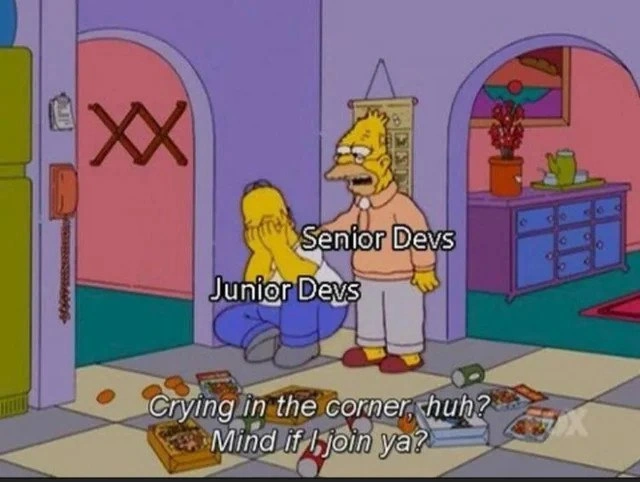
For a newcomer in tech, seeing a senior developer also looking defeated can be surprising. This meme sums up that shared struggle in a single image. It’s a screenshot from The Simpsons: Homer (the dad character) is sitting on the floor sobbing (labeled “Junior Devs”), and Grandpa Simpson (labeled “Senior Devs”) stands next to him with a worried face, saying the subtitle “Crying in the corner, huh? Mind if I join ya?” Everything in the image screams “rough day”: overturned pizza boxes, soda cans everywhere – classic signs of an all-nighter debugging session. The colors are bright and cartoonish, but the situation is one every developer finds all too real.

Let’s break down the terms and ideas here for a junior developer or anyone new to the chaos:

  • Production Fire: Not a literal fire, though it feels as urgent. This is slang for a major problem in the production environment (the live system users rely on). For example, a website crash or a severe bug that’s costing the company money. When devs say “everything’s on fire,” they mean the system is breaking in real time and everyone must drop what they’re doing to fix it. Junior devs often experience their first production fire as a baptism by fire – thrown into a crisis with a steep learning curve.
  • Technical Debt: Imagine you have a project due and you rush to finish it, cutting corners. In coding, those rushed, sloppy solutions are like taking on “debt.” It’s faster in the short term, but you’ll pay for it later with interest – the interest being the extra headaches and fixes you have to do down the road. A codebase with a lot of technical debt is hard to work with: things break unexpectedly, small changes cause big bugs, and no one is quite sure how some pieces work anymore. Junior devs encountering this mess feel lost; senior devs feel guilty because they might have contributed to that mess years ago when deadlines were tight.
  • Deadline Pressure: This is when the higher-ups say “This feature must be done by Friday” (and it’s Thursday night). Unrealistic deadlines force developers to scramble. Both juniors and seniors skip proper testing or proper design just to deliver something on time. It’s stressful for everyone. Juniors worry because they want to prove themselves and not fall behind. Seniors worry because they know rushing often creates new bugs (aka future production fires). When the pressure is constant, it leads to burnout.
  • Burnout: This is a state of emotional, mental, and often physical exhaustion caused by prolonged stress. In tech, burnout can happen when developers are repeatedly pushed to their limits with crunch times, late-night emergencies, and never-ending bug lists. A junior dev might burn out from feeling overwhelmed by everything new they have to learn under stress. A senior dev might burn out from carrying a team’s responsibilities, being on-call for emergencies, and fixing the same types of problems over and over. In the meme, both the junior and senior are showing signs of burnout: slumped posture, giving up (crying instead of actively debugging), and being surrounded by the remains of a long work night.
  • On-Call Duty: Many teams assign someone as “on-call,” meaning if something breaks at odd hours, that person gets alerted (often via a pager or phone) to respond. Here, the scene suggests maybe the junior was on-call, got overwhelmed, and the senior joined to help – and both ended up distressed. Pizza boxes and soda imply this might have stretched for hours (a common on-call horror story: called at midnight, still fighting fires at dawn). Senior devs remember those nights well, and junior devs dread them.

The Simpson’s quote in the subtitle, “Crying in the corner, huh? Mind if I join ya?”, is both funny and a little heartwarming. It’s funny because Grandpa (the elder) is supposed to be the wise, experienced one, yet he’s ready to break down and cry just like Homer. This mirrors a real-life twist: senior developers are often seen as unflappable problem-solvers, but here one admits, essentially, “I’m as stumped and stressed as you are.” There’s an empathy in that line. The senior dev isn’t blaming the junior or acting superior; he’s showing solidarity. In many developer communities, seniors will reassure juniors that struggling is normal and “yes, I’ve cried over code too.” This helps the junior not feel alone or incompetent. In fact, a good senior dev often shares their own war stories (like “I once took down the production database by accident and yes, I cried”) to comfort the junior. That’s senior dev empathy – turning a painful incident into a bonding experience.

Visually, the meme uses a well-known Simpsons template (often used in DeveloperHumor circles) to instantly convey emotion. Homer with his face in his palms perfectly represents frustration and defeat. Grandpa putting a hand on Homer’s shoulder is the concerned mentor figure. The contrasting labels “Junior Devs” and “Senior Devs” tell us the joke: despite their roles, they’re in the same boat. The pastel-colored kitchen corner becomes the metaphorical “crying corner” of an office or a Slack channel where devs vent. The scattered pizza boxes and soda cans? That’s basically the universal sign of developers working overnight. (It’s practically a trope: late deploy or outage means ordering pizza and caffeinating until it’s fixed.) So even without reading the subtitle, a developer might see this image and immediately recall their own late-night coding disasters.

For someone early in their career, the message is both cautionary and comforting. Cautionary because it shows that coding is a team sport with shared pain – you will face tough issues that might make you want to cry (figuratively or literally). It might be a gnarly bug, or a legacy system from 2005 that nobody fully understands but you have to update. Comforting because it says even the seniors, the ones you look up to, have those moments. It’s not that you’re too weak or not cut out for this if you feel overwhelmed. It’s that the struggle is real for everyone. This meme resonates in tech circles precisely because it’s so relatable. It pokes fun at the idea that “experience solves everything.” Truth is, experience just teaches you that sometimes sitting down and having a little cry (and then getting back up) is part of the process. And often, a supportive team will be right there in the metaphorical corner with you, sharing war stories and tissues, until the problem is solved.

Level 3: Tears of Tech Debt

In this scene, even the battle-hardened Senior Dev (Grandpa Simpson) ends up on the kitchen floor with the Junior Dev (Homer) for a good cry. It’s darkly funny because it shatters the illusion that experience makes you immune to coding catastrophes. The overlay text labels are a dead giveaway: “Junior Devs” on Homer with head in hands, and “Senior Devs” on Grandpa Simpson who is asking to join in. This captures a painfully familiar scenario in software teams where production fires, technical debt, and crushing deadline pressure reduce everyone – from fresh hire to team lead – to the same state of despair. The humor here comes from that shared suffering: the senior isn’t swooping in heroically to fix things; instead, he’s basically saying “Scoot over, kid, I’m gonna cry too.”

On a technical level, this meme highlights how systemic issues in software projects spare no one. For instance:

  • Technical Debt: Those quick-and-dirty code patches and temporary permanent hacks have piled up. The junior dev is sobbing because the code makes no sense, and the senior dev is crying because he remembers writing half of it under duress. Every // TODO fix this later from years past has come back to haunt them both.
  • Production Incidents: The server’s down at 3 AM (again). The new dev is panicking, frantically Googling error messages, while the senior dev – who’s seen everything fail at 3 AM – is quietly hyperventilating because they know how deep this rabbit hole goes. It’s the classic on-call nightmare: pager alerts ringing, pizza boxes on the floor, and a codebase held together by duct tape and regret. No one is getting sleep tonight.
  • Burnout and Pressure: Tight deadlines and feature creep have made the codebase a Jenga tower. Pull one wrong block (or push one wrong commit) and the whole thing crashes. Junior devs feel like it’s their fault when things break; senior devs know the whole system is a ticking time bomb built on half-baked hotfixes. The result? Both end up overwhelmed, exchanging the “we’re so doomed” look over cold pizza crusts.

The meme lands so well in dev communities because it speaks truth to power – or rather, truth to pain. It satirizes the idealized notion of the unflappable senior engineer. In reality, even the graybeards with 10+ years experience have their “I can’t handle this either” moments. We’ve all seen that Relatable Developer Experience: the bug that makes a junior question their career choices and a senior question all of software engineering. The shared misery creates a weird camaraderie. Senior devs remember being juniors overwhelmed by legacy code; now, instead of laughing at the newbie, they empathize deeply (sometimes a little too deeply, as this meme jokes). It’s a nod to mental health in tech, showing that stress and developer frustration hit everyone. In a culture that often glorifies the rock-star coder, this image points out the human side: sometimes the best mentorship a senior can offer is a seat on the floor and a good cry together.

From an organizational perspective, the meme hints at deeper dysfunctions: why are both juniors and seniors beaten down to this state? It suggests a cycle where poor planning, lack of code quality practices, and constant crunch mode create a shared trauma. The senior vs junior developers gap closes when both are coping with the same absurd demands and flaky systems. It’s a bitter little secret in many dev teams that “experience” often just means knowing exactly why you want to cry. The grandpa character literally represents that seasoned knowledge: he’s seen the codebase’s history of bugs and kludges, and he’s not surprised it’s all on fire – if anything, he’s surprised it took this long. The junior is upset not understanding the chaos; the senior is upset because he perfectly understands it. The line “Crying in the corner, huh? Mind if I join ya?” might as well be senior-dev speak for “Yep, it’s one of those days – scoot over.” It’s a scene of senior dev empathy at its darkest and finest.

Ultimately, this meme uses a pop culture reference (classic Simpsons humor) to deliver a very real message: in software, no one is too experienced to feel overwhelmed. The code doesn’t care if you have a fancy title – when things go sideways, everyone grabs a box of tissues. Seasoned engineers often carry the scars of past all-nighters and failed deployments, so they recognize a meltdown-in-progress and often join in out of solidarity (and existential dread). It’s funny because it’s true: behind every “senior” title is just a junior who survived enough fiascos to earn some gray hair, and sometimes the most veteran response to a disaster is a deep sigh and a shared cry. The meme nails this irony, getting a knowing chuckle (and perhaps a nervous laugh) from anyone who’s been through the grind of maintaining software against all odds.

Description

This is a two-panel meme using a scene from the animated TV show 'The Simpsons'. In the first panel, the character Homer Simpson is seen huddled in a corner, crying with his hands covering his face. A white text label 'Junior Devs' is placed over him. The second panel shows his father, Abe Simpson, labeled 'Senior Devs', approaching him. The room is slightly messy, with spilled snacks on the floor. A subtitle at the bottom reads, 'Crying in the corner, huh? Mind if I join ya?'. The humor stems from the subversion of expectations. Typically, a senior developer is expected to mentor or help a struggling junior. Instead, the senior developer is just as overwhelmed and wants to join in the despair, highlighting that certain problems in software development are universally frustrating regardless of experience level. This resonates with the idea that impostor syndrome and difficult challenges persist throughout a developer's career, creating a moment of shared commiseration

Comments

8
Anonymous ★ Top Pick A junior cries because they don't know the answer. A senior cries because they know the answer and it involves rewriting a legacy service that has zero documentation and is critical for production
  1. Anonymous ★ Top Pick

    A junior cries because they don't know the answer. A senior cries because they know the answer and it involves rewriting a legacy service that has zero documentation and is critical for production

  2. Anonymous

    Prod’s down - juniors sob over the null pointer, seniors join when the post-mortem fingers the 2003 stored procedure every “greenfield” rewrite vowed to delete

  3. Anonymous

    After 15 years in tech, the only difference between senior and junior devs is that seniors have optimized their crying sessions to fit within standup meetings and know which conference room has the best acoustics for existential dread

  4. Anonymous

    The only difference between junior and senior despair is that the senior's tears are properly logged with correlation IDs

  5. Anonymous

    The most senior thing about this senior dev is knowing that experience just means you've earned the right to cry in the corner too - you've just seen enough production incidents to know exactly which corner has the best WiFi signal and is furthest from the PM's desk

  6. Anonymous

    Promotion tip: “Senior” just means you can articulate why you’re crying - SLO burn rates, a half-migrated monolith, and a cronjob nobody dares delete

  7. Anonymous

    Juniors cry when prod breaks; seniors cry when it doesn’t - because it means the 2014 “temporary workaround” has officially become the architecture

  8. Anonymous

    Juniors cry over bugs; seniors over realizing those bugs scaled into architectural debt

Use J and K for navigation