Skip to content
DevMeme
3940 of 7435
When The Program Tests Back
Testing Post #4289, on Mar 22, 2022 in TG

When The Program Tests Back

Why is this Testing meme funny?

Level 1: Homework That Talks Back

This is like checking your homework and discovering the homework is checking you too. You thought you were looking for mistakes on the page, but now you are also finding out whether you understood the lesson. The meme is funny because every programmer has had a moment where the computer seems to be asking, "Are you sure you know what you are doing?"

Level 2: Bugs With Questions

Software testing means running checks to see whether a program behaves as expected. A bug is behavior that is wrong, surprising, or inconsistent with what the program should do. Troubleshooting is the process of figuring out why the wrong thing happened and how to fix it.

The caption asks whether the developer is testing the program or the program is testing the developer. That feels true because tests often expose gaps in the developer's own understanding. Maybe the code works with one input but not another. Maybe it works locally but not in deployment. Maybe the test data is unrealistic. Maybe the requirement was vague. Each failed test asks, "Did you really understand this?"

For newer developers, this is one of the first hard lessons after writing code that merely runs. A program can compile, open, and even look correct while still failing important cases. Testing teaches you to think like a skeptical user, a tired maintainer, and a future teammate who will accidentally rely on the weirdest possible edge case.

Level 3: The Suite Stares Back

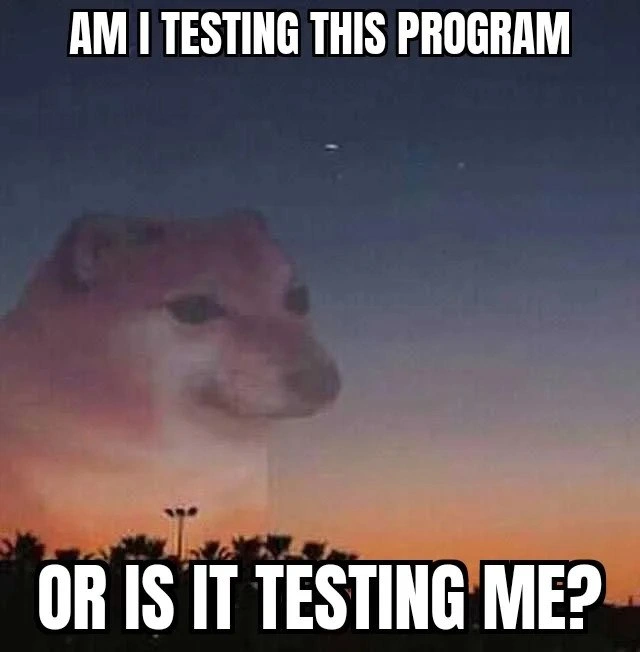
AM I TESTING THIS PROGRAM

OR IS IT TESTING ME?

The meme lands because Testing is supposed to be controlled, rational, and clarifying, but real Debugging often becomes a psychological evaluation conducted by your own codebase. The caption frames the program as an opponent: every run reveals not only whether the software works, but whether the developer understood the requirements, the environment, the state setup, the mocks, the timing, the database fixtures, and the one hidden assumption that has apparently been load-bearing since 2019.

Experienced developers recognize the exact moment being depicted: a bug fails only on CI, a test passes alone but fails in the suite, a UI test becomes flaky when the browser window is headless, or a function behaves differently because the "simple" setup mutated global state. At that point, the test is no longer just checking the program. It is checking your model of the program. That is why DebuggingFrustration and ExistentialHumor fit the image so well. The faded face in the sky looks less like a reaction and more like a developer's soul leaving the process tree.

The deeper technical issue is that testing is a design activity, not a decorative afterthought. Good unit tests isolate behavior. Integration tests validate contracts between parts. End-to-end tests simulate user flows but can be expensive and brittle. Regression tests pin down bugs that already escaped once. Each type answers a different question, and confusion starts when teams expect one kind of test to provide another kind of confidence. A green unit suite does not prove the product works; it proves those units behaved under the conditions someone remembered to encode.

The meme also points at the human cost of troubleshooting. Test failures compress uncertainty into a red line, but that line rarely says, "your fixture is stale, the clock is mocked in the wrong timezone, and the actual bug is in the serializer." Instead, it says something clinical and unhelpful, then leaves you alone with stack traces and regret. The program tests patience, humility, and whether anyone documented the setup before the last person left.

expect(invoice.total).toBe(100);
// Received: 99.9999999997
// Congratulations, the floating point lesson has found you.

Description

The image shows a faded, contemplative dog-like meme face over a sunset or night-sky background. Large white impact-font text at the top reads "AM I TESTING THIS PROGRAM" and the bottom reads "OR IS IT TESTING ME?" The meme frames software testing as an existential struggle, where running a program exposes not only bugs in the code but also the developer's patience, assumptions, and sanity. It is especially relatable for debugging sessions where every attempted test reveals a new, stranger failure mode.

Comments

1
Anonymous ★ Top Pick The test suite passed; the developer did not.
  1. Anonymous ★ Top Pick

    The test suite passed; the developer did not.

Use J and K for navigation