Java's Evolution: From Wild Lynx to Domestic Cat
Why is this Languages meme funny?
Level 1: Wild vs Tame
Imagine a big wild cat out in the snow, strong and scary, versus a small tame cat hiding in a house. The meme is saying Java used to be like that big wild cat in the 1990s – it was new, powerful, and everyone was excited and a little scared of it (in a fun way, like how a huge cat might wow you). Now, Java is more like the little house cat – it’s calm, familiar, and not very scary at all. This is funny because it shows how something can change from being wild and bold to quiet and domestic over time. Just like a pet cat that used to jump around but now just naps, Java isn’t viewed as a big adventurous thing anymore. The two cat pictures make it easy to feel the difference: one is leaping and fierce (that’s Java’s past), and the other is shy and cozy (that’s Java today). The joke makes people smile because it’s a bit like saying, “Remember when Java was the cool wild thing? Now it’s just a comfy old friend.” You don’t need to know Java deeply to get the laugh – it’s the classic story of something new and ferocious becoming old and gentle, told with big cats and little cats.
Level 2: Legacy Housecat
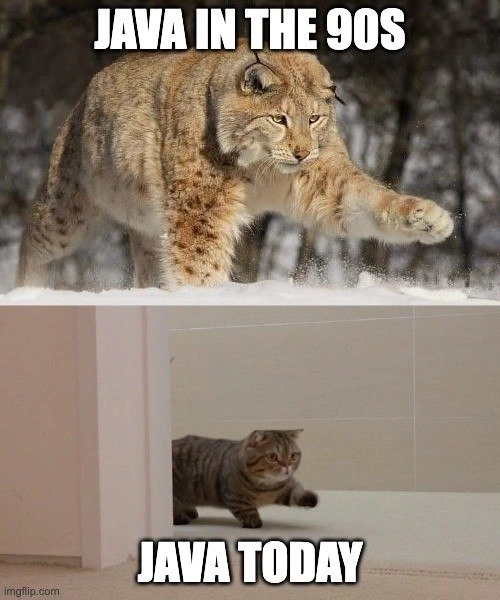
This meme uses two cat images and captions to compare Java’s evolution over time. The top picture shows a big wild cat (a lynx) leaping through the snow with the text “JAVA IN THE 90S.” This represents how Java was seen in the 1990s: powerful, exciting, and a bit intimidating. Java is a programming language that was introduced in 1995 by Sun Microsystems, and at that time it was a huge deal in the software world. Imagine everyone getting hyped about a new technology – that was Java back then. It introduced ideas like “Write Once, Run Anywhere,” meaning you could run Java programs on any computer (Windows, Mac, Linux) as long as that computer had the Java Virtual Machine. For a young developer in the late 90s, learning Java felt like playing with a revolutionary new tool – it had automatic memory management (so you didn’t accidentally crash programs by messing up memory, unlike in languages like C), an extensive library of reusable code, and it was object-oriented top to bottom (everything in Java is an object, which was a trendy design principle). Companies were adopting Java everywhere, from web applets (small programs that ran in browsers) to large enterprise systems. Because of this, people often engaged in language wars, debating if Java was better than older languages like C++ or newer rivals that emerged later. In those days, Java had a bit of a swashbuckling reputation – it was the cool newcomer that might replace the old ways of coding. That’s why the meme compares it to a large lynx ready to pounce. A lynx in the wild is strong and commanding, just as Java was commanding a lot of attention and language popularity in its prime.
The bottom image shows a small domestic cat crouching timidly behind a doorway, labeled “JAVA TODAY.” This is a humorous way to say that today Java is seen as a tame, cautious veteran rather than the daring rebel it once was. Over the past two decades, industry trends have shifted. Many new programming languages popped up and stole some of the spotlight – for example, Python became popular for beginners and data science, JavaScript became dominant in web development, and newer languages like Go and Rust are now the shiny “cool” tools for certain systems work. In this changing landscape, Java’s image has gone from cutting-edge to old reliable. We call languages like Java “legacy” when they’ve been around a long time and a lot of older projects are written in them. “Legacy” isn’t an insult per se; it just means it’s an established technology that new projects might not choose as often because there are flashier options. Java today is often used in large corporations, banks, and older systems that already have tons of Java code – it’s considered a safe, stable choice. But it’s also sometimes seen as heavy or verbose (meaning you have to write a lot of code to do simple things relative to some newer languages). The cat hiding behind the door gives the vibe of cautiousness or being a bit shy. This reflects how Java as a technology isn’t making loud headlines or bold moves these days; instead, it’s carefully updated to not break existing programs. In tech, we have the idea of backward compatibility – Java is big on this, meaning each new Java version tries hard to still run programs written decades ago. That’s great for reliability, but it means Java changes more slowly and cautiously than trendier languages that can take big leaps.
For a junior developer or someone new to programming, this meme’s contrast might reflect personal experience too. Perhaps you learned Python or JavaScript first (since those are very popular to learn nowadays), and you view Java as that “enterprise language” you only use because a job or a college course requires it. It might feel less fun or more formal – kind of how a playful kitten (like learning Python with quick results) compares to a serious older cat (Java with its strict syntax and setup). The phrase “Java today” corresponding to a timid cat suggests that Java now isn’t seen as pushing boundaries; it’s more like the dependable housecat that won’t surprise you. Meanwhile, “Java in the 90s” with the wild lynx suggests that at one time Java was unpredictable and exciting, like a wild animal roaming free. This two-panel format is common in memes to show a before-and-after or a strong contrast in a funny way. It’s using a bit of nostalgia (for those who remember the 90s) and visual metaphor to communicate how the attitude toward Java has changed. Even if you weren’t around in the 90s tech scene, you can understand: it’s like hearing about how cool something was back in the day versus seeing it as ordinary now. The humor here comes from exaggeration – of course Java isn’t literally a cat, but by comparing it to creatures we emotionally understand (fierce vs. cute), the meme makes a complex tech history point in a simple, relatable way.
Level 3: Predator to Pet
In the mid-90s, Java emerged as a fierce new predator on the programming landscape. Back then, Java was the lynx pouncing onto the scene – powerful, disruptive, and ready to dethrone older languages. Developers who had wrestled with C++ quirks and memory bugs saw Java as a bold alternative: “Write Once, Run Anywhere” (WORA) was its rallying cry. This meant you could write code on Windows and run it on Linux or a Mac without changing it – a revolutionary promise at the time. Java’s automatic garbage collection (cleaning up memory so programmers didn’t have to manually free() it) made it feel safer and more advanced. It was as if a wild cat had been unleashed in a world of tame house pets: early Java applets roamed the web, enterprise IT departments started a frenzy of rewriting legacy systems in Java, and language wars erupted. C and C++ veterans were both intrigued and a little terrified – here was a newcomer that threatened the old order, much like a lynx stalking new territory. Java was the hot new language everyone name-dropped, a true apex predator in the software ecosystem, and its rise was fueled by massive hype and industry backing (Sun Microsystems even plastered Java’s Duke mascot everywhere 🦸).
Fast-forward to today: Java is still very much alive, but its image has mellowed into that of a cautious housecat. After 25+ years, Java has become the establishment – reliable, ubiquitous, and maybe a bit domesticated. The meme’s bottom panel, showing a timid cat peeking from behind a doorway, perfectly captures “Java today.” It’s not that Java lost its capabilities (in fact, modern Java JVM performance with JIT compilers is extremely robust, and Java runs a huge chunk of servers worldwide). But in terms of perception and developer excitement, Java now behaves like a veteran housecat curled up in the enterprise living room. Why? Backwards compatibility and decades of incremental changes have kept Java stable but also conservative. The language must tiptoe carefully so as not to break millions of existing programs – this cautious evolution can feel like that timid striped cat, carefully peering around the corner. Meanwhile, new predator-like languages (think Python, JavaScript, Go, Rust, Kotlin) have entered the scene with shiny new features, grabbing the hype and headlines. The once fearsome Java doesn’t pounce on new trends as boldly; instead, it adopts features carefully (it took Java 20+ years to add lambdas and still only recently added pattern matching). Seasoned developers nod at this meme because they’ve lived through the language hype cycle: the roaring 90s when Java was the daring newcomer, and the later years where Java settled into a mature, even stodgy, standard.
This humorous juxtaposition also speaks to how our feelings about a technology change over time. In the 90s, Java’s aggressive marketing and paradigm shift (object-oriented everything! no pointers! a virtual machine!) made it feel exciting and perhaps a bit wild – companies were nervous their existing tools would be made obsolete by this newcomer. Today, few people are “afraid” of Java; if anything, some younger devs might playfully mock it as the old fat cat that’s been lounging around forever in large companies. Industry trends have a way of turning yesterday’s disruptor into today’s legacy. We’ve seen it happen with other technologies too – what was once an apex technology becomes part of the furniture. Many in tech remember when Java was the only language you’d hear about at conferences; now those same conferences are more likely buzzing about cloud, data science, or newer languages. Java has gone from the upstart to the old guard.
To illustrate the transformation:
| Java in the 90s (Wild Lynx) | Java Today (Timid Housecat) |
|---|---|
| 🐆 Revolutionary upstart – the new kid threatening C/C++, stirring excitement and fear. | 😺 Established veteran – the comfortable choice, trusted but not thrilling. |
| 🌟 High hype – Java was on magazine covers, everyone believed it’d change everything. | 💤 Low hype – Java is background noise; it runs things, but nobody’s bragging about using it. |
| 🚀 Rapid expansion – applets in browsers, enterprise adoption, “write once, run anywhere” optimism. | 🔧 Maintenance mode – powering legacy systems, adding features slowly to avoid breaking stuff. |
| 🤯 “Cool” factor – considered a cutting-edge, modern tool for serious software. | 📦 “Corporate” vibe – seen as a dependable workhorse, sometimes labeled “boring” but gets the job done. |
Notice that being a “timid housecat” isn’t entirely a bad thing. Java’s cautious evolution means it’s stable and predictable, which large organizations love. That housecat might not win races, but it’s not going to bite your hand either. In contrast, the 90s lynx Java was exciting but also came with youthful flaws – early Java was slow on modest hardware and applets often crashed browsers (some devs jokingly called it “Write Once, Debug Everywhere” when reality hit!). Over time, Java shed some of that reputation by improving performance and reliability, but the image stuck that Java today is more about maintaining huge legacy codebases than breaking new ground. Experienced engineers find this meme funny because it’s so true: they recall the swagger and bold promises of Java’s early days, and they see how it’s become a tame, even cuddly fixture of enterprise IT. The juxtaposition of a roaring lynx with a skittish indoor cat exaggerates this contrast for comic effect. It’s a playful nod to the nostalgia in programming – remembering when Java was the cool cat on the block – and an acknowledgement that in tech, every rising star eventually becomes an old, comfortable kitty snoozing in the sun.
Description
This is a two-panel comparison meme that contrasts the perception of the Java programming language over time. The top panel features a powerful, majestic lynx confidently striding through a snowy, wild landscape, with the white text 'JAVA IN THE 90S' overlaid. The bottom panel shows a small, timid-looking domestic tabby cat cautiously peeking around a corner inside a house, with the text 'JAVA TODAY' overlaid at the bottom. The meme humorously illustrates the shift in Java's reputation from a revolutionary, powerful, and versatile language in its early days (the wild lynx) to its modern perception as a more domesticated, safe, and perhaps less exciting language primarily used in corporate enterprise settings (the cautious house cat). For senior developers, this resonates with the experience of seeing a once-groundbreaking technology mature into a stable but often verbose and boilerplate-heavy tool, losing its 'cool' factor while still being a workhorse of the industry

Comments
21Comment deleted
Java used to be a wild lynx that could run anywhere. Now it's a domestic cat that can run anywhere, as long as 'anywhere' is a 16GB Docker container orchestrated by Kubernetes
Java in ’96: “Write once, run anywhere.” Java today: “Write once, bundle 800 MB of shaded JARs, ship a 2 GB container, tune ZGC, and pray the liveness probe doesn’t time out before Spring warms up.”
Just like that lynx, we all thought Java would leap elegantly into the future with its revolutionary JIT compilation and garbage collection. Twenty-eight years later, it's still trying to squeeze through the enterprise architect's AbstractSingletonProxyFactoryBean pattern while carrying the weight of every design pattern ever conceived and maintaining compatibility with code written when dial-up was cutting edge
The lynx promised to run anywhere; thirty years later it mostly runs in a bank's app server, on a JVM flag nobody dares remove
Java went from 'write once, run anywhere' revolutionary to 'AbstractSingletonProxyFactoryBean' - still running everywhere, just with more ceremony and a few extra layers of abstraction. The language that once threatened to make C++ obsolete now finds itself defending against Kotlin in its own runtime, proving that even apex predators eventually get comfortable on the couch
Java in the 90s leapt at applets; Java today tiptoes around the classpath hoping the classloader picks the right SLF4J binding
Java in the 90s pounced into browsers; today it crouches behind Spring Boot, Kubernetes, and a 2GB heap - still running the bank while pretending to be a “microservice”
90s Java: applet-slaying lynx. Today: kitten peeking from Spring's 50-layer config abyss, praying for Lombok
The picture is reversed. JAVA today is considered too bulky. Comment deleted
I think the features/posibilities are meant Comment deleted
I think that JVM was biggest success of java Comment deleted
but always 100% cpu usage on my computer,for example when it's required by vscode extension 😡 I hate java Comment deleted
Isn't vsc done in js/ts? Comment deleted
electron, to be precise. They allow plugins in other languages though afaik Comment deleted
Now you have languages like kotlin or scala that use it and have more features than plane java Comment deleted
плотная Comment deleted
what Comment deleted
it was an accident 😅 Comment deleted
If someone interested this here bellow is famous Korean cat LULU Comment deleted
I believe language server protocol implementations are generally implemented in the same language as the compiler (easier to reuse the parser that way) Comment deleted
I forget,maybe a backe-end extension for a kind of language,because several languages environment(nim,java,lua,tex,markdown,c,python,ruby,rust,haskell...) on my computer,and extentions for all of them are installed,after finding it I turn to spacevim and uninstall it completely. Comment deleted