Senior Devs Laughing When Junior's ChatGPT Code Doesn't Work
Why is this Juniors meme funny?
Level 1: Bad Advice, Broken Toy
Imagine you’re a kid who needs to build a small toy castle. You’re not sure how to do it, so you ask a clever friend for help. This friend confidently gives you a list of steps to build the castle. You follow those instructions exactly, piece by piece. But when you’re done, the castle falls apart immediately – the walls won’t stand and the pieces are all jumbled. It turns out your friend’s advice had some mistakes in it! Now you’re sitting there confused because you thought it would just work.
Seeing the mess, your older sibling (who’s built lots of these toy castles before) walks in. They look at the broken castle and then at you with a big sigh and a little laugh. They’re not really laughing at you, but they find it a bit funny how predictably things went wrong. They kind of expected this would happen because they know that friend you asked, while confident, sometimes gives bad instructions. Your older sibling has that “here we go again” look because they’ve fixed many broken toys caused by wonky advice in the past.
In the end, the older sibling helps you figure out what went wrong and how to build the castle properly. The whole situation is amusing in hindsight: you tried to save time by using that magical friend’s instructions, but it actually caused more work and a chuckle from someone more experienced. The meme is highlighting just this feeling – when we trust a “smart” helper too much and things break, the wiser person shakes their head with a knowing smile, because they’ve seen this kind of thing before.
Level 2: When Copy-Paste Backfires
Let’s break down what’s happening in simpler terms. A junior developer (someone new to the job) encountered a coding problem and decided to ask ChatGPT for help. ChatGPT is a type of AI called a Large Language Model (LLM). Think of it as an extremely advanced auto-completion engine: you give it a prompt (like “How do I do X in code?”) and it tries to continue that with a helpful answer. Often, it will provide what looks like a complete solution with code examples. This can feel like having a super knowledgeable friend or an AI pair programmer on call. However, that friend is not always reliable – it might give you incorrect code confidently, and if you don’t have enough experience to double-check, you could end up copying and pasting a broken solution straight into your project.
In the meme, the junior did exactly that: they took ChatGPT’s answer and added those AI-generated code changes into the codebase (we sometimes call this making a commit, which means saving your changes in a version control system like Git). Then they tried to run the code (or compile it, if it’s a language like C++ or Java that needs compiling). Immediately, errors popped up. In programming, when we say code “doesn’t compile,” it means the computer found something wrong with the code’s structure or references and refused to turn it into an application. It’s like writing a sentence with bad grammar – the compiler, acting like a strict grammar teacher, says “I can’t understand this, so I won’t proceed.” A simple example: imagine the AI told the junior to use a function that doesn’t exist or a wrong command. For instance, if the project is in Java and ChatGPT suggested using a list.append() method when the real method is list.add(), the code won’t compile. The computer will complain: “There is no append method here.” That’s a basic mistake, and a seasoned programmer or a quick documentation check would catch it. But a junior following AI instructions might not realize it until the error appears.
Now, enter the senior developer – someone with years of experience who has probably seen every error in the book (and maybe even caused a few themselves in their early days!). The meme shows the senior as an old king rolling his eyes in frustration. This dramatization is saying: senior devs often end up fixing the mess when something like this happens. The senior developer likely anticipated this outcome the moment they heard “I got this code from ChatGPT.” It’s not that ChatGPT is useless – it can be very helpful – but an experienced dev knows you always test and review AI’s suggestions. If you skip that step, you risk time-consuming debugging later.
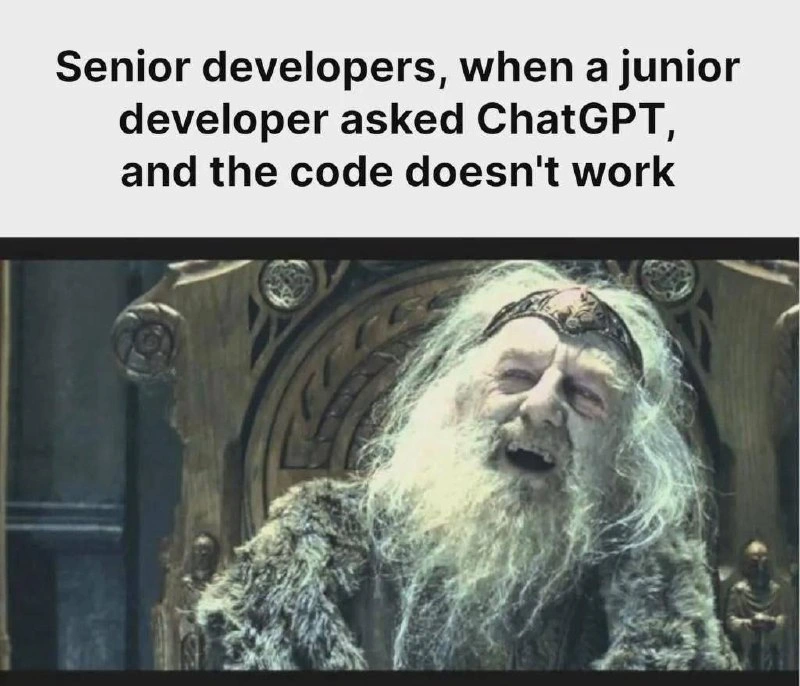
The text at the top of the meme reads, “Senior developers, when a junior developer asked ChatGPT, and the code doesn’t work.” The reason this line is funny is because it captures a common situation in today’s programming teams. Junior dev runs into a problem, junior asks ChatGPT for a quick fix, AI gives code, junior uses it without careful testing, and… something breaks immediately. It’s a modern twist on an old habit: previously, juniors might copy-paste code from Stack Overflow (a popular Q&A forum for programmers) without fully understanding it. Sometimes those snippets wouldn’t fit the problem exactly or were outdated – leading to errors and a puzzled junior. Now the source is an AI model, but the “copy-paste without understanding” issue remains. We even have a lighthearted term for this tendency: copy-paste programming or cargo-cult coding (meaning using code blindly without grasping its workings, hoping it magically does the right thing).
In the categories, this meme is tagged as Debugging_Troubleshooting and Juniors, which is exactly what’s happening: a bug popped up (code didn’t run), and now troubleshooting is needed, typically with the guidance of a senior. The tag AI_ML is there because the whole joke centers on an AI (ChatGPT) being used for coding help. And indeed, this is also about DeveloperFrustration: the frustration of having to fix something that arguably should have been avoided with a bit more care. The senior isn’t frustrated at the junior personally as much as at the situation – it’s a kind of “I have to drop what I’m doing to put out this little fire” moment. They might also be frustrated with the hype around AI tools. There’s a lot of buzz that AI will make coding effortless, but here it actually caused extra work. In the meme image, King Théoden’s eyes are rolled back and he’s half-laughing; he looks both annoyed and amused. That’s a mood many senior devs recognize: when something goes wrong in a predictably silly way, sometimes you just have to chuckle and say, “Welp, saw that coming.”
Let’s clarify a few terms and why the code might not work:
- ChatGPT-generated code: This is code produced by an AI model. It’s based on patterns from lots of example code the AI saw during training. It doesn’t guarantee the code fits your exact need. It might have errors or use outdated approaches.
- Compile error vs. runtime error: A compile error, which is what happened in the meme, means the code can’t even be turned into a running program because it breaks the language’s rules. (For example, a syntax error like a missing parenthesis, or a reference to something that doesn’t exist.) A runtime error would mean the program compiled and started, but then something went wrong during execution (like dividing by zero or a null pointer exception). Here it failed at the earliest stage – compile – which is often due to an obvious issue. It’s a bit embarrassing when that happens in a shared codebase, because it means nobody ran the code even once before pushing it in.
- Commit crumble: When they say “commits crumble,” they’re humorously describing how the submitted code changes (the commit) fail immediately. Modern development teams use automated builds and tests (often in a Continuous Integration pipeline). If a commit has a compile error, the CI system will mark it as a failed build. It’s a red flag that everyone can see. A senior developer probably monitors these or gets notified, hence the eye-rolling when they realize the culprit was a blind ChatGPT copy-paste.
- Senior vs Junior dynamics: Juniors are at the beginning of their learning curve. It’s normal for them to make mistakes or not foresee certain problems. Seniors often mentor them. One common bit of advice from seniors is “Don’t trust code you found online (or from an AI) blindly — understand it and test it.” This meme basically visualizes what happens when that advice is not followed. The senior’s weary expression = “This is exactly why I warn you, but you had to learn the hard way, huh?”
To put it simply, the meme is using a funny image and a situation to remind everyone that AI is not magic. You can’t just take whatever ChatGPT gives you and assume it will work in your project without double-checking. It also shows the human side: the communication (or miscommunication) between a junior who is trying new tools and a senior who’s a bit jaded from experience. The Lord of the Rings frame (King Théoden) is an exaggerated stand-in for the senior developer. In that movie scene, Théoden is a king who’s been through a terrible ordeal (he was literally possessed by an evil advisor and nearly lost his kingdom). In the meme, it’s like saying the senior dev feels super old and tired from dealing with one too many problems like this – but he still has a sense of humor about it (that half-groaning laugh).
For someone new to coding: the key takeaway is AI can be a helpful assistant, but it’s not a guarantee of correct code. You still need to use your own brain and testing to make sure the solution is right. And if you’re the junior in this scenario, don’t be discouraged – every developer has broken the build or written code that didn’t work at some point! Just learn from it. If a senior dev reacts like the meme, it’s usually all in good spirit – they remember being in your shoes, even if now they joke about it. After the eye-roll, a good senior will help you figure out why the code failed and how to fix it, turning the moment into a learning opportunity (and perhaps a light chuckle for the rest of the team).
Level 3: LLM Letdown
In this scene, our seasoned developer (channeling King Théoden from The Lord of the Rings) is slumped in his throne, visibly drained yet wearing a grim little smirk. Why? Because he’s just witnessed yet another LLM letdown. A keen but naive junior developer, desperate to impress or simply to unblock themselves, went to ChatGPT for coding help. The AI confidently delivered a solution, the junior hastily pasted it into the codebase – and boom, the entire thing crumbles at compile time. The top text sets the tone: "Senior developers, when a junior developer asked ChatGPT, and the code doesn't work." Translation: the senior dev’s facepalm is practically audible. It’s an I-knew-this-was-coming eye roll mixed with a half-hearted chuckle of dark humor. They’ve seen this movie before; only last year it was Stack Overflow snippets causing trouble, and now it's AI-generated commits breaking the build. Different source, same headache.
What makes this funny (in a laugh-to-keep-from-crying way) is how perfectly it captures a real-world dynamic in tech teams. Juniors, under pressure to deliver, sometimes reach for shiny new tools like a large language model thinking it’s a silver bullet. It’s the modern equivalent of copy-pasting code from a random blog – except now it comes from a chatbot that sounds extremely sure of itself. The senior developers – the battle-hardened ones who have slogged through countless debugging sessions at 3 AM – can almost predict the outcome. AI pair programming gone wrong has become a new category of war story. The junior might excitedly announce, “ChatGPT gave me this solution!” only to find that the "solution" in question won’t even compile or is logically flawed. The senior dev’s reaction in the meme (that weary, aged king laughing in exasperation) says it all: “Of course it doesn’t work. Why am I not surprised?”
There’s industry satire here about AI hype vs reality. We’re told by tech evangelists that AI will revolutionize programming, maybe even replace developers. Managers might be pushing AI tools to boost productivity, imagining juniors coding at lightspeed with an LLM whispering in their ear. The reality: the hype meets the cold, hard truth of a compiler error, and it’s the seniors who have to mop up the aftermath. It’s as if the AI handed the team a shiny new power tool without a safety manual. Sure, it can save time cutting through routine code… until it misfires and someone nearly loses a finger (or in this case, loses an evening to broken build fixes). This leaves senior devs in a paradoxical position: they are the very people whom AI was supposedly going to render obsolete, yet here they are, cleaning up the AI’s mess. As one might sarcastically quip, “AI is going to take our jobs, but not before it forces us to do overtime fixing its bugs.”
Consider a real scenario: a junior uses ChatGPT to generate a piece of code to handle, say, file processing or a database query. The AI responds with something that looks plausible – it even includes nice comments and uses a function name that sounds about right. The junior, relieved to have a quick answer, plugs it in. But when they hit compile (or start the application), the build red-lines with errors. Perhaps the AI suggested a method that doesn’t exist in the library version being used, or maybe it produced Python-esque pseudocode in a Java context. For example, the AI might output code like:
List<Integer> numbers = new ArrayList<>();
numbers.append(5); // ChatGPT suggests 'append', but Java's List uses 'add' – this won't compile!
Suddenly the junior is staring at a cannot find symbol: method append(int) error. Cue the senior engineer stepping in with that Theoden-like tired grin, because they immediately recognize what happened – the AI confidently gave incorrect code, and the junior, unfamiliar with the nuances, trusted it blindly. It’s a modern twist on the old “copy-paste from the internet” blunder. The tools have gotten more advanced, but the core issue remains: blind copy-paste culture leads to bugs.
The meme resonates with senior developers because it pokes at their collective trauma (and patience). They’ve been paragons of troubleshooting for years, dealing with everything from mysterious null pointer crashes to that one time someone thought reformatting the server would "optimize" it. This new wave – AI-generated glitches – is just the latest entry on the list. It’s both frustrating and vindicating. Frustrating, because debugging someone else’s misbegotten AI-spawned code is like untangling Christmas lights that an overconfident robot knotted up. Vindicating, in a way, because it reminds everyone why experienced devs still matter. The seniors know that good code isn’t just about making the compiler happy; it’s about understanding what the code should do in context. They can fix the immediate compile error (change that append to add, import the correct module, etc.), but they’ll also be thinking two steps ahead: “Alright, it compiles now, but does this code even do the right thing? What other subtle bugs might be lurking from this AI suggestion?” The junior, meanwhile, is learning an important lesson the hard way under the senior’s watchful (if exasperated) eye.
In more systemic terms, this meme highlights the gap between idealized workflow and reality in modern software shops. Ideally, AI assistants like ChatGPT or GitHub Copilot are supposed to act as productivity boosters, and juniors are expected to use them responsibly, double-checking and testing the output. In reality, time crunches and a bit of naiveté mean people will often take shortcuts – and that’s when things go sideways. Senior engineers often end up as the last line of defense, whether it’s reviewing a questionable commit or firefighting a broken build. The “ancient, weary king” in the throne visually exaggerates how seniors feel internally: a bit combative, a bit exhausted, aged not by years but by the accumulation of facepalm moments witnessing one avoidable fiasco after another.
And let’s not forget the junior developer’s perspective in this scenario (even though the meme is from the senior’s point of view). The junior likely isn’t being malicious or intentionally careless. They’re trying to be efficient by leveraging a powerful tool. Perhaps they don’t yet have the experience to recognize when ChatGPT’s output is off the mark, especially if the code looks legit at first glance. This meme implicitly also laughs at how convincing AI can sound. ChatGPT doesn’t say “I think maybe you could do X,” it confidently states “Here is the solution,” often with perfectly formatted code blocks. It reads like an answer from an authoritative senior engineer on a forum, so a newbie can easily be lulled into a false sense of security. Only when the compiler (or runtime) throwing errors shatters that illusion do they realize something’s fishy. At that moment, the junior turns to the real senior dev with a “Umm, it doesn’t work...” and the senior dev is like, “Yeah, no kidding.”
The bottom line: this meme lands as developer humor because it’s a spot-on commentary on AI-assisted coding and the perennial junior vs senior saga. Every senior dev has a catalog of “It didn’t work, and I had to fix it” stories. ChatGPT is just the newest character in those stories, playing the role of the overly eager but unreliable sidekick. The image of King Théoden’s exasperated laugh is meme-genius because it conveys both age-old wisdom (“we’ve been through countless battles like this”) and a kind of surrender to the absurdity (“AI can write code, they said – what could possibly go wrong, they said!”). In the end, the seniors will patch up the code as they always do, the juniors will (hopefully) learn to be a bit more skeptical of one-shot AI answers, and life in the software fellowship goes on. So it begins… again.
Level 4: Transformers vs Type Checkers
At the core of this meme is a clash between how cutting-edge AI writes code and how unforgiving compilers check code correctness. ChatGPT and similar Large Language Models operate as stochastic parrots – they generate code by predicting likely sequences of tokens based on patterns learned from vast code corpora. These models are built on the Transformer architecture, which excels at context-aware text generation but has no innate understanding of compiler rules. When an LLM produces code, it's not mentally compiling or running it; it's simply continuing text that sounds like plausible code. The result often has surface-level legitimacy (correct-looking syntax, familiar library calls) but can hide subtle or glaring errors because the AI doesn't truly know the language grammar or your project’s context the way a compiler or human does.
Compilers, on the other hand, are rigid guardians of formal language rules. A compiler performs lexical analysis, parsing, and type checking – it will mercilessly reject code that violates language syntax or semantic constraints. An AI might output a function call that looks reasonable but doesn't exist in the actual API, or use an outdated parameter that the current version of a library no longer supports. These mistakes may be only a few characters off from correct code, but that’s enough to make a program crumble before the first compile. The humor here is rooted in this fundamental mismatch: the AI’s statistical guesswork versus the compiler’s exact logic. It's an almost poetic irony – an immensely sophisticated neural network (with billions of parameters) being tripped up by a missing semicolon or a misnamed function that a simple compiler front-end catches in milliseconds.
Under the hood, there’s no magical “understand and execute” step in ChatGPT’s process. It doesn’t simulate a Python interpreter or a javac compile run when suggesting code. It lacks a built-in feedback loop to verify that the code it just spat out will actually run. In theoretical terms, the model isn’t guaranteed to produce output that lies in the language’s formal grammar (even if it usually does for well-trodden patterns). Researchers in AI and programming languages have long grappled with this generation vs validation problem. Some advanced systems attempt to integrate static analysis or unit tests into the generation process (so-called execution-in-the-loop techniques), but plain vanilla ChatGPT isn’t doing formal verification on the fly. So when the meme shows a senior developer practically aging a decade in exasperation, it’s highlighting a real technical chasm: the AI’s fluent improvisation face-to-face with the compiler’s zero-tolerance rulebook. In essence, we’re watching an unstoppable force (AI confidently generating code) collide with an immovable object (the compiler’s strict checks) – and guess which one yields? The “brilliant” AI suggestion comes tumbling down to a banal compile-time error, and the seasoned developer in the throne has seen it coming a mile away.
Description
A meme using a scene from Lord of the Rings showing King Theoden (after being freed from Saruman's control) laughing heartily on his throne. The text reads: 'Senior developers, when a junior developer asked ChatGPT, and the code doesn't work'. The image captures the knowing schadenfreude of experienced developers watching juniors learn the hard way that AI-generated code isn't a silver bullet and still requires understanding of fundamentals to debug and integrate properly
Comments
12Comment deleted
The senior dev's laugh is the same one they had when juniors used to blindly copy from Stack Overflow -- the technology changed, the lesson didn't
The fastest way for a junior to learn about technical debt is to ask ChatGPT to write production code. The senior isn't laughing at the failure, they're laughing at the brilliantly concise learning opportunity
If copy-pasting ChatGPT output actually worked, `git blame --ignore-ai` would be an official flag by now
After 20 years of debugging, you develop a sixth sense for code that was written by someone - or something - that doesn't actually understand memory management, race conditions, or why that regex will catastrophically backtrack in production
Ah yes, the classic 'ChatGPT said it would work' defense - the modern equivalent of 'but it works on my machine,' except now the machine is a probabilistic language model that's never actually compiled your code. Senior engineers have seen this pattern before: StackOverflow copy-paste evolved into GitHub Copilot suggestions, and now we've reached peak abstraction where juniors outsource understanding itself. The real debugging starts when you have to explain why a statistically plausible answer isn't the same as a semantically correct one, and that 'temperature=0.7' in the API call doesn't mean the code has been stress-tested
It’s amazing how “just ask ChatGPT” turns into “it compiles on ChatGPT’s machine” - then a senior spends the afternoon mapping hallucinated APIs to the actual architecture
LLM code is the new “works on my machine” - except the machine is a probability distribution
ChatGPT: spits out code that passes syntax checks but summons NullPointerExceptions like Balrogs from the abyss
Now add minecraft damage and death effect Comment deleted
Senior developer, when a senior developer asked ChatGPT, and the code doesn't work. Comment deleted
lol Comment deleted
gpt when junior asked senior developer Comment deleted