Skip to content
DevMeme
6486 of 7435
LinkedIn Job Posting for 'AI Waifu Software Engineer' Is Peak Job Market
AI ML Post #7111, on Sep 9, 2025 in TG

LinkedIn Job Posting for 'AI Waifu Software Engineer' Is Peak Job Market

Why is this AI ML meme funny?

Level 1: Imaginary Friend for Grown-Ups

Think about when you were a kid and you or your friends had imaginary friends or talked to stuffed animals, pretending they were real. Now imagine a company wants to hire someone to make a high-tech imaginary friend – not for kids, but for adults who love cartoons. That’s basically what this meme is about, and why it’s funny and a bit silly.

On a website for jobs, there’s a post looking for an engineer to create an “AI waifu”, which is like a fancy way to say a make-believe girlfriend powered by a computer. The joke is that a very serious job site (where people usually hire for normal jobs) has a listing for something that sounds like it came from a cartoon fan’s dream. It’s real work (using computers and AI), but the idea – making a digital anime girlfriend – is like mixing a work project with an imagination game.

So why do we laugh? Because it’s as if a toy company put up a sign saying “Wanted: Wizard to bring dolls to life” and did it in a totally formal way. It shows how far technology and trends have gone: grown-ups in tech are almost doing things from fairy tales or kids’ pretend time, but using AI magic. The meme makes us giggle at how unexpected and creative the job sounds. It’s both cool and absurd – cool that it’s possible now, and absurd that it’s an actual job title! In simple terms, the meme is funny because a business website is treating a cartoon girlfriend maker as a normal job, which is a big blend of make-believe and real-world work.

Level 2: Hype in Hiring

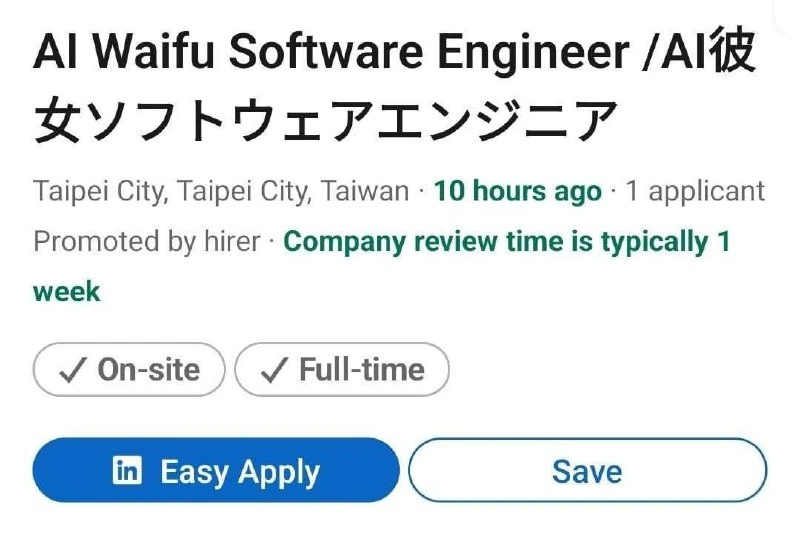
At this level, let’s break down what’s going on in simpler terms. The meme shows a LinkedIn job posting that looks authentic but is clearly a bit of a joke. LinkedIn is a professional website where companies post jobs – usually titles like “Software Engineer” or “Data Scientist.” Here, the title is "AI Waifu Software Engineer". To decode that:

  • AI means Artificial Intelligence. So they want someone who works with smart computer programs.
  • Waifu is a slang word from anime fandom. A waifu (a play on "wife") is what anime fans sometimes call their favorite female character – basically a make-believe girlfriend from a cartoon or game. It’s a humorous, nerdy term. So an "AI waifu" refers to an artificially intelligent girlfriend character.
  • Software Engineer is the standard term for a programmer who builds software.

The combination of these terms sounds funny. It implies the company wants a programmer to build a virtual girlfriend powered by AI. This is not a typical job you’d see every day! It blends a tech trend (AI assistants and chatbots) with anime culture (the idea of a waifu).

Now look at the details in the listing:

  • Taipei City, Taiwan: The job is located in Taipei. This is interesting because East Asia has a big anime and gaming culture, and also a strong tech industry. So developing an AI anime companion there isn’t too far-fetched.
  • 「AI彼女ソフトウェアエンジニア」: This Japanese text is the same title translated (AI kanojo software engineer). It literally means “AI girlfriend software engineer.” Including Japanese could mean they expect applicants who know Japanese or they want to appeal to people who love Japanese anime culture.
  • 10 hours ago · 1 applicant: The posting has been up for a short time and only one person has applied so far. That could be because it’s very new, or because not many people take it seriously or are qualified/interested. It’s a bit funny – you’d think something this hyped would have more applicants, but maybe folks are cautious or confused by it.
  • Promoted by hirer: This means the company paid LinkedIn to advertise this job post more widely. They are actively trying to get candidates (perhaps because it’s a niche role).
  • Company review time is typically 1 week: LinkedIn often shows how quickly a company usually responds to applicants. Here it says about a week. That’s a normal detail, meaning if you apply, you might hear back in a week. Not inherently funny, but seeing it under such a wild job title adds to the absurdity – like it makes the crazy job posting look officially routine.
  • Two tags “On-site” and “Full-time”: These describe the job nature. On-site means you have to work at the company’s location (no remote work from home). Full-time means it’s a regular permanent job, 40 hours a week or so. So they aren’t joking around – it’s not just a freelance gig; they want someone dedicated to this project, in the office.
  • The big blue “Easy Apply” button: On LinkedIn, this button lets you quickly apply with your LinkedIn profile. Right next to it is a “Save” button to bookmark the job. This interface is usually seen on any job ad. Showing it here makes the meme look like a real LinkedIn screenshot, which adds to the humor by grounding a silly idea in a familiar, serious context.

What’s being satirized?
Mainly, it’s poking fun at how AI is the hot trend in the tech industry and how companies sometimes chase bizarre ideas under the AI umbrella. Also, it highlights how hiring practices might target very specific interests. We often see AI in more sober contexts (like AI for finance, health, etc.), but here it’s AI for a “waifu”, which is kind of a geeky guilty pleasure concept.

For a junior developer or someone new to the tech scene, it helps to understand:

  • AI hype: Ever since breakthroughs like smart chatbots (think ChatGPT or voice assistants like Siri/Alexa), companies have been trying to apply AI everywhere. Some ideas are great, some are... odd. There have been AI apps for companionship: for example, apps where you text with an AI “friend” or “partner.” This job posting is basically about making one of those, but themed as an anime girlfriend to appeal to people who like that.
  • Anime culture in tech: A lot of tech folks are anime fans (the term weeb is slang for a non-Japanese person who’s obsessive about Japanese anime/games). It’s not unusual to see anime jokes or references in developer communities. This meme plays on that by making the job itself an anime reference. It’s like a little wink: only those who know what “waifu” means will get the joke immediately.
  • The humor in professionalism vs. absurdity: LinkedIn is where you expect dry corporate stuff. Seeing slang like “Waifu” on a site like that is like seeing someone wear a Pikachu costume to a business meeting – it’s a jarring contrast. That contrast creates comedy. It’s also a commentary on how the tech industry sometimes doesn’t take itself too seriously, or alternately, how it might take even silly-sounding stuff very seriously when money and trends are involved.

Imagine being a candidate reading this listing. If you have the right skills (machine learning, chatbot development, maybe some UX for virtual characters), and you also happen to love anime, you might think, “This is perfect for me!” It’s a niche intersection of interests. The meme implies that this is a very specific catch – hence maybe only one applicant so far. It also teases the idea: Is this really the future of work? Building emotional AI companions could be seen as innovative or as a sign that the tech world has run out of “normal” problems to solve.

In summary, Level 2 explains that the meme is a parody of a LinkedIn job ad that combines artificial intelligence trends with anime “waifu” culture. It’s funny to us because it’s presented in such a straight-faced, professional format. It’s like a hiring humor snapshot of how crazy and creative the tech job market can get when a trend (like AI) goes into overdrive.

Level 3: Algorithmic Anime Allure

Why is a serious job site advertising an "AI Waifu Software Engineer"? This meme mashes up AI hype with otaku culture, and it’s both hilarious and telling. On LinkedIn – typically a buttoned-up professional network – we see a posting literally titled "AI Waifu Software Engineer / AI彼女ソフトウェアエンジニア". A senior developer immediately recognizes this as a quirky product of the current AI/ML gold rush. The company (location: Taipei) is presumably building an AI-powered virtual companion – essentially a digital anime girlfriend. The humor lies in how tech industry trends have escalated: we’ve gone from apps and chatbots to startups earnestly seeking engineers to craft synthetic romantic partners. It’s a cocktail of AI hype vs reality and niche fandom.

From an experienced perspective, several things stand out:

  • Buzzword Job Titles: In past years, we saw goofy titles like "Rockstar Developer" or "Code Ninja" in job listings. This takes it up a notch – invoking "Waifu", a term from anime fandom, in a formal role. It’s satirical yet plausible in 2025’s climate. After crazes in crypto, VR, and NFTs, AI is the new magic sauce. Companies slap "AI" on everything, even a 恋人 (sweetheart) simulator. It’s part tech industry satire and part genuine attempt to lure talent who find the idea cool. The weeb recruitment angle (appealing to anime enthusiasts in tech) is real: many devs have anime avatars and stickers on laptops. This listing practically screams, “Hey anime geeks, dream job here!”

  • The Product Vision: Building an AI waifu means creating an artificial persona that can engage emotionally with users. Technically, that likely involves a Large Language Model (LLM) or similar AI trained on massive dialogue datasets (perhaps including romantic anime scripts or VN dialog). Think of a custom GPT-style model fine-tuned to behave like a charming anime character. The engineer would need skills in natural language processing, conversational AI, maybe even voice synthesis and avatar animation to give the waifu a voice and face. It’s a multidisciplinary challenge: blending machine learning with storytelling. A senior dev knows how tough it is for an AI to maintain a consistent persona. Ensuring the AI girlfriend is always lovable and doesn’t veer into creepiness or incoherence is a serious AI alignment problem (though it's darkly funny to imagine a production incident: “Sev-1: Waifu bot went yandere on a user!”).

  • Hype vs. Execution: Veterans have seen hype cycles. Today’s AI hype makes investors chase wild ideas. An AI partner startup in Taipei might have funding to hire engineers, but can they deliver on the fantasy? The meme’s screenshot shows "1 applicant" in 10 hours despite being Promoted by hirer, which could be poking fun: even in a hot market, a posting this quirky might not get flooded with resumes. It’s possibly a fresh listing – or maybe most engineers read it and chuckle, unsure if it’s real. A seasoned engineer might think: “Is this the future of work or just an anime fever dream?” The meme’s title asks that pointedly. Given how hiring practices follow trends, it could be both – a serious attempt that also feels like a parody.

  • Cultural Context: The inclusion of Japanese text 「AI彼女ソフトウェアエンジニア」 (which literally means "AI Girlfriend Software Engineer") hints the company is steeped in anime culture or targeting a Japanese-speaking market. Taipei’s tech scene is notable – Taiwan has strong tech talent and is geographically and culturally close to Japan. A senior dev who’s been around might recall projects like Gatebox (a Japanese holographic anime assistant) or Microsoft’s Xiaobing in China – early attempts at digital companions. Those had cult followings but also limitations. Now, with advanced AI, the dream is rekindled. The meme is funny because it highlights how career postings are not immune to pop-culture absurdity. It’s a bit of tech industry humor: mixing Silicon Valley’s hyper-innovation mindset with otaku dreams.

In sum, Level 3 sees the meme as commentary on the AI/ML hiring frenzy, where even something as outlandish as coding a cartoon girlfriend becomes a legitimate job. It tickles engineers who’ve weathered fad after fad – from “we need a blockchain for this” to “we need an AI waifu for that.” It’s absurd, yet here we are. The laughter comes with a knowing sigh: this is what 21st-century problems have come to.

Description

A screenshot of a LinkedIn job listing with the title 'AI Waifu Software Engineer / AI彼女ソフトウェアエンジニア' (the Japanese translates to 'AI Girlfriend Software Engineer'). The location is Taipei City, Taipei City, Taiwan, posted 10 hours ago with 1 applicant. It's promoted by hirer with 'Company review time is typically 1 week'. Tags show On-site and Full-time. The listing has LinkedIn's 'Easy Apply' and 'Save' buttons. This captures the absurdity of the current AI job market where roles are being created for building AI romantic companions

Comments

15
Anonymous ★ Top Pick Finally, a role where 'works well with others' on your resume can be replaced with 'works well at creating others' -- and the only coworker who'll never leave a passive-aggressive Slack message
  1. Anonymous ★ Top Pick

    Finally, a role where 'works well with others' on your resume can be replaced with 'works well at creating others' -- and the only coworker who'll never leave a passive-aggressive Slack message

  2. Anonymous

    The single applicant is probably a principal engineer who has already built three of these as side projects and is just looking for seed funding

  3. Anonymous

    Finally, a position where my decade of recommender-system tuning and my embarrassingly thorough anime trope taxonomy qualify as the same line item under “preferred experience.”

  4. Anonymous

    Finally, a job posting that acknowledges what half the AI industry is actually building - virtual companions with questionable emotional boundaries. At least they're being honest about the 'on-site' requirement; can't debug parasocial relationships from home

  5. Anonymous

    When your company's AI ethics committee asks 'what could possibly go wrong?' and your answer is 'we're literally hiring engineers to build AI waifus' - you know you've reached peak 2024 tech industry absurdity. The real question is whether the 1-week review time includes a technical interview on anime tropes or just a standard system design round for emotional attachment algorithms

  6. Anonymous

    Translation of the JD: ship a parasocial LLM with persona consistency, 99.9% reassurance uptime, and a cache-invalidation strategy for grudges - because eventual consistency doesn’t cut it in relationships

  7. Anonymous

    Finally a role where the SLA is 99.9% affection availability and the DR plan restores anniversaries from the vector DB - aka RLHF: Reinforcement Learning from Heartbreak Feedback

  8. Anonymous

    Finally, a gig where overfitting isn't a bug - it's the entire feature spec

  9. Deleted Account 10mo

    Promoted by hirer👍

  10. @SomeWhereIBelong 10mo

    Do they want ai waifus that are software engineers or software engineers who will make ai waifus?

    1. dev_meme 10mo

      Yes

    2. @M4lenov 10mo

      What would the former be paid in

      1. @SomeWhereIBelong 10mo

        Kisses

      2. @DavidGarciaCat 10mo

        it's a waifu, so... guess 😏

    3. @vadiohead 9mo

      Why not both

Use J and K for navigation