Skip to content
DevMeme
1624 of 7435
Semicolons Everywhere
Languages Post #1815, on Jul 30, 2020 in TG

Semicolons Everywhere

Why is this Languages meme funny?

Level 1: Tiny Dots Everywhere

Imagine learning to write sentences in one classroom where every sentence just ends when the line ends. Then you move to another classroom where every sentence must end with a special little mark, and the teacher notices every time you forget it. The meme is funny because the programmer suddenly sees those little marks everywhere and cannot unsee them.

Level 2: Statement Endings

A semicolon, written as ;, often tells the compiler or interpreter, "this statement is finished." In Java, for example, a line like int count = 3; needs the semicolon at the end. Python usually does not require that because a newline normally ends the statement.

That is why the meme feels familiar to anyone moving from Python into a C-style language. In Python, you write code that often looks clean and sentence-like. Then you open another language and suddenly every instruction seems to carry a little punctuation tail. Buzz is acting as if this is a majestic new universe; Woody's worried face is the beginner realizing they now have one more tiny thing to forget.

This is also where linting rules and style guides appear. Linters are tools that check code style and possible mistakes. They may enforce whether semicolons are required, forbidden, or consistently placed, because consistent syntax makes large codebases easier to scan and maintain.

Level 3: Punctuation Shock

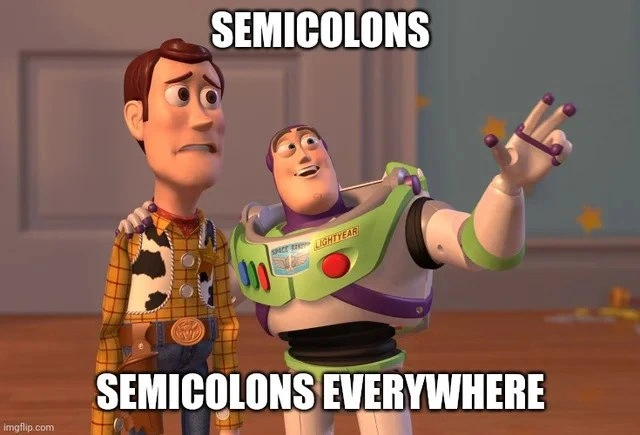
The image shows Buzz grandly presenting the world while Woody looks uneasy, with the captions:

SEMICOLONS

SEMICOLONS EVERYWHERE

The post text frames the joke as "After the switch from python to almost any other language," which is exactly the culture shock: Python uses indentation and newlines as major syntax signals, while languages like Java, C, C++, C#, PHP, and much of JavaScript culture lean on ; as a statement terminator. The meme turns a tiny punctuation mark into an invasive species.

The senior-dev angle is that semicolons are not merely cosmetic. They encode a language's parsing philosophy, tooling assumptions, and inherited history. C-family languages inherited a style where statements are explicitly terminated, which makes code less dependent on line breaks but more visually punctuated. Python chose significant whitespace, which makes layout part of syntax and removes a lot of punctuation noise, but introduces its own "why is this block indented like that?" failure mode. Pick your ritual; the compiler demands tribute either way.

The humor also hits CodeQuality and CodeFormatting because teams love turning semicolons into policy. In Java, omitting one is usually just invalid. In JavaScript, semicolons are optional in many places because of automatic semicolon insertion, which means style guides and linters can become tiny constitutional conventions. One team mandates semicolons, another forbids them, and both believe civilization depends on their side being enforced in CI.

Description

The meme uses a Toy Story scene where Buzz Lightyear gestures broadly while Woody looks uneasy, with bold white impact-font captions. The top text reads "SEMICOLONS" and the bottom text reads "SEMICOLONS EVERYWHERE," with a small "imgflip.com" watermark in the lower left. The technical context is programming language syntax and style, especially languages or teams where semicolons appear after nearly every statement. The joke points at how punctuation-heavy code can feel visually noisy, and how style conventions can become as much a cultural marker as a parser requirement.

Comments

1
Anonymous ★ Top Pick A semicolon policy is just architecture governance compressed into one byte.
  1. Anonymous ★ Top Pick

    A semicolon policy is just architecture governance compressed into one byte.

Use J and K for navigation