Google’s “in-demand languages” list adds French alongside Python and Java
Why is this Languages meme funny?
Level 1: One of These Is Not Like the Others
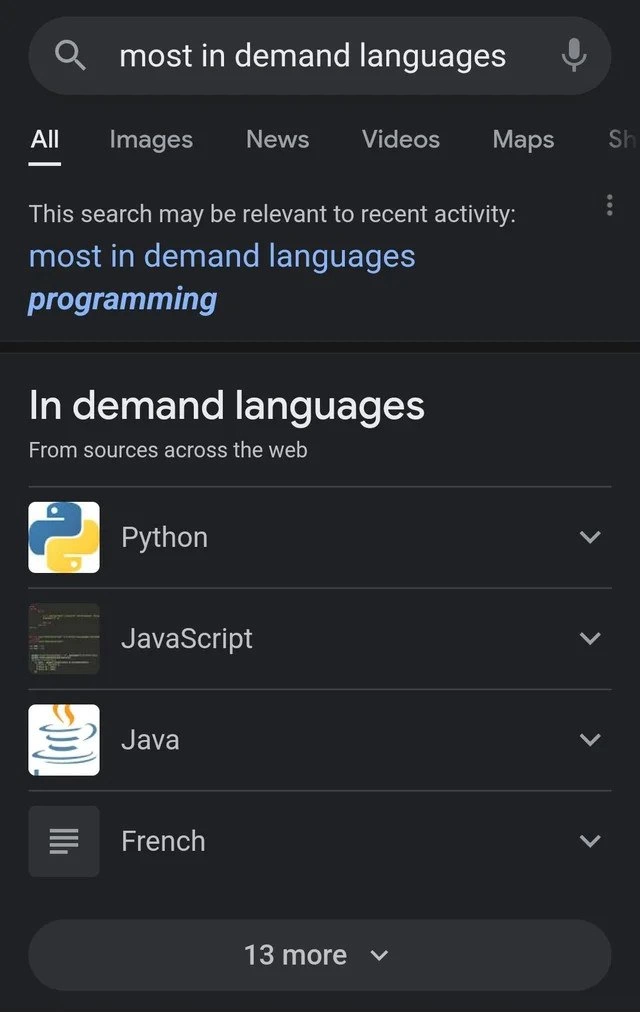
Imagine you ask, "What are the most popular languages I should learn?" You're thinking about languages for coding, like the special computer codes used to make games or websites. The answer you get starts off as expected: it says Python, JavaScript, Java – those are like the big famous coding languages (kind of how English and Spanish are big famous speaking languages in the world). But then the list suddenly includes French, which is a language people speak, not a coding language at all. It's a bit like asking "What are the best pets to have?" and someone answers, "Dogs, Cats, Goldfish... and Broccoli." Broccoli is not a pet, right? It just doesn't fit in that list!
We find this funny because one of the things in the list doesn't belong with the others. Google (the search engine) got two meanings of "language" mixed up. Three of the items are languages for talking to computers, and one is a language for talking to people. That's a silly mix-up. It shows that even a super smart computer can make a goofy mistake and put something from the wrong category into the group. The surprise of seeing French next to Python and JavaScript makes us laugh because it's so out of place. It's like if you were in class learning about coding and someone suddenly answered in French by mistake – everyone would giggle at the misunderstanding. In simple terms: the joke is that Google confused a coding language with a spoken language, and seeing them jumbled together in one list is just plain silly and amusing.
Level 2: Coding vs Speaking
Let's break down why that Google result is funny by explaining the terms. When we say Python, JavaScript, and Java in a tech context, we’re talking about programming languages. A programming language is a special language that developers use to write instructions for computers. For example, Python (not the snake 🐍, but named after the comedy group Monty Python) is used for all sorts of software development, from web apps to data science. JavaScript is the language that makes websites interactive and is basically everywhere on the web (you can't avoid it if you're doing web development). Java (the one with the steaming coffee cup logo) is a long-established programming language often used in large business systems and Android apps. These three are among the top languages employers look for in developers – they consistently rank high in demand for coding jobs. So if someone asks "what are the most in-demand languages?" in the context of programming, you'll typically hear Python, JavaScript, Java, and maybe others like C#, C++ or Go depending on the year. That covers the programming side of language popularity.
Now, on the other hand, we have French. French is not a programming language at all; it's a human language (a real-world language spoken by people in France, parts of Canada, and other countries). Normally, if someone asks about "in-demand languages" without saying "programming", they might mean which spoken languages are valuable to know for jobs or travel. In that case, languages like French, Spanish, Mandarin Chinese, or German often come up as useful to learn. For instance, a company might say "We really need employees who speak French" if they have clients in French-speaking regions. This is a common topic in the Career_HR world – which foreign languages can boost your job prospects.
What happened in the meme is that Google’s search results mixed up these two ideas. The query "most in demand languages" is a bit vague: does it mean coding languages or spoken languages? Google ended up giving an answer that accidentally combined both. The list of "In demand languages" on that screenshot first shows three programming languages (Python, JavaScript, Java) which belong to the coding world, and then one spoken language (French) which belongs to the everyday spoken language world. That mix is unexpected and funny to see. Essentially, Google treated the word "language" in two ways at once.
To a newer developer or someone not in tech, let's clarify why that's amusing. Think of it this way: Python, JavaScript, and Java are languages we use to talk to computers and make programs. French is a language we use to talk to other people. Both are called "languages" because they involve symbols and grammar, but they are totally different in use. You normally wouldn't see them listed together because you don't use French to write code (your computer wouldn't understand French sentences as instructions!) and you don't use Python to order a coffee in a café. It's a bit of a category mistake.
Google usually knows the difference if you specify. For example, if you had searched "most in demand programming languages," you'd get just coding languages, or if you searched "most in demand foreign languages," you'd get just human languages. In the screenshot, Google even suggested the word "programming" in blue text to guide the search – it was trying to help clarify. But the funny part is the result still lumped one human language in with the programming ones. So it's like the question wasn't clarified enough and the answer decided to cover both bases, just in case.
In summary, Python, JavaScript, and Java are examples of coding languages that are very popular in tech jobs right now. French is an example of a spoken language that's popular to learn for communication and some jobs. Both types of "language" are great, but seeing them on the same list is unusual. We laugh at the meme because Google accidentally put a spoken language (French) in a list with computer languages. It's a mix-up of categories — kind of like listing a bicycle as one of the top cars. It just makes you pause and say, "Wait, that doesn't belong there!", which is exactly why it's funny.
Level 3: Full-Stack Polyglot
This meme strikes a chord with seasoned developers because it plays on our expectations of what "in-demand languages" means in a tech career. Usually, when we see a ranked list of languages like Python, JavaScript, and Java, we nod along – these are the usual suspects in any "top programming languages" discussion. Then suddenly French pops up as #4, and we do a double-take. The humor comes from that one-of-these-things-is-not-like-the-others moment. Even Google’s own interface seems to be confused: three programming languages with their familiar tech logos, followed by French with a generic icon as if to say "uh, not sure what image to put here". It's an instant tip-off that something got mixed up, eliciting a knowing chuckle from developers.
The combination of programming vs. human language here is a classic context clash. In the software world, the term "language" almost always means a coding language unless specified otherwise. The developer community is constantly discussing language popularity and doing language comparison – from Stack Overflow surveys to TIOBE index rankings, we track which coding languages dominate the job market. Seeing those popularity charts is normal. But slipping a spoken tongue like French into that chart is like a punchline to a long-running joke. It's as if the notorious language wars (those endless debates about which programming language is superior) were photobombed by a random human language. Imagine a serious panel on "Python vs. Java for enterprise apps" and suddenly someone interjects, "But what about French?" It's absurd, and that's why it's funny.
There's also a touch of career humor here. Developers often fret about which languages to learn for better CareerGrowth. Articles from the career and HR world frequently advise, "Learn Python, JavaScript, etc. to get hired." Sometimes, in more general contexts, they also say, "Learn Chinese or French to boost your prospects in international business." Google essentially mashed those together. An experienced engineer might joke, "Maybe my resume needs to say I'm bilingual in Java and French now." In fact, some job postings do list both kinds of languages as requirements (for example, a developer role in Montreal might require JavaScript skills and proficiency in French). So this search result feels like an over-literal HR wish list: "Wanted: Software developer. Must know Python, JavaScript, Java, and French." It's exaggeration comedy that plays on something just plausible enough to tickle us.
The DeveloperHumor here also lies in imagining how such a suggestion came to be. We trust Google to distinguish tech queries, so when it flubs like this, it's endearing. Seasoned devs have seen their share of bizarre auto-complete suggestions or search results, but this one hits home because it involves our beloved programming languages. We can almost picture the Google algorithm as an innocent intern mixing up two spreadsheets. One list was the top coding languages of 2022, the other list was top foreign languages to learn, and they accidentally merged them. The outcome: a mixed bag ranking that makes engineers smirk. Some folks quipped that they were going to start coding in French, or that Google might be hinting at a new programming language named "French" (perhaps with syntax like bonjour { ... } instead of function or def). Others joked about libraries like francophone.js or a framework named Château (because if we have Django and Rails, why not a French castle?). These tongue-in-cheek reactions show how the community takes a small tech hiccup and spins it into a running joke.
From an organizational standpoint, it also lightly satirizes how non-technical people sometimes conflate categories. We've all seen LinkedIn profiles or resumes where a candidate lists "Languages: Java, Python, Spanish, French" all in one place. As senior devs or hiring managers, we chuckle and then clarify that usually we separate programming skills from spoken language skills. Google merging those lists feels like it made the same novice mistake. It's TechHumor meets HR humor. The fact that it came from Google, a leader in AI, just makes it richer — it's an "even the big guys get tripped up" scenario we can all appreciate. No real harm done, just a fun reminder that context is king. In the end, this meme is a lighthearted nod to how broad the word "language" is, and how even brilliant systems can create a hilarious mishmash by not narrowing things down. For those of us with years in the industry, it's a chance to laugh both at Google’s little autocomplete misunderstanding and at our own habit of obsessively ranking programming languages in the first place.
Level 4: Semantic Search Snafu
At the deepest level, this meme highlights a fascinating quirk in Google's search algorithms when dealing with ambiguous queries. The phrase "in demand languages" has a polysemy predicament: the term language can mean a programming language or a natural human language. Modern search engines use sophisticated Natural Language Processing (NLP) (it's not just simple keyword matching anymore!) to interpret user intent. Here, Google is employing a semantic approach, likely tapping into its Knowledge Graph—a massive network of facts and entities—to compile an answer. The interface says "In demand languages – From sources across the web," which implies an algorithm aggregated a list of "languages" ranked by demand from various pages. The snafu is that it didn't fully disambiguate the query context. Essentially, the search result fused two different categories: one list from tech job articles (programming languages like Python, JavaScript, Java), and another from general career advice (spoken languages like French). Even though the suggestion just below the search bar narrowed it to "most in demand languages programming", the assembled answer still straddled both interpretations.
Under the hood, Google likely identified "languages" as the key entity but struggled to decide between the "programming skills" context versus "spoken language skills". Notice the hint "This search may be relevant to recent activity: programming". The algorithms knew the user had a coding interest, so one might expect it to stick with coding languages. Yet the inclusion of French suggests the ranking system decided to hedge its bets. Possibly, multiple high-ranking pages for that query covered different domains, so Google's blended result tried to satisfy both. It's like the search engine performed a context union instead of a strict context filter. The list ended up with an outlier that made us do a double-take.
We can imagine a simplified scenario of how such a mix-up might occur in code:
programming_langs = ["Python", "JavaScript", "Java", "C#"] # from tech job sources
spoken_langs = ["English", "Spanish", "Mandarin Chinese", "French"] # from language learning sources
# The algorithm mistakenly merges both contexts:
in_demand = programming_langs[:3] + [spoken_langs[3]]
print(in_demand)
# Output: ['Python', 'JavaScript', 'Java', 'French']
Here we hypothetically combine the top 3 coding languages with one popular human language. The real Google algorithm is far more complex, but conceptually it did something analogous by merging results from different clusters of search intent. This kind of semantic blending occurs because Google prioritizes breadth: it doesn't want to miss relevant info in case the user meant either interpretation.
This deep dive reveals a truth about NLP in search: understanding context is hard. Search engines build giant webs of knowledge, but some nodes like "language" connect to multiple subgraphs (programming languages vs. spoken tongues). If the entity resolution isn't precise, you'll see cross-overs like this. Interestingly, one branch of AI is all about teasing apart such meanings. Google usually nails it (thanks to years of machine learning on queries), but even this high-tech system can have a "Tower of Babel" moment, where the lines between languages (in different senses) get hilariously crossed. It's a reminder that even cutting-edge AI can occasionally mix its metaphors — or in this case, its languages!
Description
Dark-mode mobile Google search screenshot shows the query text "most in demand languages" in the search bar. A blue suggestion beneath reads "most in demand languages programming." Below, a results card titled "In demand languages - From sources across the web" lists four expandable rows: 1) Python with the yellow-blue snake logo, 2) JavaScript with a code snippet thumbnail, 3) Java with the steaming coffee-cup logo, and 4) French with a generic layered-text icon. The juxtaposition of three programming languages and one spoken language creates developer humor about search algorithms conflating job-market demand for coding skills with human language fluency
Comments
6Comment deleted
New JD just dropped: full-stack polyglot - Python, JavaScript, Java, and enough French to debug the 15-year-old comments that insist “ceci n’est pas un bug.”
When your kid asks what language to learn for their future and Google's already decided they're getting a CS degree, not studying abroad in Paris
When you're researching which programming language to learn for your next career move and Google suggests French - because apparently, surviving legacy enterprise codebases requires fluency in both COBOL and conversational surrender. The algorithm isn't wrong though; after debugging production issues at 3 AM, 'sacré bleu' becomes the most in-demand expression in any language
Top languages: Python, JavaScript, Java… and French. The modern polyglot stack: CPython, Node, JVM - and BCP47: fr-FR for the requirements
Google’s intent classifier clearly optimized for recall: union(programming_languages, human_languages) → French in prod; I guess our stack is polyglot in two senses now
When job reqs demand 'strong communication skills' and Google delivers French - finally, a polyglot stack