Diagnosed with burnout, developer instantly adds recovery to their task backlog
Why is this MentalHealth meme funny?
Level 1: Rest Is Not a Task
Imagine you’ve been playing hard or doing homework for days without a break, and you’re so tired that a doctor or teacher says, “You’re exhausted, you really need to rest.” Now picture responding to them by asking, “Okay, but how long will it take for me to be not tired? I have a lot of chores and homework to do.” The doctor would probably just look at you, speechless. This meme is just like that. It’s funny because the person (a developer, who writes computer programs) thinks of getting better as if it’s something you can schedule and squeeze in quickly, like finishing one more assignment. It’s as silly as a kid with a broken leg asking, “Can you fix it by tomorrow? I don’t want to miss my soccer game.” We all know you can’t rush healing a broken leg or recovering from being burned out (which means totally worn out and drained). You actually have to take a break and give yourself time. The joke here is showing how sometimes grown-ups, especially those who work very hard on computers, forget that. They treat resting and feeling better like it’s just another item on their to-do list. It makes us laugh a bit, and maybe shake our heads, because it’s a reminder that no, not everything in life can be checked off like a task — especially not your health and happiness. Sometimes you just have to stop and rest, no matter how many things you think you need to do.
Level 2: The Self-Care Ticket
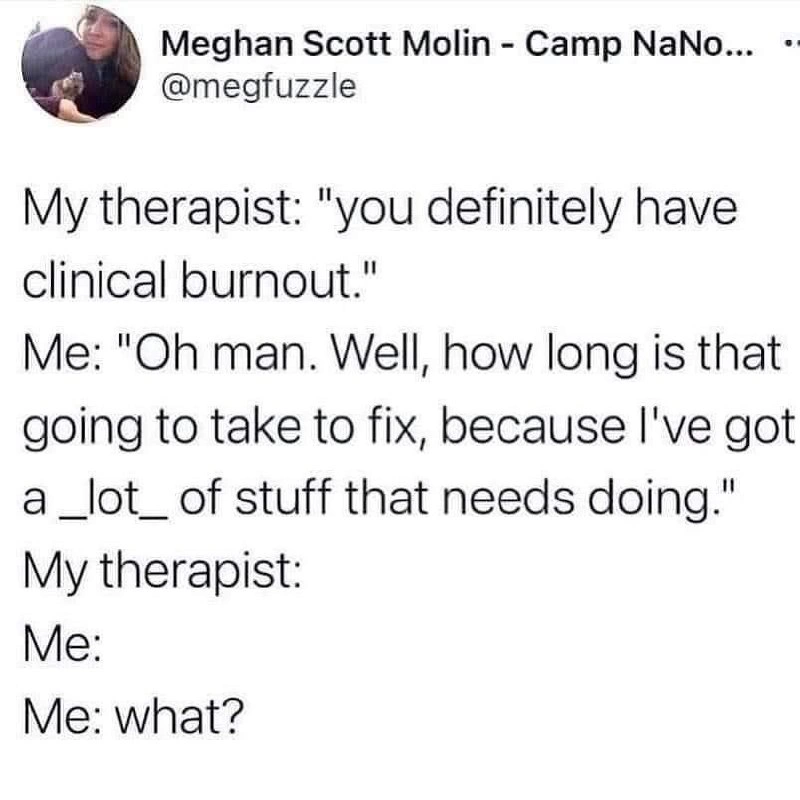
At its core, this meme shows a conversation between a therapist and a software developer about burnout. Burnout in plain terms is extreme exhaustion (mental, emotional, and physical) caused by being overworked or stressed for a long time. The therapist tells the developer, “You definitely have clinical burnout.” That means a professional is saying the developer’s exhaustion and stress are so serious that it’s a real health issue, not just “feeling a bit tired.” In normal circumstances, being told you have burnout is a sign you should slow down and take care of yourself. But the developer’s reaction is the funny (and troubling) part: they basically say, “Oh man. Well, how long is that going to take to fix? I’ve got a lot of stuff that needs doing.” In other words, instead of realizing “I must stop working and recover,” the developer immediately worries about how recovery will fit into their work schedule.
To a junior developer (or anyone new to tech), let’s break down why this is such a relatable developer experience and why it’s amusing in a bittersweet way. Developers often work with a task backlog – which is a fancy term for a big to-do list of all the tasks, bugs, and features that need to be completed. If you’ve used project tools like Jira, Trello, or Asana, you know that tasks are tracked as tickets or cards in a backlog. There are always more tasks coming in than going out; the backlog can feel endless (which is why we say task_backlog_overload when it’s really jam-packed). Developers usually plan their work in sprints (short periods, like one or two weeks, where a set of tasks from the backlog are tackled). They’re used to estimating how long a task will take and then moving on to the next thing. This is the normal workflow in software teams to maintain DeveloperProductivity and meet Deadlines.
Now, here’s the twist: the developer in the meme treats recovering from burnout as if it were just another task on that backlog. It’s as if they opened their to-do list app and added a new item: “#42 – Recover from burnout (estimate: 3 days).” This is what we’d call the self_care_ticket approach – turning self-care into a ticket. It’s funny because it’s an exaggeration of how developers think. Engineers are problem solvers. When they encounter a problem, even if it’s personal or emotional, their reflex is often “how do I fix this, and how long will it take?” Here, burnout is the “problem” and the developer asks for a timeline to “fix” it, just like they’d ask “how long to fix this bug?” or “what’s the ETA on that feature?”
The therapist’s stunned silence in the tweet (represented by those blank lines “My therapist: [nothing]”) is basically them being speechless. Why? Because in real life, you can’t fix burnout in a quick, scheduled way like you fix a coding bug. Recovering from burnout might require weeks or months of rest, changes in work habits, maybe even therapy sessions or a break from work – none of which fit neatly into a tight schedule. The developer saying “I’ve got a lot of stuff that needs doing” shows they feel pressure to keep working despite the diagnosis. This reflects a common issue in tech jobs: DeadlinePressure and a huge workload can make developers feel guilty or anxious about taking time off, even when they’re very stressed or ill. It’s a form of DeveloperAnxiety – worrying about falling behind or letting the team down if they don’t keep up their pace.
For someone newer to the industry, it might help to know that MentalHealthInTech has become a big talking point. The tech industry is known for high workloads, crunch times (like rushing to meet a release), and sometimes a culture of “always be hustling.” Many companies now encourage employees to take care of their mental health, take vacations, and practice StressManagementInTech. They might share WorkLifeBalanceTips like “make sure to log off at 5 PM” or “don’t push code on weekends.” However, despite these tips, it’s common for developers – especially those who love their work or feel responsible for a project – to ignore those boundaries. They might work late nights, respond to emails on weekends, or skip breaks when immersed in coding. Over time, that can lead to burnout, which is exactly what happened to the person in the meme.
This meme is technically about a developer’s mindset. It doesn’t require deep knowledge of programming, but understanding the work culture helps. When the developer asks the therapist “how long is that going to take to fix,” it’s funny in a facepalm way. They are treating a serious personal health issue like a quick code fix. It’s like going to a doctor who tells you “you need plenty of rest” and replying, “Sure, doc, I can fit that in between Tuesday’s and Wednesday’s meetings, will that cure me?” The reason fellow developers chuckle at this is because many of us have had that thought: trying to schedule our well-being around work, instead of the other way around. We know logically that’s not how recovery works, yet the pressure of unfinished tasks can trick us into thinking that way. This tweet is basically a gentle roast of that flawed logic we sometimes fall into. By phrasing it as a direct conversation, it highlights the absurdity: the external perspective (therapist) versus the developer’s internal drive to keep coding no matter what.
In summary, for a junior dev: the meme humorously educates us that burnout is real and you can’t just treat it like a bug fix or a quick task. It uses a bit of irony – the developer knows something is wrong (they acknowledge “Oh man” when told of burnout) but immediately flips back to work mode, as if asking “Can I get a patch for that by next week? Because sprint deadlines.” Every element is rooted in tech life: developer productivity culture, overloaded backlogs, and the need for work-life balance. It’s a reminder (wrapped in a joke) that even if you love coding, you’re not a machine. If you overload yourself, you eventually hit a limit where you need to pause and recover – and that recovery isn’t just another Jira story you can complete on a tight timeline. The therapist’s reaction says it all: that’s not how any of this works. And that little dose of reality, served with humor, is what makes the meme resonate.
Level 3: Sprinting into Burnout
This meme hits senior developers right in the DeadlinePressure feels. It’s a darkly comic snapshot of MentalHealthInTech gone awry: a developer is diagnosed with clinical burnout by their therapist, and their knee-jerk response is essentially, “Can we fix that ASAP? I’ve got features to ship.” The humor is equal parts absurd and RelatableDeveloperExperience. Seasoned engineers recognize this as a satirical mirror of tech culture’s flawed logic: treat every problem — even DeveloperBurnout — like a Jira ticket you can close in the next sprint. The tweet format (therapist’s statement, then the dev’s reaction, followed by the therapist’s stunned silence) perfectly encapsulates that awkward realization when an outsider (the therapist) witnesses how warped our priorities have become. The therapist’s silence is basically the facepalm we in the tech community should be doing ourselves: did this coder really just ask for an ETA on burnout recovery? Yup, they did, and it’s painfully on-brand.
Under the hood, this meme is poking fun at a serious DeveloperProductivity anti-pattern. Many experienced developers have been conditioned to handle everything as a task with a deadline. Production bug? Patch it by EOD. New feature request? Cram it into the sprint. Feeling mentally exhausted and on the verge of collapse? Just add a “self-care” task to the backlog and keep grinding. It’s the same mindset that leads to heroic all-nighters and that burnout-driven development cycle. The phrase “I’ve got a lot of stuff that needs doing” screams task_backlog_overload – an endless backlog that only grows. The dev in the meme has effectively turned self_care into a ticket (self_care_ticket), expecting to squeeze burnout recovery into a two-week sprint alongside code reviews and deploys. It’s a perfect illustration of how engineers, under relentless DeadlinePressure, can lose perspective and treat their own health as just another item in the GitHub issues queue.
This scenario is funny to us seniors because it’s too real. We’ve seen colleagues (or ourselves) react exactly like this. Your brain is fried, you’re logging 12-hour days, you haven’t taken a vacation in a year, and when someone (maybe an HR rep or a therapist) says “you need a break,” your first thought is, “Sure, I’ll take a break… right after I finish these 5 urgent code reviews, refactor that module, and meet Friday’s release cutoff.” The DeveloperFrustration here is that taking care of yourself starts to feel like a project with a scope and timeline. And let’s be honest, in a mismanaged environment, an engineer announcing they need time off for burnout recovery might as well be declaring a production outage – it’s treated with the same startled silence as the therapist’s in the meme. Management might respond with a blank stare (much like the tweet’s therapist character) because there’s no easy fix or Hotfix for burnout. Unlike a memory leak bug, you can’t just allocate a bit more swap space (or coffee) and keep the system (your brain) running indefinitely.
In fact, the meme cleverly highlights an underlying industry joke: developers often believe they can optimize their personal lives like they optimize code. If something’s broken, we look for a patch. If we’re short on time, we implement a quick hack to get through. Need to recover from burnout? Let’s estimate that as a 2-week sprint, assign it story points, and get it to Done. To a seasoned dev, that thought process is equal parts laughable and distressing. We know that stress_management_in_tech isn’t as simple as a GitHub issue checklist. Burnout is not a P1 bug you can squash with an all-night coding session. Yet, the culture of DeveloperAnxiety keeps us stuck in this loop: we’re anxious about falling behind on tasks, which fuels overwork, which breeds more burnout. The tweet’s silent therapist is basically the rest of the world looking at techies and saying “...seriously?”
Let’s talk context: clinical_burnout is a real condition (World Health Organization recognizes it) stemming from chronic workplace stress. In dev terms, think of it as your CPU hitting 100% utilization consistently until the thermal throttling kicks in — productivity plummets and errors spike. A therapist diagnosing someone with clinical burnout is like a system monitor flashing critical red alerts. But our developer here treats it like just another alert that can be snoozed. This is a classic case of hustle culture in tech: even when faced with a hard stop (a health crisis), the instinct is to push through. As a grizzled engineer might note with a smirk, “Of course they asked how long to fix it. That’s exactly what years of unrealistic deadlines train you to do.” We’ve internalized that anything can be resolved with enough effort and a short timeline. Got a production outage? Roll up your sleeves and fix it before users notice. Got a personal meltdown? Same strategy, apparently — fix it before the next sprint starts. It’s an absurd extension of the “can-do” attitude gone into overdrive.
The Deadlines category here is key. In agile software development, work is planned in sprints (short, intense work cycles, often 1-2 weeks long). There is an implicit idea that after a sprint, you catch your breath, but in many companies the sprint backlog is immediately followed by the next sprint’s backlog with no real rest. It’s like running a marathon in 26 mini-sprints without pausing. As any seasoned dev knows, that’s a one-way ticket to burnout. We even have gallows-humor acronyms like “PPP” (Pills, Pizza, and Pepsi) or the joke that SCRUM stands for **“Stress, Crisis, and Unending Meetings.”* It’s funny because it’s a coping mechanism — we laugh so we don’t cry. This tweet falls right into that vein: it satirizes how developers (and the tech industry at large) often ignore the WorkLifeBalanceTips they preach. The company might send out a newsletter on meditation and Work-Life Balance, but when the sprint is on the line, suddenly that “take regular breaks” advice is strikethrough in real life.
Notice the details: the tweet is by Meghan Scott Molin, and it’s formatted as a dialogue. This therapist meme style is popular in tech circles because it juxtaposes a professional giving sage advice with a techie responding in comically misguided ways. The absence of any reply from the therapist (just blank lines) emphasizes how flabbergasted a normal person would be by the developer’s response. It’s basically the therapist saying nothing, which speaks volumes: how do you even begin to explain that recovery isn’t a sprint task? For a senior dev reading this, the humor also lies in imagining that awkward therapy room moment. We can practically hear the clock ticking in the silence as the therapist tries to process the absurdity. It’s the same pause you get when you tell your non-tech friends you worked through your whole vacation — they just stare at you, wondering if you’ve lost it.
Ultimately, this meme resonates in the dev community because it’s an exaggerated reflection of reality. Everyone with a few years in the trenches has seen DeveloperBurnout cases or felt one coming. We joke about it (“haha, I’ll sleep when the project ships”), but it’s a serious issue. The tweet’s punchline “Me: what?” after the silence implies the developer genuinely doesn’t get why their reaction is concerning. That’s the scariest part — we’ve normalized this behavior. MentalHealth in tech often takes a backseat to shipping the next feature. The meme forces a chuckle that’s a little uncomfortable because it hits a truth: too many of us are adding “recover from burnout” to our to-do lists instead of actually doing it. It’s a wry commentary on how twisted priorities can get when you’re deep in the code mines. As a battle-scarred coder might cynically say, “Burnout? Just another day at the office. I’ll handle it after the deploy.” And that, folks, is why this meme is funny, sad, and utterly on point all at once.
// The developer's approach to self-care, as implied by the meme:
backlog.push("Recover from burnout");
console.log("New backlog:", backlog);
// Output: New backlog: ["Feature XYZ", "Fix bug #123", "Write tests", "Recover from burnout"]
// It's added to the list... but will it ever get done?
Description
Image is a cropped screenshot of a tweet on a white background. The tweet shows the user name “Meghan Scott Molin - Camp NaNo…” with handle “@megfuzzle” and a small circular profile photo on the left. The text of the tweet reads: “My therapist: "you definitely have clinical burnout." Me: "Oh man. Well, how long is that going to take to fix, because I've got a _lot_ of stuff that needs doing." My therapist: Me: Me: what?” The humor comes from the abrupt silence after the therapist’s diagnosis, highlighting a developer’s tendency to treat personal wellbeing like another ticket in an already overloaded sprint. Technically relevant because clinical burnout, deadline overload, and task backlogs are common issues for engineers juggling heavy workloads and unrealistic delivery schedules

Comments
19Comment deleted
Therapist marked my burnout as a P0, but the roadmap’s booked through Q4 with “strategic initiatives,” so self-care just got triaged next to “finish strangling the monolith” - ETA: the heat death of the JVM
Ah yes, the classic senior engineer approach to burnout: 'Just give me the ETA for the hotfix so I can schedule it between my 14-hour debugging session and the production incident at 3am. Maybe we can parallelize the recovery process across multiple threads?'
Classic developer response to burnout: immediately trying to estimate the sprint velocity for mental health recovery and wondering if they can parallelize self-care with their existing workload. The real bug here isn't in the code - it's the infinite loop of treating every life problem like a JIRA ticket that needs to be closed ASAP so you can get back to closing more JIRA tickets
Only in engineering do we treat burnout like a Sev-1 and ask the therapist for a same-day hotfix so we can keep breaching our personal SLA
Therapist flags burnout; dev instinctively SLAs the recovery time - because blockers wait for no one
Only engineers treat burnout like a Sev-2: open a ticket, request an ETA, and squeeze the patch between two sprints - meanwhile the error budget is you
Explaining squad, please Comment deleted
Clinical burnout = клиническое выгорание Comment deleted
That much is clear ) Comment deleted
I didn't get it Comment deleted
doctor indirectly says Meghan needs to remove stress from their life, and they think it's just another stuff that needs to be done Comment deleted
Got it, Lol 🤣 Comment deleted
Why lot is lot and not lot?🤔 Comment deleted
Lol, cannot take a vacation more than a month, cuz I have to finish a JOB first Comment deleted
Clinical or chronical? Comment deleted
Do devs really burn out? What does even mean? Comment deleted
I don't know why it happens, but when someone works too much, they can lose all mental energy they have for a while, depending on how much they overworked themselves. Comment deleted
consult wikipedia if you want to know more specific info Comment deleted
Think of your brain as a muscle. If you over exert yourself, or don't take care of it and let it rest, you can sprain or injure it and it won't be as useful until it recovers Comment deleted