Skip to content
DevMeme
2497 of 7435
Desperate debugging: when licking the code seems like the only solution left
Debugging Troubleshooting Post #2771, on Feb 21, 2021 in TG

Desperate debugging: when licking the code seems like the only solution left

Why is this Debugging Troubleshooting meme funny?

Level 1: Licking for Luck

Imagine you have a toy or gadget that just won't work no matter what you do. You pressed all the buttons, you turned it off and on, you even whacked it gently like Fonzie from those old TV shows – but nothing fixes it. At this point, you're so frustrated you might try something totally silly, like giving it a little lick or talking to it as if it’s alive: "C’mon, please work!". Will licking it actually help? Probably not! But when we're upset and out of ideas, our brains sometimes jump to goofy solutions just because we don’t know what else to try.

This meme is laughing about programmers feeling that way. Usually, to fix a broken computer program (a bug in the code), developers use logic and step-by-step checks. But sometimes the bug is so stubborn, it feels like nothing works. The joke suggests: "Well, nothing else made the code work, so you might as well try licking it!" It's like saying, "I've done everything I was supposed to, and it still doesn't work. I'm so desperate I'll even try magic or nonsense."

Think of it like trying to open a stuck pickle jar. You try with your hands, you use a towel for grip, you run it under hot water – nothing. Finally, in exasperation, you joke, "Maybe I should just kiss the jar or lick the lid for good luck!". Of course that won't actually loosen it, but it expresses how fed up you are.

So, in simple terms: this meme is funny because it shows a very frustrated developer who's run out of normal solutions. They're willing to try something crazy (and gross!) like licking the computer code, just like a last lucky charm. It’s a playful way to say, "I'm so done with this problem that even an insane idea sounds good right now." And anyone who’s ever been really frustrated with a stubborn problem – whether it’s a computer, a toy, or a jar – can chuckle at that feeling.

Level 2: Tongue-in-Cheek Debugging

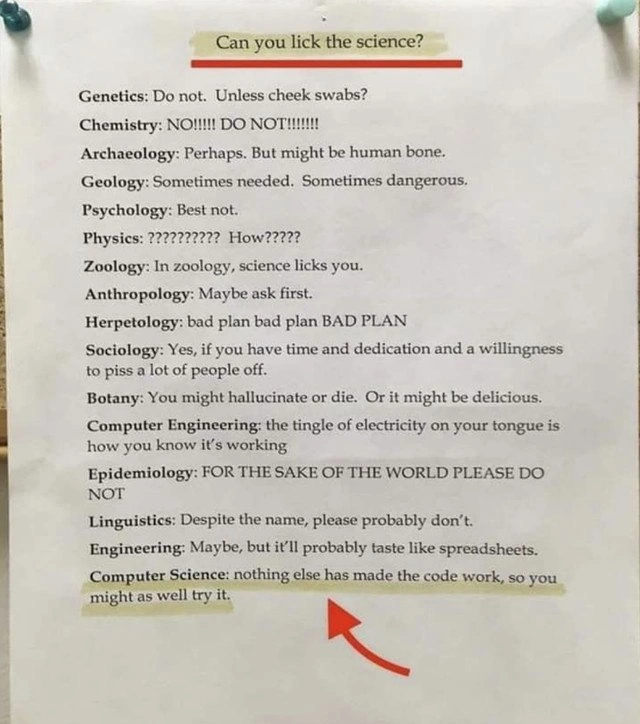
Okay, let's dial it down a notch. If you're a newer developer (or just not a hardened bug veteran yet), here's what's going on in this meme. It presents a humorous list of scientific fields with the question: "Can you lick the science?". Each line jokes about whether licking something related to that field is advisable. It’s a silly concept – and completely metaphorical in the case of programming – highlighting how, when we're really stuck on a problem, our ideas for solutions get increasingly... creative (or desperate).

Let's break some things down:

  • Debugging: This is the process of finding and fixing errors (called bugs) in your code. The term bug in programming originally came from a real insect: in 1947, engineers found a moth stuck in a Harvard Mark II computer, causing it to malfunction. They literally "debugged" the system by removing the moth from a relay! Nowadays, a bug just means any mistake or problem in the software. Debugging can feel like detective work — or whack-a-mole, when problems are stubborn. In this meme, the programmer's bug is so persistent that normal debugging has failed, leading to absurd ideas like mystical tongue-based fixes.

  • Developer Frustration: Every coder, even juniors, hits a point where a bug or an error message makes them want to pull their hair out. Maybe you’ve seen an error that just won’t go away, or the app works on your laptop but explodes on the teammate’s machine for no clear reason (**“works on my machine” syndrome). That frustration can make you joke about doing ridiculous things to appease the computer, like it's a grumpy pet. In reality, we stick to logical troubleshooting (most of the time!), but the humor here is about feeling so stuck you’d consider anything.

  • "Tastes like spreadsheets": One line says engineering might taste like spreadsheets. This is poking fun at the less-glamorous side of engineering jobs. Spreadheets (like Microsoft Excel) often represent dry, boring planning and documentation work. Many engineers and developers joke that corporate life has too many spreadsheets and meetings, not enough actual building. Of course, spreadsheets don't literally have a taste, but if they did, we imagine it's like stale paper – not exactly delicious. So licking "engineering" would be as flavorless as licking an Excel report.

  • Superstition in coding: Although we learn to debug logically (check logs, unit test, use debuggers), it's common even for less experienced devs to start trying semi-random fixes when truly stuck. Ever added print statements (console.log("WTF")) just to see where your code passes through? Or retyped a chunk of code exactly the same way because maybe this time the computer will behave? These are mild forms of programmer superstition – actions that shouldn't change anything, but we try them anyway hoping for a miracle. The meme exaggerates this by jumping to an extreme: physically licking the code.

  • Why licking? It's utterly absurd, right? You can't "lick" software code; code is abstract text. If you printed the code out on paper and licked it, you'd just get a papercut on your tongue (please don't). The meme is being "tongue-in-cheek" — a phrase that actually means "joking, not serious" — by suggesting a completely irrational solution. This phrase plays double-duty here, since tongue is literal too. The joke implies "We've tried everything rational to fix this bug. Maybe some silly magic (like licking it) will do the trick." It's funny because it's a recognizably desperate attitude, taken to a cartoonish extreme.

  • Relatability for juniors: If you haven't yet experienced a 4 AM debugging session where nothing makes sense, consider yourself lucky – it’s a rite of passage. But perhaps you've had a school project or a simple app where a bug made you so confused you did things that felt nonsensical: renaming all your variables, rebooting your computer for the tenth time, or even talking out loud to your code like "Why won't you work?!" This meme is basically that feeling, cranked up a notch. It’s saying: when you’re absolutely out of ideas, even something as silly as licking starts to sound like an option. And the implied punchline is: of course it won't help, but that's how exasperated you are.

In short, the meme uses the idea of "licking science" as a metaphor for extreme, nonsensical troubleshooting. It's categorized under Debugging/Troubleshooting and Bugs because it’s illustrating a debugging scenario gone off the rails. And it’s solid Developer Humor because seasoned programmers have all been in that absurd headspace where logic is failing, and jokingly thinking "Maybe I need to bribe the computer or cast a spell." This is a universal joke about the developer experience: even though we know code is logical, it sure feels like fickle sorcery on bad days.

Level 3: Lick of Last Resort

At this level, we're diving into the Developer Experience nightmare where debugging deteriorates into dark comedy. The meme sets up a faux "science lickability chart," culminating in a swipe at Computer Science. Each listed field has a tongue-in-cheek rule about licking:

  • Geology: Geologists really do sometimes lick rocks (halite tastes salty; clays stick to your tongue) – it's a legit field trick. Of course, some minerals are toxic, hence "Sometimes needed. Sometimes dangerous."
  • Archaeology: Rumor has it archaeologists might lick pottery or bones to tell fragments apart – bone's porous texture can stick to your tongue (gross but true). "Perhaps. But might be human bone." is both a joke and a caution.
  • Chemistry & Epidemiology: Hard NO. Licking unknown chemicals or pathogens is basically how you get a critical production incident in your bloodstream. The all-caps "DO NOT!!!!" and "FOR THE SAKE OF THE WORLD PLEASE DO NOT" mimic the dire warnings we see in documentation right before someone ignores them and causes a meltdown.
  • Computer Engineering: Ever tested a 9V battery by tapping it to your tongue? That tingle of electricity tells hardware folks the battery (or circuit) is live. "That's how you know it’s working," they joke – mixing real electronics know-how with absurdity (please don't french-kiss your GPU).
  • Engineering (General): "Probably tastes like spreadsheets." Ah, the flavor of enterprise engineering: not blood, sweat, and tears, but Excel. This pokes fun at the paperwork and project plans smothering real engineering work. A cynical veteran might say the only thing you truly build some days is pivot tables.
  • Computer Science (Highlighted): "Nothing else has made the code work, so you might as well try it." This line, literally highlighted with a red arrow in the image, is the code monkey's Hail Mary. It's lampooning that phase of DebuggingFrustration where you've tried every algorithmic fix, every printf log, every Stack Overflow potion and StackExchange spell. The bug still sneers at you, untouched. So what now? Well, maybe tongue-based debugging will scare it off! It's an absurd exaggeration of how software devs feel when a bug just won't die – you get so desperate you'd try anything, even something as fundamentally illogical (and unsanitary) as licking the code.

This is DeveloperHumor masking real pain. Every senior dev recognizes the comedy of escalating from rational troubleshooting to pure superstition. It's a parody of scientific method gone off the rails: when the experiment fails repeatedly, the "scientist" (developer) starts considering magic and ritual. In real life, we're not literally licking circuit boards or code printouts (I hope), but we do perform equally ritualistic "last resort" fixes:

  • Re-running the test suite one more time because maybe the universe will align on the 37th run.
  • Cache cleared, environment rebuilt, machine rebooted, and if that doesn't work – sacrifice a gummy bear atop the keyboard as an offering to the CI gods.
  • Adding a seemingly meaningless delay or console.log("please work") in the code – and being shocked when timing shifts and the race condition hides. Hello Heisenbug! You've just appeased the bug by accidental voodoo.
  • That moment you half-jokingly tell a junior "Did you try turning it off and on again? How about upside down? Pray to Linus Torvalds?" Sure it's snark, but only half snark, because we've seen stranger fixes.

The highlighted Computer Science line nails a specific Debugging Nightmare: when logic fails, Developer Frustration breeds superstition. It's like a form of cargo cult debugging – doing something crazy with zero scientific basis, purely because nothing else has worked. Seasoned developers smirk at this because they've been there. They've jiggled the proverbial cables, re-ordered lines that "shouldn't matter," or tapped the server rack gently as if it were a malfunctioning old TV. There's an undercurrent of "been up at 3 AM deploying hotfixes, trying random stuff until something sticks". We laugh, because otherwise we'd cry. And if licking the code did fix a bug once, you bet it would become team lore (and a horrifying new QA practice).

Ultimately, the humor thrives on contrast: Computer Science is supposed to be logical and abstract – nothing to do with tongues or taste. So suggesting a desperate bug fix via licking is absurd, yet every dev gets the feeling behind it. It’s a salty mix of DebuggingTroubleshooting truth and exaggeration: when you're that exasperated, even the stupidest idea has a seductive sparkle. After all, nothing else has made the darn code work… so you might as well give the highlighted last resort a try, right?

Description

A white sheet of printer paper is pinned to a board with teal push-pins; the heading is highlighted yellow and reads "Can you lick the science?". Listed below, each on its own line, are tongue-in-cheek instructions: "Genetics: Do not. Unless cheek swabs?", "Chemistry: NO!!!!! DO NOT!!!!!!!", "Archaeology: Perhaps. But might be human bone.", "Geology: Sometimes needed. Sometimes dangerous.", "Psychology: Best not.", "Physics: ?????????? How?????", "Zoology: In zoology, science licks you.", "Anthropology: Maybe ask first.", "Herpetology: bad plan bad plan BAD PLAN", "Sociology: Yes, if you have time and dedication and a willingness to piss a lot of people off.", "Botany: You might hallucinate or die. Or it might be delicious.", "Computer Engineering: the tingle of electricity on your tongue is how you know it’s working", "Epidemiology: FOR THE SAKE OF THE WORLD PLEASE DO NOT", "Linguistics: Despite the name, please probably don’t.", "Engineering: Maybe, but it’ll probably taste like spreadsheets.", and "Computer Science: nothing else has made the code work, so you might as well try it.". The final line is yellow-highlighted and indicated by a red arrow, underscoring a joke that programmers will attempt absurd methods when bugs resist all rational fixes. Technically, the meme lampoons the frustration phase of debugging where superstition replaces systematic troubleshooting, reflecting developer culture and the universal pain of stubborn software defects
Comments

8
Anonymous ★ Top Pick Debugging escalation chart: rebuild, bisect, rubber-duck, sacrificial coffee, then lick the board - because at that point you’re just trying to collapse the Heisenbug’s waveform with mouthfeel
  1. Anonymous ★ Top Pick

    Debugging escalation chart: rebuild, bisect, rubber-duck, sacrificial coffee, then lick the board - because at that point you’re just trying to collapse the Heisenbug’s waveform with mouthfeel

  2. Anonymous

    After 15 years in the industry, I can confirm that licking the code is still more effective than most AI-powered debugging tools - at least it gives you immediate feedback about whether production is truly on fire

  3. Anonymous

    After exhausting stack traces, rubber duck debugging, git bisect, and sacrificing a USB cable to the demo gods, the seasoned engineer knows there's only one diagnostic left: the empirical lick test. It's not in the OWASP guidelines, but when production is down at 3 AM and the monitoring dashboards are gaslighting you, sometimes you need to taste the voltage to truly understand if that Raspberry Pi is actually receiving power or just mocking your existence

  4. Anonymous

    After cache invalidation, naming, and the off-by-one chase fail, we escalate to TDD - taste-driven debugging - where a 9V tingle is your only assertion

  5. Anonymous

    Hardware has the 9V tongue test; in CS we call it Taste-Driven Debugging - add a little human-sourced entropy and the Heisenbug finally passes CI

  6. Anonymous

    CS tastes like 'code works'? That's rookie palate - seniors savor the full bouquet of tech debt reduction and on-time delivery

  7. @denis_kleshchev 5y

    But you always can lick the scientist

    1. @spiritualattunement 5y

      Mmmm

Use J and K for navigation