Kubernetes Hides the Cloud Native Rugs
Why is this Containerization meme funny?
Level 1: The Fancy Carpet Stack
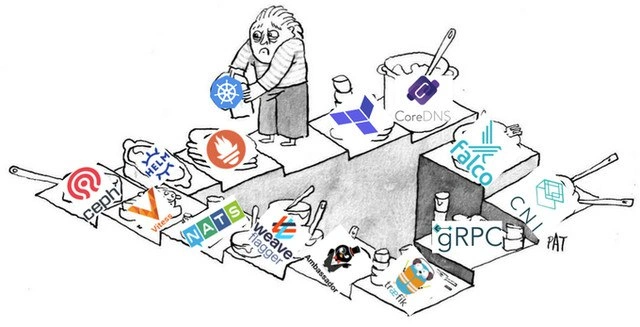
This is like putting one nice rug on top of a pile of messy rugs and saying the room is clean now. From far away, Kubernetes looks like one tidy platform. Up close, it is sitting on many other tools, and if one rug slips, the person standing on top has a very bad day.
Level 2: One Platform, Many Parts
Kubernetes is a system for running containers across a group of machines. It can schedule workloads, restart failed containers, expose services, and let teams describe infrastructure in configuration files.
The image shows that Kubernetes does not work alone. A real cluster often needs supporting pieces:
- CoreDNS helps services find each other by name.
- CNI plugins provide container networking.
- Calico can handle networking and network policy.
- Ceph can provide distributed storage.
- NATS and gRPC relate to service communication patterns.
- Load balancers route traffic to the right place.
- Monitoring tools help operators see what is breaking.
For a newer developer, the meme explains why "we use Kubernetes" is not the end of the story. It is more like saying "we use an operating system." That tells you the broad category, but not how networking, storage, security, deployment, logs, and debugging actually work. Kubernetes gives a common language, but the parts underneath still matter.
Level 3: YAML Hides Nothing
The tired person holding the Kubernetes tile captures the senior engineer's relationship with cloud-native architecture: grateful for the abstraction, suspicious of the bill. Kubernetes is sold as a clean orchestrator for containers, but the visible pile around it says the quiet part out loud. A production cluster is not just kubectl apply. It is DNS, ingress, storage classes, network policy, service discovery, monitoring, tracing, certificates, load balancing, secrets, node pressure, autoscaling, and the grim knowledge that the failing request may have crossed six systems before timing out.
The humor comes from the mismatch between the marketing diagram and the operational diagram. In a slide deck, Kubernetes is a neat box labeled "platform." In the image, it is one square among many, balanced on top of more squares, with a weary human trying to keep the stack socially acceptable. The label "the real Load Balancer" is especially sharp because Kubernetes has Services and Ingresses, but eventually some real routing infrastructure still has to carry packets. The abstraction may create a service object; it does not make physics submit a pull request.
This is where cloud-native tooling overload becomes a real engineering problem. Each component solves a valid problem, but the combined system creates a new one: who understands the boundary between them? A DNS issue can look like an application bug. A network policy issue can look like a timeout. A storage issue can look like a stuck deployment. A certificate issue can look like a bad service mesh day. Kubernetes did not remove distributed-systems complexity; it made it schedulable.
The cartoon also satirizes organizational behavior. Teams adopt Kubernetes to standardize deployment, then discover they need a platform team, an SRE rotation, a networking expert, a storage expert, and three people who know why the cluster only breaks during demos. Everyone wanted portability and scalability; what they got was a living ecosystem where every rug has a README, a controller, and a pager implication.
Level 4: Reconciliation Rugs
The cartoon shows Kubernetes as a single visible tile held by a tired figure, while the floor around it is a messy stack of cloud-native components labeled with things like:
ceph
NATS
the real Load Balancer
CoreDNS
Calico
CNI
gRPC
The deep technical joke is that Kubernetes looks like one platform, but it is really an abstraction layer over distributed-systems compromises. It gives operators a desired-state API: declare pods, services, ingresses, volumes, policies, and controllers, then let reconciliation loops push reality toward the YAML. That is elegant, but it does not repeal the hard parts. It relocates them into networking plugins, DNS, storage backends, load balancers, metrics systems, admission controllers, and every controller quietly retrying in the background.
At the theoretical level, Kubernetes is full of eventual consistency. Controllers observe state, compare it with desired state, and issue changes. But observation is delayed, caches are stale, nodes fail, packets drop, DNS records age, storage attaches slowly, and a "running" pod may not mean the application inside is ready. The rug metaphor is perfect because each component hides a different physical constraint: network reachability, name resolution, persistent storage, service discovery, traffic routing, and failure detection.
This is why the image warrants more than a simple "Kubernetes is complicated" reading. It is a picture of layered control planes. Kubernetes abstracts containers; CNI abstracts pod networking; CoreDNS abstracts service names; Calico can enforce network policy; Ceph can provide distributed storage; Prometheus-style monitoring watches the whole thing; load balancers and RPC frameworks shape traffic. Each layer is useful. Each layer also has its own state machine, failure modes, logs, timeouts, and vocabulary. The stack does not become simpler because it has logos. It becomes debuggable only if someone understands where the abstraction stops lying.
Description
A black-and-white cartoon shows a tired-looking figure standing on or holding a Kubernetes-logo tile while surrounded by many overlapping rugs or floor tiles covered in cloud-native project logos. Visible labels and logos include "ceph," "NATS," "the real load balancer," "CoreDNS," "Calico," "CNI," "gRPC," and "PAT," along with recognizable Kubernetes, Prometheus, Terraform-like, and networking/security project marks. The image reads as a visual metaphor for the Kubernetes ecosystem: the platform appears to provide one coherent abstraction, but it rests on a crowded pile of networking, DNS, load balancing, storage, monitoring, and service-mesh components. For senior engineers, the joke is the familiar gap between the clean orchestration story and the messy operational dependency graph underneath.
Comments
5Comment deleted
Kubernetes did not remove distributed systems complexity; it just gave every rug a YAML API.
I am very glad I don't have to deal with any of this Comment deleted
I think I'm up to four already T_T Ceph was worst for sure Comment deleted
Oh no! Comment deleted
I don't even recognise any of these... Comment deleted