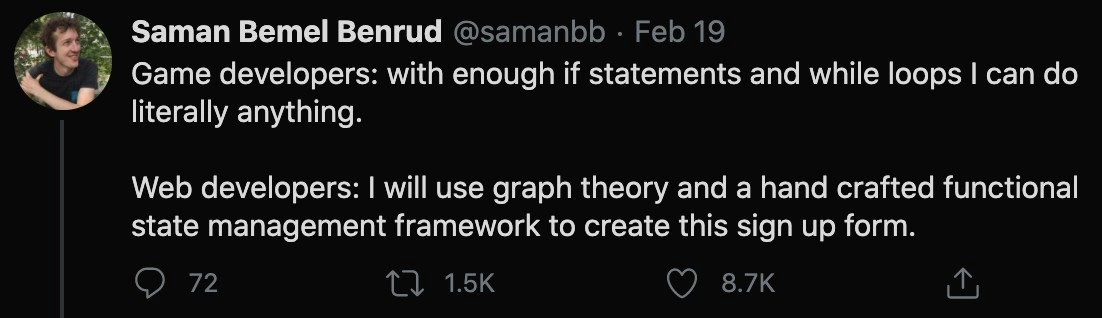
Game devs rely on loops, web devs build state frameworks for sign-ups
Why is this GameDev meme funny?
Level 1: Hammers vs Power Tools
Imagine you have two friends asked to do a simple task: hang a picture on the wall. One friend – let’s call them Gary the Game Dev – grabs a basic hammer and nail. Gary’s thinking, “With enough nails and hammer swings, I can hang literally any picture.” And you know what? He’s right. Give Gary a hammer and nails, and he can put up a small photo or build an entire wooden treehouse. It might be a lot of hammering, but those basic tools can accomplish a lot of different jobs if you use them enough.
Now your other friend – Wendy the Web Dev – is asked to hang the same picture. But Wendy shows up with a high-tech toolkit: she’s got a laser level, an electric drill, a stud-finder, and even a fancy computerized measuring device that uses satellite data and advanced math to find the perfect spot. Wendy is effectively using rocket science to hammer a nail. Sure, her method is super precise and high-tech – she’s measured the wall’s structure (like drawing a complex graph to map where the nail should go) and used a custom-built machine to press the nail in. In the end, the picture is hung just fine, but you can’t help but smile because… wasn’t that a bit much for such a simple task?
This is exactly why the meme is funny. It’s comparing someone doing something big with simple tools (the game developer making an entire game with just basic code like if and while loops, or Gary building anything with just his hammer) to someone using very fancy, complicated tools for something small (the web developer using graph theory and special frameworks just to make a sign-up form, or Wendy using all that tech just to hang one picture). We laugh because we recognize a bit of truth in it: sometimes people over-complicate things that could be simple. It’s like baking a cupcake using a massive industrial kitchen – you’ll get a cupcake, sure, but did you really need all that equipment for one little cupcake? The meme playfully pokes at this tendency, and anyone who’s tried to learn web development and felt overwhelmed by the tons of tools for a basic webpage will totally get the joke.
Level 2: Loops, States, and Over-Engineering
Let’s break down the terms and ideas here. First, “if statements” and “while loops” are basic building blocks in programming. An if statement lets the program decide to do something only if a certain condition is true (for example, “if the player’s health is 0, end the game”). A while loop makes the program repeat some actions over and over as long as a condition holds true (for example, “while the game is not over, keep moving the enemies”). In game development, a common pattern is the game loop: the game runs in a loop, updating what's happening on screen and checking conditions each frame. This is a very imperative style of programming – meaning you write step-by-step instructions for the computer to follow (“do this, then do that, if X then do Y”). It’s straightforward and close to how the machine actually processes instructions. Game developers often need this fine-grained control because games are real-time and performance-intensive. So, the meme jokingly suggests that a game dev believes these simple tools (if/while) are enough to build literally anything in their world – from character behaviors to rendering logic – and honestly, in principle they could! Many early classic games were essentially big loops with lots of conditionals deciding game logic each tick. It might not be pretty, but it gets the job done when you’re coding a game.
Now, on the other side, we have the web developers building a sign-up form – that’s the little box where you enter details like username, email, password to register on a website. A sign-up form is about as basic a task as you get in web development. You could make one with just simple HTML (the markup for the form fields), a bit of CSS (styling), and maybe a tiny snippet of JavaScript to handle the submission. But modern web apps are often built using frameworks and libraries that help manage state. State just means the current data or status of the application – for a form, the state might include “what the user has typed so far” and “whether an error message is showing or not”. Managing state gets trickier as an app grows: for example, if you have several interactive parts of a page that all need to know if the user is logged in or not, you need a systematic way to share and update that information. This is why web developers use state management frameworks. A framework like Redux or MobX provides a structured way to keep track of state changes in one central place so the whole app stays in sync. When the meme says “hand crafted functional state management framework,” it’s playfully exaggerating how a web dev might even create a custom mini-Redux or use functional programming ideas to manage something as simple as a form. The word “functional” here refers to functional programming, a style where you avoid changing variables directly and instead produce new values from old ones (kind of like math functions). In practice, a functional state management approach might mean each time you type a letter into the form, a new state object is created with that letter added, rather than modifying some mutable object in place. This can make reasoning about changes easier – there’s a whole lineage of these ideas from languages like Haskell and frameworks like React. React, for example, popularized thinking of UIs as pure functions of state: give it some state, and it renders the UI for you. Change the state, and it re-renders accordingly.
So why graph theory? Graph theory is a field of math/computer science dealing with graphs – a collection of nodes (points) connected by edges (lines). You might have heard of graphs in terms of social networks (a network of friends can be a graph) or pathfinding (finding the shortest route on a map uses graph algorithms). In the context of a sign-up form, it sounds absurd – what do graphs have to do with a form? This is the joke: it’s implying the web dev is over-complicating things by possibly treating the form’s states and transitions as a graph. To be fair, sometimes developers use something called a state machine or state graph for complex forms. Imagine a multi-step sign-up wizard where the user goes through Step 1, Step 2, etc., with maybe branches or conditional steps – that can be drawn as a graph of states (each step is a node, and moving between steps is an edge). Graph theory would help ensure you handle every possible transition (like what if the user goes back to a previous step?). But for a simple single-page form with just a few fields, bringing in graph theory is comedic hyperbole. It’s like using an industrial crane to move a stool – total overkill, but technically it would work. The meme exaggerates that web devs have a tendency to grab the latest, most powerful tools and theories even when not strictly necessary – something known as over-engineering. If you’ve ever been a junior frontend developer tasked with making a simple page, you might have felt overwhelmed by seniors insisting on using a whole framework setup with webpack, React, Redux, TypeScript, form libraries, etc., for what seems like a “Couldn’t I just use plain HTML and a bit of JavaScript?” task. That feeling is exactly what this joke riffs on.
In simpler terms: game devs (stereotypically) keep it simple and get things working with raw code, while web devs (stereotypically) make even simple things complicated by using very advanced tools and patterns. Of course, this is a generalization played for humor – in reality, game developers use sophisticated engines and web devs often keep things simple when they can – but it’s funny because it contains a grain of truth that many developers can recognize. We’ve all seen a small project where someone insisted on doing it “the proper way” with layers upon layers of unnecessary abstraction. And many of us have also hacked together a quick solution with basic code when in crunch time. Framework fatigue is real: there’s always a new JavaScript library or framework around the corner, and sometimes developers jump to use them even for trivial things, much to the bemusement of old-timers. This tweet just captures that dynamic in one snappy comparison.
Level 3: Bare Loops vs Boilerplate
This meme highlights a hilarious contrast in developer mindset between game development and modern web development. On the game dev side, there’s a stereotype (played for laughs) that game programmers are down-to-earth hackers. They’ll brute-force complex problems with raw imperative code – lots of if statements, while loops, maybe a handful of global variables – and somehow ship a functioning game. The tweet claims “with enough if statements and while loops I can do literally anything,” which taps into a shared understanding among senior coders: given time and duct tape, an experienced game dev can implement anything by piling up simplistic logic. Need an enemy AI? Write a bunch of if/else checks for behaviors. Rendering pipeline acting up? Throw a giant while loop to brute-force a solution each frame. It’s a tongue-in-cheek celebration of pragmatism over elegance. Seasoned devs have seen scrappy game codebases where almost magically, endless layers of conditions and loops create entire worlds. We nod knowingly because many of us have dug into a game’s source code or a 48-hour game jam project and found a mess of conditional logic that, against all odds, works. The humor has a bit of cynical veteran energy: “Yup, we’ve all written that spaghetti code to meet a deadline.” It’s messy but it’s also the reason an old game can run smoothly on a toaster – the code might be ugly C++ with loops unrolling like there’s no tomorrow, but it’s straightforward and performant.
Now contrast that with the web developer stereotype depicted here – the overengineer who brings a bazooka to a knife fight. Instead of writing a simple script for a sign-up form, they assemble a cathedral of modern tools: graph theory concepts, a custom state management framework, probably a virtual DOM diffing algorithm, and toss in a functional reactive twist for good measure. This is poking fun at real trends in frontend development. In recent years, even simple web features often involve a tall stack of abstractions. For example, to make a basic registration form, a team might pull in React (a component library), then add Redux for centralized state, maybe use a form validation library that internally models form fields as a dependency graph, and perhaps even manage navigation through form steps with a state machine library like XState. Before you know it, something that could be a 50-line vanilla JavaScript snippet has turned into an architecture astronaut’s dream. The meme exaggerates, but not by much – framework fatigue in frontend is a running joke. We’ve seen projects where developers introduce an entire Redux store with reducers, actions, and middleware just to handle two input fields. Or they’ll say, “Let’s use RxJS (Reactive Extensions) so our form inputs are observables and our validation logic is a stream pipeline,” effectively treating simple user inputs as a complex dataflow graph. It’s the kind of overkill that makes experienced engineers facepalm and laugh at the same time.
The humor really lands because of the role-reversal of expected complexity. Traditionally, you’d think making a 3D video game involves heavy math (physics, linear algebra, complex algorithms) and would need fancy frameworks, whereas a sign-up form is trivial by comparison. And indeed, on the surface, game dev is incredibly complex under-the-hood – game developers grapple with real-time graphics APIs, physics engines, pathfinding (which actually uses graph algorithms like A* for AI navigation), etc. But culturally, game devs often build on low-level frameworks or even write their own engines, optimizing for performance. They may avoid high-level abstractions if those abstractions sap speed or control. So game devs end up writing a lot of custom code with basic constructs, close to the metal. Meanwhile, web developers, dealing with the relatively simpler domain of forms and text boxes, have embraced high-level abstractions to manage complexity at scale. Modern web apps are not just forms – they’re mini desktop applications running in your browser, with many moving parts (UI state, server communication, user interactions). Frameworks and state management libraries bring order to chaos, ensuring, for instance, that when you update your email field, every part of the UI that cares about that email gets updated, undo/redo works, and the back button doesn’t break the app. The joke is that in practice, we often apply these heavy frameworks even when the app is not that complex (yet). It’s a form of over-engineering born from caution and trend-chasing: “What if this form eventually grows into a multi-step onboarding flow with conditional fields and complex validation? Better set up Redux and a graph of states from the start!” – a slippery slope many teams can chuckle about.
So, senior developers laugh because they’ve been there: they’ve seen the scrappy game prototype that runs on spit and while loops, and they’ve also attended the meeting where a simple feature turned into an ambitious refactor using the latest frontend paradigm. It’s funny and relatable because it rings true. There’s a bit of self-deprecation in it as well: how many of us have caught ourselves writing an overly abstract “manager” or “factory” for something that didn’t need it? Or conversely, who hasn’t quick-fixed a bug at 2 AM with an if clause jammed in an unlikely place? The meme captures those extremes in one snappy comparison.
Game Dev Motto: “Why architect what a good old loop can brute-force?”
Web Dev Motto: “Why brute-force what a neat library and a directed acyclic state graph can abstract?”
Ultimately, both approaches have their place – the meme just humorously exaggerates the contrast. Game devs care about performance and control, often willing to write more code by hand. Web devs care about maintainability and scalability, often willing to adopt abstractions even if they seem like overkill for a simple case. But the next time you see a 10-file React+Redux setup for a login form, you’ll remember this tweet and chuckle, as will any battle-worn programmer who’s seen architecture astronauts at work.
Level 4: Turing-Complete Overkill
On a theoretical level, this meme pits Turing completeness against formal graph theory abstractions. The game developer’s boast – “with enough if statements and while loops I can do literally anything” – is tongue-in-cheek but technically true. In computer science theory, a programming model that has conditional branching (if/else) and the ability to loop or recurse is Turing-complete, meaning it can simulate any algorithm. In other words, a sufficiently determined coder armed with just if clauses and loops could implement anything from a physics engine to a neural network. This minimalism is the ultimate low-level power: a reminder that under the hood, even the fanciest engine or framework just boils down to binary decisions and repeated steps. It’s as if the game dev is invoking the Church-Turing thesis as a battle cry, saying “I have the two primitives I need to conquer computation – bring it on!”
On the flip side, we have the web developer invoking graph theory and a handcrafted functional state management framework for something as simple as handling a sign-up form. Graph theory is a branch of mathematics dealing with nodes and connections (edges) – often used to model relationships or transitions. In an academic sense, modeling a user interface with graph theory isn’t completely absurd: a UI’s states (empty form, form filled, submission success, error state) can be seen as nodes in a state machine, with user actions or events as edges causing transitions between those states. Modern front-end architecture occasionally borrows from this theory – for example, state charts and finite automata from computer science ensure all those possible form states and transitions are accounted for without bugs. A complex form might be represented as a directed graph where each node is a form stage and each edge is a user action (like clicking “Next” or inputting data) that moves the form from one state to another. It’s rigorous… perhaps ridiculously rigorous for a basic sign-up sheet.
There’s also a whiff of functional programming theory here. A “handcrafted functional state management framework” suggests the web dev is wielding concepts from lambda calculus or category theory – the underpinnings of functional languages – to manage a couple of text fields. In theoretical terms, frameworks like Redux (inspired by the Elm language architecture) treat the UI as a pure function of some global state. Every change is an immutable state transition, akin to applying a mathematical function to get a new state. It’s elegant in theory: the UI becomes a predictable state transition system. However, seeing a web dev apply these abstractions to a trivial form is like watching someone prove Fermat’s Last Theorem to validate a login password. The humor stems from this comical mismatch in theoretical firepower: the game dev revels in the power of brute-force Turing-complete constructs (bare-bones but all-powerful), while the web dev heaps on additional theoretical constructs (graphs! pure functions!) for a problem that in theory doesn’t require them. It’s computing’s version of using general relativity to calibrate a kitchen scale – sure, it’s grounded in sound theory, but you don’t really need Einstein to weigh a potato.
Description
The image is a dark-mode Twitter screenshot. At the top, a blurred profile photo and the handle “Saman Bemel Benrud @samanbb · Feb 19” are displayed in white text. The tweet body reads, line-for-line: “Game developers: with enough if statements and while loops I can do literally anything. Web developers: I will use graph theory and a hand crafted functional state management framework to create this sign up form.” Beneath the tweet are typical Twitter icons showing 72 replies, 1.5 K retweets, and 8.7 K likes. Visually simple, the meme humorously contrasts minimalist imperative coding in game development with the perceived over-engineering of modern web stacks, poking fun at state-management libraries, functional paradigms, and graph-theory-inspired frameworks that engineers sometimes deploy for even trivial UI tasks
Comments
10Comment deleted
Game dev: “Give me a delta-time and a while(true) and I’ll build a universe.” Web dev: “Cool - I’ll just topologically sort my React components so the CRDT-backed email field stays in sync with the GraphQL cache during onBlur.”
Game devs ship 60fps physics simulations with 10,000 interacting objects using nested loops. Meanwhile, I just spent three sprints debating whether our email validation should be a pure function or a custom hook
This perfectly captures the eternal divide: game devs shipping AAA titles with nested if-statements deeper than their call stacks, while web devs are three PRs into implementing a Redux-Observable-RxJS-Recoil hybrid just to toggle a modal. Both approaches work, but only one requires a PhD in category theory to understand the signup flow. The real irony? The game dev's 'spaghetti' ships on time, while the web dev's 'clean architecture' is still in the spike phase when the startup runs out of runway
Game devs: two loops and a lookup table. Web devs: a DAG of reducers and a saga so the signup checkbox can reach consensus
Game devs prove Turing completeness with loops; web devs need a full GraphQL schema just to onboard a user
Only on the web can a two-field form justify a DAG scheduler and a bespoke ‘pure’ state manager - meanwhile the game dev shipped 60fps last week with three ifs, one while, and no package.json
So not fair, you swapped them! Comment deleted
So, it is vice verse ? Comment deleted
So true 😂 Comment deleted
yandere dev has logged in Comment deleted