Skip to content
DevMeme
3098 of 7435
Debugging: The Internal Monologue Edition
Debugging Troubleshooting Post #3414, on Jul 13, 2021 in TG

Debugging: The Internal Monologue Edition

Why is this Debugging Troubleshooting meme funny?

Level 1: Talking to Myself

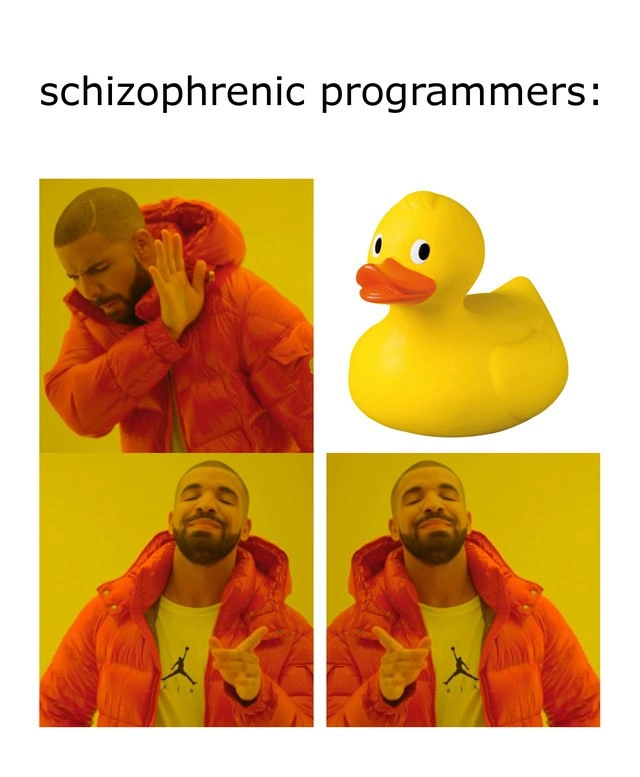
Imagine you’re trying to solve a really hard puzzle or homework question, and you start talking yourself through it. You might say, “Okay, first I do this, then that…” even though no one else is there. And guess what? Sometimes, by saying it out loud, you suddenly figure out the answer! This meme is about programmers doing exactly that. Usually, there’s a silly idea that a programmer could explain their problem to a rubber duck (a toy) to help them think. But in the picture, the programmer (that’s Drake in the meme) decides to skip the toy duck and just talk to himself instead. In the top part, he’s saying “no” to using the duck. In the bottom part, he’s happily saying “yes” to explaining the code to himself (that’s why there are two Drakes, as if he’s both people in the conversation). It looks funny because normally if you see someone chatting away to nobody, you’d think they’re being silly or a little crazy. But the joke here is that programmers sometimes need to hear their own explanation to solve a problem. It’s like when you’re stuck and you repeat the riddle out loud and suddenly it makes sense. So the meme is showing that talking to yourself can actually help you figure things out, especially in programming. It makes us laugh because it’s true – even though it’s a bit goofy, it works!

Level 2: Debugging Out Loud

Let’s break this down in simpler terms. This meme is about a popular coding trick called rubber duck debugging. If you’ve never heard of it: rubber duck debugging means talking through your code problems out loud, step by step, as if explaining to a clueless listener (like a little rubber duck on your desk). Why a duck? It’s just a cute, classic choice – any object works, but many programmers actually keep a toy duck handy. The key idea is that when you explain what your code is supposed to do in plain words, you often spot the bug or realize what you misunderstood. It’s like teaching the code to someone else, and suddenly you teach yourself in the process! For example, a programmer might literally say to the duck, “Okay, so this function takes two numbers and should add them... why am I getting a wrong result?” As they slowly elaborate every step, they might catch that they’re using a wrong formula or forgetting to return a value. The duck, of course, just sits there silently, but the act of speaking the problem out loud forces the coder to think more clearly. It’s a tried-and-true debugging method for many developers, especially when working alone. Pretty cool, right?

Now, the meme uses the well-known Drake yes/no format (often called a Drakeposting meme). In the first panel, Drake in his orange jacket is waving his hand in rejection – here he’s rejecting the rubber duck. That image is labeled (implicitly) as “No thanks, I’m not talking to a duck.” In the next panel (still the top row), we see an image of the bright yellow rubber duck itself, representing the idea of rubber duck debugging. So top row: Drake says “no” to the duck method. Then, in the bottom row, we have two identical Drake images side by side, both smiling and pointing, which is Drake’s signature “I like this” pose. The twist is that there are two Drakes in the bottom approval scene instead of Drake pointing at something else. Drake is essentially pointing at himself. This visual gag means that the programmer (represented by Drake) chooses to talk through the code with himself as the partner. He’s doing self-talk debugging. Instead of explaining his code to a toy or another person, he’s explaining it to his own mirror image (figuratively). It’s as if Drake cloned himself to be both the explainer and the listener. The meme caption even calls these “schizophrenic programmers,” a joking way to describe someone talking to themselves as if they were two people. Don’t worry – it’s not using the term in a clinical sense here, it’s just joking about how it looks if a developer is having a lively conversation with nobody else in the room!

So what’s going on, technically? The developer is skipping the actual rubber duck and just verbalizing the problem to himself. Many programmers actually do this when debugging: you might mutter, “Okay, what is this variable equal to now? Did that function even run? Let’s see…” as you trace through your code logic. It might feel a bit silly, but hearing the problem stated aloud can make things click. In essence, the meme is saying the programmer is his own rubber duck. Talking out loud to oneself serves the same purpose as talking to an actual duck. It’s a form of internal dialogue debugging where you play both roles: you ask the question and you answer it. This can be especially common when you’re coding alone late at night or working remotely with no teammate around. You become your own sounding board. And funnily enough, it often works!

To make this more concrete, imagine a simple coding mistake and how talking it out helps. Say we intended to write a function to add up numbers, but we accidentally wrote subtraction instead. When reading the code in our head, we might gloss over the error. But if we explain it out loud, it jumps out:

def sum_numbers(numbers):
    total = 0
    for n in numbers:
        total = total - n  # Developer says: "Then I add each number to total..." -> Oops, this is subtracting!
    return total

By narrating each line—“First, start total at 0. Then for each number, add it to total…”—the coder suddenly realizes, “Wait, the code says total = total - n instead of plus. That’s wrong!”. This is the kind of “lightbulb moment” rubber duck debugging can produce. The code hasn’t changed, the duck (or in this case the imaginary second Drake) hasn’t given any advice, but the act of explaining revealed the bug.

The meme humorously exaggerates this by showing Drake preferring to have that conversation with himself. It’s relatable because a lot of us developers have done exactly that. Maybe you’ve caught yourself debugging out loud, reading error messages to no one, or saying “why isn’t this working?” and then answering “oh, I forgot to call the function.” It’s a common habit in programming and definitely a source of TechHumor. The phrase “schizophrenic programmers” in the caption is highlighting, in a cheeky way, that from an outsider’s perspective we might look a little crazy carrying on a dialogue alone. But within the coding world, we understand this is just part of problem-solving. In fact, talking to yourself or a rubber duck is far healthier (and more effective) than just staying stuck and silently frustrated. It’s a quick sanity check that keeps you moving forward. So, the meme is both funny and true: it’s normal for devs to have these one-person conversations during troubleshooting. That’s why this joke resonates with so many people in tech – it’s making light of a real technique we use to squash bugs.

Level 3: Solo Pair Programming

This meme cleverly mashes up a classic debugging technique with the ever-popular Drake format. In the top panels, Drake is rejecting the idea of using a rubber duck as a coding confidant. In the bottom panels, Drake enthusiastically points to another Drake – effectively approving the idea of debugging by talking to himself. It’s a twist on the Drakeposting meme template (Drake says “no” to the first thing, “yes” to the second): here he says “no, not the rubber duck” and “yes, I’ll just be my own rubber duck!”. The caption above the images labels this scenario as “schizophrenic programmers:” – an edgy, hyperbolic way to describe developers who appear to have internal dialogues while coding. The humor hits close to home for many coders: it’s poking fun at that self-talk debugging habit that developers rarely admit to, yet so many of us do when we think no one’s watching.

At its core, this meme riffs on the well-known practice of rubber duck debugging. That’s the technique where you explain your code, line-by-line, to an inanimate object (traditionally a bright yellow rubber duck on your desk) as if it were a fellow programmer. The theory is that by articulating the problem out loud in simple terms, you often catch your own mistakes. It’s surprising how often the mere act of explaining the code reveals a bug or a missing logic step. Senior developers know that the duck itself isn’t magic – it’s the act of slowing down and elaborating your thinking that does the trick. In fact, the idea is so common it even appears in programming folklore and books (the term was popularized in The Pragmatic Programmer, where a coder literally uses a duck to debug). The duck is essentially a stand-in for a silent but attentive listener.

Now, the punchline here is that Drake (the programmer in the meme) outright rejects the poor rubber duck – he’s saying, “Nah, I don’t need this toy’s help.” Instead, he chooses to debug solo, effectively doing a one-man pair programming session. In the bottom images, Drake is duplicated: it’s Drake pointing approvingly at Drake. This represents the programmer splitting into both roles: the one asking the questions and the one answering them. In other words, he’s having a full developer self-conversation to debug the issue. It’s like he’s thinking, “Who better to understand my thought process than myself?” This twist is funny because it exaggerates a common scenario: developers often end up talking to themselves when stuck on a tricky bug, especially when no one else is around. The meme takes that to the extreme by visually showing two identical Drakes chatting, as if the programmer duplicated himself to be his own sounding board.

For seasoned devs, this image is peak DeveloperHumor: it highlights an almost embarrassing secret of the trade. Many of us have been caught moving our lips or whispering at our screen during a late-night debugging session. We might chuckle and call it “schizophrenic” in jest (as this meme does), because from the outside it looks like we’ve got multiple personalities discussing code! Non-coders might stare if they walk by and hear “Alright, what’s going on in this loop?” uttered to an empty room. But every experienced engineer knows that talking through a problem out loud, even to yourself, can be incredibly effective. It’s a way to rubber-duck debug without an actual duck. We personify Drake as the coder here literally dialoguing with himself: one Drake poses the question, the other Drake nods and responds. The joke lands so well because it’s a shared experience – a form of debugging frustration management that doubles as a sanity check. It humorously normalizes something we’ve all done: when a bug drives you up the wall, you might play both therapist and patient, asking “Why isn’t this working?” and then following up with “Let’s trace this logically…” in your own two voices.

There’s also an underlying commentary on mental health in tech buried in the joke. Software development can be isolating and mentally taxing. You spend hours wrestling with invisible problems in code. It’s no surprise that devs develop quirky coping mechanisms. The meme’s caption “schizophrenic programmers” is an exaggerated nod to how talking to oneself might seem like losing it, but it’s really just a programmer’s way to stay sane. In fact, many engineers would argue this self-dialogue keeps them from going crazy when the code refuses to cooperate. It’s a tongue-in-cheek acknowledgment that many debugging sessions are basically a form of internal dialogue debugging: half pep-talk, half investigation. Instead of rubber-ducking with an actual duck or bothering a coworker at 3 AM, you end up having a heartfelt conversation with your own brain. And hey, at least your brain (unlike the duck) might actually respond! The meme humorously validates that behavior: Drake smiling at Drake says, “Yes, this is fine – whatever gets the job done.” It’s a scenario senior developers know too well, presented in a format that’s instantly relatable and laugh-inducing.

Description

This image uses a four-panel Drake meme format with the heading 'schizophrenic programmers:'. In the top-left panel, Drake is shown rejecting a classic yellow rubber duck. The bottom two panels show Drake looking pleased and pointing, seemingly at himself or another version of himself. The meme is a play on the well-known software engineering technique 'rubber duck debugging,' where a developer explains their code to an inanimate object to find a solution. The joke, though using medically inaccurate and insensitive language, suggests that instead of talking to an external object like a duck, these programmers simply have an internal dialogue, effectively talking the problem over with themselves. For senior developers, it's a relatable take on the internal, self-directed problem-solving process that often replaces the more formal 'rubber duck' method with experience

Comments

16
Anonymous ★ Top Pick The junior dev uses a rubber duck. The senior just stares blankly at the screen while two voices in their head argue about whether the bug is in the cache, DNS, or a missing semicolon
  1. Anonymous ★ Top Pick

    The junior dev uses a rubber duck. The senior just stares blankly at the screen while two voices in their head argue about whether the bug is in the cache, DNS, or a missing semicolon

  2. Anonymous

    Who needs a rubber duck when your inner monologue is already running a 3-node Raft consensus on how that NullPointer slipped into prod?

  3. Anonymous

    After 15 years in the industry, I've realized the rubber duck is the only code reviewer who never questions my architectural decisions, never suggests premature optimization, and most importantly, never schedules a follow-up meeting to discuss 'alignment on best practices.'

  4. Anonymous

    The rubber duck never judges your O(n²) solution, never asks 'why didn't you just use a HashMap?', and most importantly, never schedules a meeting to discuss your architectural decisions. It's the perfect code reviewer - silent, patient, and somehow always helps you realize the bug was a missing semicolon three lines above where you were looking

  5. Anonymous

    Rubber duck debugging is a single point of failure; I run a Raft cluster of me, paranoid me, and future me before prod

  6. Anonymous

    Eventually you realize rubber ducking is just state serialization to an unopinionated sink - seniors swap the duck for a re-entrant monologue with lower RTT and better cache locality

  7. Anonymous

    Externalizing to a duck? Amateur. Real pros run distributed consensus algorithms across skull nodes - with zero network latency

  8. @azizhakberdiev 4y

    Barely understood

    1. @nuntikov 4y

      In software engineering, rubber duck debugging is a method of debugging code. The name is a reference to a story in the book The Pragmatic Programmer in which a programmer would carry around a rubber duck and debug their code by forcing themselves to explain it, line-by-line, to the duck. Schizo doesn't need a rubber duck, he can just talk to himself.

      1. @dontmindmehere 4y

        perfect explanation, thank you for that! I did not know that

      2. @azizhakberdiev 4y

        Thx

      3. @Dexconv 4y

        do you recommend the book?

        1. @nuntikov 4y

          its a quote from wiki, so I can't comment on book's quality

  9. @antibi0tic 4y

    True (жиза)

  10. @aria_ua 4y

    Тульпа топ.

    1. @sylfn 4y

      Please use english in this chat

Use J and K for navigation