Skip to content
DevMeme
3099 of 7435
A Creative, if Destructive, Approach to Runtime Optimization
Interviews Post #3415, on Jul 13, 2021 in TG

A Creative, if Destructive, Approach to Runtime Optimization

Why is this Interviews meme funny?

Level 1: Hiding the Work

Imagine your teacher asks you to solve a big puzzle faster. Instead of actually solving it any faster, you secretly hand the puzzle to a friend to work on in another room. You then sit back and do nothing, occasionally peeking to see if your friend is done. When your teacher comes by and asks, “Are you finished?” you grin and say “Yes, it’s basically done!” even though your friend is still busy solving it out of sight. This is like hiding the work rather than speeding it up. In the end, it still takes the same amount of time for the puzzle to be solved, but you tried to make it look like you weren’t taking long because you weren’t the one doing it directly.

This meme is funny because the person in the interview does exactly that with a coding problem – they offload the work to something else (a separate thread, which you can imagine as the “friend” doing the task) and pretend the program is super quick. The interviewer humorously says “Outstanding move,” as if this sneaky shortcut is a brilliant idea. It’s a joke: we all know the work wasn’t really done any faster at all, it was just a clever trick. It’s like praising a kid for “cleaning their room” when all they did was shove everything into a closet. The humor comes from that playful, sarcastic praise for a solution that cheats instead of truly improves anything.

Level 2: Threading Trickery

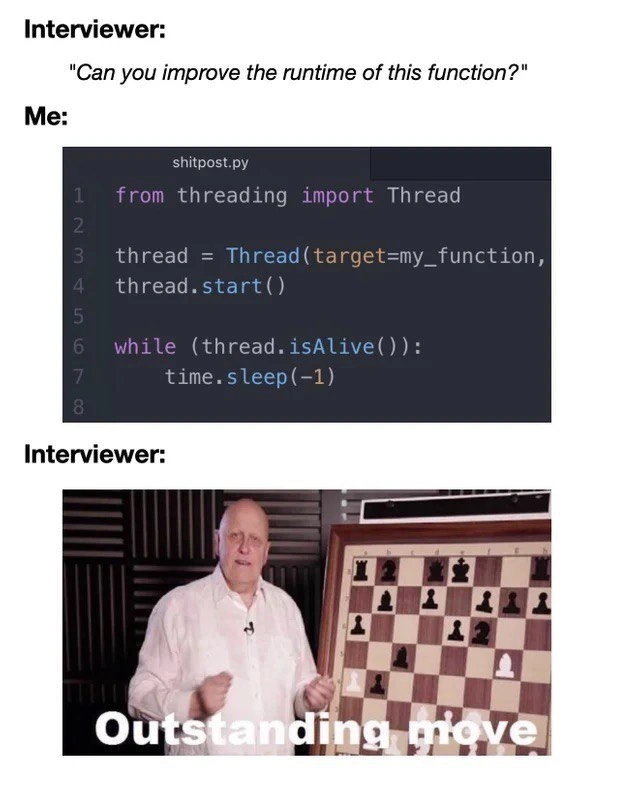
Stepping back a bit, let’s explain what’s going on in this meme in simpler technical terms. The scenario is a coding interview. The interviewer asks, “Can you improve the runtime of this function?” – meaning they want the code to run faster (take less time to do its job). Now, the “Me:” part (the interviewee) responds with a snippet of Python code that’s trying to be clever using threads.

In programming, a thread is like a mini-worker that can run tasks at the same time as other tasks. Think of it as opening a new lane on a highway for your code: you can do two things concurrently. The code shown does the following:

from threading import Thread

thread = Thread(target=my_function)
thread.start()

while (thread.isAlive()):
    time.sleep(-1)

Let’s break this down: from threading import Thread is pulling in Python’s threading API, which allows us to create new threads. Then thread = Thread(target=my_function) creates a thread object that knows it should run my_function (whatever that function does) in that new thread. Calling thread.start() actually launches that new thread and begins executing my_function in parallel to the main program. Up to this point, this is how you’d normally start a background task so it can run concurrently.

Now, here’s where the trickery comes in. Normally, if you truly wanted to speed up a program using threads, you might let the main program continue doing other work while the background thread handles a portion of the task. But in this snippet, the very next thing the main program does is enter a while loop: while (thread.isAlive()): .... The condition thread.isAlive() is essentially asking “Is the thread still running?” If yes, the loop continues. This loop is meant to wait until the thread is finished before proceeding. In other words, the main program isn’t actually doing any useful work in parallel; it’s just waiting idly for the thread to complete the same job that, originally, the function call would have done. So on the surface, this doesn’t actually improve the total time to finish the work – it’s just a very roundabout way to do the same thing.

But it gets weirder. Inside that loop, we see time.sleep(-1). The function time.sleep(x) normally makes the program pause for x seconds. For example, time.sleep(5) would halt execution for 5 seconds. You usually use this to wait a bit before checking again if something is done, to avoid using 100% CPU by asking continuously. However, a negative sleep time is not normal at all – it’s basically asking to sleep for “negative one” seconds. That’s like saying, “Pause, but for a reverse amount of time.” In Python, if you try to do time.sleep(-1), it will actually throw an error complaining that the sleep length must be non-negative. In a hypothetical world where a negative sleep was allowed, the expectation might be that it would just return immediately (no waiting) – effectively making that loop check the thread status as fast as possible. It’s a bit like saying, “Keep checking without any delay.” But writing it as sleep(-1) is a joke – it’s intentionally using an invalid value to emphasize just how far this meme-code is from real, good code. It’s essentially a no-op sleep, or put plainly, not sleeping at all between checks.

So what’s the net effect of this code? The interviewee hasn’t actually made the function itself any faster. They’ve just moved the execution of my_function onto a different thread. The main program immediately goes into a loop waiting for that thread to finish. If this code actually ran (ignoring the fact that sleep(-1) would crash), the main program would be constantly checking (hundreds or thousands of times per second) if the thread is done, doing nothing productive in the meantime. Once the thread finally completes my_function, the loop ends. At that point, the overall job is done. The total time taken is basically the same as if we just ran my_function normally! We didn’t reduce the work, we just added unnecessary complexity.

In a realistic interview scenario, when someone asks you to improve runtime, they’re looking for strategies like reducing computational complexity, eliminating unnecessary work, or maybe using actual parallel processing in a meaningful way (for example, splitting the task across multiple CPU cores or machines if it’s parallelizable). Simply throwing a task on a background thread doesn’t guarantee a speedup. In Python especially, due to the GIL (Global Interpreter Lock), two threads won’t run Python code simultaneously on two cores if it’s CPU-bound – they take turns. Threads can help speed things up only in specific situations (like one thread waiting on input/output while another does work), but you’d still normally use proper waiting methods (like thread.join() which waits for thread completion) or asynchronous patterns.

The meme is a form of InterviewHumor because it parodies what an inexperienced or cheeky coder might do under pressure: applying a goofy trick instead of a genuine solution. The final panel with the “Outstanding move” caption (taken from a popular outstanding_move_meme template) is pure sarcasm. In reality, an interviewer would likely not be impressed by this at all – they’d probably question if the candidate understands what “improve runtime” means. But in the meme, the interviewer appears to applaud it as a brilliant move, which is what makes it funny. It’s a playful jab at both performance optimization misconceptions and the sometimes absurd lengths people go to appear clever in interviews. Anyone who’s gone through coding interviews or has tried to optimize code can laugh at how off-the-mark this “solution” is, and how the meme jokingly treats it like a stroke of genius. In short, the code uses Python threading in a totally wacky way (with the negative sleep call as the cherry on top) to poke fun at the idea of faking a performance boost.

Level 3: Sleight of Thread

For seasoned developers, the humor in this meme comes from recognizing a classic anti-pattern in performance optimization. The interviewer asks, “Can you improve the runtime of this function?” – typically expecting a smarter algorithm or a more efficient approach. Instead, the candidate’s response is to perform a sleight of hand (or rather, sleight of thread), offloading the work to a new thread and immediately sleeping with a nonsensical negative value. It’s the software equivalent of sweeping dirt under the rug and claiming the floor is cleaner. The combination of misused threading and an obviously invalid sleep call is what elicits knowing groans (and laughter) from experienced programmers.

Let’s unpack why this is funny to someone who’s been around the block: First, spawning a thread to run my_function means the original function spawns a helper and then could return immediately. In principle, this can make the main thread’s runtime appear near-zero – a cheeky way to claim “Look, I optimized it; the function returns almost instantly now!” But any senior developer will smirk at this because the work hasn’t disappeared at all. The heavy lifting is simply happening asynchronously in that new thread. It’s like bragging that you finished a task super fast when in reality you just handed it off to someone else. The total execution time (wall-clock time to complete the task) hasn’t improved one bit. In concurrency terms, this is a false optimization – there’s no algorithmic improvement, just an attempt to hide the latency by doing it in parallel.

Now, the Python-specific context makes it even richer. Python’s threading library uses threads within a single process, but the infamous Global Interpreter Lock (GIL) means only one thread executes Python bytecode at a time if the work is CPU-bound. So if my_function is doing CPU-heavy calculations (the usual suspect in runtime issues), putting it in a thread won’t speed it up at all. In fact, here the main thread sits in a loop checking thread.isAlive(), which (if it didn’t error out on sleep(-1)) would burn CPU cycles continually. So you’d have two threads contending for the same core – one doing useful work, and one doing nothing but constantly asking “Are we there yet?” The result? The task might actually run slower than the original single-threaded version due to this pointless overhead! It’s a perfect example of a newbie performance “fix” that backfires, something a veteran might chuckle at because they’ve seen similar misuses in real projects (perhaps an overzealous junior trying threads or async where it wasn’t needed, causing more problems).

The snippet also uses thread.isAlive() in a loop rather than a proper synchronization method. Any senior engineer reading that will immediately think: “Why on Earth aren’t you using thread.join()?” In real code, you’d simply call thread.join() to block until the thread finishes, instead of manually polling in a loop. The busy-wait approach shown is an obvious code smell. It’s the kind of thing that would get flagged in a code review with a comment like, “This is not how you wait for a thread… also, what’s with sleep(-1)?!” The use of time.sleep(-1) is undeniably a shitpost (the code file is even named shitpost.py in the image) – it’s there to emphasize how deliberately ridiculous this “solution” is. No competent interviewer would actually praise this in real life; more likely, they’d be speechless or hit the candidate with a barrage of follow-up questions.

That brings us to the final panel: the interviewer’s reaction image. It features a chess commentator from a popular chess commentary reference meme, with the caption “Outstanding move.” This image is typically used on the internet to humorously congratulate a bold but foolish action. Here, it perfectly underscores the irony. The interviewer (portrayed by the meme) is sarcastically applauding the candidate’s absolutely absurd performance hack as if it were genius. This is a wink to all developers: we recognize that this move is so wrong that wrapping back around, it’s hilariously bold. It’s a concurrency_shortcut and an interview_performance_trick undeserving of real praise – which is exactly why it’s funny when the meme interviewer says “outstanding.” Every experienced programmer understands the shared joke: “We’ve all seen dubious tricks like this, and we all know this isn’t how you really do it.” In the realm of InterviewHumor, this meme checkmates the typical interview scenario by presenting a solution that’s technically out of bounds – and the exaggerated praise is the comedic cherry on top.

Level 4: Temporal Paradox

At the most granular level, this meme riffs on the idea of bending time and computation in impossible ways. The code time.sleep(-1) suggests a negative sleep duration, which is like asking a computer to wait for -1 seconds – essentially to finish waiting one second before it started. This is a tongue-in-cheek nod to a temporal paradox in programming: real systems strictly disallow negative waits because time in computing is monotonic (always moving forward). In fact, calling time.sleep(-1) in Python would immediately raise a ValueError – you can’t schedule an event for a time that’s already passed. Under the hood, the OS’s scheduler expects non-negative intervals for sleeping (e.g., using a system call like nanosleep on Unix), and a negative value is invalid. So the meme’s "speed hack" is literally asking for the impossible: it pretends to magically reclaim time.

From a performance theory standpoint, this solution doesn’t alter the algorithm’s time complexity at all – if the function was, say, $O(n^2)$, wrapping it in a thread does not reduce it to $O(n)$ or $O(\log n)$. All the heavy lifting still occurs; it’s just pushed onto a different execution context. In fact, if we consider Python’s Global Interpreter Lock (GIL), threading won’t even run two CPU-bound tasks truly in parallel in one process. The main thread spinning in a loop and the worker thread executing my_function are effectively taking turns on a single core. Any experienced systems developer knows that you can’t cheat the CAP theorem of performance – the work must be done somewhere, and the total CPU cycles required remain the same (or more due to overhead). By spin-waiting with an instantaneous loop (sleep(-1) hypothetically being a zero-delay), the main thread is continuously checking if the worker is done, which wastes CPU cycles in a busy-wait. This is akin to a poorly implemented spinlock that starves other threads. It’s actually worsening performance: the OS scheduler sees two active threads contending, and context switching between them has a cost.

In advanced concurrency terms, what we have here is a misguided attempt at parallelism that violates good design. Instead of using proper synchronization (like a thread join or a callback), this code tries a time-travel trick to avoid waiting. It satirically pokes at the idea that one could achieve an instantaneous program by simply moving the work elsewhere and pretending to wait negative time. The humor lands because it highlights a fundamental truth: no clever scheduling hack can break the laws of time or algorithmic complexity. The only way to truly improve runtime is to reduce or optimize the work done (better algorithms, data structures, or true parallel computation on multiple cores without a GIL). In summary, the meme’s code is a theoretical absurdity – a temporal hack that would require rewriting physics (or at least Python’s time API) to actually work. That’s why any seasoned engineer reading this is chuckling: it’s a wild (and doomed) attempt to beat the system by tricking the clock itself.

Description

This is a two-part meme format contrasting a technical interview question with a candidate's absurd solution. The top section, labeled 'Interviewer:', asks, 'Can you improve the runtime of this function?'. The middle section, labeled 'Me:', displays a Python code snippet from a file named 'shitpost.py'. The code imports 'Thread', starts a given 'my_function' in a separate thread, and then enters a 'while' loop that calls 'time.sleep(-1)'. The bottom section shows the interviewer's reaction using the 'Outstanding move' meme, which features a man next to a chessboard, sarcastically applauding the move. The technical joke is that passing a negative number to 'time.sleep()' in Python raises an immediate 'ValueError', crashing the main thread. The function's runtime isn't improved at all; the program just terminates instantly, making it seem like the task is done. For experienced engineers, this is a multi-layered joke about interview pressure, lateral thinking, and the critical difference between actual performance optimization and simply making a program stop


Comments

25
Anonymous ★ Top Pick My function's runtime is now O(ε), where ε is the time it takes the Python interpreter to process a fatal error. Your move, interviewer
  1. Anonymous ★ Top Pick

    My function's runtime is now O(ε), where ε is the time it takes the Python interpreter to process a fatal error. Your move, interviewer

  2. Anonymous

    Spawn the work in a thread, call sleep(-1), and watch Prometheus report P99=0 - turns out the fastest algorithm is convincing the metrics pipeline the request never existed

  3. Anonymous

    Ah yes, the classic 'negative sleep' optimization - because if sleeping for positive time makes things slower, surely sleeping for negative time will make them faster! Next up: improving database performance by setting the connection timeout to imaginary numbers

  4. Anonymous

    When asked to optimize runtime, this candidate discovered that negative sleep() is the ultimate performance hack - it's so fast, it travels backward in time! Who needs thread.join() when you can busy-wait with undefined behavior? The interviewer's chess analogy is apt: this move is so brilliant, it's like sacrificing your queen, both rooks, and your dignity in a single turn. At least the filename 'shitpost.py' sets appropriate expectations for code review

  5. Anonymous

    Asked to "improve runtime," I threaded it and called sleep(-1); the GIL plus a ValueError delivered the only true O(1): instant crash

  6. Anonymous

    Optimized the function to O(0): spawn a thread, return immediately - throughput unchanged, GIL unimpressed, but the KPI says “outstanding”

  7. Anonymous

    Shaves runtime to O(n/cores + eternal polling) - because proper Thread.join() is for architects, not interview gladiators

  8. @ZgGPuo8dZef58K6hxxGVj3Z2 4y

    Lol

  9. @nuntikov 4y

    what

    1. @ZgGPuo8dZef58K6hxxGVj3Z2 4y

      He makes it run on a different thread

  10. @nuntikov 4y

    -1?

  11. @bezuhten 4y

    Can u explain?

  12. @nuntikov 4y

    why not j0in?

  13. @t02x2 4y

    Threads will only use one CPU on your machine with python. Won’t be faster. Idea is funny though -> Use Multiprocessing

    1. @viktorrozenko 4y

      wait really? so Python only ever works on one CPU even when I make new Threads?

      1. @RiedleroD 4y

        there are ways to circumvent that, but it's quite complicated

        1. @viktorrozenko 4y

          might that be why Python concurrency sucks so much with its restrictions on net-card access only from the main thread and stuff like that?

          1. @RiedleroD 4y

            idk, I haven't actually done much research. I just know that python really doesn't want to be responsible for race conditions

      2. @t02x2 4y

        GIL ist the problem and has it's reasons https://realpython.com/python-gil/

      3. @slnt_opp 4y

        Yeah, it's same for many such languages, ruby too, because GIL That's why if it's about web apps one usually makes workers and forking🤷‍♂️

        1. @viktorrozenko 4y

          I just write Go instead, lol

          1. @slnt_opp 4y

            Me too, but simple stuff, like poll or smth - Django / Flask :)

            1. @viktorrozenko 4y

              Try FastAPI

  14. @t02x2 4y

    its very easy. Just use multiprocessing to start a new process. A python Interpreter can only be executed on one cpu. A new process is executed on a new cpu :)

  15. @Dexconv 4y

    laughs in go func() peasants

Use J and K for navigation