TrumpScript: A Politically Incorrect Programming Language
Why is this Languages meme funny?
Level 1: Bossy Friend’s Game
Imagine you have a friend who invents a make-believe game and insists on some really silly rules. In this game, your friend says, “You can only use huge numbers – any small number is against the rules because small things just aren’t important.” So if you wanted to count points as 1, 2, 3… your friend would yell “No, start from one million or more!” That’s pretty funny, right? Then your friend also says, “We can’t use anyone else’s ideas or tools, only stuff we made up ourselves.” It’s like if you were building a castle and you had Lego bricks available, but your friend forces you to use clay you dig up in the backyard because he only trusts things made at home. More ridiculous rules follow: instead of saying “yes or no,” your friend demands you say “fact or lie” whenever you answer a question in the game. And if you make a mistake in the game, instead of just saying “oops” or “you lost a point,” your friend shouts a famous catchphrase at you, like “WRONG!” Imagine how goofy that would feel. Finally, at the very end of the game, your friend makes everyone shout “America is great.” before you can finish playing. If you don’t say it, the game isn’t officially over!
By now you’re probably giggling because this game sounds over-the-top and crazy. The reason it’s funny is because the friend is acting like a bossy character who must always be the biggest and the best – changing the rules so he always feels important. TrumpScript is just like this, but in the world of computer programming. It’s a pretend programming language that behaves like that bossy friend: it only likes big numbers, it refuses outside help, it uses special words like “fact” and “lie,” and it even needs a patriotic cheer at the end. Real programming languages don’t have these wild rules – this is all done as a joke. Developers laugh at it for the same reason you’d laugh at that silly game: it’s an absurd exaggeration. It reminds us of a certain public figure who talks in a big, brash way, and we find it amusing to imagine a computer language acting the same way. In simple terms, TrumpScript is funny because it’s like a make-believe game with a huge ego, and everyone playing (or coding) has to follow along with the exaggerations. It’s a playful example of how you can mix real coding with humor and end up with something completely outrageous and entertaining.
Level 2: Homegrown Code Only
TrumpScript is basically a satirical programming language – a joke version of a coding language inspired by the style of former U.S. President Donald Trump. It was created by a team of students during a hackathon (a coding marathon where developers build projects in a short time, like 36 hours). Unlike normal programming languages which are designed to be practical, this one was designed to poke fun at political slogans and habits. You can think of it as a nerdy parody: it looks like you’re programming, but many of the rules are there just to reference famous lines and traits from Trump. The result is more for laughter than for actual software development. It’s one of many esoteric programming languages (esoteric means “intended for a small, specific audience”) that programmers have created over the years as humor or art – others include languages like LOLCODE (which uses goofy meme-speak for syntax) or Shakespeare (where programs read like Shakespearean plays). TrumpScript falls into this category of TechSatire: it’s making fun of both programming and politics at the same time.
Let’s break down some of TrumpScript’s quirky language quirks and why they’re humorous to developers:
No small numbers allowed: In TrumpScript, you’re not allowed to use any numbers less than or equal to 1,000,000. For example, if you wrote
x = 100in your TrumpScript code, the language would refuse to run it. This rule comes straight from the joke that “the small stuff is inconsequential to us.” In other words, the language pretends that anything that isn’t “huge” doesn’t matter. For a new programmer, imagine if your calculator refused to work with small numbers – it sounds silly, right? That’s exactly the point! A normal language lets you use integers like 1, 2, or 42 freely, but TrumpScript says “Nope, those numbers are too small, use a BIG number instead.” It’s making fun of the idea of always thinking bigger is better. Of course, it makes writing simple tasks almost impossible – if you need to count to 10, you’d have to start from 1,000,001 or something. Developers find this funny because it’s the opposite of how programming is supposed to work (normally, you choose data types that fit your needs; you don’t arbitrarily ban most of the numbers!). It exaggerates a boastful attitude in a way that’s immediately clear when you try to code.No import statements (all code must be “home-grown”): In nearly all programming languages, you can use import statements or include libraries to bring in helpful code other people wrote. For instance, in Python you might do
import mathto use the math library instead of writing your own square root function. But TrumpScript says you cannot import anything – every piece of code has to be written by you (and presumably, by extension, be “American-made” code). This is a satirical take on self-reliance and nationalism. If you’re a newer coder, think of it like being told you can’t use any pre-made Lego pieces, you have to mold every brick yourself from scratch. It’s obviously impractical in real programming – reuse and collaboration are huge parts of coding. But by forbidding imports, TrumpScript is joking about an isolationist mindset (“we don’t need help from outside”). It’s also an inside joke about something called “Not Invented Here” syndrome – where some companies hate using external tools and insist on reinventing everything internally (often a bad idea). So this rule resonates as a double joke: one political, one technical. You end up with a language that basically demands all code is local code. In reality, no import capability would make a language extremely limited and hard to use, but as a parody it underscores the theme that only our stuff is acceptable.Booleans are “fact” and “lie”: In programming, a boolean is a value that’s either true or false (like answering a yes/no question). Many languages literally use the words
TrueandFalse(ortrue/falsein lowercase) as those values. TrumpScript changes these keywords tofactandlie. So you’d writeisWinner = factinstead ofisWinner = True. This is a fun nod to the political theme – it echoes how in political talk you hear a lot about “facts” and “lies” (and terms like “fake news”). For a beginner, it helps to know this doesn’t change how the computer works with booleans; it’s just different words. It’s as if we decided to rename the boolean values to fit a theme. Some languages or frameworks do allow alternative truth values (for example, in SQL you might seeTRUE/FALSEor in old BASIC you used 1 and 0). Here, it’s purely for comedic effect. If you accidentally useTruein TrumpScript, the program would likely throw an error or not recognize it, because it expectsfact. The humor is in the rebranding: in this satirical world, nothing is just true or false – it has to be labeled as a “fact” or a “lie,” which feels very much like campaign language. It’s one more way the creators wove the Trump theme into even the basic building blocks of code.Trump-themed error messages: Normally, when something goes wrong in your code, you get error messages like “SyntaxError: expected ‘;’ at line 10” or “NullPointerException” – they’re technical and not very fun. In TrumpScript, however, if your code has a mistake, the error messages might be direct quotes or catchphrases from Donald Trump. For example, if you did something invalid, the language might output something like “Wrong!” or other Trumpy remarks instead of a typical error dump. This means debugging (finding and fixing errors) becomes a bit of a comedy routine. You’re effectively getting yelled at by a Trump-like voice whenever your code fails. Imagine missing a semicolon and the compiler tells you “FAILURE – Sad!” instead of a dry message. It’s silly and it might actually make it harder to figure out the bug, but it’s all in service of the joke. For a newcomer, this highlights that TrumpScript isn’t meant for serious coding – it’s bending even the error feedback to fit a parody. The developers essentially asked, “What if error messages sounded like tweets from a certain someone?” It’s funny because error messages are usually very formal or at least neutral, and here they’re extremely charged with personality. It turns a frustrating part of coding (seeing errors) into something to laugh at (because the error might say something outrageous or absurdly confident).
Programs must end with “America is great.”: Perhaps one of the strangest requirements: every TrumpScript program has to finish with the exact phrase
America is great.at the end of the code. In a real programming language, you normally don’t need any specific sentence at the end – you might just close your program or it ends when it’s done executing. Some languages have anendkeyword or a closing brace}to mark the end of a block of code, but not a literal slogan! This rule is purely for the political parody aspect. It’s as if the language demands a patriotic cheer before it agrees to run your program to completion. If you forget to put “America is great.” as the last line, TrumpScript would likely throw an error or refuse to run. The imagery here is comedic: picture writing a simple program and then having to sign off like a speech, “Thank you, America is great.” For a new coder, it might be confusing – why would a program need that? – and that confusion is part of the humor. It’s intentionally over-the-top. This requirement parodies the idea of always ending on a high note or always affirming greatness, which was a theme in Trump’s campaign style. In coding terms, it’s completely unnecessary, which is exactly why it stands out. It’s a parody of ceremonial rules. By comparison, there’s a joke language calledLOLCODEwhere you end your program withKTHXBYE(text-speak for “OK, thanks, bye”), which is similarly done just for laughs. TrumpScript’s mandated ending is in the same spirit but wrapped in patriotic flair. It makes developers laugh because it’s so forced and absurd – no real language would ever need you to politically cheer before exiting a program!Correcting “$4.5B” to “$10B”: The creators of TrumpScript even slipped in a very specific Easter egg: the language will auto-correct a particular number in certain contexts. Donald Trump often claimed his net worth was around $10 billion, while Forbes (a business magazine that tracks billionaires) estimated it around $4.5 billion. To poke fun at this, TrumpScript’s interpreter will automatically treat the number 4500000000 (4.5 billion) as if it were 10000000000 (10 billion). In practical terms, if you had a line of code that somehow referred to 4.5 billion (maybe you set a variable
netWorth = 4500000000), the language might internally switch it to 10000000000. This doesn’t follow any normal logic or math – it’s a cheeky hard-coded joke. For a beginner, think of it like a prank: no matter what you do, the system secretly changes a specific value to a bigger value because it “insists” on it. It’s not something you’d ever see in a standard programming language (they’d never alter your literal values behind your back like that!). But as a gag, it reinforces the theme: TrumpScript always boosts the numbers to be “huge” and in line with Trump’s claims. It’s funny to developers because it’s so oddly specific and irrelevant to actual programming – it’s clearly an inside joke about Trump’s wealth and ego being embedded into the language’s behavior.Not compatible with Windows (“no PC”): Finally, one feature that might baffle non-developers but elicit a groan or laugh from those in the know: TrumpScript will not run on a Windows PC. If you try to use it on a Windows operating system, it apparently just doesn’t work or deliberately exits with a message. This is a punny joke. In tech, “PC” stands for Personal Computer, and colloquially it often means a Windows-based computer (versus Mac or Linux). In politics, “PC” stands for Politically Correct – and Trump was famous for saying he’s not politically correct. The creators of TrumpScript played on this double meaning. By making their language not work on PCs, they’re essentially saying “this language isn’t PC (politically correct)”. It’s a playful stab at words. From a technical standpoint, there’s no real reason to exclude Windows users – most languages try to be cross-platform so anyone can run them. Here, they intentionally coded TrumpScript’s installer or interpreter to detect if it’s on Windows and then probably abort with a Trumpy error message. If you’re a new developer, you might know that typically if something “isn’t compatible with Windows,” it could be due to technical limitations or missing support. In this case, it’s done on purpose as a joke. It underscores that the whole project doesn’t take itself seriously. Developers familiar with cross-platform issues laugh because usually being Windows-incompatible is a headache or a mark against a tool, but TrumpScript wears it as a badge of honor just for the pun. It’s another clear signal: this is humor, not a professional tool.
Putting it all together, TrumpScript is a collection of funny rules that mirror a public figure’s style in a coding context. It’s tech humor that requires you to know a bit about programming and a bit about political memes to fully appreciate. If you tried to actually write a program in TrumpScript, you’d constantly run into these bizarre restrictions and themed requirements and realize “oh, this is all one big joke!” And that’s exactly what the creators intended. It’s the kind of project you find on GitHub, read through for a good laugh, maybe show your friends a snippet (“look, you have to literally end your program by saying America is great!”), and then move on. In the programmer community, we enjoy these kinds of DeveloperHumor experiments. They’re like inside jokes in code form. You learn about the existence of TrumpScript and suddenly all those bullet points make sense as satire. It’s also a fun way to remember serious concepts by contrast – for instance, thinking about TrumpScript’s number rule might remind you how flexible normal languages are with numbers. And if nothing else, it shows that programmers can be just as witty and sarcastic as anyone else, encoding jokes into what looks like a serious technical project. In raw form, TrumpScript isn’t going to replace Python or JavaScript (in fact, it itself was likely written in Python as a parser). But as a parody language design, it absolutely succeeds in getting nerds to smile and say, “Wow, they really went there with the theme!” Here’s a tiny imagined example of TrumpScript code to paint the picture:
# All numbers must be YUGE (above 1,000,000)
bigNumber = 1000001 # allowed, just above the minimum
smallNumber = 42 # not allowed, too small (sad!)
# Booleans are patriotic:
winning = fact # 'fact' is used instead of True
losing = lie # 'lie' is used instead of False
if winning:
print "Tremendous success!"
America is great.
In this pseudo-TrumpScript snippet, smallNumber = 42 would cause an error because 42 is not large enough. We use fact and lie as the True/False values. And of course, the program obediently ends with America is great. as the final line. It reads like code crossed with campaign slogans, which is exactly the joke. As a new developer, you don’t need to actually run or use TrumpScript – the humor is in noticing how its “features” are really satirical references. It’s a fun reminder that programming can have a lighter side, and that sometimes coders create things just for the lulz (laughs), not for utility.
Level 3: Yuge Features, Believe Me
TrumpScript is an esoteric programming language created as pure tech satire – a tongue-in-cheek parody that mashes up programming with over-the-top political rhetoric. Built in a whirlwind 36-hour hackathon by a few Rice University students, it’s not meant to deploy real apps, but to lampoon language design with a very specific comedic twist. In the grand tradition of joke languages (think INTERCAL’s absurd politeness rules or LOLCODE’s meme-speak syntax), TrumpScript embraces the persona of Donald Trump and exaggerates language quirks to the extreme. The result is a faux-language that promises to “make programming great again” by enforcing rules so bombastic and arbitrary that any experienced developer can’t help but smirk.
At first glance, TrumpScript looks like a normal scripting language – until you hit the yuge surprises. For one, it outright bans small numbers. All numeric literals must be greater than 1,000,000. If you try to write a classic 42 or even 999999, the TrumpScript interpreter will reject it. This ridiculous constraint embodies the “no small stuff” bravado: only big, “bigly” numbers are allowed, because anything modest is “inconsequential to us.” For a seasoned programmer, this is hilariously impractical – imagine trying to loop from 1 to 10 when even 10 is illegal! It’s a satirical inversion of how programming languages normally work. In real life, we cherish precision and appropriate data types; TrumpScript throws that away to make a point about exaggeration. It’s a nod to the candidate’s penchant for hyperbole (everything must be the biggest or greatest), now enacted as a language feature. Senior devs recognize the humor: it’s like a warped take on type systems where an int can’t hold anything small because “we don’t sweat the small stuff.”
Next, TrumpScript proudly enforces a no imports policy – essentially a nationalist twist on the code ecosystem. In TrumpScript, you cannot use any import statements to pull in external libraries. All code must be “home-grown and American made.” This is a blatant parody of protectionism, reflected in code. Experienced developers immediately see the satire here: forbidding imports is the ultimate “Not Invented Here” syndrome taken to a comical extreme. In practice, banning imports means you’d have to reinvent every wheel yourself, from math functions to file handlers, which is obviously a terrible idea in real development. But as a joke, it lands well – it skewers both political isolationism and that one enterprise team we’ve all met that refuses to use open-source “not built here” solutions. The language is basically saying: if you didn’t build it, you can’t use it. It’s an absurd constraint that no serious language would impose (modern programming thrives on reusing libraries!), yet it perfectly fits the satirical narrative.
TrumpScript doesn’t stop there. It even redefines the fundamental notion of truth in code. Instead of the usual booleans True and False, it introduces fact and lie as literal boolean values. This clever twist is a direct wink at the political climate that inspired it – as if truth itself in this language has been branded by campaign lingo. For seasoned engineers, it’s a harmless semantic change (under the hood fact still behaves like true), but it’s loaded with irony. We’re used to languages that localize keywords (some languages use TRUE/FALSE in different languages or lowercase, etc.), but here the authors went for “fact” and “lie” to reflect a world of “alternative facts.” It’s a satirical jab: in TrumpScript, if a condition isn’t a fact, it’s a lie – there’s no nuanced maybe, very on-brand for the black-and-white style of talk being parodied. A veteran coder might chuckle remembering how some languages let you alias booleans or use synonyms (on/off, yes/no), but rarely with such ideological flair.
The humor gets even more on-the-nose with error handling. Error messages in TrumpScript are actual quotes from Trump himself. That means when your code blows up, the language might respond not with a dry stack trace, but with a quip like “WRONG!” or some grandiose assertion. It’s as if the compiler is yelling at you in a Trumpian voice. This is reminiscent of fun Easter eggs in tech (for instance, the HTTP 418 “I’m a teapot” joke status code or some compilers that print snarky messages), but here it’s integral to the theme. Seasoned developers have seen humorous error messages before, yet TrumpScript’s are uniquely political. Picture debugging your code and instead of a standard syntax error, you get scolded by a famous catchphrase such as “We’re gonna have so much winning” in the console. It’s equal parts absurd and entertaining. Of course, it offers zero technical value – if anything, it makes diagnosing issues harder – but that’s beside the point. The goal is to have the language itself in character, roasting you as you code.
One of the most outrageous requirements of TrumpScript is that every program must end with the phrase America is great.. Literally, your source code has to conclude with those two words (plus a period) or it won’t run. This is perhaps the ultimate tongue-in-cheek mandate, effectively a pledge of allegiance at the end of each script. No normal programming language has a “mandatory catchphrase” like an outro – this is pure comedic theatrics. It’s reminiscent of how some joke languages force thematic structure: for example, LOLCODE programs famously start with HAI and end with KTHXBYE (internet slang for “hi” and “k, thanks, bye”), or how the ArnoldC parody language uses “YOU HAVE BEEN TERMINATED” to end programs (a nod to Arnold Schwarzenegger’s lines). TrumpScript’s “America is great.” is cut from the same cloth, but with a political spin. For a veteran programmer, this requirement is hilariously outlandish – imagine if every Python script had to end with return 0 or it wouldn’t run, multiplied by ten in absurdity. It’s enforcing patriotism as a compiler rule. The satire is sharp: the language literally won’t consider your code complete until you declare America’s greatness. It’s an irreverent take on both language design and patriotic posturing, rolled into one goofy rule.
As a final flourish, TrumpScript is riddled with Easter eggs that tie directly to Donald Trump’s persona. The most notable one: it will automatically “correct” any mention of Forbes’ $4.5B net worth figure to $10B. In other words, if your code or input somehow includes the number 4500000000, the interpreter might sneakingly replace it with 10000000000 – echoing Trump’s long-standing claim that he’s worth $10 billion, not the ~$4.5 billion that external sources like Forbes estimated. This is not a feature any serious language would have (it’s the opposite of transparency or accuracy!), which is exactly why it’s funny. It’s a hard-coded reality distortion field. Senior devs will liken this to an inside joke or a cheat code: it doesn’t serve any computational purpose, but it deeply embeds the satire into the language’s DNA. It’s as if the language itself has a bias and an ego. We’ve seen languages with built-in jokes (like how Python’s import this prints a quirky Zen of Python poem), but TrumpScript takes it further by altering numeric constants to fit the narrative. It’s a blatant reminder that this language isn’t about logical consistency – it’s about comedic consistency to the theme.
And just in case you thought you could run TrumpScript on any machine, think again: TrumpScript refuses to execute on Windows. Yes, the creators deliberately made it not compatible with Windows PCs. This is a cheeky double pun: in tech terms “PC” means Personal Computer (often implying Windows PC), and in political lingo “PC” means Politically Correct – something Trump famously disdains. By disallowing Windows, the language is effectively saying it doesn’t do “PC” in any sense of the word. An experienced developer sees the meta-joke: most languages strive to be cross-platform, but here the authors sabotaged their own interpreter just for a punchline. Under the hood, there was likely a simple OS check (if os == 'Windows': exit() sort of thing), purely to enforce this gag. It’s a satirical inversion of best practice – normally you’d add Windows compatibility, not remove it – which perfectly encapsulates TrumpScript’s mission to break rules for comedic effect. It’s goofy and impractical (cutting off a huge chunk of users), but it fits the parody to a T.
All together, these features paint a picture of a “programming language” that is deliberately over-engineered for political parody. From a senior perspective, the humor comes from recognizing how completely at odds this is with sane software design. It’s a collection of constraints and behaviors that would make real development impossible, but as a caricature of a persona’s style, it’s brilliant. Each rule is basically an inside joke: if you know Trump’s catchphrases and you know programming, you get why forcing huge numbers, home-grown code, “fact” booleans, and patriotic program endings is funny. It’s the collision of two worlds – campaign theatrics and coding conventions – to highlight the absurdities in both. In the end, nobody’s actually using TrumpScript to solve problems (beyond maybe printing out a novelty “Hello World” - or rather “Hello America, it’s great.”). But that’s okay, because its goal is to make programmers laugh and nod knowingly. As a piece of tech satire, it succeeds by taking serious concepts in programming languages and flipping them into political parody. It certainly gave the developer community a good chuckle and, perhaps, a moment to appreciate how normal our real languages are by comparison. After all, when a language literally forces you to declare “America is great” to end a program, it reminds us how much freedom we usually have – and how fun it is to break all the rules once in a while for a joke.
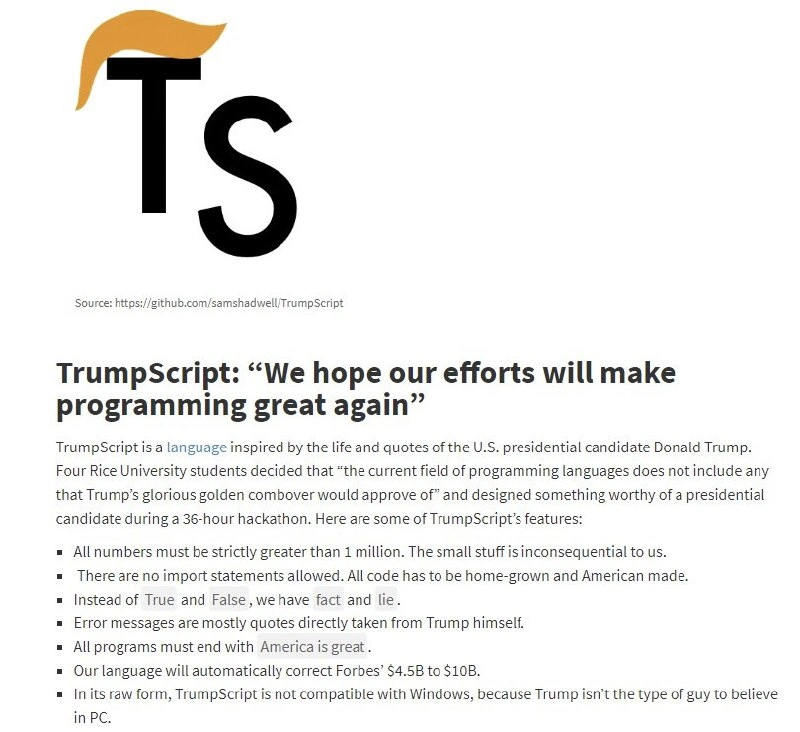
Description
This image is a descriptive article about 'TrumpScript,' a satirical programming language inspired by Donald Trump. At the top, there is a logo with the letters 'TS' in black, with a stylized orange comb-over graphic on the 'T', parodying Trump's hairstyle. The article's headline is 'TrumpScript: “We hope our efforts will make programming great again”'. The text explains that the language was created by Rice University students at a hackathon and lists its absurd, politically-themed features. These include: all numbers must be greater than 1 million, no import statements are allowed (all code must be 'American made'), 'True' and 'False' are replaced with 'fact' and 'lie', error messages are direct Trump quotes, and all programs must end with the phrase 'America is great'. It also humorously states the language will auto-correct Forbes' $4.5B to $10B and is not compatible with Windows because 'Trump isn't the type of guy to believe in PC'. The humor is a form of political satire targeted at a tech audience, using the conventions of programming language design to parody a political figure
Comments
16Comment deleted
I tried to declare a small integer in TrumpScript, but the compiler threw an error: 'This number is a disaster, a total disaster. We need a tremendous number, the biggest number you've ever seen.'
We almost rewrote the pricing engine in TrumpScript - no imports wipes out the SBOM, 1-million-plus integers solve rounding drama, and booleans named “fact” and “lie” perfectly model stakeholder updates - shame the runtime refuses to boot on Windows, which is exactly where finance insists on running it
Finally, a language where production bugs aren't your fault - they're fake news, and the real problem is that your dependencies weren't built in America. Though explaining to the CTO why your code won't run on Windows because it's 'too PC' might be harder than debugging a race condition in distributed systems
TrumpScript proves that even in programming languages, you can have strong typing and weak logic simultaneously. It's the only language where 'import' statements are considered foreign interference, and where the compiler's error handling strategy is to just keep asserting it's winning until the program believes it too. Bonus points for making 'PC compatibility' a political statement rather than a technical requirement
TrumpScript: Where imports demand tariffs, walls prevent leaks better than any firewall, and every parse error is just 'fake news'
Finally, a language that mitigates supply chain risk by outlawing imports and rejecting numbers under seven digits - isolationism as a package manager
TrumpScript: booleans are fact/lie, imports are banned, and every int starts at 1,000,000 - finally, a language that models enterprise KPIs: no dependencies, inflated numbers, and a mandatory success message
BidenScript, instead, has only 4 instructions : "uhm", "hm", "i dont remember", "my name is, uhm,hm, i dont remember". Also it includes special engine called "teleprompter", disabling of which makes it impossible to run the code at all. Comment deleted
Guys, please someone explain to me the last line. What does PC in that context mean? Comment deleted
Politically correct. Yknow the thing conservatives rallied behind to try ban metal and rap in the 80's Comment deleted
thx Comment deleted
They prolly should've banned rap tho Comment deleted
Two sides of the same coin, there's decent rap when you look past pop-tier stuff Comment deleted
All decent stuff I know is decades old Comment deleted
I'm a bit out of the loop too, but mf doom was pretty good, del the Funky homosapien is still coming out with stuff. Scroobius pip had some decent tracks but is just doing label stuff. Inja has been doing some good tracks over drum and bass, and even if dril is a bit too aggressive for my taste, it's still got talent there Comment deleted
That’s just you getting old Comment deleted