Skip to content
DevMeme
4618 of 7435
When Rubber Duck Debugging Turns into an Unsolicited Therapy Session
Debugging Troubleshooting Post #5066, on Dec 6, 2022 in TG

When Rubber Duck Debugging Turns into an Unsolicited Therapy Session

Why is this Debugging Troubleshooting meme funny?

Level 1: A Duck Who Listens

Imagine you’re trying to solve a really hard puzzle. You have a toy duck (or maybe your favorite teddy bear) sitting on the table. You start telling the duck about the puzzle piece by piece, hoping that just saying it out loud will help you figure it out. This usually works because as you explain the problem, you sometimes see the answer yourself. Now here’s the funny part: in this meme, instead of helping you solve the puzzle, the toy duck asks, “Hey, are you feeling okay? Do you want to talk about your dad or something?” It’s like you wanted help with your homework, but your toy turned into a caring friend who’s more worried about you than the homework. The picture shows the man looking at the ducks kind of confused and tired. The joke is that sometimes when we’re super frustrated trying to fix something, what we really need is a little break and maybe someone (or even a pretend duck friend) to say, “It’s alright, you’ll figure it out. How are you feeling?” It’s silly because, of course, rubber ducks can’t really talk – but it makes us laugh and remember that our feelings matter, even when we’re just trying to fix a problem.

Level 2: Rubber Duck Intervention

Rubber duck debugging is a simple but famous debugging method where a programmer explains their code out loud to a rubber duck or any harmless object. Why a duck? It’s just a cute, goofy stand-in for a human listener (and much cheaper than an actual assistant!). The idea is that by talking through your code, step by step, you’ll often spot the error on your own. It’s like when you explain a confusing homework problem to a friend and suddenly the answer clicks for you as you’re speaking. The duck doesn’t need to respond or know anything about code – its job is literally to sit there and let you work through the logic. This technique forces you to slow down and consider each part of the program, often revealing where you went wrong. It’s a staple in Debugging & Troubleshooting lore and a surprisingly effective self-help trick for coders.

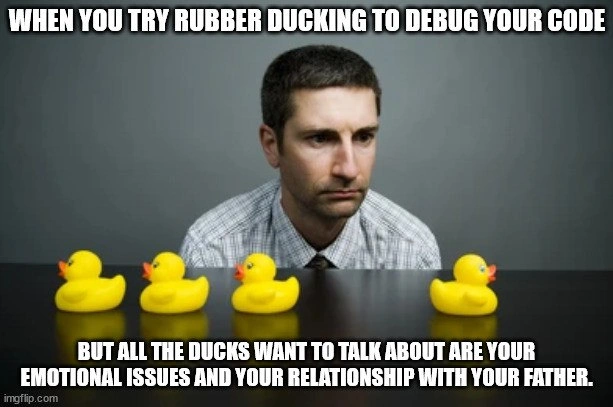
Now, the meme takes this wholesome debugging practice and gives it a funny twist. In the image, a developer has five little yellow rubber ducks lined up in front of him. (Using one duck is normal; using five ducks – that’s a developer really in need of help!) The text at the top says, “WHEN YOU TRY RUBBER DUCKING TO DEBUG YOUR CODE,” which sets the scene: he’s attempting the classic rubber_duck_debugging technique to solve a coding problem. Normally, he’d be saying something like, “Okay duck, the program enters this loop, then it should calculate the total…” hoping that explaining it out loud will pinpoint the bug.

So far, so good – this is a pretty relatable dev experience for anyone who’s learned to debug. But then comes the punchline text at the bottom: “BUT ALL THE DUCKS WANT TO TALK ABOUT ARE YOUR EMOTIONAL ISSUES AND YOUR RELATIONSHIP WITH YOUR FATHER.” This is where the meme switches from technical to personal (and silly!). Instead of quietly helping him find the bug, the ducks are imagined to be talking back like a group of chatty therapists. They’re not interested in the code at all anymore. They want to discuss his feelings, emotional health, and even deeper personal topics like his relationship with his dad.

This unexpected turn is funny because it’s so absurd. Rubber ducks are inanimate toys – they obviously can’t actually talk, let alone analyze your childhood! But the meme pretends they do. It’s lampooning the idea that a simple debugging session could turn into a therapy session. Why therapy? Well, debugging can be frustrating and stressful. If you’ve ever spent hours stuck on a stubborn bug, you know it can make you feel upset, doubt yourself, or even question why you chose programming in the first place. The meme exaggerates that feeling to the extreme: it imagines the developer basically getting a full mental health intervention from his desk ducks.

Key technical term definitions here:

  • Rubber duck debugging: explaining your code, line by line, to a rubber duck (or any object) as if it were a person, in order to find mistakes. The duck just listens; the act of explaining helps the coder think clearly.
  • Therapy session (in this context): a conversation focused on someone’s personal feelings and issues. In real life, a therapy session is with a counselor or psychologist talking about things like stress, family, emotions, etc. Here it’s used jokingly – the developer’s conversation with the ducks shifted from code to his personal life.

Why is this relevant to developer life? Because MentalHealthInTech is a real topic these days. Coding is mentally demanding, and it’s common (especially for new developers) to feel overwhelmed or discouraged when debugging for long periods. This meme resonates with developers because it highlights that emotional side. It’s saying “Yeah, debugging can drive you up the wall so much that even your rubber duck might worry about you!” Obviously, rubber ducks can’t worry – that’s the joke – but it emphasizes how intense debugging sessions can be. It’s a humorful reminder that taking care of your mental and emotional well-being is as important as fixing that pesky bug. If you find yourself talking to five ducks at once, it might be time to step back and take a breather!

So, for a junior developer, the key takeaways are: rubber duck debugging is real and useful (try it next time you’re stuck!), and feeling frustrated while debugging is totally normal. Just maybe don’t be surprised if it sometimes feels like you’re not just debugging the code, but also debugging your brain. And if a rubber duck could talk and cares more about your stress levels than your code... well, that’s the meme’s way of saying “don’t ignore the stress, maybe you need some rest or help, not just fixes to code.” It wraps a genuine piece of advice (self-care in a tough job) in a silly, memorable image. In short: debugging = sometimes hard, rubber ducks = helpful, and emotional overflow during debugging = real (so take care of yourself!).

Level 3: Freudian Quack

Rubber duck debugging is a beloved programming trick: you explain your code, line by line, to a little rubber duck on your desk in hopes of uncovering bugs. It's a form of troubleshooting that forces you to articulate assumptions and find mistakes. In this meme, though, that innocent debugging method takes a hilariously unexpected turn. The developer has five bright yellow ducks lined up, ready to hear about code logic, but instead the ducks turn into therapists. One moment you’re muttering about a NullPointerException to a silent plastic bird, and the next moment the duck is (figuratively) asking about “your emotional issues and your relationship with your father.” This absurd scenario is poking fun at how debugging sessions can feel like therapy sessions when things get really tough. It’s a classic piece of developer humor that’s both ridiculously exaggerated and uncomfortably relatable. After all, who hasn’t had a late-night debugging stint that devolved into questioning life choices?

On a serious note, the humor lands because it highlights a real undercurrent in tech: MentalHealth struggles in high-pressure development environments. The meme blends Debugging_Troubleshooting with a candid nod to MentalHealth in the developer’s everyday life (often called DeveloperExperience (DX)). Seasoned engineers recognize the pattern: a simple debugging method (“rubber ducking”) spirals into an introspective rant. It’s as if even your inanimate debugging buddy can sense your debugging frustration and decides to hold a duck consultation for your burnout. The caption about father issues riffs on a classic therapy cliché (thanks, Freud) – it’s an over-the-top way to say “buddy, this problem might be deeper than syntax errors.” Relatable? Oh, absolutely. It’s relatable dev experience because many of us have felt that mix of debugging hell and personal overwhelm when a bug just won’t make sense.

Let’s break down why this hits home for veteran developers: when you’re stuck on a pernicious bug, you often start voicing the problem step by step. Maybe you line up actual rubber ducks or (more likely) you just imagine a listener. As you explain, you might suddenly realize, “Oh, I forgot to handle the null case on line 42,” and voila, the act of explaining surfaces the bug! This is the ideal outcome of rubber duck debugging – the duck doesn’t talk back or judge, it just listens while you solve the problem yourself. But real-life debugging isn’t always so straightforward. Sometimes explaining the code doesn’t immediately reveal the answer, and you end up venting: “...and then this function returns the wrong value for no reason! Why is everything broken?!” You might start overflowing with emotion – frustration, stress, doubt. The meme exaggerates this to comedic effect: instead of helping you find the bug, your faithful rubber ducks now want to address your emotional overflow. It’s like the ducks collectively hold up a sign saying, “Intervention time! Let’s talk about your feelings.”

This tongue-in-cheek scenario also alludes to the mental health in tech conversation. Developers often joke about needing therapy after dealing with legacy code or impossible deadlines, and here the joke becomes literal. The rubber_duck_debugging process is subverted: the focus shifts from the broken code to the possibly broken coder. The five ducks facing the programmer look like a panel of concerned listeners. (Five ducks — that’s some serious group therapy!) The man’s blurred, weary face says it all: he came for a bug fix, but stayed for a heart-to-heart. The humor is that of recognition: we laugh because it’s true enough that debugging a gnarly problem can feel like coding therapy. You confront not only the code’s issues, but your own impatience, anxiety, or impostor syndrome. In extreme cases, you’re left pondering, “Is it the code that’s wrong, or is it me?” This meme takes that feeling and runs with it, straight into parody territory. Even the rubber ducks — usually silent, patient tools for debugging — are depicted as having had enough. They’d rather discuss your childhood than that spaghetti code in front of you!

To seasoned devs with a dark sense of humor, there’s an extra layer of irony: we often anthropomorphize computers (“why won’t you work, you stupid machine?!”). Here we anthropomorphize the ducks. They’re given the voice of reason or concern that perhaps our human coworkers miss when we’re heads-down in crisis. It’s a cheeky reminder that sometimes the biggest bug in the system is stress. As a result, the meme’s punchline lands with a mix of laughter and a knowing sigh. It’s saying: “Been there, debugged that, and yeah, at some point even the duck knew I needed a break.” In the world of DeveloperExperience_DX, where all-nighters and DebuggingFrustration are common, this meme cleverly pushes the idea that maybe our debugging tools (even toy ducks) care about our well-being, not just our code. It’s humor with heart, coated in a layer of sarcastic absurdity that experienced devs appreciate.

Description

The meme shows a middle-aged man with a sad, contemplative expression, sitting at a dark table in front of four small, bright yellow rubber ducks. The scene has a somber, almost interrogative mood, set against a plain grey background. The top text, in a white impact font, reads, 'WHEN YOU TRY RUBBER DUCKING TO DEBUG YOUR CODE'. The bottom text continues the joke: 'BUT ALL THE DUCKS WANT TO TALK ABOUT ARE YOUR EMOTIONAL ISSUES AND YOUR RELATIONSHIP WITH YOUR FATHER.' The humor comes from subverting the well-known software engineering technique of 'rubber duck debugging,' where a developer explains their code to an inanimate object to find flaws. Instead of a technical breakthrough, the developer faces an unwanted and deeply personal psychological analysis from the ducks, humorously blending the stress of debugging with underlying personal anxieties

Comments

12
Anonymous ★ Top Pick I tried to explain my async race condition to the duck, but it just stared back and said, 'Let's unpack why you feel the need to rush everything, both in your code and your relationships.'
  1. Anonymous ★ Top Pick

    I tried to explain my async race condition to the duck, but it just stared back and said, 'Let's unpack why you feel the need to rush everything, both in your code and your relationships.'

  2. Anonymous

    I scaled rubber-duck debugging to five replicas for high availability; they formed a quorum and scheduled a post-mortem on my unresolved childhood dependencies instead

  3. Anonymous

    Started explaining my race condition to the duck, ended up realizing the real race condition was between my career ambitions and my inability to maintain healthy boundaries with production deployments at 3am

  4. Anonymous

    Ah yes, rubber duck debugging - the only code review where the reviewer has perfect 20/20 hindsight about your childhood trauma but zero opinions on your O(n²) algorithm. At least when your CI/CD pipeline fails, it doesn't ask why you're really afraid of commitment. Though honestly, after explaining the same race condition to a duck for the third time at 2 AM, maybe some introspection about life choices isn't entirely unwarranted

  5. Anonymous

    Tried rubber-duck debugging; five whys later we’re at my childhood and the ducks filed a Jira for “unresolved parental dependency.”

  6. Anonymous

    Rubber ducking: because sometimes the real stack trace originates in childhood

  7. Anonymous

    Explained a deadlock to the duck; it called it “mutual exclusion from dad” and prescribed exponential backoff - of therapy

  8. @callofvoid0 3y

    Programmer with schizophernie

    1. @RiedleroD 3y

      Schizophrenia in english

  9. @ZgGPuo8dZef58K6hxxGVj3Z2 3y

    Imagine having 2 variable names that almost look the same when reading. Hahahha imagine it would happen /s

    1. Deleted Account 3y

      х and x :)

      1. @sylfn 3y

        -> x

Use J and K for navigation