When the Haskell Developer Audits a High School Math Class
Why is this Mathematics meme funny?
Level 1: Calculus for Counting
Imagine you’re in a class learning something simple – say, how to add two numbers. You’re all practicing adding 2 + 3 to get 5, pretty basic stuff. Then one kid in the back stands up and shouts, “Hey, why don’t we use this super fancy math formula from advanced calculus to do that?!” The reaction from the teacher is immediate: “No! Stop! This is just basic addition time, not crazy advanced math time!” Everyone probably giggles because it’s obvious that the kid’s suggestion is complete overkill. It’s like using a rocket ship to travel across the street. The funny part is how ridiculously out-of-place the idea is. In the meme’s case, the class was just learning simple complex numbers (a topic like adding and multiplying basic two-part numbers), and someone suggested using a very high-level math concept (something you might not learn until much later in a math career) to solve a tiny problem. It made the teacher so frustrated she basically said, “Shut up, this isn’t the time for that!” It’s humorous because we all understand the situation: sometimes, a person gets way too excited about a cool new idea and tries to use it everywhere, even when it’s not appropriate. It’s the classic case of bringing a ridiculously complicated solution to a simple problem. The laughter comes from recognizing how silly that is – it reminds us of a friend who’d try to fix a tricycle with NASA-level rocket science. The meme exaggerates this to make a point: sometimes, you just have to learn to walk before you try to fly, and no amount of big fancy ideas will impress a teacher if you shout them out at the wrong time.
Level 2: Steep Learning Curve
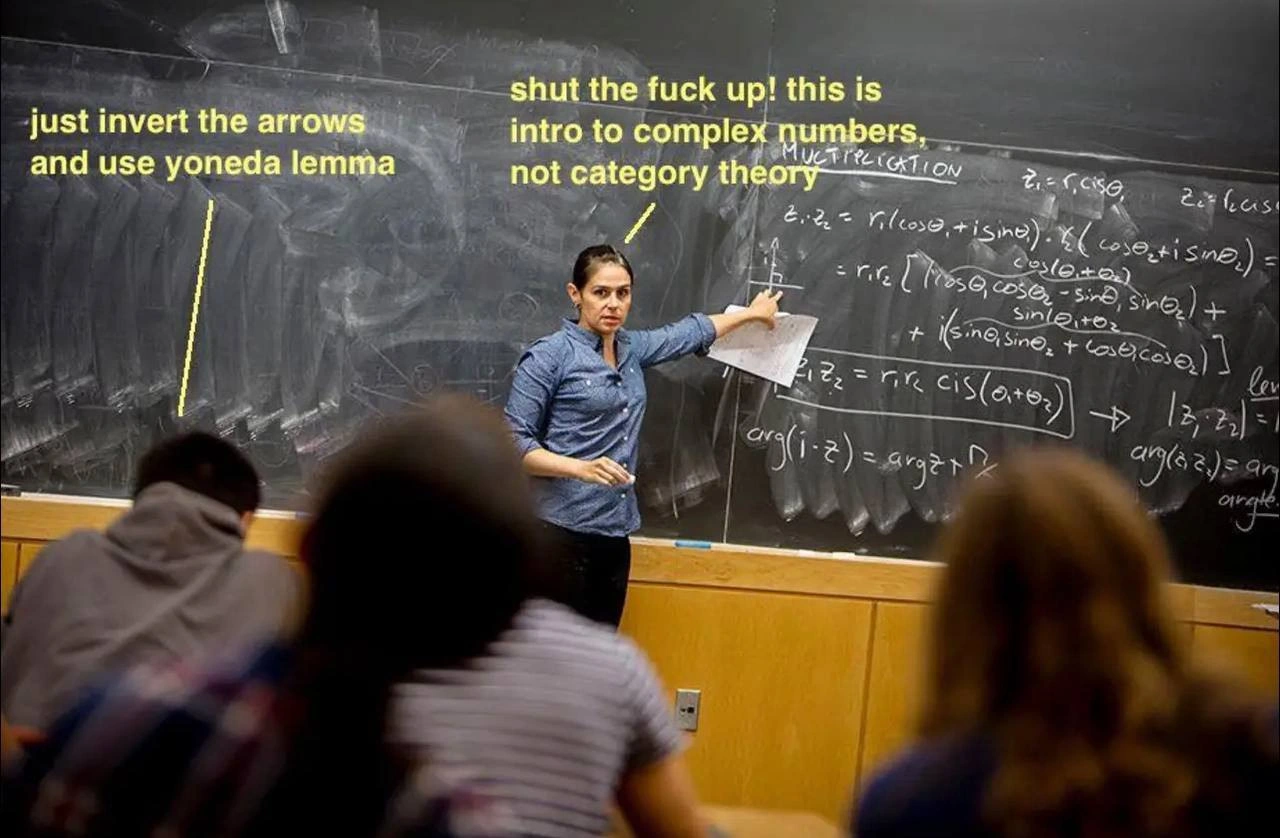
Let’s break down why this scenario is funny, in more everyday terms. The class is Intro to Complex Numbers – probably one of the first times students learn about complex numbers $z = a + bi$ (where i is the imaginary unit). In this class, they cover basics: how to add, multiply, and represent complex numbers. On the chalkboard, the teacher has written formulas like $z_1 \cdot z_2 = r_1 r_2 \cis(\theta_1 + \theta_2)$, which is a way to multiply two complex numbers using their polar forms (cis θ is shorthand for $\cosθ + i\sinθ$). They’re also noting things like $\arg(i \cdot z) = \arg z + \pi/2$, which illustrates that multiplying by $i$ rotates a complex number by 90 degrees on the complex plane. All of this is Mathematics 101 material – concrete and visual. The students are just getting comfortable with the idea that a number can have a “magnitude” and an “angle” (that’s what arg refers to, the angle or argument of the complex number). So far, so good.
Enter our overzealous functional programmer in the back row. Functional programming is a style of coding where you use mathematical functions to avoid changing state or mutable data. Languages like Haskell or OCaml are big on this, and they often borrow terminology from advanced math. People who get into these languages sometimes dive into category theory, which is a very abstract branch of math. Category theory deals with general patterns that show up across mathematics by focusing on relationships (arrows) between structures, rather than the internal details of those structures. It’s like a unifying language for math – very powerful, but very abstract. One famous concept from category theory is the Yoneda lemma. Now, to be clear, the Yoneda lemma is way beyond the scope of a freshman complex numbers class. It’s usually taught in grad-level math or theoretical computer science. In plain terms, the Yoneda lemma says you can understand an object (say, a shape or a data type) completely by looking at all the ways it interacts with every other object in the system. It’s deep stuff – for instance, in programming, this idea can optimize certain computations or clarify how data types relate. But you’ll almost never hear about Yoneda in everyday coding unless you hang out in very nerdy FP circles.
So why is everyone laughing (or groaning)? Because the student’s suggestion is hilariously out-of-place. “Just invert the arrows and use Yoneda lemma” – this is something you might jokingly say when discussing a gnarly abstract problem or trying to impress with theoretical knowledge. Inverting the arrows is category-theory-speak for looking at a problem in a “mirror image” way (formally, considering the opposite category). And using the Yoneda lemma implies applying one of the most abstract theoretical tools to solve a problem. It’s the ultimate nerd snipe. Suggesting that in an intro class is like suggesting a jet engine to make a bicycle go faster during a basic biking lesson. The LearningCurve difference is enormous. The professor is understandably upset – the remark isn’t just off-topic, it could utterly confuse the students who barely know what a complex number is, let alone functors or natural transformations (more category theory terms). The line “this is intro to complex numbers, not category theory” says it all: the teacher is basically yelling, “Keep it simple! We’re not diving into that abstract stuff right now.” It’s a bit like during a beginner guitar class, someone interjecting with “have you tried playing this piece in 13/8 polyrhythm with microtonal tuning?” – technically interesting, but completely inappropriate for the audience.
This joke also taps into AcademicHumor: the setting is a lecture hall, and academic folks love poking fun at themselves. There’s often that one student (or colleague) who read something on Wikipedia or took one advanced course and now tries to bring it up everywhere. It’s a TechnicalAbsurdity because the solution offered doesn’t match the problem’s scale at all. Think of it this way: Complex numbers are a well-understood topic with straightforward solutions; you don’t need a sledgehammer when a hammer will do. Category theory, and Yoneda lemma especially, is like a nuclear-powered sledgehammer. The absurdity makes those in the know chuckle – it’s an InsideJoke among math and programming geeks. And for people newer to these concepts, the scene is still funny because you can sense the huge gap in understanding. The tags like abstract_math_in_programming and FunctionalProgrammingConcepts highlight that this is about mixing two worlds: the down-to-earth world of basic math learning, and the rarefied world of abstract math that some programmers adore. The poor professor just wanted to teach how to multiply complex numbers, and suddenly someone’s talking about categories and arrows – no wonder she lost her cool!
Level 3: Category Theory Crashers
This meme hits home for seasoned developers and mathematicians because it lampoons a familiar scenario: the overenthusiastic expert-in-training derailing a basic lesson with advanced theory. We’ve all met that person in a meeting or classroom – the one who just has to connect a simple problem to some esoteric concept that no one else asked for. Here it’s the functional programming aficionado (likely a Haskell fan) crashing an Intro to Complex Numbers class with unsolicited category theory wisdom. The humor draws on a classic InsideJokes trope: functional programmers are notorious for loving category theory. They learn about monads, functors, and the Yoneda lemma, and suddenly every programming or math problem starts looking like a nail for their new abstract hammer. It’s akin to a developer who just learned about design patterns trying to use the Visitor pattern to reverse a string. TechnicalAbsurdity arises because complex numbers are a concrete, geometrical topic – you multiply $z_1$ and $z_2$ by adding angles and multiplying magnitudes (as shown by the chalkboard formula $z_1 \cdot z_2 = r_1 r_2 \cis(\theta_1 + \theta_2)$). There’s no need to invoke heavy theoretical machinery here; it’s like suggesting a quantum field theory to balance your checkbook.
The AcademicHumor is spot on. Picture the classroom: the professor is explaining how multiplying by $i$ rotates a complex number by $90^\circ$ (hence the chalked “arg(i·z) = arg z + π/2” on the board). Suddenly, from the back, our functional programmer blurts out, “Just invert the arrows and use Yoneda lemma!” It’s a non sequitur rocket-launch of an idea that whooshes past everyone’s heads. Other students swivel around like, “What did they just say?” The lecturer, caught between disbelief and annoyance, responds with an exasperated “shut the fk up! this is intro to complex numbers, not category theory.”** That punchy retort is funny because it’s relatable – any instructor or senior engineer has felt the urge to shout some version of “Not now, genius!” when a discussion is derailed by needless complexity. It underscores the LearningCurve mismatch: the class is crawling, and this one person is flying a fighter jet above them.
This dynamic is an inside joke in engineering circles too. In many teams, there’s a running gag that the moment someone mentions “monads” or “category theory” in a code review for simple CRUD logic, half the team’s eyes glaze over. It’s not that these concepts aren’t powerful – they are – but there’s a time and place. The meme cleverly captures that tension. On one side, the student’s suggestion sounds like absurd technobabble (and let’s face it, “Yoneda lemma” is almost comically arcane to anyone outside specialized math or FP circles). On the other side, the instructor’s profanity-laced shutdown is cathartic; it’s the voice of every frustrated team lead who just wants to focus on the basics without a drive-by lecture on abstract theory.
There’s also a subtle nod to the culture clash in tech and math education. Category theory is highly abstract – often considered graduate-level mathematics – whereas complex numbers show up in a freshman course or even high school. The meme milks that disparity. It’s the equivalent of a newbie asking how to center a div in CSS and getting an answer referencing Turing-completeness and the halting problem. The joke lands because many of us have been in a room where someone flexes their deep knowledge at the wrong moment. It elicits a mix of admiration (“Wow, you know about Yoneda lemma”) and face-palming (“Dude… not applicable here”).
Ultimately, this meme playfully chastises that one friend or colleague who can’t resist over-abstraction. It bonds those who find themselves saying “Let’s solve the actual problem first, then consider fancy generalizations.” And for the category theory buffs in the audience, it’s a chance to laugh at themselves – after all, when you have a categorical hammer, everything looks like a commutative diagram. (As an aside, at least the student didn’t bust out the infamous line “a monad is just a monoid in the category of endofunctors” – that might have made the chalkboard spontaneously combust!) This meme perfectly captures that tongue-in-cheek clash between keeping it simple and going off the deep end, a scenario all too familiar in both Mathematics and software Learning environments.
Level 4: Inverting the Arrows
At the deepest theoretical layer, this meme is a nod to category theory fanaticism colliding with basic math. The phrase “just invert the arrows and use Yoneda lemma” is dripping with advanced math jargon. In category theory, morphisms (a fancy word for functions or mappings) are often drawn as arrows between abstract objects. Inverting the arrows means considering the opposite category (turn every f: A -> B into an fᴼᴾ: B -> A). This flipping perspective can turn problems on their head, often revealing dual statements or simplifying proofs. It’s a wild approach to suggest in an elementary context – sort of like telling a calculus student to solve an equation by viewing it from a fourth spatial dimension. The Yoneda Lemma itself is a crown jewel of category theory – a powerful, general result that essentially says "you can understand an object by all the ways it relates to other objects." Formally, it provides a natural isomorphism between morphisms into an object and elements of a functor applied to that object. In plainer terms, Yoneda is like the ultimate identity-theft trick: an object in a category is completely determined by how other objects see it through all possible arrows. It’s abstract, deep, and undeniably elegant. In functional programming (especially in Haskell or Scala), the Yoneda lemma isn’t just ivory-tower theory – it inspires real coding techniques. The so-called Yoneda trick is used to optimize certain computations by transforming one functor into another to postpone work. For example, Haskell developers might introduce a Yoneda wrapper to speed up mapping over a functor without immediate execution:
-- A simplified glimpse of the Yoneda trick in Haskell
newtype Yoneda f a = Yoneda { runYoneda :: forall b. (a -> b) -> f b }
-- This leverages the Yoneda lemma: instead of mapping directly over f,
-- we store the transformation to apply later, potentially improving performance.
This is serious CSFundamentals territory, bridging math and computation. So when someone blurts out “use Yoneda lemma” in a context about multiplying complex numbers, they’re basically pulling the emergency brake to divert a grade-school train onto a high-speed theoretical railroad. It’s hilariously absurd from a technical standpoint: complex numbers (even the cis(θ) notation on the board for $r,\cis(\theta)$ polar form) belong to basic algebra, while Yoneda lives in an abstract realm where algebra and topology and logic all mingle through category theory. The meme’s punchline lives in this gulf: one student’s brain is orbiting in abstract math space, while the rest of the room is still learning the alphabet of complex arithmetic. In short, the Yoneda lemma suggestion is a FunctionalProgrammingConcepts in-joke, referencing how functional programmers sometimes see any problem as an opportunity to deploy high-level abstractions (even when wildly unnecessary). It’s as if the student shouted, “Hey, I know a universal solution – let’s rewrite the problem in the language of functors and natural transformations!” Sure, category theory can unify and generalize many concepts, but dropping Yoneda on an intro class is like invoking Shakespeare to fix a spelling error. The humor for the initiated lies in recognizing that beautiful, universal abstractions (like Yoneda’s insights) are being applied completely out-of-context – a bit like using a space telescope to find your car keys.
Description
This meme is set in a university lecture hall. A female professor is pointing to a chalkboard covered in mathematical formulas for complex numbers, such as 'z = r(cosθ + i sinθ)'. Her expression is one of severe annoyance. The image has superimposed yellow text representing a dialogue. An unseen student suggests, 'just invert the arrows and use yoneda lemma'. The professor's text responds, 'shut the fuck up! this is intro to complex numbers, not category theory'. The humor derives from the massive intellectual leap between the two subjects. Complex numbers are a foundational topic in math and engineering, whereas the Yoneda lemma is a highly abstract and notoriously difficult concept from category theory, a field of advanced mathematics. The joke mocks intellectual grandstanding, where someone proposes an absurdly complex and irrelevant 'solution' to a simple problem, a behavior sometimes seen in highly technical or academic communities

Comments
7Comment deleted
This is the academic equivalent of a junior dev, fresh off a functional programming tutorial, suggesting a monad transformer to solve a FizzBuzz problem
Yesterday’s design review: I suggested a simple ComplexNumber struct; the FP whisperer said, “invert the arrows - Yoneda gives us multiplication for free.” Now it’s a 600-line typeclass and our sprint velocity has a non-zero imaginary part
This is every code review where someone suggests replacing your working SQL query with a graph database, Kafka streams, and eventual consistency just to fetch user preferences
This perfectly captures the eternal tension between the category theorist who sees every problem as a natural transformation and the pragmatist who just wants to multiply two complex numbers. Sure, you *could* prove complex multiplication via the Yoneda lemma by treating complex numbers as functors from the category of one-object groupoids, but at some point you're just showing off that you read 'Categories for the Working Mathematician' while everyone else is trying to pass their undergraduate analysis course. It's the mathematical equivalent of refactoring a simple CRUD app into a full event-sourced CQRS architecture with domain-driven design - technically impressive, pedagogically questionable, and guaranteed to make your colleagues question your judgment
“Just invert the arrows and apply Yoneda” is the math equivalent of “just put it on Kubernetes” - technically true, operationally cruel
Ask for z1·z2; someone proposes “invert the arrows and apply Yoneda” - and suddenly multiply is a functor chain with a natural transformation, scheduled as platform modernization
Yoneda lemma before Euler's formula? Truly entry-level complex numbers for FP architects