The 'Learn to Code' Dream vs. The 5-Year Burnout Reality
Why is this MentalHealth meme funny?
Level 1: Easier Said Than Done
Imagine a TV commercial that promises: “Become a master chef in just 2 weeks and open your own restaurant, earning lots of money with hardly any training!” It shows someone going from cooking simple meals to running a five-star kitchen in no time. Sounds amazing, right? Now fast forward five years. In reality, that person has been working as a cook for a long time in busy restaurants. They’re tired and stressed, and one day they suddenly forget how to boil an egg. They stare at the pot and go, “Uh… what do I do again?” Boiling an egg is super basic — just like making an array in coding is a basic task. It’s funny (and a bit sad) because the big promise made it sound so easy to become an expert, but real life turned out very different. After all that work, even an experienced chef can blank out on a simple thing when exhausted.
This meme uses the same idea but in the world of programming. At first, the guy was told coding would be easy and he’d become a genius developer almost overnight. Later, we see him all worn out after years of hard work, and he can’t remember something simple from the beginning of coding class. It’s poking fun at how easy things are said to be versus how hard they really are. In short, what sounded like a quick and effortless path to success ended up being a long journey where even the basics can trip you up once in a while. That huge gap between “No problem, you’ll be amazing in no time!” and “Wait, how do I do this again?!” is why the meme is both funny and very relatable to anyone who has learned a tough skill like programming.
Level 2: Basic Array Blues
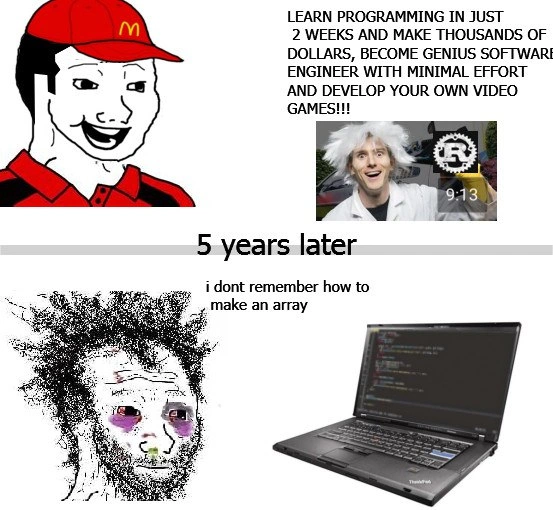
In plain terms, this meme highlights the difference between fantasy and reality when learning to code. The top part shows a person (the cartoon Wojak character in a McDonald’s uniform) seeing a flashy ad about becoming a programmer in just two weeks. This is a parody of real ads you might find on YouTube or websites. Coding bootcamps and online tutorials sometimes market themselves with grand promises like, “Learn programming fast, get a high-paying job, and even make cool video games!” They make it sound like anyone can go from zero to expert almost overnight. The ad in the meme even drops the Rust logo (a trendy programming language) and has a crazy-looking scientist for extra flair. It’s trying to grab a beginner’s attention by saying, “Look, you’ll learn cutting-edge stuff easily and be a genius!” For someone working a non-tech job (like the Wojak in his fast-food uniform), that message is super tempting and exciting.
Then the meme jumps to “5 years later.” The bottom part shows the reality after five years of actual programming work. The same guy is now an experienced developer (you can tell from the Lenovo ThinkPad laptop and the weary look on his face). He’s totally exhausted — dark circles under his eyes, messy hair — basically looking burned out. And he’s thinking, “I don’t remember how to make an array.” Now, an array is one of the simplest concepts in programming. It’s basically a list of items in order (like a row of numbered boxes where you can store values). For example, in Python you can make an array (technically a list in Python) like this:
numbers = [1, 2, 3] # a list of three numbers in Python (an array-like structure)
But different programming languages have different syntax and rules for arrays. In JavaScript you’d do let numbers = [1, 2, 3];, whereas in a lower-level language like C you might write int numbers[3] = {1, 2, 3};. The meme specifically showed a Rust logo, so here’s how you’d create an array in Rust:
let numbers: [i32; 3] = [1, 2, 3]; // an array of 3 integers in Rust, with type and length specified
As you can see, the idea is the same (storing three numbers), but the exact symbols and format differ by language. It’s easy for a programmer to mix up or forget the precise syntax, especially if they haven’t used that particular language in a while. After five years in software development, our Wojak has probably learned multiple languages and dealt with hundreds of different coding problems. In that time, it’s actually normal to occasionally blank out on a small detail — like the right way to declare an array — particularly when you’re tired or have your mind full of bigger issues.
The funny (and reassuring) part is that even experienced developers forget basic things sometimes. This can lead to a bit of imposter syndrome, which is when you worry you’re not as good as everyone thinks you are (because “How can I forget something so simple?!”). But the reality is that forgetting something small doesn’t make you a bad programmer; it just makes you human. The learning curve for programming is long and ongoing. You definitely can’t become an expert in just two weeks, and even after years of coding, you’ll still find yourself learning new things – and occasionally relearning old basics you forgot.
So, the top of the meme pokes fun at the overly optimistic marketing of some coding courses. It’s saying, “They told me I’d be a coding genius in no time and get rich quick.” The bottom of the meme is the punchline: “Here I am, years later, feeling drained and forgetting how to do something as basic as an array.” This hits home for a lot of developers. Many of us remember being beginners who were lured in by the hype (“programming is easy money!”), and then later we all face moments of doubt where we can’t recall things we learned at the very start. The meme is a humorous reminder that learning to code takes time and effort, and even when you’ve been doing it a while, you’ll have those “why am I blanking on this?!” moments. And that’s completely normal in the software journey.
Level 3: Bootcamp to Burnout
Another day, another get-rich-quick coding ad guaranteeing instant success in software. In the top panel, a wide-eyed Wojak in a McDonald’s uniform stares at a screaming advertisement: “LEARN PROGRAMMING IN JUST 2 WEEKS AND MAKE THOUSANDS!” It’s the kind of hyperbolic bootcamp hype that veteran developers love to roll their eyes at. The ad crams in every buzzword: become a “genius software engineer” with “minimal effort” and even develop video games, all practically overnight. Sure, become a coding wizard in two weeks without breaking a sweat — what could possibly go wrong? There’s even a cameo by the Rust logo and a wild-haired "mad scientist" thumbnail, as if mastering one of the most powerful (and notoriously tricky) systems languages could be done in a 9-minute YouTube video. The absurdity here nails a real industry pattern: marketing that promises learning to code is a quick, easy path to riches, versus the reality that programming is a steep climb with countless pitfalls.
“5 years later,” says the gray divider — and reality hits hard. The bottom panel reveals the same character, now a disheveled, sleep-deprived developer hunched over a ThinkPad with a dark-themed IDE. He’s sporting the classic burnout look: bloodshot eyes, scraggly hair, probably more caffeine than blood in his veins. And the kicker:
"i dont remember how to make an array"
This line is comedy gold for seasoned devs, because forgetting something as fundamental as an array after five years in the industry is both painfully relatable and darkly funny. The humor comes from the colossal gap between the bootcamp miracle promise (instant genius, instant wealth) and the imposter-syndrome-flavored reality (“Wait, how do I declare a simple array again?”).
This meme is a spot-on satire of the hype-versus-reality gap in software careers. We’ve all seen those newbie-targeted ads that oversell what it takes to become a developer. They promise the coding equivalent of a get-rich-quick scheme. Experienced programmers know the truth: it takes years of practice to get good at coding, and even then, technology changes so fast you’ll often feel like a beginner again. The inclusion of Rust is telling — a language loved by senior engineers for its efficiency and safety, but also one with a steep learning curve. The ad essentially says, “Become a Rust expert in two weeks,” which is laughable to anyone who’s wrestled with borrow checker errors for months.
Now jump to five years of real-world coding. That once-enthusiastic bootcamper has been through the wringer of on-call rotations, tight deadlines, and shifting tech stacks. He’s probably worked in multiple programming languages by now. On a bad day, muscle memory betrays you: you might type ArrayList when you meant [], or mix up array syntax between Python, Java, and Rust. Developer fatigue is real. After countless sprint cycles and late-night bug hunts, even a CS fundamental like “how to declare an array” can slip your mind. It’s the programmer equivalent of a "senior moment." You stare at the screen thinking, “I’ve done this a hundred times… why can’t I remember?” Your brain’s cache evicts the trivial details under stress, usually at the worst possible moment (like during a live demo or a job interview).
What really drives the joke home is that sense of developer frustration and humble pie. No matter how “pro” you become, there are days you feel utterly clueless on something basic. It’s a universal equalizer — even the coder who optimizes complex systems might still Google the syntax for a simple array literal in a language they haven’t touched in a while. (Yes, even senior devs sometimes quickly search “Python initialize array” when no one’s looking.) That shared “ugh, it happens to me too” feeling is exactly why experienced developers smirk at this meme. It cuts through the marketing fluff and says: coding is hard, quick fixes are rare, and even the pros have brain-fart moments. The journey from “two-week coding genius” to “five-year coder who occasionally forgets arrays” is practically a rite of passage in this field, and we’re laughing (a bit nervously) because it’s true.
Description
This is a two-panel 'before and after' meme using Wojak characters. The top panel shows a cheerful Wojak in a McDonald's uniform, representing someone starting their programming journey, filled with optimism. The text reads, 'LEARN PROGRAMMING IN JUST 2 WEEKS AND MAKE THOUSANDS OF DOLLARS, BECOME GENIUS SOFTWARE ENGINEER WITH MINIMAL EFFORT AND DEVELOP YOUR OWN VIDEO GAMES!!!'. A YouTube thumbnail for a Rust tutorial is shown, symbolizing the entry point into this dream. The bottom panel, labeled '5 years later,' depicts a burnt-out, haggard Wojak, looking exhausted and bruised. Next to him is an old laptop and the text, 'i dont remember how to make an array.' The meme humorously contrasts the grandiose promises of coding bootcamps and quick-learning schemes with the grueling reality of a long-term software engineering career, which can lead to burnout, imposter syndrome, and even forgetting the most fundamental concepts under pressure. It's a cynical take on the tech industry's high-stress environment and the gap between expectation and reality

Comments
14Comment deleted
The five-year plan: go from believing you'll build the next AAA game in Rust to forgetting the syntax for `let mut my_vec = Vec::new();`. The borrow checker claims another soul
Five years after that “become a Rust genius in 2 weeks” ad, I can model an eventually-consistent, event-sourced system across three regions - right after I Google “Rust fixed-size array syntax” for the hundredth time
Five years later you're googling array syntax while the bootcamp grad you hired is explaining to the board how blockchain will solve everything
Five years into your career and you're Googling 'how to initialize array' for the third time this week - not because you're incompetent, but because you've been so deep in distributed systems architecture and Kubernetes orchestration that you genuinely can't remember if it's `[]`, `new Array()`, or `Array.from()` in this particular context. The real senior move is admitting that nobody actually remembers syntax; we just remember which Stack Overflow answer has the green checkmark
Five years after “learn to code in 2 weeks,” I architect geo-failover, but “how do you make an array?” still starts with “which language?” and ends with me copying the nearest [] from whatever repo I’m in
Bootcamp grads ship MVPs in weeks; seniors outsource arrays to Copilot because 'minimal effort' finally pays off
Year five and my brain runs LRU: array syntax keeps getting evicted by incident runbooks and language context switches, so I’m Googling “Rust vec vs slice vs array” while the deck still promises “genius in 2 weeks.”
Based Comment deleted
At least He's not working at McDonald's anymore Comment deleted
he still works at Mcdonalds, just the IT department of it Comment deleted
damn cpp arrays Comment deleted
Java arrays Comment deleted
at this point, array is already confusing for some people (because every language seems to have its own implementation of basic array-like structure). Arrays can be static, dynamic, single-type, mutable, immutable, and other random stuff Comment deleted
He means how to make an array from scratch Comment deleted