The Gospel of REST and Its Unknowing Heretics
Why is this API meme funny?
Level 1: Read the Instructions
Imagine you’re trying to bake a cake, and instead of following a recipe, you just start dumping ingredients together randomly. A friend is literally waving the recipe book at you through the kitchen window, pointing at the step-by-step instructions you’re ignoring. Inside, you’re proudly stirring away, and the friend quips, “If the cook could read, they’d be very upset!” In other words, if you actually read the instructions, you’d realize you’ve been doing it all wrong and you’d probably feel pretty bad (and end up with a ruined cake!). That’s exactly the joke here: some developers didn’t “read the instructions” on how to use a REST API properly, and they treated it like something it’s not. It’s funny in the same way as watching someone push on a door that has a giant “PULL” sign – the answer is right in front of them! The meme is reminding us in a playful way: read the signs and follow the basics, or you might cook up a disaster without even realizing it.
Level 2: Back to REST School
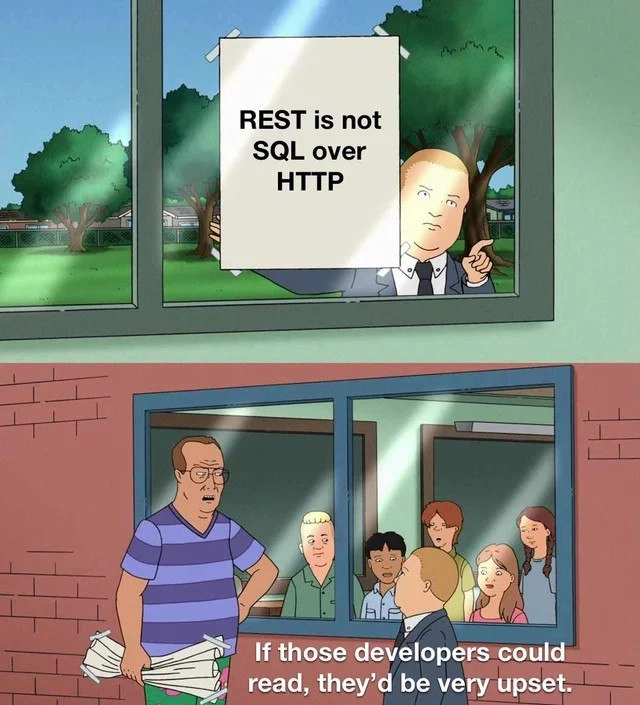
Let’s break down what’s happening here in simpler terms. The meme uses a two-panel cartoon classroom scene to illustrate a tech lesson. In panel one, we see a character outside a classroom window holding up a white sign with bold text: “REST is not SQL over HTTP.” This is basically like someone holding up a big “Warning!” or “Lesson 1:” poster. “REST is not SQL over HTTP” means that a REST API (a style of web service interface) should not be used as if it were a direct SQL database query. We’ll unpack that in a second.
In panel two, the perspective flips to inside the classroom. There’s a teacher figure handing out worksheets and a bunch of students who have turned to look at the window (where the sign is). The teacher says, “If those developers could read, they’d be very upset.” This caption is a humorous jab. It implies: the message on that sign is extremely important and relevant to those developers, but apparently they haven’t “read” or understood it — if they did, they’d realize they’ve been doing something wrong and feel bad about it. It’s like the teacher saying, “Oh boy, if they only paid attention to the book, they’d recognize their mistakes and probably freak out at how off-track they are.” The joke targets a common scenario in software teams: developers not reading documentation or fundamental guides, and thus misusing technology out of ignorance. The classroom setting reinforces that this is a basic lesson that some people missed; it’s API Design Kindergarten and a few “students” still need to learn their ABCs.
Now, let’s clarify the tech meaning here in a newbie-friendly way. REST stands for Representational State Transfer – which is a fancy term for a set of guidelines on how to design web services. When we design a RESTful API, we treat the server’s data as resources. For example, if we have an app about school, we might have resources like /students, /teachers, /classes. Each of these corresponds to some data entity, and we use standard HTTP methods to operate on them (like GET to retrieve data, POST to create new data, PUT/PATCH to update, DELETE to remove). The idea is to use a uniform and intuitive set of URLs and methods so that anyone can guess how to interact with the service: e.g., GET /students/123 would fetch the student with ID 123. This is what we mean by a resource-oriented API – it’s all about nouns (things) and standard verbs (actions).
On the other hand, SQL is a query language for databases. You usually write SQL to ask the database questions like, “Hey, give me all students who scored more than 90,” which in SQL might look like: SELECT * FROM students WHERE score > 90;. SQL is extremely powerful and lets you specify exactly what you want from the database (which columns, what filtering conditions, how to sort, etc.). However, SQL is something you run inside the database or via a database client — normally, users of a web API don’t directly send SQL commands to a server. Why? Because an API is supposed to provide a layer of abstraction. The API decides how to fetch or modify data under the hood; the client just makes a high-level request.
So when the sign says “REST is not SQL over HTTP,” it’s warning against a specific misunderstanding_rest: thinking that you can (or should) expose the power of SQL through a REST API directly. In other words, an HTTP API shouldn’t act like a direct database query interface. For example, imagine a developer sets up an endpoint like:
GET /students?score>90&sort=name
or even worse:
GET /query?sql=SELECT%20*%20FROM%20students%20WHERE%20score>90
The first approach (/students?score>90&sort=name) is somewhat okay if the server parses those parameters and safely turns them into a proper database query internally. It’s using HTTP query parameters to filter, which can be part of good design if done carefully. The second (/query?sql=SELECT * FROM ...) is a blatant example of treating the API like a SQL tunnel — the client is literally sending a raw SQL command over HTTP. That’s a huge no-no in typical API design! It’s not only a security risk (SQL injection vulnerability screaming to be exploited), but it also breaks the whole idea of the API being in control of what queries are allowed. The client in that case knows too much (table names, column names) and has too much freedom. It’s as if the developer skipped designing any real API and just said, “Here, I don’t know much about REST, let’s just take whatever query the frontend wants to send and run it on the database.” 😬
Even when it’s not as extreme as raw SQL in the URL, a lot of newbie developers make subtler versions of this mistake. For instance, they might create tons of specific endpoints like /getStudentsByGrade, /getStudentsByClassAndTeacher, /getStudentsByEnrollmentDateRange – for every new query need, they add a new endpoint. This is basically imitating SQL queries (each endpoint corresponds to a specific query) instead of thinking in terms of more general resources and relationships. It leads to a bloated, hard-to-maintain API where the number of endpoints explodes. If those devs read a good book or tutorial on APIDesignBestPractices, they’d realize it’s better to have a few flexible endpoints (like GET /students with query parameters for filtering, or separate resources like /classes/{id}/students for context) rather than an endpoint per query variation.
Another common issue is abusing HTTP methods. Some developers misunderstand the roles of GET, POST, etc. For example, doing POST /students/search with a big JSON payload of search criteria — they’re basically using POST just to avoid putting the search query in the URL, but still treating it like a direct query mechanism. Or they might use GET for something that’s not a simple data retrieval (like triggering actions via GET). These are signs that they see the API as just a thin wrapper over custom operations (like remote procedure calls), instead of embracing the standardized, RESTful way of doing things. In a well-designed REST API, the pattern and purpose of each request is clear and follows conventions (so clear that even devs who never saw your API could guess how to use it if they understand REST). When someone turns it into “SQL over HTTP,” those conventions get tossed out the window (quite literally in the meme!). That’s why it’s upsetting for knowledgeable API designers.
Let’s connect this to a relatable junior-developer scenario. Say you’re new to backend development and you need to build a feature for an app: list all students with score > 90. If you’ve just learned a bit of database querying, you know how to get that data with SQL. But if you haven’t fully learned REST design, you might think, “Okay, my client (maybe a React app) needs to get these students. I’ll just make an API endpoint /topStudents or maybe even a general /query endpoint where the client can send any criteria.” It works in the sense that you can retrieve the data, so you deploy it. You’re happy until… another developer or a senior on your team looks at it and their eyes widen: What did you just do? That senior might literally want to hold up a sign to you that says “This is not how REST is supposed to work!” In our meme, that’s exactly what’s happening. The outside character is effectively that senior developer intervening in our “class” to point out the mistake. The junior devs (the students) are staring, perhaps confused. The teacher’s sarcastic remark “if they could read…” implies that the information was always available (maybe in the project guidelines, or any REST tutorial), but the juniors just didn’t bother to read it. It’s a bit embarrassing, right? But also funny from an outside perspective because it’s such a fundamental thing – it’s like watching someone try to use a laptop’s CD drive as a cup holder; you laugh but also want to go, “No no no, that’s not what that’s for!”
In summary, this meme’s scenario is a lighthearted roast of developers who misuse REST APIs. It emphasizes API vs Database query as two different concepts: an API is an interface with defined requests and responses (hiding the internal details), while a database query is a low-level request for data with full control over conditions. Mixing them up leads to bad design. The classroom cartoon drives the point home that this is a basic lesson that some have missed. And the textual punchline underlines the importance of actually reading and understanding fundamental documentation – something every junior developer learns (sometimes the hard way). It’s relatable because many of us have either made these mistakes ourselves when we were starting out or have had to gently (or not so gently) correct a colleague who did. The meme packaging just makes that lesson extra memorable and shareable.
Level 3: Remedial REST Class
Any experienced backend developer will immediately smirk at this scene. It’s a classic case of devs treating a REST API as if it were a direct database hotline – essentially SQL over HTTP. In the first panel, a suited character (think of a fed-up senior engineer or an API architect) is outside the classroom window holding up a sign that literally reads “REST is not SQL over HTTP.” This blunt message is trying to pierce through the glass of ignorance. In the second panel, inside the classroom, a teacher hands out papers while bewildered “student” developers stare at the window. The teacher deadpans, > “If those developers could read, they’d be very upset.” This punchline hits home for seasoned devs because it’s a tongue-in-cheek way of saying “RTFM, folks!” – i.e., read the documentation or the fundamental guidelines you clearly missed. It’s a scene many seniors have metaphorically lived through: APIDesignBestPractices written in plain sight, yet completely ignored by the team. The meme humorously frames it as a DeveloperHumor classroom lesson that’s painfully obvious to everyone except the students who need it most.
So why exactly is this combination of elements so hilarious (and cringe-inducing) to the seasoned crowd? The phrase “REST is not SQL over HTTP” is practically a battle cry in backend engineering circles. It jolts memories of code reviews or architecture discussions where someone inevitably tries to design an endpoint like GET /runQuery?sql=SELECT * FROM users WHERE ... 🤦♂️. In real-world APIDevelopmentAndWebServices, this is an anti-pattern we see too often. Instead of thinking in terms of resources and HTTP methods, some developers treat the API as a remote database that clients can query arbitrarily. It’s the exact misunderstanding the meme calls out: a GET request isn’t meant to be a free-for-all SELECT statement with URL parameters standing in for WHERE clauses. When we see Bobby Hill (our suited messenger) pressing that sign against the glass, it’s the senior dev community collectively pressing fundamental API wisdom into the faces of those who didn’t get the memo. The humor comes from exasperation: we’ve explained these concepts so many times that now we’re resorting to giant signs and sarcasm.
This meme also cleverly captures the RelatableHumor of documentation and best practices being right in front of us (sometimes literally on a screen or a wiki), yet being blissfully ignored. The classroom setting isn’t random – it represents a basic lesson that has to be taught again and again. The suited character might as well be Roy Fielding himself (the creator of REST) crashing a newbie class to set them straight. Meanwhile, the devs inside represent a team that wrote a bunch of /** TODO: fix this API design later **/ comments or never read a post beyond “how to build a quick CRUD.” When the teacher says “if those developers could read, they’d be very upset,” it’s a roast: it implies the devs haven’t read the APIDesignBestPractices documentation (or maybe the sign on the window!), and if they did, they’d realize with horror how badly they’ve messed up their API. It’s funny because it’s painfully true – often developers don’t read the manual or the architectural guidelines, and when reality (or a production bug) finally forces them to, they have that upset “oh no… what have I done?” moment.
On a more serious note, this scenario highlights a deeper industry pattern: the confusion between RESTful API design and RPC or query-like behavior. REST (Representational State Transfer) is an architectural style with defined constraints and a focus on resources (nouns like /students, /orders/123, etc.), whereas SQL is a query language for databases. Treating one like the other can lead to all sorts of issues. Experienced developers have seen the fallout of this misunderstanding:
- Tight Coupling & Technical Debt: When an API is treated like a database, the client and server become tightly coupled. For instance, the client might construct queries with specific field names or conditions, effectively knowing too much about how data is stored. If the database schema changes, every client breaks. A true RESTful approach hides these details behind a stable interface. As veterans, we’ve trudged through refactoring those kinds of APIs, basically un-teaching the system from an RPC disguised as REST back to a proper RESTful model. It’s the kind of refactor that makes you sigh, “we shouldn’t have to do this if they’d followed the damn sign in the first place.”
- Security Nightmares: Letting clients specify arbitrary query conditions (or God forbid, raw SQL) opens the door to injection attacks and data leaks. It’s like handing the user a loaded gun pointed at your database. Seasoned backend devs have PTSD from incidents where someone hit a “searchUsers” endpoint with a weird query that caused a full table scan in production, bringing the system to its knees. A true REST design forces more disciplined, predefined interactions (e.g., specific query params like
?status=activethat the server safely handles). - Performance & Caching Issues: REST relies on HTTP semantics (caching GET responses, for example, to improve performance). If one treats GET as a random query runner with dozens of dynamic parameters (or uses POST when they should use GET just to send complex queries), it busts caching and makes scaling harder. Senior engineers have witnessed seemingly “simple” query endpoints causing massive load because every request is unique and nothing can be cached at the CDN. That sign in the meme is basically saying “Stop! You’re breaking the fundamental assumptions that let the web scale.”
- Misuse of HTTP Methods: Along with misuse of endpoints, there’s often misuse of methods. We’ve seen newbies try to do
POST /getUseror useGETfor operations that change data (GET /deleteUser?id=5). These are cardinal sins in RESTful design. A veteran backend developer will cringe-laugh at that because it’s REST 101 stuff – as basic as “pull, not push” on a door. The meme’s classroom vibe nails it: we’re teaching kindergarten-level API design and somehow that sign still isn’t sinking in.
Historically, this misunderstanding has been around as long as REST itself. Older devs remember the transition from SOAP and RPC-style APIs to RESTful approaches in the early 2000s. Back then, a lot of folks just mapped their old RPC habits onto HTTP and called it “REST.” That’s where this idea of “SQL over HTTP” really took off – people creating endpoints that looked like getUserByEmail and getUsersBySignupDate for every query permutation, or even one mega-endpoint like /query that accepts JSON or SQL queries. It’s basically reimplementing a database interface at the HTTP level. Roy Fielding’s dissertation explicitly warned against this by emphasizing a uniform interface and HATEOAS (Hypermedia As The Engine Of Application State), which means the server should guide what’s possible next via links, rather than the client formulating arbitrary queries. In practice, not many implement HATEOAS fully, but the spirit is clear: the client shouldn’t be constructing queries as if the HTTP API is a SQL terminal. When experienced devs see this meme, they nod and think, “yep, someone skipped Chapter 1 of REST and went straight to writing funky endpoints.” It’s equal parts funny and frustrating to see how often this lesson needs repeating.
Interestingly, the industry has responded to the desire for more flexible queries over HTTP in other ways. A senior dev might chuckle that GraphQL was born because front-end teams kept demanding “just give me exactly the data I want in one round-trip.” GraphQL is essentially a type-safe query language over HTTP (served from a single /graphql endpoint), but crucially, it’s a separate approach that explicitly manages queries and schemas – not something you ad-hoc bolt onto REST. We’ve also seen standards like OData that extend REST with query-like capabilities (think $filter and $select parameters in the URL). Those solutions acknowledge that while REST is great for many things, treating it as a direct query engine is problematic without additional structure. The meme’s sign is basically telling naive developers, “Don’t roll your own ad-hoc query language on top of REST!” If you need the power of expressive queries, use a proper tool or standard for it – don’t just stuff a giant WHERE clause into a query string and call it a day.
Ultimately, the humor here resonates because it encapsulates a scenario every seasoned engineer can relate to: misunderstanding_rest in action and the exasperation of trying to correct it. The BackendHumor hits close to home. We’ve all attended some “remedial REST class,” whether as the frustrated teacher or the chastened student. There’s that mix of facepalm and I-told-you-so when we realize how a simple concept (like “treat resources as resources, not as a database”) wasn’t grasped. Sometimes it literally feels like standing outside a window, yelling instructions that no one listens to. This meme distills that feeling into two panels of comedic art. In short, it’s poking fun at the gap between APIDevelopment ideals and the messy reality – and doing so with a scene that’s absurdly relatable. If only those developers would read (the sign, the docs, the best practices)… they’d save themselves a lot of upset down the road, and we could finally take that poster down.
Description
This is a two-panel meme using the 'If those kids could read, they'd be very upset' format from the animated show King of the Hill. In the top panel, the character Bobby Hill is inside a building, viewed through a window, pointing emphatically at a sign he has taped to the glass. The sign reads, 'REST is not SQL over HTTP'. In the bottom panel, his father, Hank Hill, stands outside with a group of children looking bewildered. Hank, holding a newspaper, says, 'If those developers could read, they'd be very upset.' The meme hilariously critiques a common anti-pattern in API development where so-called 'REST' APIs are merely thin wrappers that expose database query capabilities directly over HTTP, rather than abstracting the underlying data model into a proper resource-oriented architecture. For senior engineers, it's a sharp jab at the widespread misunderstanding and misapplication of REST principles, highlighting the frustration of seeing a nuanced architectural style reduced to simple CRUD operations

Comments
15Comment deleted
Some developers think HATEOAS is an ancient Greek god who punishes you for writing self-documenting APIs
Litmus test: the moment your GET /users endpoint sprouts a WHERE clause, you haven’t built an API - you’ve launched JDBC-as-a-Service with a 50 ms latency surcharge
After 15 years of explaining that REST isn't just CRUD endpoints returning database rows as JSON, I've realized the real stateless architecture is my hope that anyone will actually implement HATEOAS or even remember what the acronym stands for
This meme perfectly captures the eternal struggle of explaining that REST isn't just 'SELECT * FROM users WHERE id=?' with extra steps. The real tragedy is that somewhere, right now, a developer is building an API with endpoints like '/getUser' and '/updateUser' while confidently telling their team they're 'doing REST.' Meanwhile, Roy Fielding's dissertation sits unread, much like the documentation for every framework we've ever used. The architectural irony is that these same developers will later complain about API inconsistency while their endpoints are essentially just RPC calls cosplaying as RESTful resources
Treating REST like SQL over HTTP is how you end up with POST /query, 200 for constraint violations, zero cacheability, and an API that’s RPC in witness protection
REST isn't SQL over HTTP; when GET accepts WHERE, you've invented an ORM-by-proxy with cache-busting URLs and SRE playing DBA
REST APIs bloated with SQL query strings: because HATEOAS was too RESTful for that SELECT * FROM users endpoint
Have you ever heard of Spring Data Rest? Comment deleted
Argh, literally knew a dev at a previous company who wanted to do this. Literally he wanted to send sql queries to the api and execute them. Goddamn Comment deleted
That's too narrow-minded. To make this truly universal and portable you should also send a valid connection string just in case. Comment deleted
Seems legit Comment deleted
So glad I don't work there anymore Comment deleted
hello fellow developers have you heard of https://github.com/PostgREST/postgrest 🌚 Comment deleted
what does it mean? it means return whats needed for requester? Comment deleted
Yeah, not REST, because GraphQL is SQL-over-HTTP! Comment deleted