The 'It Works, Don't Touch It' Moment
Why is this Debugging Troubleshooting meme funny?
Level 1: The Magic Flashlight Fix
Imagine your favorite toy or gadget suddenly wouldn’t work no matter what you tried. Let’s say it’s a flashlight that won’t turn on. You’re worried because it’s dark and you need it. In a bit of a panic, you decide to do something kind of random: you give the flashlight a good shake and tap it on the side just hoping it might spring to life. And unbelievably, the light flickers on! You feel a huge wave of relief and happiness because now it’s working again. But at the same time, you're a little surprised and thinking, “I had no idea if that was going to work.” It’s funny and relatable because sometimes we solve a problem by pure luck, without knowing the exact reason. Just like with that shaky flashlight, the programmer in the meme tried a wild guess to fix their code, and was just as astonished (and relieved) when it actually worked.
Level 2: Shotgun Debugging 101
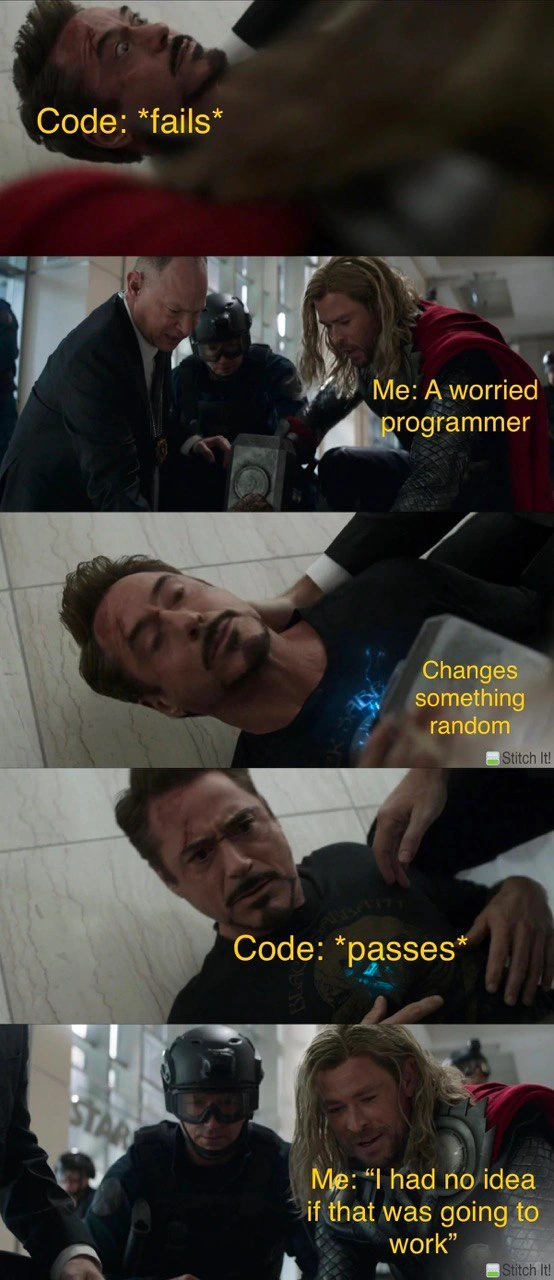
Let's break down what’s happening in this meme in plain terms. The developer’s code is failing tests – meaning the program isn’t working as expected. In software development, we write unit tests (small programs that automatically check if our code is doing the right thing). When those tests come back with failures, it indicates there's a bug or mistake somewhere. Here, the first panel says "Code: fails", showing that something in the code base didn't pass its tests. The programmer (captioned "Me: A worried programmer") is understandably anxious; failing tests can hold up progress, especially if you're about to release your software or merge your code changes.
Now, what does the programmer do? Instead of immediately knowing the cause, they change something seemingly random in the code. This could be anything: maybe tweaking a configuration, renaming a variable, adding a small delay in the code, or even reordering two lines. The key is that it's a shot in the dark – the programmer isn't sure this change is relevant to the problem. In the meme’s third panel, this action is dramatized by Thor pressing his magical hammer to Iron Man’s chest. (In the movie scene, Thor was basically jump-starting Iron Man like a human defibrillator!) That’s not a typical medical procedure, just like the programmer’s change isn't a logical fix derived from understanding the bug. It's more of a "Well, let's try this..." moment born out of panic debugging and frustration.
Amazingly, it works! The tests that were failing now all pass (fourth panel). In the image, Iron Man (representing the code) suddenly sits up, revived, with his chest device glowing; analogously, all the test indicators turned green. This result is both happy and a little suspicious. The final panel shows Thor looking very relieved and saying, "I had no idea if that was going to work." That line perfectly sums up the mix of emotions: relief that the problem seems fixed, but also the uneasy knowledge that it was basically a lucky guess.
So why did a random tweak fix the tests? Often it’s because the failing scenario was what developers call a flaky test. A flaky test is one that sometimes passes and sometimes fails, due to factors like timing, order of execution, or external conditions, rather than a consistent logical error. For example, imagine a test that checks if a user can log in, but it fails if the server response takes more than 2 seconds – one run it might fail (if the server was slow at that moment), the next run it passes (if the server responded quickly). Or think of a test that relies on some data not being left over from a previous test: it might pass the first time but then fail the second time if some state wasn't reset. These situations are frustrating because you can't reliably reproduce the failure every time; the bug seems to come and go.
Another possibility is what's jokingly known as a Heisenbug. This term (inspired by physicist Werner Heisenberg's name) describes a weird bug that seems to disappear or change when you try to investigate it. It's like the act of observing it (adding print statements or running the program in debug mode) makes the bug vanish or behave differently. In our context, the programmer’s random change might have altered the program's behavior just enough to avoid the bug without truly fixing the underlying issue. For instance, maybe there was a timing issue (like two parts of the code getting out of sync by a few milliseconds). Changing something small in the code can inadvertently change the timing, making everything line up just right so the tests pass. The bug might still be there under the hood, but now the conditions are different so it didn't show up.
Shotgun debugging (as the level title says) is the practice of trying a bunch of potential solutions to see if any of them fixes the problem, kind of like firing a shotgun and hoping at least one pellet hits the target. It's not the most methodical way to debug, but when you're stuck and desperate, you might resort to it. A junior developer might first encounter this when they don't yet have a lot of debugging experience. Say you wrote some code that isn't working, and you can't figure out why; you might start changing things at random: add a console.log here, change a number there, rerun the tests, and so on, hoping to stumble upon a fix. When one of those attempts suddenly makes the error go away, you're both excited and puzzled.
In the meme’s superhero analogy, using Thor's hammer to fix Iron Man is like using a random trick to "jolt" your code into working again. It's not how you're taught to solve problems, but in the moment it feels like tapping the side of a flickering TV to get the picture back — a quick, somewhat mysterious fix. The programmer is happy the tests are green (because that means the immediate crisis is over), but also knows they got lucky. Usually, the correct course after such a miracle fix is to investigate further and understand what actually happened. Why did that weird change matter? Is the bug truly gone or just hiding?
To recap in simpler terms: The code had errors (failing tests), the developer tried a random fix without fully understanding the root cause, and suddenly everything worked. It's funny to developers because we've all been in that sticky situation and felt that “phew, it’s fixed... I guess?” moment. It's a mix of "Hooray, it’s working!" and "Uh-oh, what did I even do?". The meme captures that feeling with a dramatic flourish using Avengers heroes, turning a dry coding dilemma into an epic scene. But behind the humor is a real lesson: if a random tweak fixes your bug, you might have only fixed the symptom and not the real problem — and that's something to be wary of, even if you're doing a quiet victory dance because your tests finally passed.
Level 3: Voodoo Debugging Rituals
Any seasoned developer will chuckle (and maybe cringe) at this scenario. The meme nails the absurdity of voodoo programming – when you throw random changes at a failing system hoping one will magically resurrect it. In the visuals, we have a dramatic superhero moment: Thor jump-starting Iron Man's heart with a lightning-charged hammer. Translate that to tech: the worried programmer (Thor) applies an arbitrary change (a mystical hammer strike) to the ailing code (Iron Man on the floor). Miraculously, the code springs back to life (tests pass), and our programmer is both relieved and astonished, muttering "I had no idea if that was going to work."
Why is this so funny and familiar? Because it captures a real developer nightmare: flaky tests and non-deterministic bugs that defy logical reasoning. In a perfect world, unit tests fail for a clear reason and you can methodically find the root cause. In reality, you might have a test that passes on your machine but fails on CI, or one that fails only on Fridays or under a full moon. 😅 For all you know, that failing test might be flagging a regression (a new change breaking something that used to work), but since it only fails intermittently, figuring that out becomes a Sherlock Holmes exercise. Maybe an API call in the test occasionally times out, or there's a race condition that surfaces one run in ten. You're under pressure — CI is red, the release is blocked — so you resort to what we jokingly call "shotgun debugging" or "try a bunch of stuff until something works." This could mean changing a config value, reordering lines of code, adding a slight delay, or even just re-running the test suite hoping for luck. It's both desperate and common.
The industry anti-pattern being poked at here is fixing the symptom, not the cause. The code is “healed” like Tony Stark jolted back to life, but we haven't truly defeated the villain (the underlying bug). Seasoned devs have war stories like "the build only passed after I added a dummy file read" or "toggling a feature flag off and on made the error go away." These sound like crazy rituals or offerings to the coding gods. In fact, one common joke is performing a "rubber chicken ceremony" (i.e. doing something seemingly irrelevant and quirky to appease a glitchy system).
Let's be honest: this kind of random fix often happens at 3 AM or minutes before a deadline. The team lead is pinging you, the QA environment is on fire, and you've tried everything rational. So you say, "screw it, let's change this one thing I don't fully understand and see what happens." When it works, it's equal parts triumph and terror. You commit the change with a shaky hand. (Ever seen a commit message like "Temporary fix - not sure why this helps but tests pass"? It's practically a meme itself.) You genuinely feel like you got away with something — that you cheated fate. But at the same time, you know this bug might just be hiding, waiting to resurface later (perhaps in production at 2 AM, gulp).
From an organizational standpoint, these situations reveal gaps in testing and process. Proper suites should be deterministic: given the same code and environment, they yield the same result every time. When that isn't true, senior engineers know to suspect things like:
- Race conditions or timing issues – e.g. two threads or processes interfering unpredictably, depending on subtle timing.
- Uninitialized or leftover state – one test’s run influencing another because some global state wasn't reset (order-dependent tests).
- External dependency unreliability – calling a real API or database that sometimes fails or is slow, causing sporadic test failures.
- Randomness or time-of-day factors – tests that rely on random numbers or the current time can behave differently each run if not controlled.
- Infrastructure quirks – "Works on my machine" syndrome, where the CI server or another environment has a slight difference (network latency, file system speed, CPU cores) that triggers a failure you can't reproduce locally.
In the meme’s spirit, one could imagine the programmer exclaiming, "By the power of Thor, be green!" as they apply an odd fix, and lo and behold, the Jenkins pipeline goes green. Everyone watching the pipeline (the agents in the background of the image) is stunned but relieved. It's humorous precisely because it's a too-real mix of relief and dread. The dev is basically thinking, "We got away with it this time, but I have no clue why that worked..." That feeling is a cocktail of debugging frustration and guilty victory that any experienced coder knows all too well.
To visualize the moment, here's a dramatization in developer terms:
# Running tests... (everything is falling apart)
$ npm test
FAIL tests/my_app.test.js (10 failed)
Error: Something is not right...
... [stack trace] ...
Tests: 90 failed, 10 passed
# Desperate random tweak: change a minor thing in code, e.g., add a delay or tweak a config
$ vim src/config.js # e.g., add a small timeout or logging
$ git commit -am "Attempt fix: add slight delay to initialization"
$ npm test
PASS tests/my_app.test.js
✔ All tests passed! (Green at last)
In the end, this level of analysis appreciates the meme's wink to our shared experience: sometimes debugging feels less like engineering and more like casting spells. You do a little dance, change a random line, and suddenly everything works. It’s funny to us because we’ve been that programmer praying over a lifeless codebase, hitting "run tests" one more time, and whispering "please... please..." Only in our case, we usually don’t have a magical hammer — just a lot of luck and maybe a coffee as our potion. And when it finally passes, we sigh in relief, laugh nervously, and hope nobody asks us why the fix worked in the code review.
Level 4: Heisenbug Uncertainty
At the deepest level, this meme exemplifies the phenomenon of a Heisenbug – a software bug that defies deterministic reproduction. Under the hood, certain failures (like tests that fail inconsistently) often stem from the non-deterministic behavior of complex systems. For example, imagine a multi-threaded unit test failing due to a subtle race condition. The threads interleave unpredictably: one execution sees the bug, another execution doesn't. Introduce a seemingly irrelevant change – perhaps a stray print statement or a minor code refactor – and you have effectively perturbed the system's timing. Thanks to chaos embedded in concurrency, that small tweak can alter scheduling enough to avoid the problematic interleaving. The bug appears "fixed," but only because the conditions triggering it have been sidestepped.
This isn't magic; it's computing physics. Modern runtimes and CPUs can behave like chaotic systems under certain circumstances. A line of code that does nothing useful (like adjusting an unused variable) might still shift the program's memory layout or instruction timing. In a language like C/C++, an undefined behavior bug (say, reading from an uninitialized pointer) can manifest differently depending on tiny changes in compiler output. Something as trivial as adding a no-op operation or changing optimization flags might move the memory addresses of variables, inadvertently masking the bug. It's reminiscent of the observer effect in quantum mechanics – the act of observing or instrumenting the code (like running it in a debugger or with logging) changes its behavior.
The term Heisenbug itself riffs on Heisenberg's Uncertainty Principle. In debugging, as in physics, attempting to measure or fix the problem disturbs it. A classic example is when adding a printf or enabling debug mode makes a crash disappear because it changes the program's execution flow or timing. In our meme, the "random tweak" is akin to a blindfolded scientist poking the system and collapsing its wavefunction into a passing state. We end up with tests that pass not because we truly eliminated the fault, but because we've altered the runtime conditions. This level of analysis underscores a sobering truth: the code was likely teetering on the edge of correct behavior versus failure, and a small nudge tipped it into the "passes" territory. The underlying bug may still lurk in Schrödinger's box, waiting to resurface when conditions align again.
Description
A five-panel meme using scenes from the Marvel movie 'The Avengers' to illustrate a common debugging scenario. In the first panel, Tony Stark (Iron Man) lies dying, labeled 'Code: *fails*'. In the second, a concerned Thor is labeled 'Me: A worried programmer'. The third panel shows a hand touching Stark's arc reactor with the text 'Changes something random'. In the fourth panel, Stark gasps back to life, labeled 'Code: *passes*'. The final panel shows a relieved but baffled Thor, with the caption 'Me: "I had no idea if that was going to work"'. The meme humorously captures the desperation of making arbitrary changes to fix a bug when logical approaches have failed. For senior engineers, this is a relatable, if slightly painful, reminder of dealing with flaky tests, race conditions, or complex state interactions where a fix works for reasons that aren't immediately clear, creating both relief and future technical debt

Comments
7Comment deleted
This is how you get a commit message like 'Various stability improvements' and a code comment six months later that says, '// I don't know why, but removing this line breaks production.'
Dropped a no-op “if (false) return;” in the hot path and every flaky test healed itself - apparently the CI pipeline accepts ritual offerings
The scariest part isn't that it worked - it's knowing you'll have to explain the fix in tomorrow's stand-up and pretend it was intentional architectural insight rather than desperately toggling async/await until the race condition accidentally resolved itself
The senior engineer's version of the scientific method: hypothesis (code is broken), experiment (change something vaguely related), observation (tests pass), conclusion (commit immediately before the universe realizes its mistake). We've all been that Avenger trying to revive production with a random config tweak at 3 AM, only to have it work and spend the next hour in existential dread wondering if we've just masked a deeper issue or accidentally fixed a race condition. The real superpower isn't knowing why it works - it's having the discipline to not immediately push to main and call it a day
Cargo cult debugging: random diffs appease the Heisenbug gods, explanation strictly forbidden in prod
CI turned green after a random tweak? You synchronized two race conditions and promoted the bug to a Heisenbug
Nothing humbles a staff engineer like a no-op commit making CI green - proof our system is only strongly consistent under “cache just got nuked” semantics