Skip to content
DevMeme
460 of 7435
Presenting the MVP (Minimum Viable Panic)
Agile Post #529, on Aug 7, 2019 in TG

Presenting the MVP (Minimum Viable Panic)

Why is this Agile meme funny?

Level 1: Please Don’t Break

Imagine you had a school project due, like building a small robot or a model, and you kind of forgot about it until the last minute. The night before the presentation, you scramble around your house finding random pieces – Lego wheels, an old circuit board, some glue, maybe a popsicle stick. Somehow, you manage to put together something that sort of looks and works like what you were supposed to make. Phew!

Now, the next day, there’s an assembly and you have to show off your project on stage under bright lights. You carry your wobbly, glued-together robot up there. Your shirt is a bit untucked (you were up all night fixing this thing), and you’re sweating because you know how fragile it is. The teachers and other kids are watching like an audience at a big show. You gently set your project down, force a smile, and start explaining it as if it’s the coolest thing ever – all the while thinking, “Oh please, please don’t fall apart right now.”

That feeling – nervously showing something that you threw together at the last minute, hoping it doesn’t break in front of everyone – is exactly what this meme is joking about. In the picture, Homer Simpson is like that nervous kid (or developer), and the weird gadget on the wheelbarrow is the clunky project held together by tape. The bright spotlights and people watching are like the demo or presentation where everyone is judging it. It’s funny because we can all relate to being in that spot: doing just enough work to present something and then crossing our fingers that it holds up while everyone’s watching.

Level 2: Prototype Panic

Let’s break down what’s happening here in simpler terms. In Agile software development, a “sprint” is a short cycle (often 1-2 weeks) where a team works to build some features or improvements. At the end of a sprint, there’s usually a meeting called a sprint review or demo day. This is basically show-and-tell time for developers: you have to present what you made to your team and other stakeholders (like your boss, project manager, or clients). It can be nerve-wracking, especially if what you have is more of a quick prototype than a finished product.

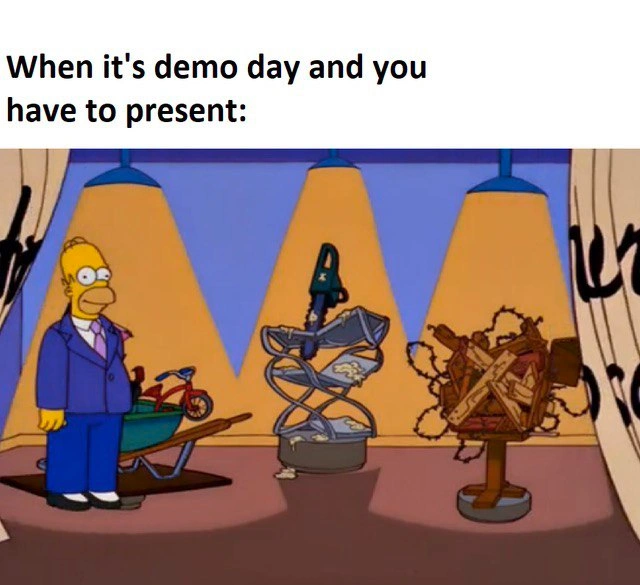
The meme uses a scene from The Simpsons where Homer Simpson is on stage with some very odd sculptures (one is a spiral of metal with gadgets, another is a pile of wood and rope). They’re all under bright spotlights as if they are masterpieces in an art show. In the meme’s caption, it says: “When it’s demo day and you have to present:” implying that Homer is you, the developer, and those weird contraptions are the product of your sprint. It’s a funny exaggeration of how a developer’s work can feel right before a demo. You might look at your project and think, “This thing is a mess, barely held together – and I have to show it to everyone!”

Why call it a “Frankenstein”? Frankenstein’s monster in fiction was made by piecing together bits of corpses and jolting them to life. A Frankenstein code or project is a slang for something thrown together from mismatched parts – maybe you copied some code from Stack Overflow here, used a quick script there, hard-coded a few values for now – all just to make it work quickly. The result works, but it’s kinda ugly inside. In professional terms, that ugliness is called technical debt or poor code quality: shortcuts and kludges that will eventually need fixing. In the moment, though, you simply hope it doesn’t collapse.

During a demo, things are usually done in a very controlled way to avoid triggering bugs. Developers often stick to the “happy path” – that means showing only the scenario where everything goes right. For example, if you built a login feature but didn’t have time to handle password resets or error messages properly, you’ll just demonstrate a successful login with the correct password and avoid the edge cases. The meme shows Homer’s “inventions” on pedestals as if they are perfect: similarly, in a demo, we shine a spotlight on the parts that work and gloss over (or hide) the parts that are broken or incomplete.

The tags like ReleasePressure and ReleaseAnxiety are about the stress of an upcoming release or deadline. A sprint demo is exactly that kind of pressure moment. You might have been up late the night before deadline fixing last-minute issues (often called a crunch or fire-fighting). It’s relatable to any developer who’s ever hurried to finish a project: your creation does kind of work, but it’s held together by proverbial duct tape. Maybe you’ve even done a class project or hackathon project like this – lots of quick fixes, ignoring proper structure just to get it working by demo time. Then when you present, you’re nervous because you know all the flaws. That anxiety is what the meme humorously captures. It says, “Hey, we’ve all been Homer in that blue suit, faking confidence next to our janky project, hoping others will admire it (and not see the broken parts).”

In Agile meetings like this, everyone wants the demo to succeed. Your teammates might even play along, asking only the questions you know you can answer or not poking at known weak spots. It’s a bit of a “demo theater”. Afterward, there’s often an unspoken agreement that some serious fixing will happen before the code goes to production (real users). This way, stakeholders get to see progress (so they’re happy), and the developers buy a little more time to clean things up. The meme is developer humor because it exaggerates this common situation to an absurd visual: Homer’s wacky inventions represent our half-baked features, and the fancy spotlight is the formal demo meeting where everyone oohs and aahs. It’s funny and painfully relatable if you’ve been through it.

Level 3: Demo Day Dread

At the end of an Agile sprint, there’s often a grand reveal: the sprint demo. This meme nails the comedy-horror of that moment. Homer Simpson, looking uneasy in an ill-fitting suit, stands in as the developer who spent the last 48 hours frantically stitching together a feature like Dr. Frankenstein. The contraption on the wheelbarrow is our hastily built prototype – a tangle of code and duct tape that somehow (barely) does what it’s supposed to, as long as nobody breathes on it too hard. Under bright spotlights (just like the intense stare of stakeholders in a demo meeting), even spaghetti code tries to masquerade as a polished product. The humor comes from that dissonance: we’re presenting junk art as if it were the Mona Lisa of software.

For seasoned engineers, this scene triggers flashbacks of sprint reviews where a “working” feature is held together by last-minute hotfixes hot fixes and prayers. Everyone in the room politely applauds the demo like it’s high art, while the dev team shares nervous glances, silently chanting "please don't crash, please don't crash". The meme’s text “When it’s demo day and you have to present:” captures that sickly mix of panic and showmanship. It’s funny because it’s true: we’ve all demoed something that’s one NullPointerException away from disaster.

Why does this keep happening? In the rush of deadlines, teams often take on more work than is realistically achievable with good code quality. Business stakeholders push for ambitious scope ("We promised this feature in the sprint!") and developers, eager to deliver, cobble components together just to have something to show. The result is a Frankenstein’s monster of software – stitched from mismatched parts (“quick, reuse that old script, nobody will know!”) and brought to life with a jolt of late-night caffeine. It’s alive... for now. The code might not follow any known design pattern (unless “git commit -m 'temp fix for demo'” counts as a pattern), but it works on the happy path. Just don’t let anyone stray from the script during the demo!

This scenario is a rite of passage in the industry. Even with the best sprint planning, unexpected bugs and integration hell often mean the “Definition of Done” quietly shifts to “done enough to demo.” The meme’s Simpsons imagery amplifies the absurdity: Homer’s bizarre sculptures on stage = our dubious features under review. It resonates because every senior dev has done the Show & Tell of shame: presenting a Minimum Viable Product that is more minimum (and barely viable) than product. The stakeholders smile and nod at the shiny surface, blissfully unaware of the chaotic code under the hood. Meanwhile, the dev team is mentally calculating how much refactoring and bug-fixing will be needed later to turn this art project into real, stable software. It’s a bit of theatrical fraud we collectively laugh at – the ReleasePressure to impress in a meeting leads to these comically precarious demos. In essence, the meme humorously exposes the gap between software engineering ideals (clean, tested code delivered on schedule) and real-world practice (hack it till it works, then pray in the demo). And trust me, that gap can feel as wide as Homer’s grin is forced.

Description

A meme captioned 'When it's demo day and you have to present:' featuring a scene from The Simpsons. Homer Simpson, dressed in a suit, stands nervously on a stage under spotlights, presenting several bizarre and chaotic 'outsider art' creations. These include a wheelbarrow with a tricycle, a twisted metal stand with a chainsaw, and a stool covered in planks and barbed wire. The scene perfectly captures the feeling of a developer demoing a feature that is barely held together with hacks and technical debt. The absurd 'inventions' are a visual metaphor for a chaotic codebase or a fragile system that you have to present as a functional product to stakeholders, managers, or clients, all while hoping it doesn't crash spectacularly

Comments

7
Anonymous ★ Top Pick My project has three environments: dev, staging, and 'please-god-don't-click-that-during-the-demo'
  1. Anonymous ★ Top Pick

    My project has three environments: dev, staging, and 'please-god-don't-click-that-during-the-demo'

  2. Anonymous

    Sure, the build is held together by npm-link voodoo and a Docker volume nobody understands - but at least the PowerPoint is in dark mode

  3. Anonymous

    The architecture diagram was beautiful, but behind the API gateway is a monolith doing interpretive dance with seventeen different ORMs while a cron job from 2009 holds everything together with duct tape and prayer

  4. Anonymous

    The three stages of a live demo: the polished localhost version you rehearsed at 2 AM, the staging environment that 'mostly works' when you click through it nervously, and the production deployment where every microservice decides to embrace eventual consistency at exactly the wrong moment - while your CTO watches and that one dependency you forgot to pin suddenly breaks the entire UI. At least the tricycle compiled

  5. Anonymous

    Our sprint review achieves strong consistency only under N=1 presenter and a preloaded seed script

  6. Anonymous

    Today’s piece is ‘loosely coupled’ - held together by feature flags, mocked APIs, and a cron job named glue

  7. Anonymous

    Demo day MVP: chainsaw for slashing tech debt, wheelbarrow for feature hauling, torture rack for stakeholder expectations

Use J and K for navigation