Skip to content
DevMeme
462 of 7435
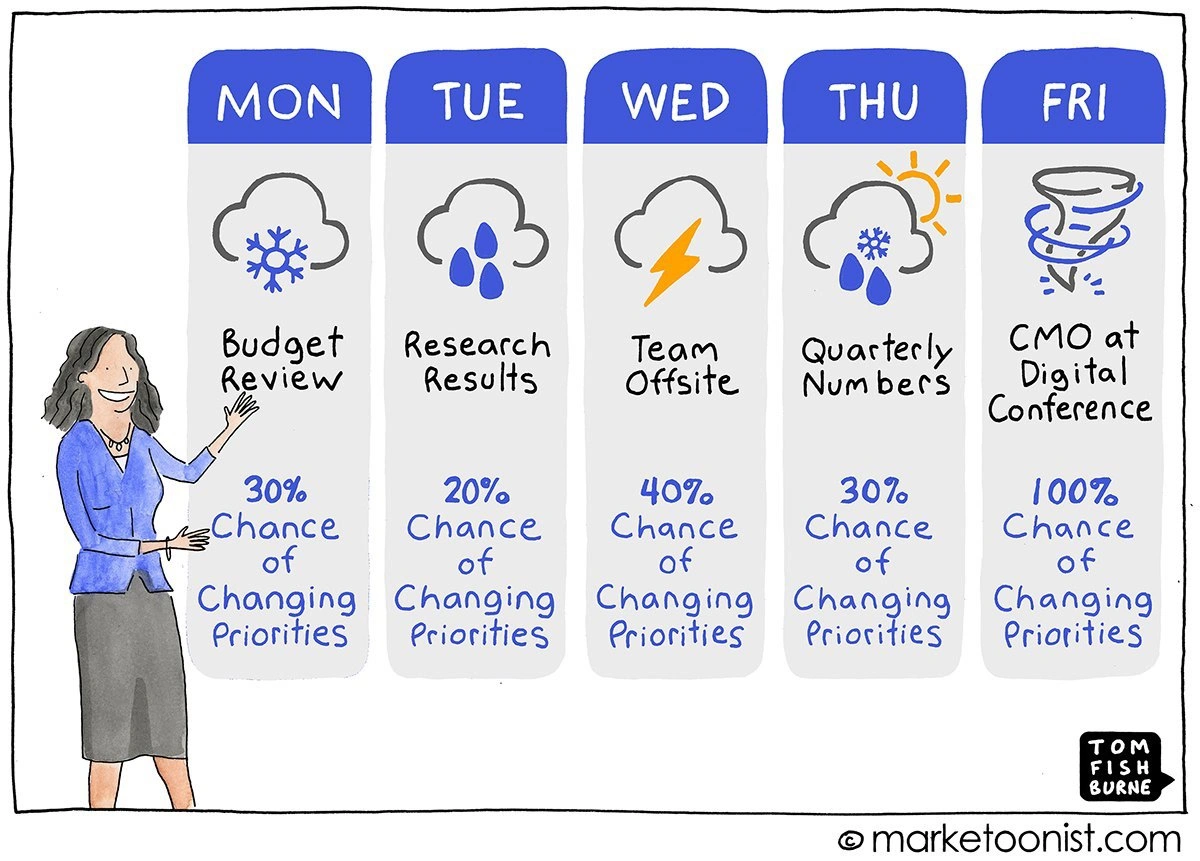
The Corporate Weather Forecast: 100% Chance of Whiplash
CorporateCulture Post #532, on Aug 7, 2019 in TG

The Corporate Weather Forecast: 100% Chance of Whiplash

Why is this CorporateCulture meme funny?

Level 1: Like the Weather

Imagine you plan a fun week of playing outside. On Monday, you want to ride your bike, Tuesday you’ll go to the playground, Wednesday you’ll play soccer with friends, and so on. You’re really excited and you think nothing will change those plans. But then real life starts acting like the weather. On Monday it suddenly snows – oops, bike ride canceled, you have to stay in and build a snowman instead. Tuesday comes and it rains all afternoon, so the playground is too muddy; you end up watching a movie indoors. Wednesday, a big lightning storm hits during soccer time, so that game is called off. Thursday was supposed to be sunny, but you get a mix of everything – a bit of sun, then surprise hail, then rain – and your plans keep shifting (maybe you play outside for a few minutes, then run back in, then back out…). By Friday, a huge tornado (yikes!) is definitely coming, so you know you won’t be doing that picnic you planned; you’ll be in the basement for safety. Every day, something unexpected with the weather changed what you could do.

This is exactly why the meme is funny: it’s saying work plans can change just like that, too. Grown-ups at a company might start the week thinking “We’ll finish project A by Friday,” but each day some new “storm” (like a big meeting or a boss’s new idea) blows their plan off course. By the end of the week, they’re doing something completely different from what they first planned. It feels as unpredictable as guessing the weather! The comic uses a weather forecast chart to make it easy to understand — just like you can’t control a surprise storm, a team can’t always control sudden changes at work. It’s a playful way to show that no matter how much you plan, you should always be ready to adjust, because plans can change as quickly as the weather.

Level 2: Weathering Agile Storms

Let’s break down the meme’s scenario in plain terms. In Agile software development (like the Scrum framework), a sprint is a short, focused work period (usually 1 or 2 weeks) where a team agrees to complete certain tasks. Think of a sprint as a promise: "This week, we’ll finish A, B, and C." A backlog is the master to-do list of tasks/features, and at the start of the sprint the team picks a few of those to tackle. Ideally, once a sprint starts, the priorities shouldn’t change until it’s done – the team is supposed to focus only on the chosen tasks. The reality, however, can be different when real-world events intervene. This cartoon uses a weather forecast metaphor to show how each day something outside the development team’s control can disrupt those plans.

Stakeholders are people who have a stake in the project’s success – for example, executives, product managers, clients, or department heads. They’re the ones requesting features, setting deadlines, or shifting goals based on business needs. When you see terms like StakeholderExpectations or StakeholderPressure, it refers to those folks pushing for results or changes. In a healthy process, stakeholders and the development team agree on priorities at sprint planning and then let the team work. But in many companies, stakeholders will still barge in mid-sprint with "urgent" changes. The meme humorously lists a stakeholder-driven event each day to show how dynamic reprioritization (a fancy way to say “changing the plan on the fly”) happens over and over. It’s basically saying: “Even if we plan our work for the week, something will come along to mess it up.”

Let’s decode each day’s event in the comic and how it can alter a team’s priorities:

  • Budget Review (Monday): This is when higher-ups examine project budgets. For a dev team, a budget review might mean your project’s funding is adjusted. Imagine you’re working on Feature A, but on Monday the finance meeting decides to cut funding for that feature or allocate more money to Project Y. Suddenly your team is told to switch focus. That’s why there’s a “30% chance of changing priorities” on Monday – a budget shake-up can start the week off with “Stop what you’re doing, we can’t afford that now” or “We got approval to hire for a different project, everyone pivot!”. The snowflake icon is like a budget freeze – sometimes projects get put on ice.
  • Research Results (Tuesday): Perhaps the UX research team or data analysts present findings on Tuesday. Say they discovered users actually want Feature X more than Feature A, or a new trend in the market. These research results (raindrop icon for a drip of new information) can make managers rethink what the dev team should be doing. Maybe yesterday Feature A was top priority, but now data suggests it won’t move the needle – so by Tuesday afternoon, Feature X takes priority. The comic gives a 20% chance here; not every research report triggers a pivot, but it can. For a junior dev, this might be the day you hear, “About that task you started... we need to switch gears to something else that just came up from the research.”
  • Team Offsite (Wednesday): A team offsite means the team (sometimes the whole department or company) is away from their usual work, maybe for training, team-building, or big-picture brainstorming. On Wednesday, the cartoon shows a lightning bolt – indicating something striking or disruptive. An offsite can disrupt the sprint simply because the team isn’t coding that day. Also, offsites often produce new ideas or strategic decisions. For example, during a brainstorming session the bosses might decide “Let’s change our product strategy starting tomorrow.” There’s about a 40% chance that after a day of escape rooms and Flipchart discussions, you come back Thursday to find a new direction or extra tasks that weren’t part of Monday’s plan. (At minimum, you lost a day of development, which can put pressure on the remaining work.)
  • Quarterly Numbers (Thursday): This refers to the company’s quarterly performance data – sales figures, user growth, revenue, etc., usually released at quarter’s end. The icon shows mixed weather (sun, rain, snow) because those numbers can be interpreted in many ways. Good numbers might make leadership ambitious (add new features! accelerate timelines!), while bad numbers might cause panic (fix churn NOW! drop everything for a hotfix!). So on Thursday there’s a 30% chance priorities change to react to these metrics. For instance, if new sales are down 10%, suddenly the feature that addresses customer acquisition becomes the most important, and whatever you were doing might get sidelined. As a junior dev, you might experience this as, “We need all hands on deck to improve metric X before the end of the month.” The sprint plan gets adjusted to chase those quarterly targets.
  • CMO at Digital Conference (Friday): CMO stands for Chief Marketing Officer – a top executive responsible for marketing strategy. A digital conference is an event where industry folks talk about the latest trends (like “How AI is revolutionizing everything!”). When an executive attends such conferences, they often come back very excited about something new they learned. The cartoon shows a tornado on Friday because the CMO’s fresh ideas can whirl into the office and upend everything. That’s why there’s a "100% chance" of priority change on Friday – it humorously implies it’s guaranteed. For example, if the CMO hears at the conference that “voice assistants are the future,” you can bet by Friday afternoon your team is suddenly asked to integrate voice commands into your app, even if you were working on something completely different. This is a known running joke in tech: “Uh oh, the boss went to a conference... brace yourselves for random new directives.” As a developer, you learn to expect that a high-ranking exec with new ideas can instantly change the question of “What are we working on today?”.

By laying out each day like a weather report, the meme makes a complex point in a funny way: a development team’s weekly planning is at the mercy of external events, much like our outdoor plans depend on the weather. If you’re new in the industry, you might feel confused or whiplashed the first time this happens — one day you’re coding Feature A, the next day Feature A is dropped because “urgent new priority!”. It’s not that your planning was bad; it’s that the business environment is always changing. AgileHumor like this highlights the gap between textbook Agile (where you “respond to change” in a controlled way) and real-life corporate agile (where change sometimes hits like a surprise thunderstorm every other day). The key takeaway for a junior developer: don’t panic. This kind of dynamic reprioritization is common. Teams adapt by staying flexible, communicating often, and sometimes gritting their teeth through the chaos. Over time, you get better at “weathering” these storms — keeping calm and coding on even when yesterday’s plan gets washed away. And you’ll definitely learn to check the “forecast” (aka the stakeholder calendar and company news) so you’re not caught without an umbrella when the Friday surprise blows in!

Level 3: Corporate Climate Chaos

The meme cleverly recasts an Agile sprint plan as a whimsical weather forecast, and it hits uncomfortably close to reality. In a seasoned developer’s experience, planning a software sprint can feel as chaotic as predicting the weather. You start Monday under clear skies with a meticulously laid-out backlog, but by Friday a storm of new demands has swept through. This comic exaggerates that phenomenon in a way that makes veteran engineers smirk (and maybe cringe): the only thing more unpredictable than the weather is a week of corporate project management.

It’s funny because it’s true — StakeholderExpectations and management whims blow through like unstable weather fronts, constantly threatening your sprint commitments. The cartoon’s "forecast" for each day highlights how various business events create turbulence in an engineering team’s priorities. Seasoned devs recognize each of these storms:

  • Monday (Budget Review) – A cold front moves in. A budget meeting can freeze funding for one project (hence the snowflake icon) or suddenly thaw money for another. One minute you’re set to build Feature A, then finance says “budget cut” or “all-in on Product X”. Cue 30% chance your carefully planned tasks get re-scoped or put on ice.
  • Tuesday (Research Results) – A drizzle of data. The user research or A/B test results come in (raindrops icon), dampening yesterday’s plan. Perhaps metrics show the feature you’re working on isn’t as important as a newly discovered user pain point. There’s maybe a 20% chance the team pivots to address a different issue because suddenly “data-driven” means “drop everything, we found a new insight!”.
  • Wednesday (Team Offsite) – A lightning strike in clear skies. The whole team (and sometimes leadership) is out doing trust falls and brainstorming (lightning bolt icon) instead of coding. Apart from lost coding time, offsites often generate “great new ideas” that weren’t on the roadmap. By the time everyone’s back, there’s a 40% chance some shiny new initiative zaps the original sprint goals.
  • Thursday (Quarterly Numbers) – A mixed forecast of sun and snow. The Q3 results are announced with a flurry of mixed signals (sunshine and snow in one cloud). Maybe sales are down or a key metric is off-target. Leadership goes from optimistic to worried in a flash. There’s around a 30% chance of scope change: “We must address this now to appease the board!” Suddenly, half the team’s working on an emergency feature or fire-fighting a KPI, deviating from the sprint plan.
  • Friday (CMO at Digital Conference) – The tornado touchdown. This is the week’s big twister of chaos, spinning directly out of an executive’s excitement. The Chief Marketing Officer returns from a fancy industry conference full of new buzzwords and wild ideas (hence the tornado icon). Whether it’s “We need a chatbot ASAP!” or “Let’s pivot to VR/AI/blockchain!”, a Category 5 priority shift is guaranteed. A 100% chance of changing priorities means whatever you were coding Thursday is now immediately shelved for the CMO’s latest brainwave.

Each of these daily “weather events” satirizes a real corporate pattern. The humor lands because any senior engineer has watched their supposedly stable sprint backlog get blown apart by at least one of these forces. It highlights the clash between idealistic planning and the messy reality of CorporateCulture. In theory, Scrum teams commit to a two-week sprint and changes are held until the next cycle. In practice, managerial DeadlinePressure, surprise opportunities, and HiPPOs (Highest Paid Person’s Opinions) can smash through that protective boundary like a tornado through a picket fence. The Agile manifesto did tell us to welcome change, but embracing change can feel more like embracing whiplash when it’s happening every day.

Reading this forecast, battle-hardened devs can practically smell the irony. It’s the “weekly chaos report” we know too well: Monday optimism eroded by mid-week surprises and finally obliterated by Friday’s executive mandate. The comic is poking fun at how project management in some companies is as predictably unpredictable as spring weather. The presenter in the cartoon grins like a meteorologist of madness, gesturing at the inevitable storm front of new priorities. And as every veteran knows, sometimes we actually do check our “organizational climate” — scanning calendars and Slack channels — like a weather radar, trying to anticipate the next priority upheaval. In the end, the forecast is always the same: 100% chance of change.

Description

A five-panel cartoon by Tom Fishburne (marketoonist.com) depicts a weekly corporate forecast, presented by a smiling woman in business attire. Each panel, labeled Monday through Friday, has a weather icon, a business activity, and a percentage for the 'Chance of Changing Priorities'. Monday is snowy ('Budget Review', 30%), Tuesday is rainy ('Research Results', 20%), Wednesday is a thunderstorm ('Team Offsite', 40%), and Thursday has mixed precipitation ('Quarterly Numbers', 30%). The punchline is Friday, which features a large tornado icon for the 'CMO at Digital Conference' with a '100% Chance of Changing Priorities'. The comic humorously captures the volatility of corporate planning. For senior developers, it's a deeply relatable satire on how executive whims, especially after exposure to industry buzzwords at conferences, can create chaos and completely derail established roadmaps and sprint plans, rendering previous work and planning obsolete
Comments

7
Anonymous ★ Top Pick Our roadmap is version-controlled in Git, but the real source of truth is whatever keynote the CMO live-tweeted this morning
  1. Anonymous ★ Top Pick

    Our roadmap is version-controlled in Git, but the real source of truth is whatever keynote the CMO live-tweeted this morning

  2. Anonymous

    Sprint planning is just the CAP theorem in business casual: you can lock scope or keep estimates accurate, but by Friday’s “CMO tornado” the org partitions and you lose both

  3. Anonymous

    The only thing more predictable than Friday's conference-driven pivot is the Monday morning Slack message: "Great news team, I met someone at the conference who's doing AI differently - let's explore synergies with our Q3 roadmap."

  4. Anonymous

    Every engineer knows the real sprint velocity formula: V = (story_points × focus_time) / (1 + 0.3×budget_reviews + 0.2×research_pivots + 0.4×offsites + 0.3×quarterly_panic + ∞×executive_conferences). That Friday tornado isn't a weather event - it's a CMO returning from a conference with 'just one small idea' that will definitely require a complete architectural rewrite by Monday

  5. Anonymous

    Stable priorities: the third hard problem in computer science, after naming things and cache invalidation

  6. Anonymous

    Our roadmap is a CRDT with one special replica called “CMO at a conference” - it’s last-write-wins and always writes “AI” on Friday

  7. Anonymous

    Our sprint plan models well - until exec_at_conference == true; then pivot_probability collapses to 1.0 and Jira becomes a weather app

Use J and K for navigation