Ramadan fasting meets web cookie consent in a UI pun meme
Why is this DataPrivacy meme funny?
Level 1: Cookie Confusion
Imagine your mom told you, “No eating any cookies until dinner!” Now, picture you’re using a computer and a little box pops up saying, “Do you accept cookies?” You click “Yes” without thinking. Uh-oh! It sounds like you just agreed to have some cookies, right? You might giggle and worry that mom (or in the meme, a watchful figure like Allah) thinks you snuck a treat. 🙈 But really, the computer meant something totally different by “cookies.” The joke is all about a mix-up: the same word “cookie” can mean a yummy snack or a tiny bit of computer data. So the meme makes a silly scenario where clicking a computer button feels as naughty as eating a cookie when you’re not supposed to. It’s funny because nobody actually ate anything – it just sounds like they did! It’s a playful reminder that words can be tricky, and sometimes our brains play jokes on us when one word has two meanings.
Level 2: Banners & Biscuits
This meme plays on the two meanings of cookies in everyday life versus tech. First, the Ramadan context: during the month of Ramadan, Muslims fast from sunrise to sunset — that means no food or drink (not even a sneaky biscuit or cookie!) while the sun is up. It’s a serious commitment; accidentally eating or drinking is a common concern for those fasting. Now, enter the tech world’s idea of a “cookie”: an HTTP cookie is a small piece of data that a website stores on your computer to remember things about you. For example, a cookie might keep you logged into a site or remember what’s in your shopping cart. Because cookies can also be used to track what you do online (raising PrivacyConcerns), many websites show a cookie banner or consent modal — that little pop-up message saying “This site uses cookies, do you accept?”.
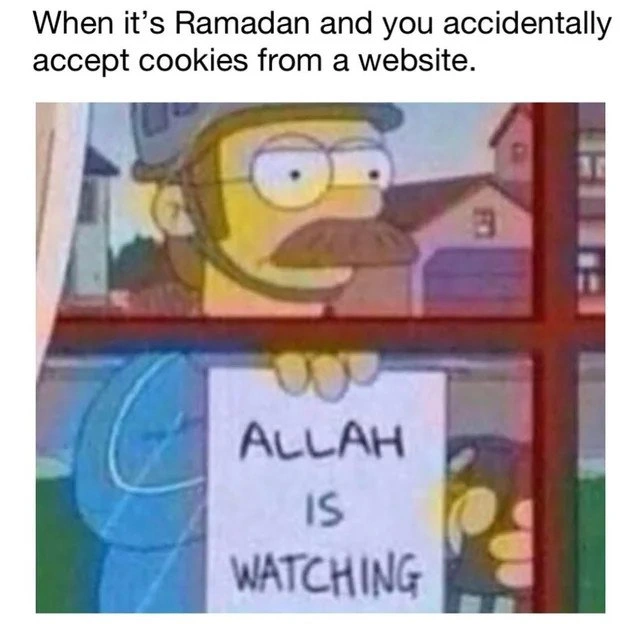
So, normally if you click “Accept cookies” on a website, you’re just saying “sure, save those small data files on my browser.” It has nothing to do with real cookies you eat. But here’s the joke: the meme pretends that clicking that button is like literally accepting cookies to eat! The caption says: “When it’s Ramadan and you accidentally accept cookies from a website.” The person in the meme (a cartoon character from The Simpsons) is holding a sign that says “ALLAH IS WATCHING,” as if to playfully warn you that you might be breaking your fast. It’s poking fun at the idea that someone fasting would feel guilty just from the words “accepted cookies,” since during Ramadan you’re trying so hard not to even think about snacks.
In simpler terms, it’s a pun. The word "cookies" has two meanings:
- Cookie (web): a piece of website data (for WebDevelopment, this is routine and usually harmless).
- Cookie (food): a sweet treat (for someone fasting, this is off-limits during the day).
Normally, accepting a website’s cookies is a boring technical action related to Data Privacy settings (often due to laws like GDPR in Europe that require user consent). But the meme imagines it as a temptation or mistake in the food sense. The humor is enhanced by the Simpsons reference: the character shown is Ned Flanders, Homer Simpson’s extremely religious neighbor known for his catchphrase optimism and moral strictness. In the image, Ned (who typically might say something like “God is watching”) is instead shown with an “Allah is watching” sign. This mash-up is intentionally absurd but relatable to anyone who’s seen those cookie consent pop-ups.
The overall effect is a lighthearted UX/UI joke too. Those cookie consent banners are now part of the user experience on most websites, and let’s be honest, many users just click “Accept” out of habit. Here, doing that during Ramadan sets up a goofy misunderstanding. It’s like the internet’s privacy rules accidentally tripped over a religious rule. The meme makes you smile because you realize no actual fasting rule was broken, but it feels momentarily like it might have been. In short, it’s highlighting how one word – “cookie” – can live in two worlds (tech and real life), creating a funny little collision of meanings.
Level 3: Privacy vs Piety
At first glance, this meme mashes up a web developer’s world with a moment of religious observance. The top caption sets the scene: “When it’s Ramadan and you accidentally accept cookies from a website.” In the image, a bespectacled, mustachioed cartoon character (recognizably Ned Flanders from The Simpsons, a show often mined for meme material) peers through a window holding a sign that reads “ALLAH IS WATCHING.” This is a playful twist — Ned Flanders is usually a devout Christian neighbor, but here he’s repurposed to deliver an Islamic reminder. The humor comes from a double meaning: during Ramadan, Muslims fast (no eating or drinking during daylight), so “accepting cookies” sounds like sneaking a bite of actual cookies (a big no-no while fasting). But in tech, accepting cookies means clicking “Yes” on that ubiquitous cookie consent banner that pops up on websites. The meme hilariously imagines a pious observer (hence the Allah is watching sign) catching you in the act of clicking “Accept” – as if you just broke your fast by eating a forbidden cookie, when really it was just a website data thing!
On a technical level, the meme riffs on everyday WebDev and UX/UI patterns. Virtually every modern website shows a cookie consent modal – a small interface element asking your permission to store HTTP cookies in your browser. These cookies are tiny pieces of data that websites use to remember who you are, keep you logged in, or track your activity (for example, to personalize ads). Thanks to data privacy regulations like GDPR (the EU’s General Data Protection Regulation), sites must explicitly ask users to consent to non-essential cookies. So the phrase “accept cookies” has become extremely common on the web. Developers recognize this as the “cookie banner” at work – a direct result of PrivacyConcerns and DataPrivacy laws. It’s a bit of a UX headache: many users find these pop-ups annoying (they disrupt the browsing flow), leading to what some call UX failures. We often end up clicking “Accept” on autopilot just to make the banner go away. In other words, it’s very easy to accidentally accept all cookies without really thinking – exactly what the meme jokes about. Here, that mindless click is treated like a comical “slip-up” in religious fasting. The devout faster in the meme would never intentionally eat a cookie at noon, but a website’s “Accept Cookies” button? That’s clicked without a second thought – oops!
There’s also a clever irony that senior devs and privacy geeks might appreciate: accepting website cookies means you’re allowing the site (and often third-party trackers) to monitor your activity – in a sense, someone really is “watching” you, just not Allah but perhaps Google Analytics 😅. The “ALLAH IS WATCHING” sign exaggerates the surveillance vibe in a tongue-in-cheek way. It’s like mixing holy oversight with the feeling of being tracked online. Experienced developers might chuckle because they’ve implemented these consent banners themselves and know how perfunctory they often are. Under the hood, clicking Accept usually triggers some JavaScript to set a cookie that remembers your consent choice. The meme’s “accidental” scenario hints at how consent banners sometimes use design tricks (like a big bright Accept button vs. a hidden Reject option) – essentially nudging you to consent even if you’re fasting... er, cautious. It’s poking fun at both the seriousness of religious rules and the absurdity of web cookie rules colliding in one moment. This cultural crossover is unexpected, which is why it’s so funny to tech folks. It reminds us that even something as mundane as a privacy popup can become comedic when context shifts.
To a seasoned dev, there’s an extra layer of cringe-humor: implementing cookie compliance is often a tedious requirement, much like observing strict rules can be trying – and slip-ups happen. The meme encapsulates that “oh no, what have I done?” moment. You can imagine a fasting developer quickly hitting “Accept all cookies” then jokingly looking over their shoulder as if they’ve been caught with crumbs on their face. The Ned Flanders (Simpsons) reference is the cherry on top: he’s the classic nosy but well-meaning neighbor reminding you to stay virtuous. In a tech office during Ramadan, a joke like this might get shared for a light-hearted laugh, bridging colleagues’ cultural understanding. It’s a niche joke that lands well if you know both sides: the seriousness of Ramadan fasting and the silliness of web cookie consent. The DataPrivacy angle (cookie compliance) and the religious meme angle (fasting_humor) together create a perfect storm of geeky pun. In summary, the meme humorously warns developers: be careful what you click during Ramadan – those “cookies” might count in a way you didn’t expect! 🍪👀
// The scenario in code:
if (isRamadan && fasting && userClicks("AcceptCookies")) {
console.warn("ALLAH IS WATCHING"); // 🍪 Oops, wrong kind of cookie?
}
Description
The meme shows a still from an animated sitcom: a bespectacled moustached character peers through a window while holding up a white sheet of paper that reads "ALLAH IS WATCHING." Above the image, black caption text states, "When it’s Ramadan and you accidentally accept cookies from a website." The joke hinges on the double meaning of “cookies” - edible treats prohibited during daylight fasting versus HTTP cookies that appear in consent banners. Visually, muted suburban backgrounds and a red-framed window contrast with the stark black lettering on the sign, while the technical humor references everyday web-dev UX patterns (cookie pop-ups) and data-privacy requirements
Comments
18Comment deleted
Accidentally hit “Accept All” during Ramadan - now I’m writing middleware that intercepts Set-Cookie headers between fajr and maghrib, 301-redirects to /repent, and logs an audit trail for both GDPR and Judgment Day
When your cookie consent banner has better observability than your distributed tracing setup, but at least both are equally ignored by users
The real horror isn't breaking fast - it's realizing you just accepted cookies from 47 third-party trackers, granted localStorage permissions, and somehow agreed to share your biometric data with a subsidiary in the Cayman Islands. At least with Ramadan, you know exactly when the fasting ends; with cookie consent dark patterns, your data is being digested indefinitely across ad networks you've never heard of
Ramadan mode: I remap “Accept All” to “Reject non‑essential; Set‑Cookie: HttpOnly; SameSite=Strict; calories=0” - legal says calories isn’t a valid attribute, marketing says everything else shouldn’t be either
Consent banners are the only UI where one click can break a fast and our data‑minimization policy; Legal wants “Accept all,” the DPO wants default off, and I just want cmp.rejectAll() on page load
Accidentally consenting to cookies during Ramadan: the only time devs fear divine 403s
Allah is an fbi agent or what Comment deleted
It's a fasting month for Muslims (wiki) (месяц, когда мусульмане соблюдают пост) Comment deleted
I just learned it and I see this meme XD Comment deleted
Accepting is different than eating something. Theoretically, should not be a problem! Comment deleted
Theoretically you are given cookie to feed it to the same site later Comment deleted
But can you eat the rich during Ramadan? Comment deleted
I don't eat rich people, not poor ones 😱. Comment deleted
but they are eating us and whole world! Even in Ramadan! Comment deleted
no, but you can feed them to the poor. Comment deleted
Cannibals? Comment deleted
more like cannabis Comment deleted
Smoking Muslim people are more worried about smoking than eating during the daylight until the sunset, Comment deleted