Skip to content
DevMeme
994 of 7435
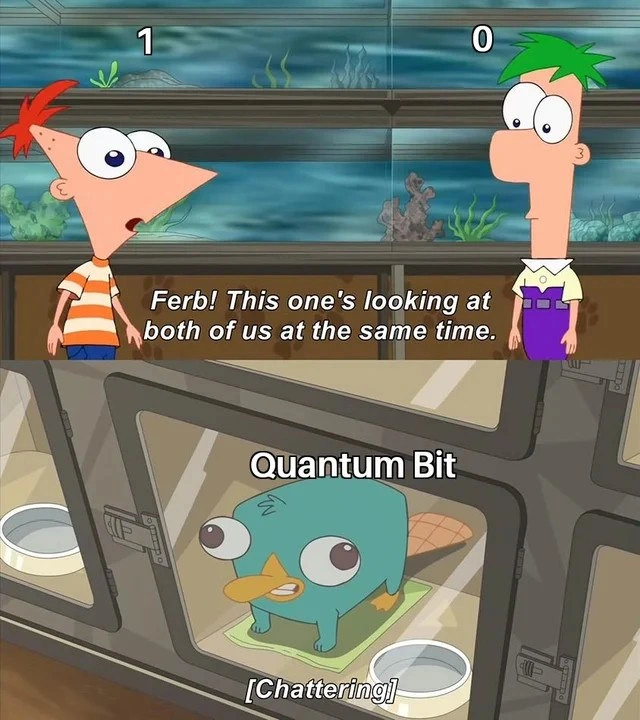
When the qubit observes you as 0 and 1 at the same time
QuantumComputing Post #1119, on Mar 8, 2020 in TG

When the qubit observes you as 0 and 1 at the same time

Why is this QuantumComputing meme funny?

Level 1: Two Places At Once

Imagine you have a friend who somehow manages to be in two different places at the same time – sounds impossible, right? This meme jokes about something kind of like that, but with bits (the things in computers that are like tiny on/off switches). In normal life, a switch is either on or off, a person is either here or there. You can’t have both at once. That’s why it’s silly: in the picture, a little platypus (Perry from Phineas and Ferb) is inside a box and looking at two kids at the same exact time, one kid representing “0” and the other representing “1”. The kids are totally shocked, because normally an animal (or a computer bit) would choose one thing to focus on. This goofy scenario is showing how in quantum world, the rules are different – a quantum bit can kind of do two things simultaneously, like being 0 and 1 at once. It’s as if you asked, “Is this light switch on or off?” and the answer came back, “Yes.” 😄

Think of it like a magic coin that when you flip it, it doesn’t land heads or tails... until you actually peek. While it’s flipping in the air, it’s sort of both. In the meme, Perry the Platypus is like that magic coin: he’s treating both kids (0 and 1) as if they’re the chosen one. It’s a funny, cartoon way to show something that in real life is very strange but true in quantum physics. The humor is in the impossibility – we all know you can’t really be two things at once, so seeing it happen in a cartoon makes us laugh. It’s highlighting that quantum bits play by magical-sounding rules compared to everyday things. The emotional core is amazement and absurdity: “Can you believe this little guy is looking both ways at once? That’s crazy!” Just like we laugh at a cartoon character doing something physically impossible, tech folks chuckle at the idea of a bit that breaks the usual rules.

In plain terms: the meme is funny because it shows a completely impossible scenario (being 0 and 1 at the same time, or looking at two people at once) in a simple, relatable way. Even if you don’t know the science, you can giggle at Phineas’s surprised face and the absurdity of the situation. And if you do know a bit of the science, it’s even funnier, because you get why they chose a platypus in a box to represent this weird “two places at once” idea. It’s like a kid’s cartoon accidentally teaching you a wild science fact. So, whether you’re five or fifty, the idea of something being in two states at once is both mind-bending and amusing – and that’s exactly the feeling this meme captures.

Level 2: A Bit of Both

At this level, let’s break down the key concepts and references for someone with a basic computing background (or a curious junior developer). The meme is comparing a classical bit to a quantum bit (qubit) using a fun cartoon analogy. In everyday computing (your laptop, phone, writing simple Python scripts, etc.), a bit is the smallest unit of information and it can only be one of two values: 0 or 1. It’s like a light switch – it’s either off (0) or on (1). All our software, at the very lowest level, runs on billions of these little switches being in one state or the other. This idea is one of the core CS fundamentals: binary logic.

Now, a quantum bit, commonly called a qubit, is much more exotic. It comes from the field of quantum computing, which is an approach to computation that uses principles of quantum physics. A qubit also has two basic states analogous to 0 and 1 (often we still call them “the 0 state” and “the 1 state”). But here’s the twist: a qubit can exist in a combination of both states at once! This is referred to as superposition. It’s as if you had a coin that you flipped into the air – while it’s spinning, you can’t really say it’s heads or tails; it’s sort of both in limbo. Only when it lands (i.e., you observe it) do you get a definite heads or tails. Similarly, a qubit remains in a fuzzy both-0-and-1 state until you measure it. When you do measure (observe) a qubit, it “collapses” to either 0 or 1, and that’s the result you get, just like catching the coin. You can think of superposition as the qubit hedging its bets, storing a probability for 0 and a probability for 1 at the same time.

The meme illustrates this with the characters Phineas and Ferb from the animated show (tagged phineas_and_ferb for reference). In the top panel, Phineas has a big number 1 over his head, and Ferb has a 0. This represents the two possible states of a bit: Phineas is like the “state 1” and Ferb is like the “state 0.” Typically, a bit could be either Phineas or Ferb, so to speak, but not both at once. In the scene, Phineas says: “Ferb! This one’s looking at both of us at the same time.” That’s the punchline: the “one” he’s referring to is revealed in the bottom panel to be Perry the Platypus, who is labeled “Quantum Bit.” Perry is literally a platypus from the show (tagged perry_the_platypus), and here he’s used as the embodiment of a qubit. He’s in a pet-store style enclosure (like a little cage with a glass front, pet_store_tank style), and he’s somehow gazing with one eye at Phineas (1) and the other eye at Ferb (0) simultaneously.

Of course, in reality a platypus (or any creature) can’t actually look in two different directions at once (unless it’s a chameleon or something with independent eye movement – platypuses definitely can’t do that!). But that impossibility is exactly the joke. Perry doing this impossible feat is a metaphor for how weird a qubit is compared to a normal bit. A normal bit could only focus on Phineas or Ferb, not both. But a qubit is like a magical pet that looks at both. That’s why Phineas is so startled – it’s not what he expects from a run-of-the-mill creature, just like a new developer wouldn’t expect a bit to hold two values at once.

Let’s clarify some terms:

  • Quantum Bit (Qubit): the basic unit of quantum information. It’s like a bit, but thanks to quantum mechanics, it can be a mix of 0 and 1. If we had to give a real-world analogy: imagine a bottle flip that hasn’t landed yet, in that moment it isn’t flat on either its bottom or top – it’s sort of in between. Or think of a spinning coin as mentioned – in mid-air it’s not heads or tails. That’s like a qubit before you measure it.
  • Superposition: this is the word used to describe the qubit being in both states simultaneously. It’s a fundamental concept in quantum physics. In the context of computing, superposition allows a qubit to hold more information than a classical bit – at least until you look at it. It’s a bit like having parallel possibilities. If someone says “this qubit is in superposition,” they mean it hasn’t decided on 0 or 1 yet; it’s somehow both in a quantum way.
  • Measurement (Observation): this is when you check the qubit’s value. In quantum computing, measuring a qubit forces it to pick a side (0 or 1) randomly according to the probabilities associated with its superposition. Before measurement, the state is fuzzy; after measurement, it’s sharply one or the other. In the meme, the act of “looking” is essentially the measurement. Phineas notices the qubit (Perry), which in real quantum terms would make the qubit’s superposition collapse. (In cartoon logic, Perry is looking back at both, which is a funny twist but we can interpret it similarly – the moment they catch Perry’s behavior, he might stop doing it, just like a qubit might stop being in superposition once measured!).
  • Classical vs Quantum: The meme is fundamentally a classical_vs_quantum joke. Classical bits (like normal computers use) abide by classic common-sense rules (0 or 1, not both). Quantum bits break those rules (both until checked). This difference is what makes quantum computing so powerful in theory – a qubit can explore multiple possibilities at once – but also what makes it so non-intuitive.

For a junior developer or a student, the big takeaway is: In quantum computing, weird things are normal. A qubit can be in a superposition of states, meaning if you asked it “Are you 0 or 1 right now?” the honest answer would be “Yes!” (as in both). The meme personifies this by showing a creature literally responding to two different stimuli at once. It can be helpful to recall that this weirdness only holds as long as nobody is directly checking. The moment someone looks (performs a measurement), the magic ends and the qubit will behave just like a random classical bit (you’ll just get one of the two outcomes). So in practice, quantum computers work by setting qubits up in careful superpositions, letting them interact (even getting entangled with each other for complex correlations), and then measuring to get a result at the very end. We never see the “both at once” directly – we infer it from the outcomes statistics when we repeat experiments.

One more subtle detail: the caption [Chattering] on the bottom panel is actually the closed-caption text from the original cartoon scene (likely Perry making his cute platypus chattering noise). It adds to the humor: the qubit (Perry) isn’t explaining itself in any intelligible way, it’s just doing its quirky thing. In real life, qubits don’t chatter of course, but they do require isolation and special conditions to maintain their state. In a way, they live in their own little world (often in a literal box – like a dilution refrigerator or an isolated chamber) until we decide to look at them. The meme’s use of a pet store tank setting for the “Quantum Bit” is pretty on-point: quantum hardware often reminds one of exotic animals kept in carefully controlled environments. And just as an exotic pet might behave in non-intuitive ways, a quantum bit doesn’t behave by the usual pet/bit rules.

Summing up this level: the meme is teaching a bit of Quantum Computing 101 in the guise of a joke. A qubit is not like an ordinary bit – it’s special because it can be in a combination of the basic states (0 and 1). Phineas and Ferb, as curious observers, represent the normal world reacting with confusion to this special ability. If you’re new to these concepts, the meme might prompt you to learn more about why a qubit can do that – and that’s exactly the kind of intellectual curiosity such humor is meant to spark. It’s computer science humor that doubles as a mini-lesson in quantum mechanics! In short, a qubit is “a bit of both” 0 and 1 until you take a look. Weird, but true – and that’s why this meme is funny to folks who know just enough about quantum computing concepts to get the joke.

Level 3: Superposition Shenanigans

For the seasoned developer or computer science veteran, the humor here lies in recognizing a fundamental quirk of quantum computing wrapped in a pop-culture package. The meme riffs on the difference between a classical bit and a quantum bit (qubit) by using Phineas and Ferb, two beloved cartoon characters, to personify the binary states. Phineas standing under a big white “1” and Ferb under a “0” is basically saying: “here are the two possible states of a bit, 0 and 1.” In classical computing, those are mutually exclusive – any given bit in a running program is either 0 or 1 at any moment, never both. That’s the bedrock of all our digital logic, from flipping bits in memory to boolean flags in code.

Enter the Quantum Bit, represented by the ever-staring Perry the Platypus in the pet cage. The caption “Ferb! This one’s looking at both of us at the same time.” is Phineas expressing shock that this creature isn’t behaving like a normal pet (or by analogy, not behaving like a normal bit). The qubit seems to be simultaneously focusing on the “0” state (Ferb) and the “1” state (Phineas). This is a playful way to say: a qubit can encode 0 and 1 at the same time. To an experienced dev familiar with quantum concepts, that line immediately screams superposition. It’s the kind of thing you learned from a quantum computing primer or a CS fundamentals course: unlike classical bits, qubits can be in a superposition of basis states until you measure them. The shock on Phineas’s face mirrors a programmer’s initial disbelief when first hearing “it can be both 0 and 1 simultaneously.” It sounds like someone’s pulling your leg or describing a glitch in the matrix!

The humor also comes from role reversal and anthropomorphism. In real life, we (the observers or programmers) are the ones “looking at” a qubit to determine its value. But here the meme imagines the qubit looking back at us – or rather, at the representatives of 0 and 1 – at the same time. It’s a clever twist: if observing a qubit forces it to choose a state, what happens if the qubit is the one doing the observing? The meme cheekily suggests that from the qubit’s perspective, it sees both outcomes concurrently. This absurd scenario tickles any developer who knows the golden rule of quantum measurement: you can’t peek at a qubit without disturbing it. By giving the qubit a conscious role (“looking at both of us”), it subverts the typical dynamic and highlights just how bizarre the quantum paradigm is compared to our everyday computing intuition.

Many veteran programmers have gone down the rabbit hole of quantum computing out of curiosity. Perhaps they tried out IBM’s Q Experience, writing a bit of Q# or Qiskit code to flip qubits with a Hadamard gate and observe the results. They know that if you prepare a qubit in an equal superposition of |0⟩ and |1⟩ (for instance, by applying a Hadamard transform to an initial |0⟩ state), the qubit’s state is something like “both 0 and 1.” But the moment you measure it, you’ll only get either 0 or 1, with 50/50 probability. This is often demonstrated with a simple experiment in code or pseudocode:

# Pseudo-code illustrating a qubit measurement scenario
qubit = create_qubit()        # Start with qubit in state |0>
apply_hadamard(qubit)         # Now qubit is in superposition (|0> + |1>)/√2
value = measure(qubit)        # Collapse qubit: value will be 0 or 1 (randomly)
print("Measured value:", value)
# You will never see "Measured value: 0 and 1" – the act of measuring forces a single outcome.

A senior engineer will appreciate the above snippet: calling apply_hadamard(qubit) is essentially the programming equivalent of Perry the Platypus going into superposition mode, and calling measure(qubit) is like Phineas opening the cage to see what’s inside – suddenly Perry is either definitely looking at Phineas (state 1) or at Ferb (state 0), but not both. The code comment makes the same point the meme does: you’ll never get a readout of “0 and 1 at the same time” once you actually measure; you only get one result per observation. This is a fundamental quirk that seasoned devs chuckle at, because it breaks the normal rules of debugging and program state tracking. In classical debugging, you could, say, log a variable’s value at any time and you’d get a definite answer. In a quantum algorithm, trying to log the state of a qubit midway will just end the superposition party early and give you a definite classical bit, ruining the quantum computation. It’s like the system saying “if you ask me, I’ll tell – but then I stop being in superposition.”

This meme hits on the culture shock between classical and quantum computing within the developer community. Those well-versed in CS fundamentals know how binary states work in circuits and code. So, seeing a cartoon call out a bit that can eyeball both a 0 and a 1 simultaneously is hilarious because it encapsulates that shockingly non-classical behavior in a single image. It brings to mind all the “mind blown” moments senior devs had when first learning about quantum phenomena: how electrons can act like waves and particles, how entanglement allows correlated behaviors at a distance, and of course how a qubit defies a straightforward truth table.

Another layer of appreciation for the experienced folks is how the meme uses a silly, innocent cartoon context to convey a really profound concept. Phineas and Ferb is a kids’ show known for its clever humor that often also entertains adults. By using these characters, the meme sets a lighthearted tone: it’s as if we’re in on a geeky inside joke delivered in the guise of a Disney cartoon. If you’ve been in software long enough, you’ve likely encountered the barrage of hype around quantum computing (“Quantum supremacy,” anyone?). You know there’s serious science behind it, but also that it’s an area where popular understanding is murky and full of almost magical-sounding descriptions. This meme cuts through that by anthropomorphizing a qubit as a platypus. It says: “Sure, the science is complex, but at the end of the day, a qubit is just a funny little thing that can do this wild trick of being in two states. Isn’t that both ridiculous and amazing?” Seasoned devs enjoy this because it reflects their own mix of skepticism and awe. We’ve all joked in the office about how quantum computers are basically “spooky voodoo machines” that do everything and nothing until you look – this meme captures that sentiment in one clean visual gag.

Finally, let’s talk about the shared experience aspect. The caption “Ferb! This one’s looking at both of us at the same time.” evokes the kind of WTF moment you might have the first time you seriously confront quantum logic. It’s that wide-eyed, cartoonish astonishment. Senior developers have been there – perhaps not with quantum bits specifically, but whenever confronting a new paradigm that upends the old rules. Think about the first time you encountered multithreading races, or non-deterministic behavior in distributed systems (like eventual consistency): it’s confusing and awe-inspiring that something can have no single definitive state from certain viewpoints. Quantum computing is an extreme example of that. Thus, the meme resonates as a humorous affirmation: “Yep, quantum bits are crazy – even Phineas and Ferb are freaked out!” It’s a bonding laugh for those in the know, poking fun at how far removed quantum reality is from our comfortable binary world.

Level 4: Schrödinger’s Platypus

At the deepest theoretical level, this meme hides a nod to quantum superposition and the classic paradox of Schrödinger’s cat (here humorously replaced by Perry the Platypus in a box). In quantum computing, a qubit isn’t constrained to a single binary value like a classical bit; instead, it exists in a linear combination of basis states. Formally, a qubit’s pure state can be written as a quantum superposition of the basis $|0\rangle$ and $|1\rangle$:

$$ |\psi\rangle = \alpha,|0\rangle + \beta,|1\rangle, $$

where $\alpha$ and $\beta$ are complex probability amplitudes (with $|\alpha|^2 + |\beta|^2 = 1$). This means the qubit is in a two-dimensional Hilbert space spanned by $|0\rangle$ and $|1\rangle$. It’s not in state 0 or 1, but a mixture of both – conceptually both 0 and 1 at the same time. Only upon measurement does the state collapse to one of the two basis states, yielding a definite 0 or 1 outcome with probabilities $|\alpha|^2$ and $|\beta|^2$ respectively.

In the meme’s top panel, Phineas is labeled 1 and Ferb is labeled 0, effectively personifying the computational basis states. Perry, labeled Quantum Bit in the bottom panel, is peering out from a container (much like Schrödinger’s thought-experiment cat in a box) and is described as “looking at both of us at the same time.” This is a playful illustration of a qubit’s wavefunction having support in both the $|0\rangle$ and $|1\rangle$ state simultaneously. The caption [Chattering] under the Quantum Bit is a tongue-in-cheek touch – real qubits don’t literally chatter, but they do exist in an indecipherable quantum state until observed. It hints at the quantum noise and uncertainty inherently present before measurement; in quantum circuits, an unmeasured qubit might as well be “chattering” with potential, undefined behavior relative to classical certainty.

From a physics perspective, this scenario flips the usual observer effect: typically we (the observers) measure the qubit, collapsing its superposition. Here, instead, the qubit is depicted as the observer seeing the classical states (0 and 1) simultaneously. It’s a witty inversion of the famous quantum measurement problem – reminiscent of the Wigner’s friend thought experiment or the notion of quantum observers. In a real quantum system, if a qubit were somehow entangled with an observer’s state, the perspective of who is observing whom can indeed get mind-bending. The meme simplifies this into cartoon logic: the qubit (Perry) gazes out and “observes” both basis states (Phineas and Ferb) at once.

This alludes to the deep idea that in the quantum realm, reality isn’t definite until interaction (observation) occurs. Until you “open the box” (or in this case, the pet carrier) to check on the qubit, it’s as if it’s aware of both possibilities. The quantum computing in-joke here is strong: developers who have dabbled in quantum algorithms know that a qubit must often be treated abstractly as a probability amplitude vector. You can’t just print its state midway, because interrogating it directly (like Phineas trying to peek at Perry) forces a collapse to a single classical bit. In formal terms, the unitary evolution of a qubit’s state is reversible and rich in information until you perform a measurement (a non-unitary, irreversible operation that yields one classical bit of information and destroys the delicate superposition).

It’s worth noting how apt Perry’s character is for this analogy. In the Phineas and Ferb series, Perry the Platypus famously leads a double life: a harmless pet by day and a secret agent by stealth. His owners never witness his agent persona – much like how an outside observer never directly “sees” a qubit’s superposition state. By the time Phineas or Ferb turns to look, Perry has dropped the fedora and is back to being a normal platypus, just as a measured qubit is no longer quantum-weird but just a 0 or 1. This parallel is likely unintended but delightfully fitting: the qubit/platypus can be thought of as covertly in two states at once, but it’s only ever caught in one state when observed.

In essence, the meme packs a lot of quantum insight under the hood of a simple cartoon scene. It highlights the counterintuitive fundamentals of quantum computing (a core part of modern CS fundamentals research): that information at the quantum level doesn’t obey the neat either/or rules of classical bits. Instead, it inhabits a fuzzy, math-rich realm of probabilities and phase. For those familiar with concepts like the Bloch sphere representation of qubit states or the linear algebra behind quantum logic gates, this image prompts a knowing chuckle. We recognize that Perry’s two-eyed stare at both 0 and 1 is a metaphor for a qubit’s wavefunction spanning two eigenstates. It’s a fun, visually intuitive take on what is usually expressed through complex vectors and bra–ket notation in textbooks. That’s why this meme hits a sweet spot: it transforms an abstract, heady principle of quantum mechanics into a goofy yet insightful visual scenario that only collapses into a single punchline once you measure—er, interpret—it!

Description

The meme consists of two cartoon panels from Phineas and Ferb. Top panel: Phineas (left) with a white number "1" above his head and Ferb (right) with a white "0" above his head stand in front of an aquarium; subtitle text reads, "Ferb! This one's looking at both of us at the same time." Bottom panel: a pet-store style cage shows Perry the Platypus staring outward; white caption over the cage reads "Quantum Bit" and the closed-caption below says "[Chattering]". The joke riffs on quantum superposition - unlike a classical bit that is either 0 or 1, a qubit can simultaneously be both, hence the character ‘looking at’ both 0 and 1. Developers familiar with quantum computing fundamentals will immediately connect the humor to real-world challenges in measuring and reasoning about qubits


Comments

6
Anonymous ★ Top Pick Quantum bits are basically senior architects in design review - simultaneously 0% and 100% on board until you ask for sign-off, then the wavefunction collapses to “needs another RFC.”
  1. Anonymous ★ Top Pick

    Quantum bits are basically senior architects in design review - simultaneously 0% and 100% on board until you ask for sign-off, then the wavefunction collapses to “needs another RFC.”

  2. Anonymous

    After 20 years of explaining quantum computing to VCs, I've realized Perry the Platypus is the perfect metaphor - everyone thinks they understand what state he's in until you actually try to observe him, then your entire mental model collapses faster than a wave function meeting a measurement operator

  3. Anonymous

    When your quantum computing colleague tries to explain superposition using a children's cartoon and it's somehow the clearest explanation you've heard all week - because nothing says 'enterprise-ready quantum infrastructure' quite like a platypus in a box simultaneously judging both your architecture decisions at once

  4. Anonymous

    Quantum bit: like our prod Heisenbug - both 0 and 1 until you turn on tracing, then the observer effect collapses it to “cannot reproduce.”

  5. Anonymous

    Qubits: the only bits that can validate both the happy path and edge case until you force a measurement

  6. Anonymous

    Our multi‑region feature flag is basically a qubit - 0 and 1 until an exec opens Grafana and the rollout collapses to “off.”

Use J and K for navigation