Skip to content
DevMeme
7082 of 7435
Physics Timeline: Smooth Sailing Until the 20th Century Hits
Mathematics Post #7765, on Feb 26, 2026 in TG

Physics Timeline: Smooth Sailing Until the 20th Century Hits

Why is this Mathematics meme funny?

Level 1: The Jigsaw With Extra Pieces

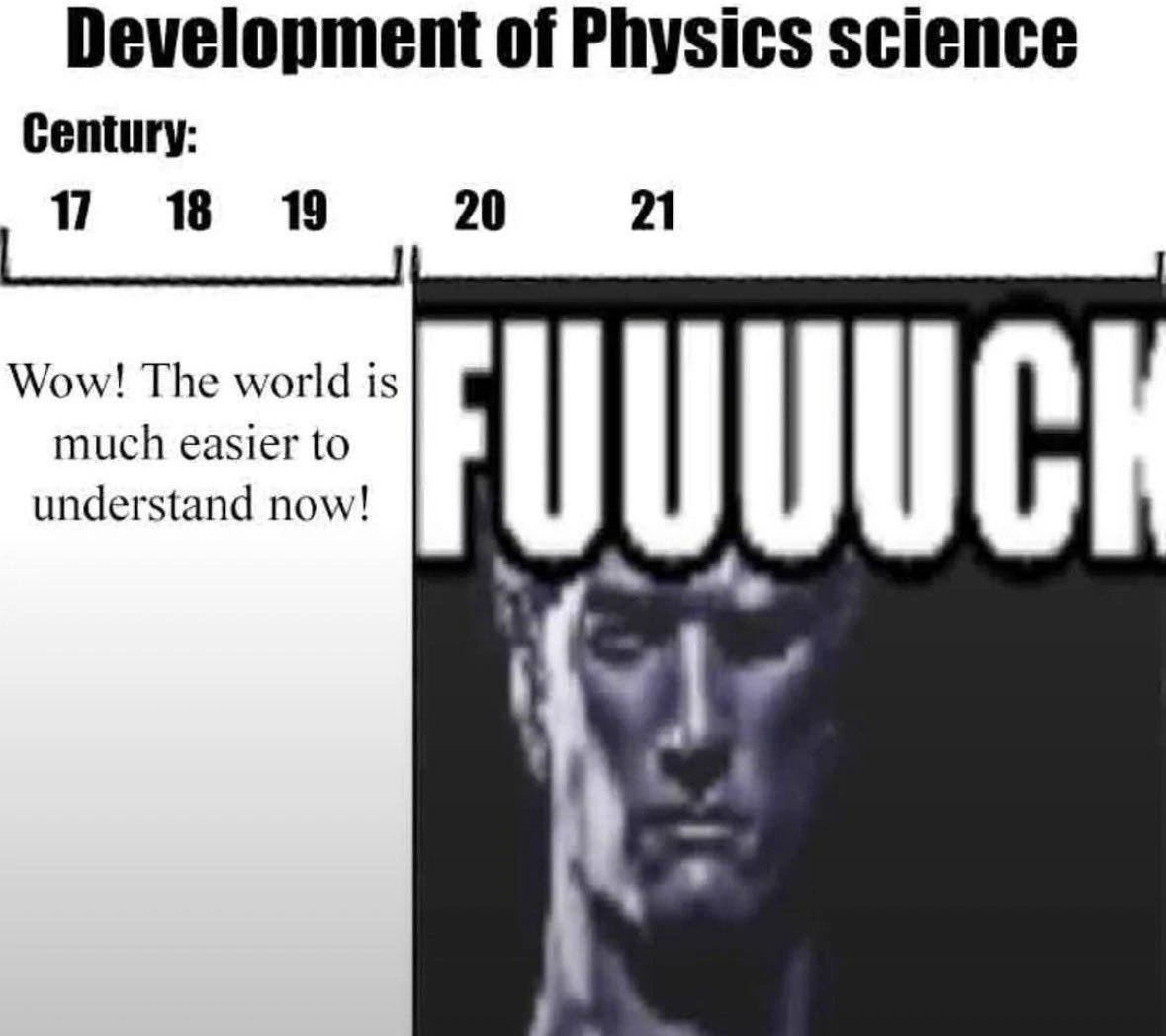
Imagine doing a jigsaw puzzle that's going great — the picture is coming together, you feel like a genius, you're almost done. Then you find a hidden box underneath the table with ten thousand more pieces, and they don't match the picture you thought you were making at all. For 300 years, scientists felt like they'd nearly finished the puzzle of how the world works. Then the 1900s opened that second box, and the universe turned out to be far stranger and harder than anyone imagined. The stone face making the FUUUUCK expression is exactly how it feels to think you're done and discover you've barely started.

Level 2: The Two Eras, Defined

  • Classical (Newtonian) physics — centuries 17–19 — is the intuitive stuff: objects have definite positions and speeds, forces cause predictable motion, and if you know the starting conditions you can compute the rest. It matches everyday experience, which is why it felt like the world had become "easy to understand."
  • Relativity (early 20th century) breaks the idea of universal time and space: measurements of length and time depend on how fast you're moving, and nothing travels faster than light. There's no shared, absolute "now."
  • Quantum mechanics (early 20th century onward) breaks certainty itself: tiny particles don't have definite values until measured, and you can only predict probabilities of outcomes. The act of observing changes the result.
  • A paradigm shift is when a field's foundational assumptions get replaced wholesale — not a tweak, a teardown. The FUUUUCK statue is the human reaction to realizing the comfortable model was incomplete.

The takeaway for learners: feeling like you finally "get it" is often the moment right before a deeper layer reveals you didn't. That's not failure — in physics it produced the most important discoveries ever made.

Level 3: The Comfort Was the Anomaly

What makes the timeline land is its sly historical claim: the easy part was the exception, not the rule. For three centuries physics enjoyed a winning streak where intuition and mathematics agreed — apples fall, planets orbit, heat flows, and the equations describing them feel like polished common sense. That bred the famous late-19th-century hubris, the sentiment (often attributed to Kelvin) that physics was essentially complete save for "two small clouds" on the horizon. Those two clouds — the blackbody catastrophe and the Michelson–Morley null result — became quantum mechanics and relativity, the two theories that ate the entire 20th century. The bracket in the meme is the calm; the statue is the storm that was hiding inside the loose ends.

Anyone who's worked on a large system feels this in their spine. The paradigm shift here is the same emotional arc as inheriting a codebase that "works fine" until you discover the assumptions it rests on are false — that the thing you modeled as simple is irreducibly weird, and that the weirdness isn't a bug to be cleaned up but the actual nature of the domain. The gap between determinism vs. probability is the gap between "I can reason about this by stepping through it" and "I can only describe its statistics." Physicists spent the 1700s feeling like senior engineers who'd finally documented everything, and the 1900s feeling like juniors on day one of a system nobody understands.

Level 4: When the Universe Stopped Being Deterministic

The meme's structure is a timeline titled "Development of Physics science" with a century axis — 17, 18, 19, 20, 21 — where centuries 17 through 19 sit under a tidy bracket captioned "Wow! The world is much easier to understand now!", and the moment the 20th century begins, the chart cuts to the gigachad statue glaring out of a black panel beneath enormous white letters reading FUUUUCK. Compressed into that cut is the single most violent epistemological rupture in the history of science, and it's worth taking literally.

The 17th–19th century stretch is the triumph of determinism. Newton's laws, then Lagrangian and Hamiltonian mechanics, then Maxwell's electromagnetism — a worldview where, as Laplace boasted, an intellect knowing every particle's position and momentum could compute the entire past and future of the universe. The math was hard but the philosophy was free: reality was a clockwork, observer-independent, with definite values waiting to be measured. Then 1900 happens. Planck quantizes energy to fix blackbody radiation and quietly detonates continuity. Einstein's 1905 relativity makes simultaneity observer-dependent — there is no universal "now," and mass, length, and time bend with velocity. Then quantum mechanics finishes the job: the Heisenberg uncertainty principle ($\Delta x , \Delta p \geq \hbar/2$) says position and momentum cannot simultaneously have definite values — not because our instruments are crude, but as a structural feature of reality. The wavefunction evolves deterministically via the Schrödinger equation, yet measurement yields only probabilities, and the Bell inequalities later proved there's no hidden-variable escape hatch that restores local realism. The universe didn't just get harder to calculate; it stopped having definite answers until you looked. The statue's face is the correct response of every physicist who thought they were nearly done.

The deep joke for technically literate audiences is that this exactly mirrors how complexity ambushes engineers. Reality went from a single-threaded, strongly-consistent system with global state to a distributed one where observers disagree about ordering (relativity is literally a relativity-of-simultaneity problem, the same way distributed systems have no global clock), and where you can only ever query probabilistic, eventually-resolved state. Classical physics was the monolith; quantum mechanics is the moment the architecture went distributed and nobody can agree on what happened first.

Description

A timeline meme titled 'Development of Physics science' with a 'Century:' axis labeled 17, 18, 19, 20, 21. A bracket spans centuries 17-19 with the caption 'Wow! The world is much easier to understand now!' - the era of Newtonian mechanics and classical physics. From century 20 onward, the image cuts to a dark panel of a stern stone-faced statue (the 'gigachad/FUUUCK' template) with giant white letters reading 'FUUUCK', representing the arrival of relativity and quantum mechanics shattering intuitive understanding. The humor maps directly to engineering: elegant deterministic models giving way to probabilistic, observer-dependent chaos

Comments

4
Anonymous ★ Top Pick Classical physics was the monolith era; quantum mechanics is when reality went eventually consistent
  1. Anonymous ★ Top Pick

    Classical physics was the monolith era; quantum mechanics is when reality went eventually consistent

  2. @async_andrew 4mo

    what does it mean to understand the world?

  3. @ZmEYkA_3310 4mo

    Holy shit hakiter. Fraud yesterday for sure!

  4. @RiedleroD 4mo

    "devs with memes" when they post a single meme that isn't about IT:

Use J and K for navigation