Skip to content
DevMeme
6686 of 7435
Google AI Announces Quantum Computing Breakthrough: 13,000x Faster Than Classical
QuantumComputing Post #7330, on Oct 24, 2025 in TG

Google AI Announces Quantum Computing Breakthrough: 13,000x Faster Than Classical

Why is this QuantumComputing meme funny?

Level 1: Too Good to Be True

Imagine a famous chef announcing he’s created a new super-oven that can bake a cake 13,000 times faster than a normal oven. A cake that usually takes an hour now takes mere seconds! All the young bakers are amazed, picturing instant cupcakes on demand. But the old master chefs just smile and reach for their salt shakers. They’ve been around long enough to know that extraordinary claims often come with a catch. Maybe the oven only works that fast on a tiny cupcake, or maybe the cake doesn’t bake evenly. The experienced chefs aren’t saying the chef is lying; they just want to see it actually work and taste the cake for themselves. It’s funny because the claim sounds too good to be true – and when we hear something like that, our first reaction is a mix of excitement and skepticism. Just like those master chefs, the senior engineers in the meme hear a wild “13,000× faster” claim and think, “Awesome, if real… but let’s see it proven before we believe it.”

Level 2: Quantum vs Classical

Let’s break down what’s happening in this meme. First off, quantum computing is a cutting-edge approach to computing that uses qubits instead of regular bits. A regular bit (in your laptop or phone) is like a tiny switch that can be 0 or 1 (off or on). A qubit, on the other hand, can be 0, 1, or a mix of both at the same time (thanks to a quantum phenomenon called superposition). Qubits can also be linked together by something called entanglement, which means they can coordinate in ways that classical bits can’t. These properties let quantum computers explore many possibilities with far fewer steps than a normal computer in certain problems.

Google’s tweet is bragging about a quantum computer achievement: running some algorithm (a set of instructions to solve a problem) way faster than a classical supercomputer could. A classical supercomputer is basically a huge assembly of powerful normal computers all working together. Think of rows and rows of servers with thousands upon thousands of processing cores crunching numbers in parallel. They’re what we use now for extremely heavy tasks (like simulating weather, modeling physics, or training large AI models). Google is saying their quantum machine solved a particular problem 13,000 times faster than one of these classical giants. To give an intuitive sense: if the world's fastest supercomputer might have taken, say, a couple of days to finish that task, the quantum computer did it in just a few minutes. That’s a massive speed-up!

Now, there are a few important terms in that tweet. “Verifiable algorithm” means the problem they solved has a clear answer that can be checked. In the past, Google did a famous quantum demo in 2019 (achieving quantum supremacy) where their quantum computer did something no classical computer could realistically do. The catch? That task was basically producing a very specific set of random numbers — it was hard for a normal computer to do, but also hard to tell if the quantum computer’s output was “right” (since it was essentially random data). It was a big milestone in theory, but it didn’t have a practical result you could verify in a normal sense. This time, by saying verifiable, Google implies “we solved a real math or science problem that has an answer we can double-check.” That makes the claim more concrete because everyone can agree if the answer is correct.

They also mention past milestones: in 2019 the quantum supremacy proof-of-concept, and then in 2024 their new Willow chip solving a big issue in quantum error correction. The Willow chip is presumably the name of Google’s advanced quantum processor. The error correction part is important: quantum computers are super sensitive. Qubits can lose their information very quickly due to tiny disturbances (imagine trying to carry a stack of plates on a unicycle — any wobble and whoops, the plates fall). Quantum error correction is like having spare plates and a method to recover the stack if a few plates slip. It means using extra "helper" qubits to detect and fix mistakes when the main qubits get disturbed. For almost 30 years, scientists have known error correction is theoretically possible, but doing it in practice is incredibly hard. In 2024, Google claims they cracked a key challenge in making error correction actually work on their hardware. That’s a big deal because without error correction, you can only do very short, simple calculations on a quantum computer before the “noise” (random errors) messes everything up. With error correction, in theory you could run much longer calculations and tackle more complex, useful problems.

Now, about that “13,000× faster” claim: it naturally raises eyebrows. People who work with supercomputers might ask “13,000× faster in what scenario exactly?” because often these comparisons are done for one very specific test. It doesn’t mean a quantum computer is generally 13,000 times faster on everything. It means for that one chosen problem, the quantum approach blew the classical approach out of the water. Why only that one? Because quantum computers aren’t magic bullets for all tasks – there are just certain types of problems they’re really good at (usually involving huge numbers of possibilities, complex quantum physics simulations, or optimization of certain kinds). For many everyday computing tasks (like browsing the web, doing spreadsheets, or running a video game), a quantum computer offers no benefit and might even be slower. So this claim is about a special case. Still, it’s a significant special case if true, because it shows a huge gap for something that matters in the research world.

So why are “seniors reaching for salt shakers”? That’s referring to the saying “take it with a grain of salt.” It means to be skeptical — to not immediately believe something completely. Older, more experienced engineers (“seniors”) have seen a lot of hype in tech. They tend to reserve judgment until they see proof and details. The announcement sounds exciting, but they want to see more evidence and make sure it’s not just marketing exaggeration. They remember, for instance, that after Google’s 2019 quantum claim, other experts found ways to partially replicate or challenge it using clever classical tricks, meaning the quantum leap wasn’t as absolute as it first sounded. So, hearing another “huge breakthrough” now, they are cautious. It’s like, “Okay, awesome news — but let’s see the peer-reviewed paper, let’s see independent verification, and let’s see how useful this really is.”

One more thing in the post’s caption: it jokingly contrasts OpenAI and Google. OpenAI is the company behind ChatGPT and other AI projects. When it says “OpenAI: We launch Chromium wrapper,” that’s poking fun at OpenAI for apparently releasing something very trivial (a Chromium wrapper is basically just a web browser – Chromium is the open-source browser engine behind Google Chrome. Calling something a "wrapper" around Chromium makes it sound like they just re-branded the Chrome browser with minimal changes). Then it says “Also Google (still only 105 qubits tho): [big announcement].” The meme is humorously saying: on the same day, one company (OpenAI) put out news that’s pretty mundane, while another company (Google) announced a mind-blowing scientific breakthrough. The aside “(still only 105 qubits tho)” is a little cheeky reminder that Google’s quantum computer, while advanced, has 105 qubits, which is not an enormous number by computing standards. It’s the poster’s way of saying, “Google made a huge claim, but don’t forget their quantum hardware is still in early days (only 105 qubits available to use).” For perspective, your classical computer has billions of basic bits. Even other quantum efforts, like IBM’s, have chips with over 100 qubits, so Google isn’t alone at that scale. In short, cool achievement, but we’re not talking about a full-blown quantum revolution just yet.

In simpler terms, this meme highlights hype vs. skepticism in tech. Google’s tweet is hyping a futuristic tech breakthrough with a big number. The experienced folks are the voice of reality, saying “let’s not get carried away until we see it really working outside the lab.” And the OpenAI vs Google contrast shows how on any given day tech news can range from the banal (a new browser app) to the extreme (quantum leaps), yet both can be talked up. The seasoned engineers find it a bit amusing and approach all such news with healthy skepticism: excited to see progress, but waiting for real-world proof.

Level 3: Seasoned Skepticism

Now imagine a senior engineer scrolling through X (Twitter’s new skin) and spotting that exuberant Google AI tweet. The announcement screams “major breakthrough” with a flashy 13,000× faster figure, and sure enough, this veteran’s hand instinctively reaches for the salt shaker. Why? Because they've seen this show before. The tech world loves big headline numbers and bold proclamations, but experienced folks have a reflex to take it with a grain of salt until proven in the real world.

In 2019, Google made waves with a claim of quantum supremacy – solving a problem faster than any classical computer could – and the media buzzed with “quantum computers have left classical computers in the dust!” But seniors remember what came next: debates, fine print, IBM’s rebuttal, and the realization that the problem solved had no practical use (it was basically generating random numbers). Fast forward to this tweet: another eye-popping number, another historic first. The veteran engineer isn’t unimpressed (13,000× is huge!), but they immediately wonder “13,000× faster at what, exactly?” and “How long before someone finds a classical workaround or caveat?” They've learned that when a claim sounds too good to be true, it often is – or at least, it's true only under very special conditions.

This skepticism isn’t negativity for its own sake; it’s born of patterns observed over decades – the TechHypeCycle at work. Early-career devs might see a headline like this and think we’re on the cusp of sci-fi computing. Seasoned devs recall hype waves from the past: the AI bubbles, the VR revolutions, the blockchain panaceas – each heralded as game-changing, each tempered by reality soon after. Quantum computing has been hyped for years, and while it is steadily advancing, every announcement of “we did X that was impossible before” is followed by years of incremental grind before it affects everyday computing. The veteran trope is that quantum computing (much like fusion energy) is always “five years away.” So a tweet proclaiming we’re “closer to quantum computers that can drive discoveries in medicine and materials science” evokes a polite, eyebrow-raising nod from the old-timers. Sure, we’re closer. We’re also “closer” to Mars colonization with each rocket test, but you won’t see seniors packing their bags for the Red Planet just yet.

To illustrate how a senior might mentally translate this tweet, let’s break down the PR-speak versus the seasoned filter:

Google’s Tweet says... Seasoned dev hears...
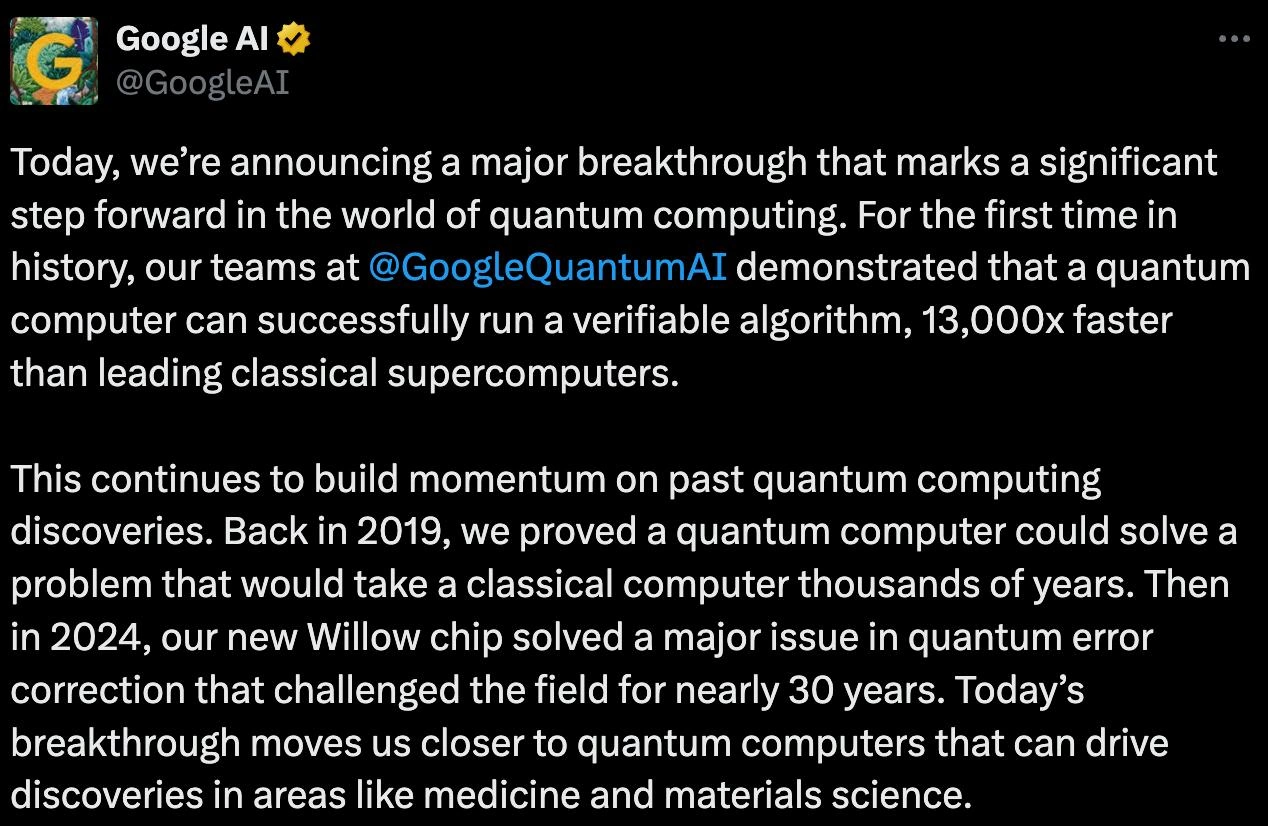
“major breakthrough… significant step forward” Nice milestone, but we’ve heard “breakthrough” before. What’s actually new under the hood?
“quantum computer can run a verifiable algorithm” They picked a problem with a known answer this time (no more magic black-box claims). Smart move, but let's see details.
“13,000× faster than leading classical supercomputers” Impressive number! ...assuming no one finds an optimized classical trick next month.
“continues to build momentum on past quantum discoveries” We’re chaining together press releases now – remember 2019’s supremacy and 2024’s chip? Yup, PR timeline is in full swing.
“moves us closer to… discoveries in medicine etc.” Someday this could matter for real problems, but we're still in the lab demo stage. Keep the champagne on ice for now.

The right column is basically the silent commentary running through many seniors’ heads. It’s not that they dismiss the achievement – it’s scientifically very cool – but they know the difference between a one-off demonstration and a deployable technology. Google dropping a big announcement like this is also a signal in the ongoing race (Google vs IBM vs academia vs startups) in QuantumComputing. Every few years, one of them claims the new speed crown or qubit record. The seniors have become jaded connoisseurs of these claims, comparing notes: “Only 105 qubits? Remember when we thought we’d have thousands by now?” or “13,000× faster on that niche simulation – wake me when it runs Crysis, or heck, even just my database migration.” It's half-joking, half-serious skepticism.

There’s also a dash of humor in how this meme’s post frames the situation. It contrasts two tech headlines: OpenAI apparently announcing something pedestrian (“We launch Chromium wrapper”, which sounds like just repackaging Chrome with maybe an AI twist) versus Google announcing something straight out of a sci-fi lab. It’s like saying, on the same day one company launched a new app skin and another claimed to bend the laws of physics. The subtext is that tech news can be equally bombastic about very unequal feats. A senior dev chuckles at both: OpenAI’s news might be overhyped productization, and Google’s news is hyped bleeding-edge science – and neither will likely change their life in the short term. The AIHypeVsReality vibe and IndustryTrends_Hype are strong here. One headline is hyping a trivial thing, the other is hyping a profound experiment with caveats, and the seasoned engineer approaches both with cautious interest rather than wild excitement.

So, with salt shakers at the ready, the senior crowd acknowledges Google’s achievement (“Good job, truly!”) but also murmurs about all the unsolved practical issues. They’ll swap war stories about past hype: “Remember when quantum annealing was sold as real quantum computing? Yep, we survived those D-Wave headlines too.” They know progress is real but gradual. In the end, the humor of the meme comes from that contrast in reactions: the official tweet brims with optimism and big numbers, while the wise old techies raise an eyebrow and quietly grin. They’ve learned to separate hype from reality, even as they secretly hope this time the breakthrough is as big as advertised. Until then, pass the salt.

Level 4: Spooky Speed-ups

Google's bold claim of a 13,000× quantum speed-up sparks deep questions in theoretical computer science. At this level, we consider why such a claim is significant. In complexity theory terms, a genuine exponential quantum advantage implies tackling a problem in the class BQP (problems solvable by a quantum computer in polynomial time) that isn't feasible for any classical algorithm in P or even probabilistic BPP. In other words, the quantum machine might be solving something fundamentally faster than a Turing machine ever could without quantum effects. The tweet mentions a "verifiable algorithm," which suggests they picked a problem with a definite answer that can be checked classically (unlike the 2019 quantum supremacy experiment which produced a random distribution). This points to progress: moving from abstract sampling demonstrations to a more structured computational task that classical supercomputers struggle with. If indeed the task sits outside classical reach, it strengthens the evidence that quantum computers can exploit physics to solve certain problems asymptotically faster than classical machines.

To unpack that 13,000× number: it likely came from comparing the runtime of a specific quantum algorithm on Google's quantum processor to the estimated runtime of the best-known classical algorithm on a top-tier supercomputer. In 2019, Google’s 53-qubit Sycamore chip took about 200 seconds to sample from a random quantum circuit, a task they estimated would take a classical supercomputer thousands of years (a practically infinite gap). That was hailed as quantum supremacy, but it was somewhat controversial because IBM found clever classical shortcuts that reduced the task to mere days on a large cluster – a dramatic illustration that classical algorithms can catch up when optimized. Now, in 2025, claiming "13,000× faster than leading classical supercomputers" suggests Google tackled a more meaningful computational problem. Perhaps they ran a quantum simulation or optimization that's known to blow up exponentially on classical hardware but stays efficient on a quantum processor. Crucially, verifiable means we can confirm the quantum result is correct (maybe the problem has a known solution or can be partially checked), which addresses a criticism of the earlier quantum supremacy claim.

From a hardware perspective, consider what 105 qubits means. A quantum state of 105 qubits lives in a space of size $2^{105}$ (about $4 \times 10^{31}$ basis states!). No classical computer can explicitly manage that many states; it's why simulating a general 105-qubit quantum system is astronomically hard. For illustration, imagine writing a Python script to calculate the number of classical states:

n_qubits = 105
states = 2**n_qubits
print(f"{states} possible states")
# This prints a number around 4e31: far more states than any classical computer could ever track.

A classical supercomputer – even one with hundreds of thousands of CPU cores and accelerators – would choke on that state-space. Quantum machines leverage superposition and entanglement to explore such vast spaces in ways classical algorithms simply can't, at least not directly. This is why certain problems (like factoring large numbers or simulating quantum physics) are believed to have exponential classical complexity, yet a quantum approach can find answers more efficiently. A 13,000× speed-up is an eye-catching piece of evidence that for the chosen problem, the quantum approach scaled much better than known classical methods.

However, a seasoned theorist will note that "13,000× faster" often comes with caveats. The comparison is only as fair as the classical baseline used. HPC experts might ask: was the classical supercomputer running the absolute best algorithm or just a straightforward brute force? Often, initial quantum breakthroughs pick a problem carefully chosen to favor quantum. It's not cheating—it's demonstrating a point—but classical computer scientists love to optimize their codes when challenged. (In 2019, faced with Google's claim, IBM tightened their simulation algorithms and significantly closed the gap.) So there's an ongoing cat-and-mouse game: quantum researchers design a task believed to be intractable for classical machines, and classical experts respond with improved algorithms or more brute force (sometimes even redefining the problem conditions) to reassert classical capabilities. A 13,000× separation today could shrink if a new algorithm or more hardware enters the classical side of the ring. Or it might truly hold up as tasks scale, indicating a more fundamental gap. That's exactly the crux of quantum supremacy claims – proving a gap that no classical ingenuity can bridge for some problem size.

Another layer of complexity is noise and error correction. Google's tweet references their 2024 breakthrough on the Willow chip addressing a 30-year challenge in quantum error correction. Quantum hardware doesn't get these speed-ups for free: qubits are fragile, and errors accumulate rapidly (from decoherence, gate imperfections, crosstalk, you name it). Error correction is the process of encoding one logical qubit into many physical qubits so that you can detect and fix errors on the fly, much like redundancy in classical error-correcting codes but way more complex due to quantum's no-cloning rule. For decades, building a single error-corrected logical qubit that actually improves reliability (instead of making things worse with overhead) was elusive. In 2024, Google presumably demonstrated a milestone: maybe using the surface code or another scheme to keep a logical qubit stable longer than the best physical qubit. That was a necessary step toward scaling quantum computers. But even if you have error correction working in principle, it eats up a ton of qubits. Those 105 physical qubits might boil down to only a handful of logical qubits once they're error-corrected. If the algorithm they ran was "verifiable" and complex enough to need error mitigation, they likely had to use some of those qubits for error-correcting overhead or fancy calibration to suppress noise.

So the speed-up comes with an asterisk: it's 13,000× faster under the conditions that the quantum computer could actually run the algorithm to completion without errors derailing it. The current generation of quantum processors (often called NISQ devices – Noisy Intermediate-Scale Quantum era machines) can only run algorithms up to a certain size or depth before noise overwhelms the result. That severely limits real-world applications today. This is why HPC veterans are a bit salty: they know that until full error tolerance is achieved, a quantum computer might ace a lab experiment or a contrived benchmark but still not be ready to, say, break your encryption or revolutionize drug discovery overnight. There’s a huge difference between a specialized task done once really fast and a general-purpose quantum computer that reliably outperforms classical machines on a broad array of problems.

In summary, this meme sits at the intersection of cutting-edge theory and practical skepticism. The QuantumComputing research is pushing into territory where quantum machines tackle tasks beyond classical reach, fulfilling long-promised potential. That 13,000× figure is a stark symbol of how quantum algorithms can leverage physics in ways classical silicon can't. Yet, every such announcement in this industry comes with a chorus of "but let's see the fine print." The academic excitement is real – these results inch us closer to quantum computers tackling real-world problems in chemistry, materials science, etc. – but the cautious scrutiny from experienced engineers is equally warranted. Physics might allow a huge speed-up in principle, but engineering and IndustryTrends_Hype history remind us to question how far away that principle is from practice. In a way, it's a triumph entangled with healthy doubt: a spooky-fast result that will be dissected, verified, and hopefully extended on the long road from lab breakthrough to everyday computing reality.

Description

A screenshot of a tweet from @GoogleAI (verified) announcing a major quantum computing breakthrough. The text states that for the first time in history, teams at @GoogleQuantumAI demonstrated a quantum computer can successfully run a verifiable algorithm 13,000x faster than leading classical supercomputers. It references building on 2019's quantum supremacy proof and 2024's Willow chip solving quantum error correction. The post positions this as a step toward practical quantum computing for medicine and materials science

Comments

25
Anonymous ★ Top Pick 13,000x faster is impressive until you realize the verifiable algorithm was probably 'generate a random number' -- the one thing quantum computers have always been overqualified for
  1. Anonymous ★ Top Pick

    13,000x faster is impressive until you realize the verifiable algorithm was probably 'generate a random number' -- the one thing quantum computers have always been overqualified for

  2. Anonymous

    OpenAI drops a new JavaScript framework, and the world loses its mind. Google casually hints at breaking modern cryptography, and the only people who notice are three physicists and everyone who has to update their threat models

  3. Anonymous

    Great - now we can run Hello World in 3.7 yoctoseconds, as long as the dilution fridge doesn’t need a reboot

  4. Anonymous

    13,000x faster sounds impressive until you realize it still can't compile your node_modules folder before the heat death of the universe

  5. Anonymous

    When your quantum computer is 13,000x faster but still can't decide if the bug is in superposition or just your code

  6. Anonymous

    Willow's error correction breakthrough: finally, qubits that stay stable longer than a junior dev's feature branch

  7. Anonymous

    Cool - 13,000x faster on a “verifiable algorithm”; wake me when the error rate and cooling budget are 13,000x smaller

  8. @hur7m3 8mo

    Wake me up when it runs Doom

  9. @ZmEYkA_3310 8mo

    +nft

    1. @JackOhSheetImSorry 8mo

      +AR/VR

      1. @hur7m3 8mo

        +yet another variation of a butthole as a logo

  10. @Icrarkie 8mo

    Can this quantum computer show a videos of cute cats to us? 😻

  11. @NaNmber 8mo

    ok but can you f*ck it tho?

  12. @Artkash 8mo

    Ok, now let's find at least one useful verifiable algorithm.

  13. @spacenuke 8mo

    The only useful quantum computers are annealers, for the next decade at least

    1. @fleebz 8mo

      short variational algorithms look promising on discrete qubit machines

  14. @spacenuke 8mo

    They are good at optimization problems on a scale most people don’t need

  15. @spacenuke 8mo

    Googles big quantum result last time was “look guys we have real random numbers” which is babbys first quantum demo

  16. @spacenuke 8mo

    Now they say they have some echo wave modelling thing, which is cute but again, too niche to be meaningful

  17. @fleebz 8mo

    most likely photonic implementations are the only ones that will have a significant speedup long term

    1. @spacenuke 8mo

      I know some folks at a photonics company and they do have some progress but again the qubit count is really low and will be for a long time

  18. @spacenuke 8mo

    Josephson junctions remain the best, most proven mechanism for a qubit

  19. @spacenuke 8mo

    I have always wanted an optical computer, I wonder is anyone is still working on optical classical compute

    1. @fleebz 8mo

      fault tolerant optical quantum computer

  20. @fleebz 8mo

    you have a very distant vision

Use J and K for navigation