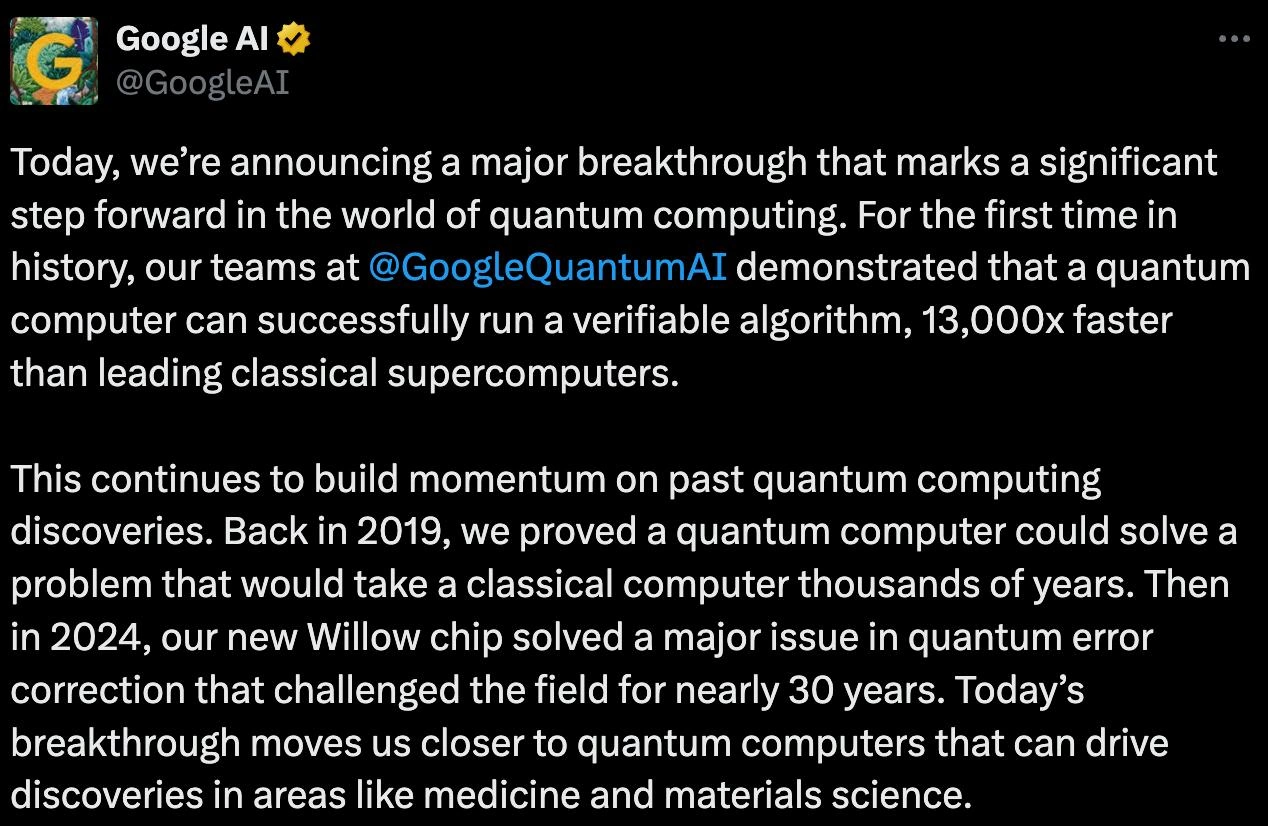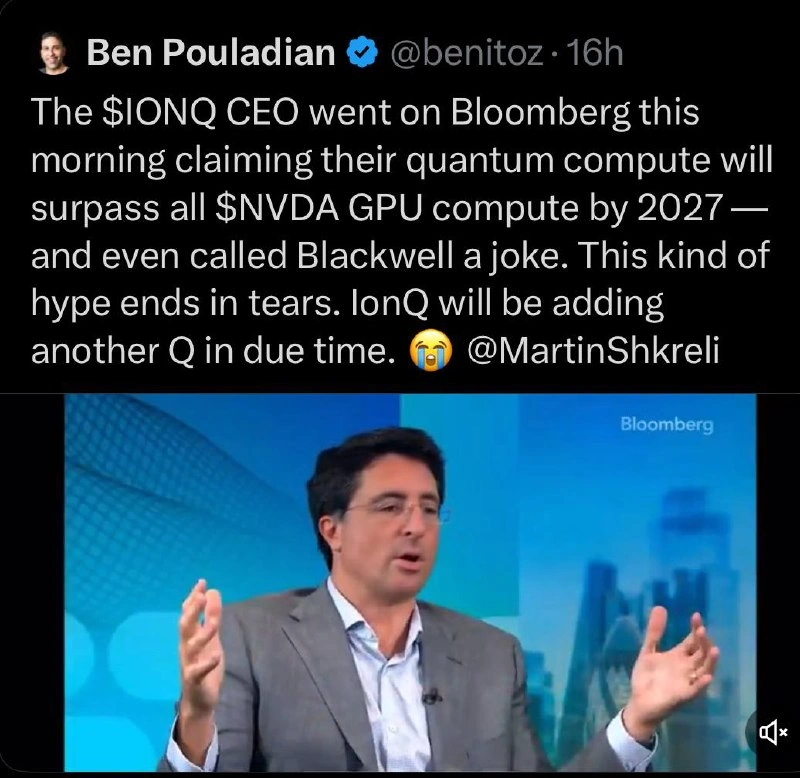
Shor's Algorithm Creeps Toward Practice
Why is this QuantumComputing meme funny?
Level 1: Future Lockpick
Imagine everyone uses locks that are safe because no normal person can make the special key quickly enough. Then a science paper says, "A future machine might make those keys with fewer parts than we thought." The locks are not broken today, but the people responsible for important doors should start changing them before the new key machine shows up.
Level 2: Quantum Keys Explained
Shor's algorithm is a quantum algorithm that can factor large numbers and solve related discrete-logarithm problems much faster than known classical algorithms, assuming a large enough fault-tolerant quantum computer exists. That matters because common public-key cryptography uses problems like factoring and discrete logs as the lock on the door.
RSA is based on multiplying two huge prime numbers together. Multiplication is easy, but reversing it to find the primes is hard for normal computers when the numbers are large enough. Elliptic-curve cryptography, including curves such as P-256, uses a different mathematical problem, but Shor-style quantum algorithms threaten it too.
Qubits are the basic units of quantum computation. The catch is that real qubits are noisy. To run a long, accurate computation, a quantum computer needs error correction, which usually means many physical qubits are used to create fewer reliable logical qubits. So a paper claiming a lower physical-qubit requirement is a big deal because it suggests the hardware target may be less distant than people assumed.
The image itself does not show the paper title; it only shows the arXiv logo. That is why the post message is essential context. The humor is that a plain academic-paper logo can carry heavier implications than a flashy breach alert. If you work in security, a quiet resource-estimate paper can be scarier than a loud headline because it affects planning years before the practical attack arrives.
Level 3: Q-Day Budget Meeting
The senior-developer humor is in the mismatch between the bland arXiv card and the operational blast radius. Developers see arxiv and think "interesting paper." Security teams see Shor plus lower resource estimates and think post-quantum migration, certificate lifetimes, hardware security modules, firmware signing, VPNs, package signatures, identity systems, archived encrypted data, and the phrase "harvest now, decrypt later" quietly ruining lunch.
The post's mention of people "talking about Google breaking RSA" captures the usual discourse failure. Quantum cryptography news gets flattened into either "everything is broken" or "wake me up when it factors RSA-2048." Both are lazy. The useful reading is in the middle: current public-key cryptography is not instantly dead, but systems with long-lived secrets cannot wait until the first public demonstration of a cryptographically relevant quantum attack. Migration has dependency trees, compliance gates, embedded devices, forgotten libraries, customer integrations, and that one legacy Java service whose TLS stack is mostly archaeology.
The paper context also pokes at a familiar engineering pattern: the blocker moved. For years, "millions of qubits" sounded comfortably far away. A result arguing for 10,000 to 26,000-ish physical qubit regimes under specific architectural assumptions does not remove the engineering mountain, but it changes the shape of the mountain. Neutral-atom systems, reconfigurable arrays, fault-tolerant operations, and high-rate codes are not procurement-line items yet for normal companies. Still, planning timelines are built from credible trajectories, not from vibes.
This is why the meme belongs in cryptography and security, not just quantum computing. RSA, Diffie-Hellman, and elliptic-curve systems are infrastructure dependencies. They are not isolated algorithms in a textbook; they are embedded in TLS, SSH, code signing, package distribution, device updates, authentication, banking, messaging, and cloud control planes. When a paper suggests the cost of attacking those assumptions may be lower than expected, the correct developer reaction is not panic-deploying quantum crystals. It is inventory, threat modeling, and moving PQC work out of the "someday" bucket.
The arXiv logo makes the whole thing drier and funnier. No dramatic hacker mask, no neon lock shattering, no stock image of binary rain. Just academic typography quietly saying, "Your key-management strategy has entered peer review." Somewhere, a roadmap owner just created a Jira epic with a title nobody wants to estimate.
Level 4: Factoring The Future
arxiv
The visible image is almost aggressively minimal: just the arxiv logo on a white background. That restraint is the joke. Nothing in the picture screams "security incident," yet the post context points at a paper titled "Shor's algorithm is possible with as few as 10,000 reconfigurable atomic qubits", which is the kind of sentence that makes cryptographers reach for migration roadmaps and makes executives ask whether RSA is "the Bitcoin one."
At the deep technical level, the anxiety comes from Shor's algorithm, which attacks the mathematical assumptions behind major public-key systems. RSA depends on the difficulty of factoring a large integer N = p * q. Elliptic-curve cryptography depends on the difficulty of discrete logarithms over elliptic-curve groups. Classical computers do not have known efficient algorithms for those problems at production key sizes. A sufficiently capable fault-tolerant quantum computer changes that by reducing the hard part to period finding, then using quantum interference and the quantum Fourier transform to extract the period efficiently.
The paper's important claim is not "a laptop-sized quantum box broke RSA this morning." It is a resource-estimate compression claim. Older practical estimates for cryptographically relevant Shor runs often lived in the millions of physical qubits because quantum states are fragile, gates are noisy, and useful logical operations require quantum error correction. The post's paper context says that high-rate error-correcting codes, better logical instruction sets, circuit design, and neutral-atom hardware could push some estimates down to far smaller physical systems, with as few as 10,000 reconfigurable atomic qubits for cryptographically relevant scales under plausible assumptions.
That phrase "physical qubits" matters. A physical qubit is the actual noisy quantum object in the lab. A logical qubit is the protected computational unit made by encoding information across many physical qubits. Error correction is the tax collector. If the architecture reduces that tax, the date of "not practical yet" moves closer without anyone needing to claim the machine already exists. This is why the meme is not panic, exactly. It is a calendar notification from mathematics.
RSA security assumption:
factoring large N is infeasible classically
Shor pressure:
fault-tolerant quantum computer -> efficient factoring/order finding
engineering caveat:
logical qubits are expensive because physical qubits are noisy
paper-shaped anxiety:
what if that expense is much smaller than the old budget spreadsheet said?
Description
The image is a clean arXiv logo on a white background, with gray lowercase letters spelling "arxiv" and the central "X" formed by crossing gray and dark red strokes. The post context points to the arXiv paper "Shor's algorithm is possible with as few as 10,000 reconfigurable atomic qubits," submitted March 30, 2026. The paper argues that advances in quantum error correction, logical instruction sets, and neutral-atom architectures could reduce cryptographically relevant Shor resource estimates from millions of physical qubits to far smaller systems under plausible assumptions. The technical relevance is the pressure this kind of result puts on long-term cryptographic planning, even though it is a resource-estimate paper rather than a practical claim that RSA is broken today.

Comments
1Comment deleted
Post-quantum migration has the same energy as backups: everyone agrees it matters right up until someone asks for a deadline.