Skip to content
DevMeme
995 of 7435
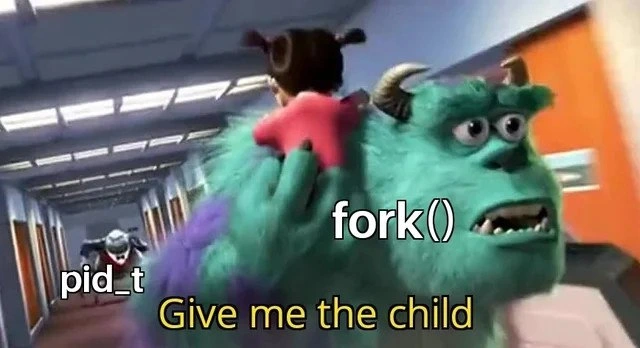
Fork runs off with child process while pid_t demands its return
OperatingSystems Post #1120, on Mar 8, 2020 in TG

Fork runs off with child process while pid_t demands its return

Why is this OperatingSystems meme funny?

Level 1: Chasing the New Kid

Imagine you had a magic machine that could copy you into a twin. You press a button and — poof! — now there are two of you: an original “parent” you and a new “child” you. Now picture you grabbing this new little twin and running off down the hallway for fun. But the school principal sees this and starts running after you shouting, “Hey, bring me that new kid!” They want to catch the new twin to put their name on the school list and take attendance. This scene would look pretty silly, right? That’s basically what’s happening in the meme: a big friendly monster grabbed a child and ran, and another monster is chasing yelling “Give me the child!” In computer terms, a program made a copy of itself (that’s the child process), and the computer is saying “Give me the details of that new child!” so it can keep track of it. It’s funny because it turns a dry computer task — making a copy of a program and noting its ID — into a wacky monster chase, which is a much more playful way to think about it.

Level 2: Meet Your New Child Process

Let’s break down the technical references in this meme. In Unix-like operating systems, when a program wants to create a new process, it uses the fork() function. Calling fork() creates a child process – essentially a duplicate of the current process. The original program becomes the parent process, and the newly created program is the child. Both processes will continue executing from the point where fork() was called, but with one key difference: the return value of fork() tells each process which one it is.

In C (and other POSIX compliant languages), fork() is declared to return a pid_t type, which is typically an integer type used to represent process IDs. Every process on the system has a unique PID (process ID number). When you call fork(), you usually do something like:

#include <unistd.h>
#include <stdio.h>
#include <sys/types.h>

int main() {
    pid_t pid = fork();              // create a new process
    if (pid == 0) {
        // This code runs in the CHILD process
        printf("Child process here! pid=%d\n", getpid());
    } else if (pid > 0) {
        // This code runs in the PARENT process
        printf("Parent here, child pid=%d\n", pid);
    } else {
        // fork() returned -1, which means creation failed
        perror("fork failed");
    }
    return 0;
}

Let’s explain that: when fork() is called, the operating system makes a new child process that is almost an exact copy of the parent process at that moment. Both processes (parent and child) will return from the fork() call. In the child process, fork() returns 0, so in the code above, the if (pid == 0) branch executes only in the child. In the parent process, fork() returns the child’s PID (a positive number). That means the else if (pid > 0) branch runs only in the parent, and the variable pid contains the ID number of the new child process. If something went wrong and the OS couldn’t create a new process (for example, if the system is out of resources), fork() would return -1 in the parent and no child would be created (that’s what the error branch checks).

So effectively, one line pid_t pid = fork(); results in two running copies of the program: one where pid == 0 (the child) and one where pid is the new child’s ID (in the parent). The type pid_t is just a data type (typically a signed integer type defined in <sys/types.h>) that is used to store process IDs. The parent uses the child’s PID if it needs to manage the child – for example, to wait for the child to finish by calling waitpid(pid, ...) or to send the child a signal. The child process can call functions like getpid() to find out its own PID, or getppid() to get its parent’s PID, but it already knows it’s the child because fork() returned 0 for it.

Now, how does this relate to the meme? The meme uses characters from a famous scene in Monsters, Inc. to personify this concept. In the image, Sulley (the big teal monster) is labeled with “fork()” (you can see the letters “fo” on his back, implying the word fork()). He’s running off carrying Boo (the little girl, who in this analogy is the “child” process that was created). Far behind, a monster representing pid_t is chasing them, and the subtitle reads “Give me the child.” In programming terms, think of Sulley as the action of calling fork() – he “creates” or obtains the child (Boo). The chasing monster labeled pid_t represents the program expecting the child’s PID return value. “Give me the child!” is a funny way of saying the pid_t (the variable/type) wants the child’s identifier that fork is supposed to return. In code, that’s exactly what happens: the result of fork() is assigned to a pid_t variable in the parent, effectively handing over the child’s ID to that variable.

It’s a playful illustration of child process semantics. The child process (Boo) is a new execution of the program. The system call fork() (Sulley’s action) is how that child comes into existence. And the pid_t value (the chasing monster) is how the parent process (or the operating system) keeps track of that new child. If you’ve ever taken an Operating Systems class or done low-level Unix programming, you’ll know this is a core concept: you always check the pid_t from fork() to see if you’re in the parent or child, and to record the child’s PID. The meme simply makes it visual and funny by quoting the movie: in Monsters, Inc., the villain demands the child back; here pid_t “demands” the child’s PID back from fork(). It’s a bit of developer humor mixing a Pixar reference with a Unix programming concept. Even if you’re new to these terms, you can now see why it’s humorous – it’s turning an abstract programming idea into a scene from an animated comedy.

Level 3: POSIX Child Custody

This meme takes a classic UnixCulture inside-joke and runs wild with it. In the image (a nod to Pixar’s Monsters, Inc.), we see Sulley the monster sprinting off with the little girl Boo – here labeled as being taken by fork(). Chasing behind is another monster with “pid_t” over its head, yelling “Give me the child.” For experienced developers, this immediately clicks: it’s a dramatization of what happens when you call fork() in a C program. The fork() call “kidnaps” a piece of the program, spawning a new child process (Boo), and the system (or your code) represented by pid_t is essentially demanding that new child’s PID be handed back. In code, this is exactly what happens: you call fork() and then capture its return value in a pid_t variable. That return value in the parent is the child’s process ID, which is how the OS formally “receives” or records the new child. The meme humorously frames this as a custody chase – fork() took off with the child, and pid_t yells after it to return the child (process).

Why is this funny to a seasoned programmer? Because it anthropomorphizes a routine systems programming concept with a scene of dramatic monster movie urgency. Every Unix/C developer knows the mantra: call fork, get a pid back. The parent process must keep track of the child’s PID (of type pid_t) – for instance, to eventually call waitpid(child_pid, ...) and clean up after the child exits. If you ignore that PID, you’ll have a “lost” child – akin to Boo wandering off in the monster world – which in computing terms becomes a zombie process if not reaped. So the caption “Give me the child” isn’t just a random quote; it’s the OS (or the parent’s pid_t variable) insisting on getting that child’s ID so it can do its job. Seasoned devs chuckle because we’ve all been there: forgetting to handle the return of fork() properly can lead to chaos, and here it’s dramatized as a literal custody battle.

This also pokes fun at how low-level programming and OS internals can sound like family drama. The term “child process” is official jargon, and the parent-child relationship in process tables is real. The meme riffs on that: fork() is basically the “parent” creating (or grabbing) a child, and pid_t is like the bureaucratic paperwork chasing after to make sure that child is accounted for. In the Monsters, Inc. scene being referenced, a character (Mr. Waternoose, the factory boss in the film) shouts “Give me the child!” in a tense chase. Superimposing pid_t onto that character is perfect coding humor. It implies that the strong type system / OS is yelling at fork(): “Hey, give me that new process’s ID!” — which is exactly what happens in a proper program when you retrieve the fork result.

For veteran Unix programmers, the humor also lies in recognizing how ancient and unchanged this mechanism is. Since the early days of UNIX, fork() has been how we spawn processes, and pid_t (usually just an int under the hood) has been the way to refer to processes. It’s a bit absurd if you think about it: one function call returns twice and we just roll with it. The meme’s absurd chase captures that feeling. It’s “Developer Humor 101” for OS folks — akin to joking that fork() sometimes needs “child support.” In meetings or code reviews, a line like pid_t child = fork(); is mundane, but depict it as a monster abduction and suddenly the mundane becomes hilariously epic. It resonates because every programmer who’s worked with processes has dealt with this parent-child bookkeeping. We know that if fork() is Sulley grabbing a new child, then pid_t is the authoritative figure saying “Alright, you created this kid — now give me its details!”

The shared experience here is also about debugging fork behavior. Seasoned devs remember the first time they used fork() and saw their code run twice in parallel — a moment of “Wait, what just happened?!” Maybe you printed a log message without checking pid == 0 vs >0, and got double messages (one from each process). It’s a rite of passage in systems programming. This meme taps into that memory: the chaotic feeling of a new process running off, and you scrambling (like pid_t chasing Boo) to regain control by grabbing the PID and managing the situation. It’s exaggeration and personification rolled into one clever image. In short, the meme hits home for any developer who has juggled Unix processes: it’s a comical take on taking responsibility for your forked “offspring” – you can’t just fork and forget; that pid_t will come knocking, saying, “Give me (the info about) the child!”

Level 4: Monstrous Copy-on-Write

Under the hood, the fork() system call is a fundamental operation in operating systems that creates a brand new process by cloning the calling process. When you call fork() in a Unix-like OS (via the POSIX/C standard library), the kernel performs a process clone: it duplicates the parent process’s memory space, registers, and resources to form a child process. This isn’t a trivial copy-paste; modern kernels use a clever optimization called copy-on-write. Instead of immediately copying every byte of the parent’s memory, the OS marks those memory pages so that parent and child initially share the same physical memory until one of them tries to modify something. At that moment, the OS copies just that specific page so each process gets its own separate copy. This makes forking efficient despite the child starting as an almost identical copy of the parent.

Crucially, the new child gets its own process ID. The kernel assigns a unique PID (of type pid_t) to the child and keeps track of it in the process table (a roster of all processes). The function signature in C is pid_t fork(void): it returns a value of type pid_t. In the parent process’s context, fork() will produce the child’s PID as the return value. In the child process, the same call returns 0 (since from the child’s perspective, it has no “child” – it is the child). If the fork fails (e.g. due to resource limits), it returns -1 in the parent, and no new process is created. This dual-return behavior is unique – it’s like one function call magically returns twice, in two different processes.

It’s the kernel’s way of telling the parent “here’s the new child’s ID.” The parent process’s code typically looks like:

pid_t pid = fork();
if (pid == 0) {
    // We are now executing in the child process
    // Child can call exec() or perform independent tasks
} else if (pid > 0) {
    // Still in the parent process
    // 'pid' is the child’s process ID here
} else {
    // pid < 0 means fork() failed, no child created
}

In this snippet, a variable of type pid_t (here pid) receives the child’s ID when in the parent. You can imagine that the pid_t variable is essentially demanding the child’s PID from the fork() call. The parent will use this PID to manage the child (for example, to wait for it or to send signals to it). Meanwhile, the child process uses the fact that fork() returned 0 to know “I am the child” and can get its own PID via getpid() if needed. This parent-child identification dance is baked into Unix process creation semantics.

So, when fork() “runs off” with the child process in the meme, it’s symbolizing how fork() spawns a new process. The chasing pid_t embodies the code/OS expecting the child’s PID in return. Deep down in the kernel, after creating the child, the OS indeed hands that child’s PID back to the parent’s caller (of type pid_t). It’s as if the system call completes by saying, “Okay, I made your new process, here’s the pid_t (ID) for it.” If the parent doesn’t eventually reap (wait for) the child by that PID, the child could become a zombie process haunting the process table – a fact seasoned systems programmers know well. In short, this meme humorously personifies a low-level Unix operation: a monstrous fork() cloning a process and the OS (through the pid_t return) demanding, “Give me the child’s ID!”

Description

Animated still from Monsters Inc: a long fluorescent-lit hallway with orange doors on both sides. In the foreground, Sulley - a large teal monster with purple spots - sprints away carrying the small girl Boo over his shoulder; white text over Sulley’s back reads "fo" (the remaining letters are intentionally obscured, implying "fork()"), and Boo herself is partly hidden by Sulley’s hand. Far behind, a sleek, gray monster gives chase; white text above the pursuer reads "pid_t". Large yellow subtitle text along the bottom says "Give me the child". The meme plays on UNIX process creation: fork() produces a child process, returning its PID (of type pid_t) to the parent, so the type "pid_t" is humorously shown demanding the new "child" that fork() is carrying away
Comments

6
Anonymous ★ Top Pick fork() bolts with the kid, pid_t’s sprinting after yelling “waitpid() before it zombifies!” - and somewhere in the distance, init sighs, “Fine, I’ll adopt another one.”
  1. Anonymous ★ Top Pick

    fork() bolts with the kid, pid_t’s sprinting after yelling “waitpid() before it zombifies!” - and somewhere in the distance, init sighs, “Fine, I’ll adopt another one.”

  2. Anonymous

    The real horror isn't Sulley wanting the child - it's when fork() returns -1 and you realize you've hit the process limit while your production server is melting down at 3 AM

  3. Anonymous

    The perfect visualization of fork() semantics: you call it once, but like Sulley's determination, it returns twice - once in the parent with the child's PID, and once in the child with 0. Though unlike the movie, the child process doesn't come with adorable giggles, just a complete copy of your address space and the existential question of 'wait, which process am I?' that every systems programmer has pondered at 3 AM while debugging a daemon that's spawned more children than they can count

  4. Anonymous

    Sulley forks the kid, but Mike demands it back before it zombies out - classic Unix parenting fails to reap properly

  5. Anonymous

    The whole fork contract in one frame: pid_t demands custody, the parent gets the child PID, the child gets 0, and waitpid() files the paperwork before a zombie shows up

  6. Anonymous

    UNIX custody battle: fork() makes the child, pid_t wants the number - skip waitpid(-1, NULL, WNOHANG) and you’ll be running a zombie daycare in prod

Use J and K for navigation