Skip to content
DevMeme
993 of 7435
Deploying live fixes over phone FTP, the peak adrenaline developer moment
Deployment Post #1117, on Mar 8, 2020 in TG

Deploying live fixes over phone FTP, the peak adrenaline developer moment

Why is this Deployment meme funny?

Level 1: No Safety Net

Imagine you're walking on a tightrope without a safety net underneath. All your friends are watching. If you slip, things could go really wrong. Your heart is pounding, but you keep going because you have to get to the other side. When you finally make it, you breathe a huge sigh of relief and maybe feel a bit like a superhero. Deploying a fix straight to a live website from a phone feels just like that. It's super risky and scary, kind of exciting too, but definitely not how you'd normally do things. The meme is funny because it’s saying a developer doing this crazy, dangerous stunt is living a “thriller” life – like an action hero of coding – even though, in reality, it’s a situation you’d want to avoid if you could.

Level 2: Feel The Panic Protocol

Let's break down what's happening in simpler terms. The tweet describes a developer making a direct change to a live system using FTP on a phone. For newer developers (or those lucky enough to avoid this), here's what that means:

  • FTP (File Transfer Protocol): This is an old way to move files from your computer to a server. Imagine sending a file over the internet much like attaching something to an email, except there's no encryption – it's sent in plain text. FTP was widely used decades ago to upload website files. Today it's largely replaced by more secure methods (like SFTP or deploy pipelines), but some systems still support it. In the meme, the dev is basically opening an FTP app on their phone to send an updated file straight into the running server. Think of FTP as a direct tunnel into the server’s file system. It’s quick and dirty.

  • Production environment: This refers to the actual live website or application that real users are currently using. Making changes in production (prod) is serious because if you mess up, customers immediately feel it. Usually, developers prefer to make changes in a staging or testing environment first (where only test users or internal folks see it), verify everything works, and then deploy to production. Here, the person skipped all that, going straight to prod. It's like doing a fix on a live rocket that's mid-launch rather than testing on a model on the ground.

  • No CI/CD pipeline: A CI/CD pipeline is a set of automated steps that take new code, run tests, and deploy it to production in a controlled way. It's the modern standard for deployments – kind of like a factory line that checks quality at every stage. In this meme scenario, the developer bypassed the factory line entirely. There was no continuous integration (combining and testing changes) or continuous deployment (automated release). Instead, it was manual: edit file -> upload via FTP -> cross fingers. For a junior dev, imagine you have a library book that needs a page fixed – CI/CD is like taking it to a bookbinder to replace the page properly. What happened here is more like scribbling the fix directly in the library book while people are reading it.

  • Cowboy coding/deployment: This term means doing things in a wild, just-get-it-done manner, without following normal rules or processes. Here the "cowboy" approach was to shoot from the hip with an impromptu fix. The developer didn't wait for code review (where colleagues check your code), didn't run tests, and certainly didn't document the change. They probably were on on-call duty – meaning they were responsible to fix emergencies off-hours – and they found an urgent problem and patched it in whatever way possible. On-call humor often includes tales like this, where an on-call engineer has to improvise a fix at odd hours, sometimes with odd tools (like a phone). It's both scary and something you laugh about later.

  • Deployment risks and adrenaline: Deploying new code always carries some risk (DeploymentPainPoints are a real thing!). Even with good practices, devs feel jitters when pushing to prod because something unexpected can happen. Now imagine amplifying that by doing it from a phone, on a live system, with no safety checks. The adrenaline rush is huge because you know you're one wrong command away from potentially crashing the site. This is why the tweet calls it a "thriller life" experience. It's akin to a high-pressure race against time. Junior devs might feel nerves just deploying normally; doing it this way is like those nerves on steroids.

In summary, the tweet is joking that making a live fix via phone & FTP is the ultimate developer adrenaline rush. It's a bit like a rite of passage in a twisted sense – something not recommended at all, but if you survive it, you earn a certain crazy story to tell. Importantly, it's highlighting what not to do in real-life scenarios. We have processes and tools for a reason (to avoid this exact panic-inducing situation!). But the fact that some of us have been there and done that... well, that's what makes it funny. It's an inside joke about the extremes of deployment pain points that newbies learn to avoid and veterans shake their heads at (while maybe smirking, remembering "that one time").

Level 3: High-Stakes Hotfix

Deploying code directly to production via a phone and FTP is basically the no parachute version of software deployment. It's the kind of move a battle-worn engineer pulls when all else fails (or when there's no proper process in place). Here, the meme highlights a developer bragging (half-jokingly) about editing a live system with nothing but a smartphone and an FTP client. Why is this funny (and horrifying) to experienced devs? Because it breaks every rule in the book and throws caution to the wind:

  • No CI/CD pipeline, no safety net: Instead of a CI/CD (Continuous Integration/Continuous Deployment) pipeline carefully building, testing, and reviewing changes, this approach is pure cowboy. The code goes straight from a phone to the production server. It's like deploying via git push drag-and-drop on your touch screen. One typo in a phone keyboard could bring down the site. The normal safety nets (code review, automated tests, staging environments) are completely bypassed. In the dev world, that's adrenaline mixed with terror.

  • FTP and old-school chaos: FTP (File Transfer Protocol) itself is an ancient method of copying files to servers. It's plain, unencrypted, and about as secure as shouting your password across a crowded room. Modern practices use SFTP or pipeline tools, partly because plain FTP is a security nightmare. So the meme isn't just about a quick fix; it's about using a stone-age tool in a mission-critical scenario. It's the equivalent of diffusing a bomb with a butter knife. Seasoned developers remember when deploying a website meant opening an FTP client (or even a browser-based file manager), dragging a file into a live server directory, and refreshing to see if everything exploded or not. That nostalgia comes with a side of yikes.

  • The adrenaline rush & shared war stories: The tweet says "You haven't lived a thriller life until..." for a reason. Many veteran engineers have a war story of a cowboy deployment under pressure. Example: production is on fire, it's 3 AM, you're on an on-call shift, and you get an alert while away from your laptop. Maybe you're at dinner or on a train (worst case: on spotty mobile data). You whip out your phone, use some FTP app, and live-edit a config or hot-patch some code on the server to stop the bleeding. Your heart races because one false move could knock out the service for thousands of users. When it's over, your hands are shaking from the adrenaline. It's a "thriller life" moment only those who have been in the trenches understand. The humor comes from that mix of pride and terror: pride that you saved the day in an insanely improvised way, terror at how close to the sun you flew.

  • Skipped process, systemic issues: This scenario implicitly pokes fun at the lack of proper processes. Why would anyone be fixing prod from a phone? Possibly because there's no remote desktop or VPN setup, no automation, or the team hasn't invested in robust deployment tooling. It’s an anti-pattern born out of urgency or negligence. It's funny in hindsight ("haha, remember when I edited the site live from my iPhone to fix a typo?") but it's also a bit of a tech horror story. Industry veterans see it as a symptom of deployment pain points: maybe management never allocated time for a safer deployment system, or perhaps the team was understaffed, leading to desperate measures. It's Release Anxiety taken to an extreme: deploying untested changes straight to prod will certainly test your blood pressure.

  • "Works for now" but tomorrow...? Another layer to this humor is the unspoken aftermath. Sure, you fixed the bug via phone FTP in the heat of the moment. But now production is out-of-sync with your code repository. The change you made might get accidentally overwritten the next time someone deploys from the official pipeline (if one even exists). Or worse, maybe you didn't have version control at all (small setup), and that phone-uploaded file is the only copy of the "fixed" code. This is how technical debt grows: quick fix now, bigger headache later. Senior devs laugh (or groan) because they've either done this or had to clean up after someone who did. It's an embodiment of "It was crazy, it worked, let's never do that again."

The meme strikes a chord with experienced developers because it's an exaggeration of real scenarios. It's funny because it's true: Under pressure, best practices often get thrown out the window. Everyone preaches not to make changes in production manually, yet here’s this bold soul doing it from a phone of all things. It's simultaneously a brag and a confession of guilt. In the world of deployments and production issues, this is the kind of stunt you chuckle at only after you survive it.

Description

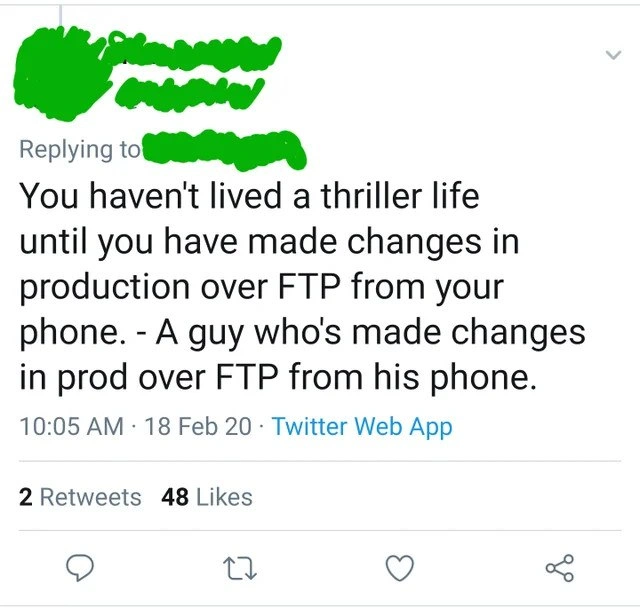
Screenshot of a Twitter reply; the avatar and username are masked with green scribbles. Tweet text reads: “You haven't lived a thriller life until you have made changes in production over FTP from your phone. - A guy who's made changes in prod over FTP from his phone.” Below the text, Twitter UI shows the timestamp “10:05 AM · 18 Feb 20 · Twitter Web App” and engagement metrics “2 Retweets 48 Likes.” The image humorously highlights an engineer admitting to editing a production system via insecure FTP directly from a mobile device - skipping CI/CD, code review, and any safety net - illustrating reckless deployment practices and the rush (and risk) of cowboy fixes in live environments

Comments

6
Anonymous ★ Top Pick Forget GitOps - real adrenaline is ThumbOps: live-patching main.php via mobile FTP while your SOC 2 auditor is still on the conference bridge
  1. Anonymous ★ Top Pick

    Forget GitOps - real adrenaline is ThumbOps: live-patching main.php via mobile FTP while your SOC 2 auditor is still on the conference bridge

  2. Anonymous

    The only thing more terrifying than debugging a race condition in production is realizing your deployment pipeline is 'FileZilla on iPhone' and your rollback strategy is 'pray the cached version still works while you frantically thumb-type corrections on a 5-inch screen.'

  3. Anonymous

    Ah yes, the classic 'FTP from phone to prod' maneuver - when your deployment pipeline is literally just you, your thumbs, and a prayer. It's the perfect storm of anti-patterns: unencrypted file transfer, no version control, zero peer review, and the ergonomic nightmare of editing config files on a 6-inch screen. But hey, at least you're not blocked by that 3-day CI/CD pipeline approval process. Who needs GitOps when you've got thumb-ops? The real thriller isn't whether the change will work - it's whether you'll remember what you changed when everything breaks at 3 AM

  4. Anonymous

    Nothing says enterprise change management like a C/F pipeline - Copy over FTP from a phone; RBAC is whoever remembers the password, and rollback is praying the CDN hasn’t purged yet

  5. Anonymous

    Prod changes over FTP from phone: blast radius 'global', rollback strategy 'panic'

  6. Anonymous

    Prod via FTP from your phone is YOLOps: your thumbs are the CI, your data plan is the CD, and rollback is hoping the CDN still serves yesterday’s file

Use J and K for navigation