Skip to content
DevMeme
3298 of 7435
Normal vs. Quantum Computing: Certainty vs. 'Perhaps'
QuantumComputing Post #3622, on Aug 31, 2021 in TG

Normal vs. Quantum Computing: Certainty vs. 'Perhaps'

Why is this QuantumComputing meme funny?

Level 1: Why Not Both?

Imagine you have a light switch in your room. A normal light switch is either completely on (the light is shining, like “yes”) or completely off (darkness, like “no”). That’s how regular computers work: everything inside is like a bunch of tiny light switches set firmly to on or off. Now picture a magical light switch that, when you flip it, doesn’t go fully on or off, but hovers somewhere in between – the light is kind of half-on, half-off until someone actually looks at it. 😃 Sounds silly, right? That magical in-between switch is what a quantum computer’s bit is like! If you ask a normal computer a yes-or-no question, it’s like asking a friend who always either nods yes or shakes their head no very clearly. But if you ask a quantum computer the same question, it’s like asking a very indecisive friend – at first they might shrug and say “perhaps...” with a blank face. Only when you really press them (which is like measuring the qubit) do they finally say yes or no, and even then it might be yes one time and no the next time if you asked the same question again.

It’s funny because we expect computers to be strict and predictable, almost like a strict teacher who only says “right” or “wrong.” The idea of a computer saying “maybe” is as absurd as a cow casually giving you a “perhaps” when you ask if you finished your chores. 🤭 In everyday life, “maybe” usually means someone hasn’t decided or is unsure. Seeing a cow (of all things!) represent a super-advanced quantum machine is ridiculously charming – it’s a big goofy moo-ment. The meme makes us laugh by showing that a quantum computer sort of acts like it can’t make up its mind until the last second. It’s the same kind of humor as if you asked your voice assistant, “Is it going to rain?” and instead of yes or no it just went, “umm... perhaps.” We’d find that pretty silly! But that’s actually a hint of truth about quantum computers: until you check, the answer isn’t set in stone. So the core joke is: normal computers are like simple yes/no machines, and quantum computers are like a maybe machine. That unexpected twist, illustrated with a crazy anime scene and a dopey cow, is what makes the meme both educational and fun.

Level 2: Binary vs Superposition

Let’s break down the basics behind the joke. Normal computers (the kind we use every day) run on classical bits which can only be in one of two states: 1 (Yes) or 0 (No). Think of a bit like a tiny light switch or an electrical transistor: it’s either on or off with no middle state. This is the foundation of all typical computing and Boolean logic – every value in your program’s memory, every pixel, every piece of data ultimately boils down to a bunch of 1s and 0s. When the meme shows the JoJo character yelling “YES!” four times and “NO!” four times under “normal computers,” it’s dramatizing this strict binary certainty. In real life your PC isn’t literally yelling yes or no, of course, but it is decisively flipping bits to either 1 or 0. For example, a condition like if (x > 10) will evaluate to true (yes) or false (no) with complete determination. If x is 15, that’s a yes every time; if x is 5, that’s a no every time. Classical hardware and logic gates ensure there’s no ambiguity – the answer to a yes/no question is firm and repeatable.

Quantum computers, on the other hand, use something called a qubit (quantum bit). A qubit follows the rules of quantum mechanics, which are very different from classical physics. The big idea highlighted in this meme is superposition. A qubit isn’t stuck as 0 or 1 – it can be in a state where it’s kind of 0 and 1 at the same time. It’s as if you had a magic coin that could be both heads and tails simultaneously until you look at it. The meme’s “quantum computers: PERHAPS” line is referring to this phenomenon. The cow saying “perhaps” (maybe) humorously represents a qubit’s ambiguous state. Until you check a qubit (by measuring it), you can’t say it’s definitely yes or definitely no – the best you can say is, perhaps it’s yes and perhaps it’s no. It’s probabilistic. For example, a qubit could be set up so that when you measure it, there’s a 70% chance you get “Yes (1)” and a 30% chance you get “No (0)”. Before measurement, it’s legitimately in a blended state of yes/no with those probabilities. This is a fundamental QuantumComputing concept that often blows newcomers’ minds.

Let’s connect each part of the meme to real-world meaning:

  • Top “normal computers” section: The bold text YES! and NO! repeated is a flashy way to say normal bits are binary and definite. In reality, if you open up a computer, you won’t see neon “YES!” signs 😅 – you’ll see billions of transistors. Each transistor is like a tiny faucet for electricity that’s either allowing current through (which we interpret as a 1, or “yes”) or not (0, “no”). When you chain a bunch of these together, you get logical operations. For instance, an AND gate takes two input bits and outputs yes (1) only if both inputs are yes (1 AND 1 = 1, otherwise it outputs 0). Everything from your calculator app to a Google search is ultimately broken down into these yes/no decisions at the hardware level. BooleanLogic (named after mathematician George Boole) is the algebra that describes how these true/false values combine. It’s all very deterministic – the same inputs produce the same yes/no outputs every single time.

  • Bottom “quantum computers” section: The cow with “PERHAPS” illustrates the qubit’s in-superposition answer. A qubit uses principles like electron spin or photon polarization to store information. For example, we might use an electron’s spin, which can be up (our 1) or down (our 0). Thanks to quantum physics, that electron can actually be prepared in a state that is a mix of spin-up and spin-down. It’s not that we just “don’t know” the true state – it really doesn’t have a single true state until measured! If you ask a quantum system a yes/no question (by performing a measurement in computational basis), the answer you get will seem random – one time yes, another time no – but with probabilities you can predict from the qubit’s state. So if a friend asked a quantum computer, “Is the answer 42, yes or no?”, the computer might internally have the state “perhaps yes and no,” and when forced to answer, it’ll say “YES” 50% of the time and “NO” 50% of the time (for an equal superposition). Until that answer is demanded, the correct description of the state is essentially “perhaps.” This is why the meme jokingly treats "perhaps" as an actual state for quantum hardware. It’s a playful way to introduce qubit logic: unlike binary bits, qubits embrace uncertainty until the final moment.

To visualize the difference, consider this simple comparison of a classical bit vs a qubit:

Classical Bit (Binary) Qubit (Quantum Superposition)
State is either 0 (No) or 1 (Yes). State can be 0, 1, or a superposition of both.
Example: A tiny transistor is off (0) or on (1). Example: An electron can be in a mix of spin-down (0) and spin-up (1).
If you read it, you always get the same value stored. (It’s definite.) If you measure it, the state collapses to 0 or 1. Before that, it was undetermined.
Follows Boolean logic – e.g., must be either true or false at any time. Follows quantum probabilities – outcomes follow a probability distribution until observed.
Easily inspected without changing it – you can check a bit’s value any time. Cannot be observed without altering it – measuring forces a decision (no peeking!).

In short, normal computers are built on bits that give clear-cut answers (the meme’s shouting YES! or NO!). Quantum computers are built on qubits that hold clouds of possibility – they only give a definite yes/no when you look, much like the cow finally saying “perhaps... okay fine, here’s the answer.” This fundamental difference is exactly what the meme is highlighting in a fun, exaggerated way. It’s both a joke and a mini-lesson in how binary_vs_superposition defines classical vs quantum computing. As a developer or CS student, understanding this concept is the first step into the wild world of QuantumComputing. And as the meme shows, sometimes the best way to remember a complex idea is through a bit of TechHumor and a chuckle at a cow’s one-word wisdom!

Level 3: Bizarre Bits Adventure

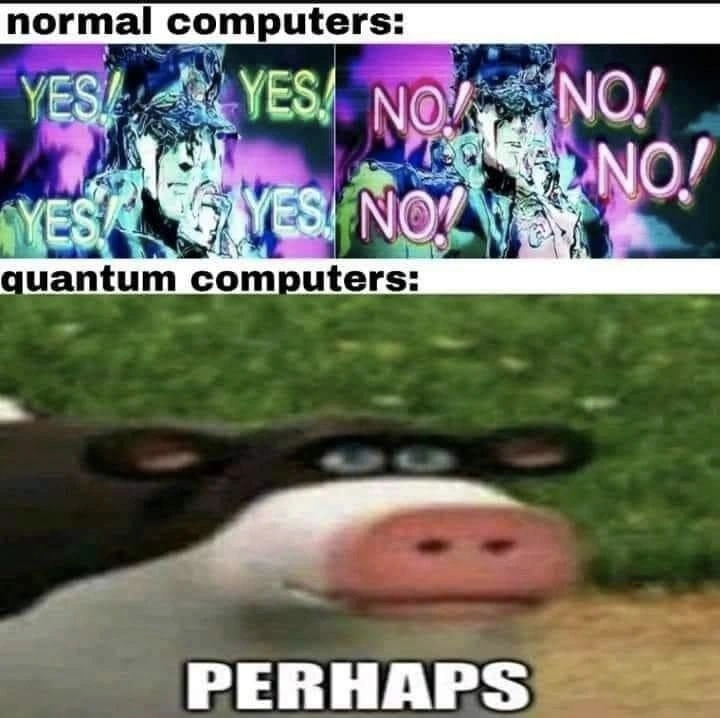
This meme brilliantly mashes up pop culture with a fundamental computing paradigms comparison. In the top half, labeled “normal computers:”, we see neon-tinted panels from a JoJo’s Bizarre Adventure meme. The anime character (Jotaro Kujo, for those in the know) emphatically yells “YES! YES! YES!” in one panel and “NO! NO! NO!” in the other. It’s an exaggerated, flamboyant depiction of absolute affirmation vs. negation – a perfect allegory for classical computers that operate on strict Boolean logic. A classical bit is either on or off, 1 or 0, true or false – no in-betweens. The JoJo meme’s over-the-top yes/no repetition humorously personifies how normal computers are 100% certain and binary. In real-world terms, that’s your PC’s transistors each decisively in a state, or your program variables holding definite values. We normally take this binary certainty for granted; a boolean flag in code can’t be kinda-true or sorta-false – it’s one or the other, as decisively as Jotaro’s screaming YES or NO.

Now enter the bottom half labeled “quantum computers:” – a starkly different vibe. We see a blurry CGI cow from the movie Barnyard with a vacant stare, captioned simply with “PERHAPS.” This image is a well-known meme template on its own (the Barnyard perhaps cow meme), often used online to answer questions with a deadpan “maybe.” Here it symbolizes a quantum computer’s qubit confronted with a yes/no question. Instead of confidently picking a side like a classical bit, the qubit responds with a metaphorical “uh, perhaps?” The contrast is comedic gold: after all the neon YES/NO drama upstairs, the quantum computer’s answer is delivered by a doofy cow basically shrugging 🤷 and saying “maybe.” It’s like the meme is shouting, “In quantum land, even the computer isn’t sure!” This juxtaposition tickles developers because it captures in absurdly simple terms what is so strange about quantum computing.

From a seasoned developer’s perspective, the humor cuts deep: we’re used to machines that follow deterministic rules. If you ask a classical program a yes/no question (say, evaluate a condition in an if statement), it will reliably give a yes (true) or no (false) every time under the same conditions. There’s comfort in that predictability. Now along comes quantum computing with qubits, and suddenly the answer to the same yes/no question could be “yes,” “no,” or “perhaps – try again” depending on quantum probabilities! It almost feels like dealing with an extremely indecisive junior developer or an unpredictable API that sometimes returns true, sometimes false. It’s both fascinating and a little terrifying: imagine writing a function and getting a different result 50% of the time — on purpose! Seasoned engineers chuckle because it upends the “always be deterministic” mantra we hold dear. The meme exaggerates this as if you literally get a “PERHAPS” string back from quantumComputer.askYesNo(). Of course, in reality a quantum algorithm’s output is ultimately either yes or no on each run, but you might need to run it many times to gather enough statistical confidence. Still, that feels like an engine that replies, “perhaps… try asking me again.” 😂

Another layer of inside humor: the yes_no_perhaps pattern here isn’t just random; it playfully echoes the idea of a ternary logic (three-valued logic) but through the lens of quantum physics. In classical computing history, we’ve experimented with “maybe” states in things like fuzzy logic or SQL’s NULL (which is essentially “unknown” in a yes/no context). Those were human-designed concepts to handle uncertainty in an otherwise binary system. But in quantum computing concepts, nature herself gives us this “perhaps” state intrinsically via physics! The meme winks at this by showing Yes, No, and Perhaps as three panels – as if quantum hardware natively has a third answer. Every experienced dev who has grappled with a bug that randomly vanishes when observed (the infamous heisenbug) can appreciate the cosmic irony: now we have computers where unpredictability isn’t a bug at all, it’s a feature. In fact, debugging a quantum program is literally like chasing a heisenbug – observing the system changes it. The shared pain and wonder of that realization unify the developer community: “Wow, this quantum stuff really is bizarre – even more bizarre than JoJo’s!”

And let’s not overlook the pure meme culture at play. Developer humor often thrives on mixing TechHumor with PopCultureReference. JoJo’s flamboyant yes/no meme and the Barnyard cow are recognizable in internet culture; by repurposing them, the meme speaks to our cross-disciplinary geekdom. We love JoJo’s absurdity and we love poking fun at complicated tech – put them together, and you’ve got a memorable joke. The Bizarre Bits Adventure we see is essentially an anime_reference_jojo colliding with high-level science. It’s an accessible handle on a hard topic: anyone who’s tried to wrap their head around qubit logic has likely had a moment of “So… it’s not yes or no… it’s maybe?” accompanied by a confused cow-like stare. This meme reassures us that feeling bewildered by superposition is normal – and hilariously frames that confusion. In short, it distills a complex quantum computing paradigm into one of the oldest tropes in programming jokes: the computer that mysteriously replies “It depends.” Only here, it’s not because of ambiguous requirements or bad inputs, but because the universe fundamentally works that way! How’s that for a punchline in CS_Fundamentals? 😄

Level 4: Schrödinger's Bit

At the quantum-mechanical core, a qubit exists in a superposition of states, meaning it can be mathematically described as both 0 and 1 at the same time until observed. In formal terms, we write a qubit’s state as a linear combination like:

$$ |\psi\rangle = \alpha,|0\rangle + \beta,|1\rangle,\qquad \text{with } |\alpha|^2 + |\beta|^2 = 1,, $$

where $|0\rangle$ is the “YES” state, $|1\rangle$ is the “NO” state, and $\alpha$, $\beta$ are complex probability amplitudes. Quantum superposition means the qubit occupies a probabilistic state in a two-dimensional Hilbert space, much like Schrödinger’s cat being both alive and dead in the famous thought experiment. Only when we measure (observe) the qubit do we get a definite answer: it collapses or “picks a side” – yielding Yes (1) with probability $|\alpha|^2$ or No (0) with probability $|\beta|^2$.

In a classical bit, there’s no such uncertainty – a bit is binary: strictly 0 or 1 at any given time (never both). But a qubit lives in a fuzzy quantum limbo of perhaps, able to interfere with itself. This is the mind-bending leap from Boolean logic to quantum logic. Classical logic follows clear rules (like the law of excluded middle: something is either true or false). Quantum logic defies that: until a measurement is made, a proposition about a qubit can be true AND false simultaneously in a superposed state. The meme humorously labels that weird third-like state as "PERHAPS," capturing the essence that a qubit isn’t a simple 1 or 0 but something more exotic.

Under the hood, quantum computers leverage this uncertainty as a feature, not a bug. By preparing qubits in specific superpositions and entangling them, quantum algorithms (like Shor’s factoring algorithm or Grover’s search) explore multiple possibilities at once. They nudge these simultaneous yes/no states through clever interference so that wrong answers cancel out and the correct answer emerges with high probability. It’s as if the quantum computer says “perhaps” to every possibility until the final measurement yields a decisive YES or NO for the solution. This qubit logic vastly differs from classical step-by-step computation – it’s more like waves of probability rippled by unitary transformations (quantum gates) rather than flipping definite electrical switches.

Notably, observing a qubit’s state is a destructive inquiry: you can’t peek without forcing a decision. (This is analogous to a Heisenberg Uncertainty flavor: the act of measurement perturbs the system.) In classical debugging, we can print a variable anytime; in quantum computing, trying to “print” a qubit’s value mid-computation will collapse it out of superposition – poof, no more PERHAPS! This limitation is rooted in the no-cloning theorem and the fundamentals of quantum mechanics, and it makes quantum algorithms feel like orchestrating an elaborate dance you can only judge at the very end. The meme captures this counterintuitive reality: a normal computer lives in a binary world of black-or-white certainty (dramatically shouting YES! or NO!), whereas a quantum computer operates in a continuous, uncertain spectrum of maybes (a blank-faced “perhaps” until you check). The bottom line is that what seems like indecision (“maybe it’s yes and no”) is actually a profound physical principle. In the theoretical realm of QuantumComputingConcepts, this is the magical superposition_probabilistic_state that makes quantum algorithms powerful – and to a newcomer, hilariously bizarre.

Description

This two-panel meme humorously contrasts classical and quantum computing. The top panel, labeled 'normal computers:', shows a character from the anime 'JoJo's Bizarre Adventure' in two states: one surrounded by the word 'YES!' in neon green and another surrounded by 'NO!' in neon pink, representing the binary certainty (0 or 1) of classical bits. The bottom panel, labeled 'quantum computers:', features the popular 'Perhaps' cow meme - a blurry, close-up image of a cow's face with the caption 'PERHAPS' in a bold, white font. The joke lies in the oversimplification of quantum mechanics. While classical computers operate on definite states, quantum computers use qubits, which can exist in a superposition of both 0 and 1 simultaneously. When measured, a qubit collapses to a definite state, but its pre-measurement state is probabilistic, not a vague 'perhaps.' This meme cleverly uses the cow's ambiguous expression to represent the counter-intuitive and non-binary nature of quantum superposition, making a complex topic accessible and funny for a tech-savvy audience

Comments

7
Anonymous ★ Top Pick A qubit walks into a bar and the bartender asks what it wants to drink. The qubit says, 'Yes and no.'
  1. Anonymous ★ Top Pick

    A qubit walks into a bar and the bartender asks what it wants to drink. The qubit says, 'Yes and no.'

  2. Anonymous

    Writing unit tests for qubits is easy: every assert is green and red at the same time - right up until the CTO looks over your shoulder and the whole suite decoheres

  3. Anonymous

    After 20 years of explaining quantum computing to VCs, I've realized the 'Perhaps Cow' perfectly captures both superposition and my confidence level when asked if our quantum algorithm will actually provide speedup over classical approaches in production

  4. Anonymous

    Quantum computers are the only systems where 'it works on my machine' is literally true and false simultaneously until your manager observes the demo - at which point the wavefunction collapses into a production outage

  5. Anonymous

    Quantum is eventual consistency for booleans - everything’s “perhaps” until measurement collapses the waveform and your error-correction budget

  6. Anonymous

    Quantum computing: where every architecture decision is both scalable and doomed until observed

  7. Anonymous

    Quantum computing: where asking for a boolean is a side effect, certainty costs coherence, and every printf is a production incident

Use J and K for navigation