The dark humor of process management
Why is this OperatingSystems meme funny?
Level 1: Everyone Back on the Bus
Imagine a school field trip: the teacher is like the parent process, and the students are like child processes. At the end of the trip, the teacher is happy when every student (child) gets back on the bus before the teacher themselves goes home. Why? Because the teacher wants to make sure all the kids are accounted for and safe (that’s the “cleanup”). If a student wandered off after the teacher left, that would be a big problem – a bit like a stray process with no parent looking after it. In the computer world, having children finish first means the “teacher” program can double-check everyone is done and nothing is left behind. So the meme is joking that a software engineer likes it when all the little helper programs finish and are safely checked off (children “die”) while the main program is still running (the parent is still around). It sounds like a terrible thing in normal life, but in a computer it’s a good and tidy ending – like every student back on the bus, ready to go home, and no one lost at the museum. The engineer isn’t actually harming kids; they’re just making sure every task is finished in the right order!
Level 2: Process Parenting 101
Let’s break down the jargon in that meme. In computer science, a parent process is simply a program that starts another program. The new program it starts is called a child process. Just like a family tree, the operating system keeps track of which process started which – so we end up with parent-child relationships between processes. For example, when you open a terminal and run a command like gcc to compile code, your shell is the parent process and gcc becomes a child process of that shell. When gcc finishes its work (compiling your program) and exits, it “dies” in OS terms. The shell, as the parent, gets notified that its child process has finished. This is normal and expected: the child terminates (ends execution) and the parent is still around to hear about it.
Now, the meme says the engineer is happy when children die before their parents. Why on earth would that be? Because in computing, that means everything worked in the right order! If the child process terminates before the parent, it means the parent process is still running and can properly handle that termination. The parent typically does so by calling a function like wait(). Think of wait() as the parent process doing a headcount and cleanup for its ended child. This cleanup step is officially called process reaping – the parent gathers the child’s exit report so the operating system can free up any leftover tidbits from the child process. When the parent reaps the child, the child is completely gone from the system (it’s like cleaning up the child’s room after they move out).
If the parent doesn’t do this, we get what’s called a zombie process. A zombie process isn’t alive (it’s already stopped running), but it hasn’t been cleaned up either – it’s stuck in the system’s process list marked as a “defunct” process, awaiting the parent’s attention. It’s as if a child finished their chores but is still hanging around because the parent hasn’t checked and signed off their work. Zombies are usually harmless in small numbers, but they are a sign of bad housekeeping in the code. You might even see them when you run commands like ps – zombies will show up with a status like “Z” or “defunct”. Engineers definitely don’t want to see lots of those, so they prefer writing programs that properly wait for children to finish.
What about the reverse scenario? If a parent process dies or exits before its child, then the child is called an orphan process. But unlike real life, an orphan process isn’t left abandoned and crying – the operating system immediately steps in. In Unix/Linux, an orphaned child process gets “adopted” by a special system process (with process ID 1, often named init or systemd). That special process will become the new parent and ensure the orphan child’s termination is handled (when it eventually dies, it won’t stick around as a zombie because init will reap it). So orphans don’t roam forever; the OS has a foster care system for them! Still, if the parent died first, it means the original program didn’t get to handle its child’s exit. It’s usually a sign that something unexpected happened (like the parent crashed) or the design wasn’t intended to have the parent gone that soon. Either way, it’s less orderly.
So, in summary: a software engineer is “happy” when the child processes finish before the parent process shuts down because it means the program ran smoothly and cleaned up after itself. No child processes were left hanging (no zombies), and the parent was responsible and alive to do all the necessary cleanup (reaping). It’s a morbid-sounding phrase, but it’s really just saying “we like it when our helper tasks end normally and our main program can tidy them up.” All the terms here – parent, child, orphan, zombie – are just metaphors used in computing. No real children or parents are involved, only programs. The humor comes from the contrast between the everyday meaning of those words and their technical meaning in OperatingSystems. Once you know the context, the sentence transforms from horrifying to a clever way of describing good process management practices. It’s an example of how DeveloperHumor often requires understanding the lingo: what sounds ghoulish is actually a routine success story in a programmer’s world.
Level 3: Wait for It
At first glance, the meme’s definition reads like something out of a horror story:
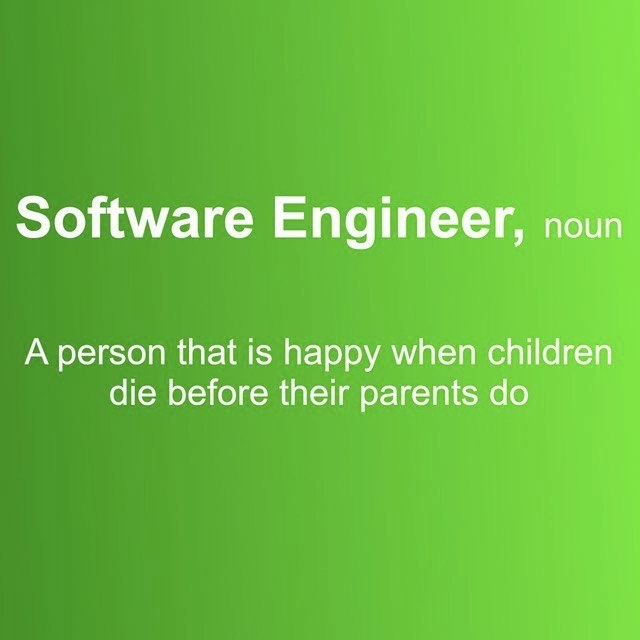
Software Engineer, noun: A person that is happy when children die before their parents do.
Seasoned developers immediately recognize this as tongue-in-cheek Dark Humor about process management. The meme uses a formal dictionary-definition style for comedic contrast, describing in plain English a scenario that is grisly in real life but perfectly healthy in computing. In the realm of Systems Programming, being "happy when children die before their parents" refers to the parent-child process relationship and the ideal order of termination. This joke hits home for engineers who have battled rogue processes and seen what happens when things terminate in the wrong order.
Why is this funny (in a twisted way) to experienced devs and sysadmins? Because it’s an insider reference to a classic problem: orphan processes and zombie processes. In day-to-day development, especially when dealing with servers, daemons, or any process that spawns other processes, there's an expectation that the parent will clean up after the child. When a child process finishes (dies) while its parent is still running, it’s great news — the parent gets a notification (often via a SIGCHLD signal in Unix) and can wait() to gracefully reap the child. The parent is essentially saying, “Good, my worker finished and I’m still here to tie up loose ends.” Every senior engineer knows the relief of seeing child processes terminate normally, because the alternative can be messy: if a parent forgets to wait or dies too soon, zombies start appearing or orphaned children wander off for init to handle.
Many of us have opened a terminal and run ps or top only to find <defunct> processes listed — those are the infamous zombies. The first time you encounter them, it’s a mix of confusion and amusement (zombies, really?). They’re a sign that some parent process isn’t doing its janitorial duties. Perhaps a web server forks worker processes and a bug prevented it from calling wait(), leading to dozens of zombies haunting the process table. In production, this can become a headache: too many zombie processes can eat up process IDs and indicate resource leakage. The meme wryly implies that a good software engineer celebrates seeing child processes die properly (and promptly) under the watchful eye of the parent, because it means no resource leak, no undead processes, and a well-behaved program.
This darkly funny perspective also highlights how casually violent everyday developer language can sound. We routinely talk about “killing processes,” “child processes dying,” or “orphaned tasks,” so much that we forget how it might shock outsiders. The meme plays on that disconnect. It’s styled as if defining what a software engineer is at their core — someone who finds joy in something morbid — which is absurd and hilarious when you realize it’s referring to the perfectly benign act of cleaning up computer processes. Experienced engineers chuckle because they’ve been there: there’s genuine satisfaction (and maybe a tiny fist-pump) when your daemon shuts down its worker processes in the correct order. No orphan_processes left running amok, no zombies left uncollected. Everything terminated in neat order – just the way it should in a well-behaved system.
Historically, this has been the expected norm since early operating systems like UNIX: parents are responsible for their children. Over the decades, engineers have developed patterns to avoid orphaning and zombifying processes. For instance, a common trick in daemon programming is the double-fork: the process forks a child and immediately exits (so the child is orphaned and adopted by init), then that child forks a grandchild and exits, leaving the grandchild with init as its parent. This way, init (which always calls wait() on orphans) will reap the intermediate, and the final child runs under init’s supervision, ensuring no zombies if it ends. It’s a bit roundabout, but it guarantees that a reliable parent (PID 1) is around to clean up. In more modern systems (like Docker containers), developers include tiny init processes (like tini) or proper signal handling in the container’s PID 1 process to reap zombies inside containers. All these practices boil down to one philosophy: make sure every child that dies has a parent to hear about it.
So, when a sysadmin or backend engineer sees this meme, they likely smirk and think, “Ha, exactly – better the child processes finish while the main process is up, rather than the other way around.” It’s a shared understanding that under the technical joke, there’s real wisdom: if children outlive their parent in a program, you have cleanup problems; if the parent outlives the children, all is well. In short, we’re happy (and a bit relieved) when our child processes die in the expected order. The meme wraps that truth in dark comedic wrapping, and that’s why it resonates in DeveloperHumor circles. No actual children are harmed – just pesky zombies getting their well-deserved final rest.
Level 4: No Zombie Left Behind
Deep inside an Operating System, processes form a family tree. When a process (the parent process) creates a new process (a child process) via a system call like fork(), the OS kernel establishes a parent-child relationship. In Unix-like systems, every process has a parent process ID (PPID) linking it to whoever spawned it. Now, when a child process terminates (i.e. it dies by calling an exit function), it doesn’t vanish immediately. Instead, it enters a special limbo state as a zombie process. A zombie process is basically a deceased process that’s still hanging around in the OS’s process table, haunting the system with its exit status. The only way to fully remove this undead entry is for the parent to acknowledge the child's death by calling the wait() system call (or a variant like waitpid()). This act of calling wait() is known as reaping the child process – much like the Grim Reaper collecting souls, the parent collects the child’s exit status and the OS can finally lay that process to rest (free its PID and resources). If the parent process is still alive and well, it should be happy to reap its children promptly. Failure to do so means zombies accumulate. They don’t consume CPU or memory (they're truly dead), but they tie up a process table slot and appear as <defunct> in process listings. Too many zombies can eventually exhaust the system’s PID table or indicate a resource management bug.
In contrast, if a parent process dies before its child, that child becomes an orphan process. The OS doesn’t leave orphans to roam free; on Unix, they get immediately adopted by the special PID 1 ( historically the init process, or nowadays a service manager like systemd on Linux). PID 1 acts as the ultimate foster parent, automatically calling wait() on orphaned children to clean them up. This adoption prevents zombie buildup even if the original parent is gone. However, the ideal scenario is that the original parent outlives its children and performs the reaping itself. This is why a systems engineer genuinely prefers that child processes terminate before their parent process does – it’s a hallmark of correct process management. It means the parent was around to supervise the shutdown and nothing was left dangling.
To see this concept in action, consider a simplified C code snippet:
#include <sys/wait.h> // for wait()
#include <unistd.h> // for fork()
int main() {
pid_t pid = fork();
if (pid == 0) {
// Child process: do some work then exit
// (In real life, might exec a new program here)
_exit(0); // child ends itself (dies)
} else if (pid > 0) {
// Parent process: wait for the child to finish
int status;
wait(&status); // Reap the child, retrieving its exit status
// Child is now fully gone, no zombie left behind
}
return 0;
}
In this code, the parent creates a child. The child process calls _exit(0) to terminate. The parent then executes wait(&status), which blocks until the child dies and then reaps it, cleaning up the zombie. If we omitted the wait(), the child would become a zombie – it’s dead, but the kernel would keep its exit code around, waiting for a parent that might never come. If the parent itself died before calling wait(), the orphaned child would be adopted by init (PID 1) which would then perform the reaping. This fundamental design (dating back to early UNIX) ensures that every child’s death is noticed by someone, keeping the system tidy. The meme’s morbid-sounding scenario is actually describing this elegant process lifecycle rule: a proper parent waits for and outlives its children (processes), resulting in a clean, zombie-free system. It’s a dark but accurate description of good OS housekeeping.
Description
The image displays text in white font against a solid lime-green background, formatted like a dictionary entry. The top line reads 'Software Engineer, noun'. Below it, the definition is given: 'A person that is happy when children die before their parents do'. This is a classic piece of dark, technical humor that plays on a double meaning understood by developers. In operating systems and systems programming, processes can create child processes. A 'parent' process is responsible for managing its 'child' processes. If a parent process terminates before its child, the child becomes an 'orphan process,' which can be problematic. More critically, if a child process terminates but the parent fails to properly 'reap' it (by reading its exit status), the child becomes a 'zombie process,' consuming system resources. Therefore, a software engineer is indeed 'happy' when child processes terminate correctly before their parent, as this signifies clean, predictable behavior and avoids resource leaks. The joke's humor comes from the morbid and shocking literal interpretation when heard by someone outside the field
Comments
9Comment deleted
A junior dev asked me why we need to reap child processes. I told him if we don't, our system process table starts to look like the cast of 'The Walking Dead'
The only time I feel like a responsible adult: when SIGCHLD arrives and I can waitpid() - proof my kids exited cleanly before systemd had to run the orphanage
After 20 years of debugging zombie processes and orphaned children in production, you realize the real horror isn't the metaphor - it's explaining to the CTO why your perfectly functioning process tree just cost the company $50K in AWS bills because someone forgot to call wait() in a loop that spawned 10,000 child processes per second
The real tragedy isn't the inheritance itself - it's when you realize your parent class has been deprecated for three years, but the child classes are still in production and nobody knows how to safely kill them without bringing down the entire system
Only in Unix is good parenting cheering when the kids exit first - remember SIGCHLD + waitpid(), or they’ll linger as zombies
Unix parenting 101: better a prompt exit(0) from the kids than a zombie horde clogging your process table
Only in Unix do we celebrate children exiting early - every missed waitpid() makes on‑call act as PID 1’s babysitter
Why? 🤔 Comment deleted
Processes Comment deleted