Skip to content
DevMeme
3362 of 7435
Quantum Computer Go Brrr on RSA Encryption
QuantumComputing Post #3694, on Sep 14, 2021 in TG

Quantum Computer Go Brrr on RSA Encryption

Why is this QuantumComputing meme funny?

Level 1: A Key That Opens Every Door

Imagine you have a super magical key-making machine. With this machine, you can create a key that can open every lock in the world – from your house door to the biggest bank vault. Now, your friend hands you this powerful key machine and says, “Okay, but promise me you won’t go and open the world’s biggest safe with it, because that safe protects everyone’s treasures.” The joke in the meme is that as soon as the friend says this, the person (the “Me” in the meme) is already dashing off, machine in hand, to that giant vault, grinning ear to ear. It’s funny because the friend’s warning is super serious – “don’t cause chaos!” – but the person just can’t resist doing the one thing they were told not to do. In real terms, breaking RSA encryption is like unlocking all the secret messages and data that are supposed to stay locked. The meme makes it silly by pretending this incredibly complex, world-changing act is just a casual, impulsive decision – like grabbing the cookie you were told not to touch. It’s the contrast between a huge consequence (opening every door, breaking every secret) and the lighthearted way it’s presented (two friends passing a gadget and goofing off) that makes it amusing. Even if you don’t know the tech details, you can understand the playful “I’m gonna do it anyway!” vibe and why that’s a classic recipe for a laugh.

Level 2: Encryption, Qubits & You

Let’s break down the meme’s key ideas in more straightforward terms. First, we have RSA encryption: this is one of the most common ways to secure information, used in everything from web browsers to secure emails. RSA works on a simple premise – it’s easy to multiply two large prime numbers together, but really hard to do the reverse (finding those two primes if you only have their product). The product of two primes is often denoted as n = p × q. Here n is made public as part of the RSA key, while p and q (the prime factors) are kept secret. If an attacker finds p and q, the jig is up – they can decrypt everything that was encrypted with that RSA key. However, integer factorization (finding p and q from n) is incredibly time-consuming for large numbers using any normal (classical) computer. This is why RSA has been reliable: even supercomputers would need astronomically long times (far longer than the age of the universe in many cases) to factor a number hundreds of digits long.

Enter quantum computing – a totally different kind of computer that uses qubits instead of regular bits. A qubit isn’t just 0 or 1, but can be in a combination (superposition) of both 0 and 1 at the same time. Moreover, qubits can be entangled with each other, meaning they can coordinate in ways that classical bits can’t. What this means practically is that a quantum computer can explore many possible solutions simultaneously because of superposition. Certain problems that are impractically slow on classical computers can be solved much faster on a quantum computer by exploiting these quantum effects. Shor’s algorithm is a famous algorithm (a set of steps, like a recipe) designed for a quantum computer. What it does is solve exactly that hard problem – it finds the prime factors p and q of a large number n. If you can do that quickly, you essentially break RSA encryption. Shor’s algorithm uses some advanced math and quantum tricks: one of them is something called the quantum Fourier transform, which helps find patterns in quantum states. The mention of “inverse QFT” in the diagram is referencing that step. To put it more simply, Shor’s algorithm turns the problem of factoring into finding a repeating pattern in a sequence of numbers, and the quantum Fourier transform is a tool that finds that repetition very efficiently using qubits.

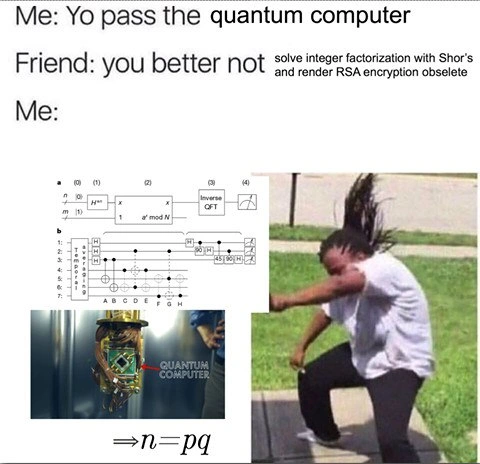
Now, the meme text is styled as:
Me: “Yo pass the quantum computer”
Friend: “you better not solve integer factorization with Shor’s and render RSA encryption obsolete”
Me: (proceeds to do exactly that, shown via images)

This format is a known meme culture template where someone asks for an object (“pass the quantum computer”) and the friend preemptively says “you better not do the very thing everyone would jokingly expect,” and then the original person is shown doing it in a big way. It’s a formula for comedic irony. In a more everyday meme, it might be like:
Me: “yo pass the aux cord”
Friend: “you better not play weird music”
Me: (blasts the weirdest song possible)
Here, instead of an aux cord and weird music, the stakes are much higher (and nerdier): a quantum computer and breaking cryptography. The friend’s warning, “you better not solve integer factorization with Shor’s and render RSA obsolete,” is basically them saying: “don’t do the one extremely chaotic thing you could do with a quantum computer: break all our encryption.” It’s phrased in technical terms: “solve integer factorization” (meaning factor a big number) “with Shor’s” (using Shor’s algorithm) to “render RSA encryption obsolete” (make RSA useless because you cracked its secret). That whole sentence is essentially the scenario security folks worry about in a nutshell. The meme is funny because it spells out that scenario so bluntly in a casual friend-to-friend talk, which is a bit absurd – friends usually don’t talk in that kind of highly technical lingo, but this is a nerdy meme so it’s part of the charm.

Let’s look at the images in the bottom panel (under “Me:”) and explain each:

  • Quantum circuit diagram (labeled A–H, mod N, inverse QFT): This is a representation of the steps inside Shor’s algorithm. Each horizontal line is a qubit (think of it as the quantum version of a wire carrying a bit). The boxes and symbols on those lines are quantum logic gates (operations done on the qubits). “if mod N” suggests a step where the circuit is doing something like computing (a^x \mod N) (multiplying numbers modulo N, which is a key part of generating the repeating pattern needed for factoring). “Inverse QFT” is literally telling us this is the final step of Shor’s algorithm where the quantum system is transformed in a way that measuring it will give the needed information (the period of that repeating pattern). To someone who hasn’t seen quantum circuits, this diagram might look like alien gibberish – but in context, it’s showing the actual method the “Me” plans to use on the quantum computer to crack RSA. In summary, it’s the qubit circuit diagram of Shor’s algorithm, included to emphasize, “Yup, we’re doing this by the book.”
  • Gold cryogenic quantum computer photo (labeled “QUANTUM COMPUTER”): That shiny gold apparatus is what a real quantum computer’s guts often look like – specifically, it’s the cooling system (a dilution refrigerator) and wiring for a quantum computer. Quantum processors have to be super cold (fractions of a degree above absolute zero) to work properly because any heat or noise can disturb the qubits. The photo has a sci-fi look: lots of dangling cables and metal plates – these are there to shield and link to the qubits at various temperature stages. The meme uses this image to represent the quantum computer itself. This is humorous because normally you’d think of a “computer” as maybe a box or a laptop; here it’s basically a piece of lab equipment. Tacking the label “QUANTUM COMPUTER” on it is like labeling a huge rocket engine as “CAR” – it shows that this thing is in a league of its own. This adds to the silliness of the request “Yo pass the quantum computer” – you can’t exactly pass that heavy, sensitive contraption around like a soda can! But the meme takes that impossibility and plays it straight for laughs.
  • “⇒ n = p q” math expression: This is a short way of saying “and then a miracle occurs… we got the factors!” In plainer terms, it shows the end goal: the large number n has been split into p and q. If n was an RSA public key, p and q are the secret primes that the owner of that key keeps hidden. By obtaining them, you’ve basically broken the encryption. So this part of the image just explicitly states what the outcome of running Shor’s algorithm is. In context, seeing “n = p q” tells the viewer that the person did factor the number. It’s the classic result that nullifies RSA. Think of it like the meme showing a lock symbol and then an arrow to an open lock — it’s a visual “I defeated this security”.
  • Blurred, sprinting person (the meme’s “Me” character): The guy in this image is caught mid-motion, hair flailing, as he launches into a sprint or an excited leap. You can almost hear the whoosh. This is a common meme image used to depict someone rushing to do something with zero hesitation. It represents the meme’s author (or any excited techie) being so eager to break RSA with the quantum computer that they’re literally jumping into action. The humor is that it shows reckless enthusiasm – the character is basically ignoring the friend’s warning instantaneously. In the context of the meme, as soon as the friend says “don’t do it,” the “Me” character is already in motion, hauling that quantum computer (in spirit) to carry out Shor’s algorithm as fast as possible. It’s exaggeration, of course: nobody can really run off with a quantum computer like that. But it symbolizes the idea of immediately doing the forbidden thing with glee.

For someone newer to these concepts, why is this funny or interesting? Because it’s mixing a casual, familiar style of joke with a very high-stakes technical scenario. It helps to know that RSA encryption being broken would be a massive deal – like overnight, a lot of secure systems would become insecure. We often joke about this in tech as a hypothetical “world-ending (for computer security) event”. Here the meme maker imagines themselves gleefully causing that event with the help of a futuristic gadget. It’s a bit like a kid finding their dad’s car keys and joyriding a Ferrari around the block, except the “car” here is a quantum computer and “speeding” is breaking the encryption that secures the digital world. The friend is the voice of reason (“This is a bad idea, it will make a mess”), but the protagonist is that chaotic good (or chaotic neutral) character who can’t resist trying out the cool thing, consequences be darned.

Finally, there’s a broader context: post-quantum security. You might wonder, since experts know about this threat, what’s being done? There’s an active effort in the tech world to develop post-quantum cryptography – new encryption methods that quantum computers wouldn’t be able to break (at least not easily). This meme gets a laugh from people who follow these developments because it dramatizes the exact problem those researchers are trying to solve. It’s like a cartoon of the “nightmare scenario” they’re preventing. For now, in real life, quantum computers aren’t yet strong enough to actually do this to real RSA keys (they can only handle very small examples). But everyone is racing to switch to new algorithms well before quantum tech catches up. So this meme is also a tongue-in-cheek reminder: “imagine if someone actually could do this today – yikes!” It’s equal parts funny and thought-provoking for those learning about cybersecurity and quantum tech.

Level 3: Casually Breaking the Internet

From a senior developer or security engineer’s perspective, this meme hits on a very real anxiety wrapped in humor. It imagines a world where quantum computing is as accessible as borrowing a friend’s laptop – a world that would send every cryptographer into a cold sweat. The text follows a familiar meme formula: “Me: Yo pass the X, Friend: you better not Y, Me: [does exactly Y at top speed].” Here, X is the quantum computer and Y is “solve integer factorization with Shor’s and render RSA encryption obsolete.” The friend’s warning reads like a highly specific, geeky punchline: they know exactly the one mischievous thing an over-eager nerd would try if handed a quantum computer – breaking RSA! Seasoned devs recognize this as the ultimate "forbidden fruit" scenario in CryptographyAlgorithms: RSA is everywhere (HTTPS, SSH keys, code signing) and it’s protected solely by the fact that factoring big numbers is impractically hard. The friend basically says “don’t you dare break the internet’s security, okay?” which of course is exactly what the meme protagonist immediately does.

The humor comes from the relatable inevitability of it. Hand a hacker or researcher something as revolutionary as a quantum computer, and of course they’re going to try Shor’s algorithm out. It’s like giving someone a key to the kingdom. The friend’s plea “you better not…” is futile – it’s precisely what everyone’s itching to do if they could. This taps into the collective understanding in the tech community: we’ve all heard the near-mythical promise that quantum computers could demolish RSA encryption by factoring the large number (N = p ⋅ q) that forms the RSA modulus. So the friend’s hyper-specific warning isn’t random at all; it’s referencing that well-known vulnerability. It’s as if a friend said, “don’t push the big red button that says ‘Do Not Press’,” and you smirk because pressing that button is too tempting. Here the “big red button” is running Shor’s algorithm on a real quantum machine, and the chaos it unleashes is making RSA obsolete (i.e., worthless for security).

For those in the industry, the phrase “render RSA encryption obsolete” hits close to home. RSA encryption has been a bedrock of online security for decades – basically the padlock icon in your browser owes its existence to the difficulty of prime factorization. Everyone from senior devs to IT managers has been hearing about the looming “Y2Q” (Years to Quantum) when we might need to switch out our encryption schemes. So the meme is funny because it dramatizes that exact moment of upheaval in a casual, meme-y way. It’s like a dev’s version of a disaster movie scene, but portrayed as a jovial act between friends. The image collage amplifies this:

  • Quantum Circuit Diagram (Shor’s algorithm) – This isn’t just any circuit; it’s a credible depiction of Shor’s algorithm with qubit registers, gates, and the quantum Fourier transform step (marked "inverse QFT"). Including that in the meme is an chef’s kiss detail that senior folks appreciate. It’s saying, “we know exactly how one would break RSA: here’s the schematic.” It’s the equivalent of showing the blueprint of the Death Star if the meme was about blowing up a planet. The complexity of this diagram (qubits A–H, conditional mod N gate, etc.) is part of the joke: it’s super serious science being used for a mischievous stunt. Seasoned engineers recognize those elements and think, “hah, they went all-in on the accuracy.”
  • The Quantum Computer Cryostat (golden fridge apparatus) – Anyone who follows QuantumComputing has seen photos of these beautiful, steampunk-looking rigs. They know that real quantum computers are delicate machines operating at millikelvin temperatures, not something you can literally pass around. The friend saying “yo pass the quantum computer” conjures an absurd image: it’s like someone casually handing over a several-ton, million-dollar scientific instrument. This absurdity isn’t lost on experienced folks – it’s highlighting how non-casual quantum tech really is. The cryostat stands for the serious hardware needed, underscoring the joke that our meme protagonist somehow has one at hand, ready for some Security shenanigans.
  • “⇒ n = p q” (factoring result) – This is essentially the trophy shot: the meme character’s “crime” in progress. Breaking RSA means finding those secret primes p and q, so showing the equation (n = p \times q) is a concise way to say “I did it! I factored N.” To an experienced dev, this evokes the fundamental RSA key structure: public key = n, private key = (p,q). Seeing that arrow to (n=pq) is the “drop mic” moment of the meme’s action. It visually represents that the encryption has been cracked wide open.
  • The Sprinting Guy (the eager me) – This blurry, mid-sprint frame of a person lunging forward with determination is a common meme image used to depict someone bolting to do something they shouldn’t. It perfectly captures the reckless enthusiasm here. In context, “Me:” is literally shown as me sprinting to run Shor’s algorithm. For those who’ve ever felt that irrepressible urge to try out a powerful new tool or attack vector, this image is hilariously on point. A senior engineer might imagine this is how a rogue actor at an agency might react if they secretly got a quantum computer: gleefully racing to slurp up everyone’s RSA keys. The hair flying and blurred motion illustrate that he’s not just walking to break RSA; he’s sprinting full tilt. This adds to the humor by implying there’s zero hesitation – the moment I get the machine, off I go into cryptographic mayhem.

Beyond the images, the meme speaks to a broader meme culture moment in tech: anxiety about quantum supremacy combined with a bit of gallows humor. People in security circles joke nervously about “Q Day” – the day a quantum computer actually cracks RSA-2048 or another widely used cipher. This meme is basically relatable humor about that scenario. It’s funny because it’s inevitable that the first thing many of us would want to do with a functioning universal quantum computer is exactly the thing we fear: test if today’s encryption holds up (spoiler: it wouldn’t). There’s also an element of “hold my beer” energy: the friend’s warning is like saying “don’t do the ultimate dangerous stunt,” and the “Me” is like “hold my qubit, I got this.”

Experienced developers also catch the nuances in the friend’s phrasing: “solve integer factorization with Shor’s.” That reads almost like an exam prompt or something out of a research paper, not a casual chat – which is precisely why it’s comedic. It’s overly formal and technical for a friend to say, highlighting the meme’s self-awareness that this is nerd territory. The meme knows that we know these terms, and it flaunts them. It’s essentially winking at the audience: both you and I know what Shor’s algorithm is and why it’s scary. That in-group reference to quantum computing concepts makes the meme especially satisfying to those who have that background.

Senior folks also recognize the subtext: post_quantum_security efforts are racing against time. NIST (the standards body) was, around the time of this meme (2021), already hosting competitions for quantum-resistant cryptography. The industry is well aware that RSA and ECC (Elliptic Curve Cryptography) crumble under quantum attacks (Shor’s algorithm also breaks ECC by solving discrete logs similarly). So the “Friend” in the meme is basically echoing every security chief’s plea to the quantum research community: “Please, not yet! We’re not ready!” And “Me” is the embodiment of the inevitable progress (or that one chaotic neutral person) that doesn’t heed the plea. In simpler terms, it humorously personifies the looming clash between new tech and old security infrastructure.

In summary, to a seasoned developer or cryptographer, this meme is a burst of TechHumor that combines accuracy and absurdity. It takes the very real concept of quantum supremacy fears – that a sufficiently advanced quantum computer could overnight make RSA useless – and frames it as a goofy friend scenario. The device that threatens all digital secrets is turned into a casual party favor in the setup. That contrast is gold. People in the know laugh because it’s both incredibly true to the tech (down to the inverse QFT) and tongue-in-cheek about the context (nobody’s actually passing a dilution refrigerator like a blunt). It’s the kind of joke you chuckle at and then maybe nervously think, “Haha…ha... gulp, one day this will be real.” And then you go read up on lattice-based encryption again.

Level 4: Quantum Fourier Finesse

At the cutting edge of Quantum Computing and theoretical Cryptography, this meme is a nod to the deep science behind breaking RSA. It references Shor’s algorithm, a famous quantum algorithm that can factor large integers exponentially faster than any known classical method. Shor’s algorithm demonstrated that the cornerstone of RSA encryption – the assumed hardness of integer factorization – isn’t an absolute if you have a powerful quantum computer. Here’s why this is such a big deal: in classical computing, factoring a huge number (like a 2048-bit RSA key) is so hard it might as well take longer than the age of the universe. But in the quantum realm, Peter Shor showed in 1994 that factoring can be done in polynomial time. The core insight involves transforming the factoring problem into a period-finding problem, then using a Quantum Fourier Transform (QFT) to extract that period from an entangled quantum state. Just as a classical Fourier transform finds the frequency of a repeating signal, the QFT finds the hidden periodicity of the function ( f(x) = a^x \mod N ) by manipulating probability amplitudes across many superposed states.

In the schematic shown (item (1) in the meme’s collage), we see a quantum circuit with labeled qubits A–H, an "if mod N" conditional operation, and an "inverse QFT" stage. This is essentially the blueprint of Shor’s algorithm: the qubits go through a series of gates that perform a superposition of exponentiations mod N, then an interference pattern via the QFT reveals the period r such that (a^r \equiv 1 \pmod{N}). Once that period r is measured from the quantum state (hence the “inverse QFT” uncomputing the phase), classical post-processing can derive the prime factors. For example, if r is even and not a trivial cycle, one can compute:

$$ p = \gcd(a^{r/2} - 1,, N) $$

to retrieve a nontrivial factor p of N (and similarly get q = N/p). Essentially the math yields n = p q, which is exactly what the meme shows in item (3) as the triumphant result of the computation. The “$⇒ n = p q$” text is the factorization outcome: the large number n has been cracked into its prime factors p and q. This elegantly captures how Shor’s quantum routine would make RSA’s secret key trivially obtainable once you have p and q.

The significance is profound. In complexity theory terms, factoring appears to leap from a super-polynomial complexity class into BQP (Bounded-Error Quantum Polynomial-Time). While not proven NP-hard, factoring has stood as a one-way function that underpins RSA’s security. Shor’s algorithm leverages quantum mechanics (superposition and interference) to cut through that complexity like a hot knife through butter. The quantum circuit diagram in the meme isn’t just random techno-babble; it’s representing the actual modular exponentiation and QFT that make Shor’s algorithm work. Seeing the label "inverse QFT" is a wink to those who know the algorithm’s inner workings – that’s the pivotal step where the quantum magic happens, revealing the periodicity needed to deduce the factors. It’s a reminder that quantum physics can solve certain problems in ways classical algorithms fundamentally can’t, by exploring many computational paths at once and using interference to amplify the correct answer.

Now, this theoretical prowess comes with a big caveat: an actual quantum computer capable of factoring, say, a 2048-bit RSA number would need thousands (or even millions) of high-quality qubits and error-corrected operations. Today’s quantum processors have maybe a few dozen to a few hundred noisy qubits, so we’re not quite passing around quantum computers at parties yet. That’s part of the humor – the meme posits a world where you can casually say, “pass the quantum computer,” when in reality these machines reside in specialized labs and often look like that gold-plated chandelier contraption in item (2) of the image. That gold device is a dilution refrigerator that keeps qubits at near absolute zero. Cryostats and intricate control circuitry are needed to maintain quantum coherence. It’s absurd (and hilarious to the initiated) to imagine someone literally picking up such a device and handing it over like it’s a smartphone. The meme combines this meme_format_yo_pass joke with highly technical content: mention of Shor’s algorithm and RSA obliteration. The clash between the casual tone (“yo pass the quantum computer”) and the extremely sophisticated action (using it to solve integer factorization, upending modern cryptography) is what gives experienced folks a nerdy chuckle.

Finally, the specter looming behind the humor is real: if and when quantum supremacy extends to practical tasks like breaking RSA, all our current RSA-based security would indeed become obsolete overnight. This is why there’s a whole field of post-quantum security scrambling to develop new cryptographic algorithms (like lattice-based or hash-based cryptography) that even a quantum computer can’t crack easily. The meme captures a moment of “quantum supremacy fear” in a comedic nutshell: one moment you have secure encryption, the next moment a quantum-empowered buddy might sprint off to shatter it. It’s as if the meme says, “Quantum computing’s coming for your cryptography – and it’s excited to do so.” The technical accuracy of the references (Shor’s, QFT, factorization) paired with the absurd scenario makes this a delightful TechHumor piece for those deeply familiar with these QuantumComputingConcepts.

Description

A multi-panel meme using the 'You better not' format. The top text dialogue reads: 'Me: Yo pass the quantum computer', 'Friend: you better not solve integer factorization with Shor's and render RSA encryption obsolete', followed by 'Me:'. The bottom half is split into two sections. On the left, there are scientific diagrams of quantum circuits, a photo of the core of a physical quantum computer, and the mathematical formula 'n = pq'. On the right, a person is enthusiastically dancing the Milly Rock, implying they are doing exactly what their friend warned against. The meme's humor lies in the nonchalant way it treats a catastrophic event for modern cybersecurity. Shor's algorithm, run on a sufficiently powerful quantum computer, can efficiently factor large numbers (the 'n = pq' problem), which would break RSA encryption, a cornerstone of current digital security. The dance represents the gleeful, chaotic energy of a tech enthusiast finally getting to play with world-changing technology, regardless of the consequences

Comments

11
Anonymous ★ Top Pick My friend warned me not to use the quantum computer to break RSA. I told him not to worry, I'm just trying to figure out if my cat is both in the box and out of the box at the same time
  1. Anonymous ★ Top Pick

    My friend warned me not to use the quantum computer to break RSA. I told him not to worry, I'm just trying to figure out if my cat is both in the box and out of the box at the same time

  2. Anonymous

    Shor factoring 4096-bit RSA is the easy part - the real quantum nightmare is convincing finance we have to rotate every hard-coded PEM before the auditors observe the wavefunction

  3. Anonymous

    The real quantum entanglement is between the promise of breaking RSA in polynomial time and the reality of needing error correction for millions of logical qubits while your quantum computer decoherences faster than a junior developer's confidence during their first production incident

  4. Anonymous

    The real quantum entanglement here is between your career prospects and that 'just testing' commit that broke every SSL certificate in production. Sure, Shor's algorithm runs in polynomial time, but explaining to your CISO why you pointed a quantum computer at the company's PKI infrastructure? That conversation scales exponentially with each passing second - which is why our protagonist is already achieving classical speedup in the opposite direction

  5. Anonymous

    Shor's algorithm: turning 'unfactorable' RSA moduli into trivial period-finding faster than you can say 'post-quantum migration'

  6. Anonymous

    Shor’s is adorable on a whiteboard; in prod it’s a single Jira: “Replace RSA globally” - assignee: everyone

  7. Anonymous

    Shor’s is the only PoC that instantly converts your entire 4096-bit PKI into a P0 post-quantum migration backlog

  8. @metal_Dash 4y

    Ok

  9. @pxrxnoia 4y

    ok

  10. @adhdnigga 4y

    smort

  11. @pipipuputch 4y

    I understood 🧠 +20iq

Use J and K for navigation