Skip to content
DevMeme
3361 of 7435
When Developers Give Users a New 'Bell' Feature
Stakeholders Clients Post #3693, on Sep 14, 2021 in TG

When Developers Give Users a New 'Bell' Feature

Why is this Stakeholders Clients meme funny?

Level 1: It’s a Hat

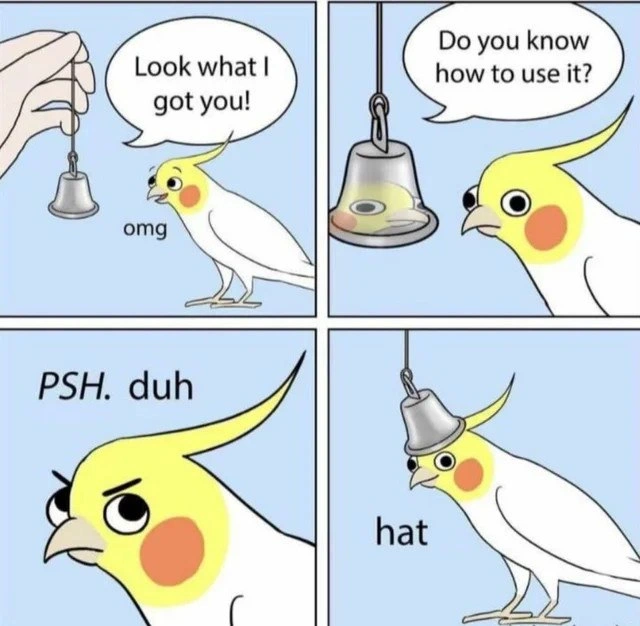
Imagine your friend gives you a new cool toy, like a little bell that’s supposed to ring and make a pretty sound. You’re super excited and don’t want to admit you have no idea how to use it. So when they ask if you know what to do, you puff up your chest and say, “Of course I do!” But instead of ringing the bell, you put the bell on your head like a funny hat. 😅 Now, that’s obviously not what the bell is for! The bell was meant to be rung so it tinkles, but you used it as a hat because you were a bit too proud to ask how it really works. That’s exactly what’s happening in this comic. The little bird is like a person who got a new gadget and is overly confident. It’s cute and silly because the bird ends up with the bell on its head, proudly saying “hat,” as if that’s what the bell is meant for. We find it funny because we’ve all felt a bit silly like that – pretending we knew something and then using it totally the wrong way. It’s like when a kid gets a new kitchen tool from their parent and instead of stirring soup with the ladle, they plop it on as a helmet. The humor comes from seeing someone so confident do something so obviously goofy. In the end, the bird with the bell-hat shows that sometimes we act like we know everything, only to create a goofy moment – and it makes us laugh and remember to maybe ask for help next time.

Level 2: Shiny Tool Confusion

In this meme, a cute cockatiel (a small parrot) represents a developer, and the tiny silver bell is a new software tool – like a new programming library or framework the dev just got. The hand in the first panel saying “Look what I got you!” is like your colleague or boss introducing a cool new tech tool: maybe a new JavaScript framework or a shiny cloud service. The bird’s excited reaction, “omg”, is just like a developer getting all hyped up about this tool. We often call these things “shiny new toys” in developer culture – we’re eager to play with the latest developer tooling because it’s supposed to make our life easier or our app better. This excitement is part of DeveloperExperience_DX – the fun and curiosity that comes with new tech.

The second panel, with the bell hanging and the question “Do you know how to use it?”, translates to someone asking the dev, “Hey, do you actually know how this library works?” Maybe a senior team member or our inner voice is checking if we’ve read the instructions. The cockatiel just stares, and in the next panel answers, “PSH. duh.” That “PSH. duh.” is an overconfident answer – basically the bird (developer) says “Of course I do!” in a dismissive way. This is a setup for the joke: the bird is bluffing. It claims to know how to use the tool, but we suspect it might not. This is really common in real life when developers are too proud or excited to admit they haven’t fully learned something. Maybe the dev glanced at a tutorial and thinks that’s enough. This feeling can come from a bit of ego or the pressure to appear competent. There’s even a known concept in learning called the learning curve – how quickly or slowly you can pick up a new skill. A steep learning curve means it’s hard at first. Many new frameworks have a steep learning curve, even if they promise a better DX (Developer eXperience) once you know them. Here the bird is ignoring the learning curve, assuming it’s “duh, easy.”

Now the punchline: in the last panel the cockatiel uses the bell completely wrong – it sits under it so the bell becomes a little hat on its head. The bird proudly says “hat.” as if that was the goal all along. 😂 In reality, a bell is meant to ring and make a sound (perhaps the bird was supposed to ring it to get a treat). By calling it “hat,” the bird shows it had no idea what to do with the bell, despite its confident “I know how to use it.” This is analogous to a developer misusing a tool in a way it’s not intended. The dev might have said they understood the new library, but their implementation is as incorrect as putting a bell on your head instead of ringing it.

For example, imagine a junior programmer given a powerful data visualization library. They assure everyone, “Yeah I got this,” but then use it to do something it wasn’t built to do – like using the chart library to try to send network requests or some totally off-label use. The result will be weird or broken. It’s similar to the cockatiel’s bell-helmet: technically the bird used the bell (it’s physically on its head), but not in a meaningful or correct way. In real dev life, this might show up as a piece of code that uses a framework incorrectly. Maybe the dev integrated a new framework (which provides a whole structure for your application) but they only used it to do one trivial thing or used it wrongly. One common newbie move: including a huge framework like React or Angular, but still manipulating the HTML DOM directly like they did with simple scripts, because they haven’t learned the framework’s way. Essentially, they’re not leveraging the tool – it’s just sitting on their project “as a hat.” The code runs, but it’s not right. Senior devs or code reviewers spotting this will immediately realize the person didn’t truly understand the tool.

Let’s break down a few terms that relate to this scenario:

  • Library vs. Framework: A library is a collection of helpful code you can call when you need it. It’s like getting a new power drill with attachments – you use it when appropriate. A framework is more like a pre-built structure or set of rules for building your app – akin to an entire workbench or mold you build within. In either case, you usually need to learn how it expects you to use it. If you misuse a library or framework, it’s like using a drill backwards or assembling the workbench wrong. The meme’s dev (cockatiel) clearly didn’t follow the expected use of the bell tool.
  • Developer Experience (DX): This refers to how easy and pleasant tools are for developers to use. Good DX (like good documentation, clear APIs, helpful error messages) helps devs learn the proper use quickly. If a tool has poor DX, devs might get confused and use it wrong. In the comic, one might joke that the bell’s “DX” wasn’t great for the bird – maybe no one explained it well – but more likely, the bird just didn’t bother to learn (a user error 😅).
  • Learning Curve: This is the time and effort required to get good at something new. A gentle learning curve means you can pick it up quickly; a steep one means it’s hard at first. Many modern tools come with a steep initial learning curve. Here, the dev underestimated the learning curve. They thought ringing the bell would be obvious, but ended up doing something silly. In dev terms, it’s like thinking a new framework is straightforward because the demo looked easy, but when you try, you realize you’re lost – yet you might not admit it.
  • Overconfidence: In learning (and especially in tech), overconfidence happens when someone thinks they know more than they actually do. The cockatiel saying “PSH. duh” is pure overconfidence. It’s funny in the meme but in real life it can lead to bugs and odd solutions. A humble approach would be reading the documentation, experimenting, and asking questions. But many of us, especially when excited, skip straight to “I totally get it” and dive in. The result can be messy — just like wearing a bell instead of ringing it.

This meme is popular in DeveloperHumor circles because it captures an inside joke: developers often see (or commit) ridiculous misuses of tech out of enthusiasm or misunderstanding. It’s an affectionate ribbing, not mean-spirited. We’ve all been the cockatiel at some point, eager to try something new and then face-palming later when we realize we did it wrong. The phrase “End users be like” in the post caption adds an extra twist: sometimes developers joke that end users (non-developers using our software) misuse features or do unexpected things. Here, the developer themselves becomes the “end user” of a new dev tool, doing something unexpected (and funny) with it. It’s a playful reminder that no matter how smart we think we are, when we’re new to something we might act just like a confused user.

In short, the meme uses a simple bird-and-bell scenario to symbolize a confident dev tackling a new piece of tech without proper understanding. It highlights the humor and inevitability of learning mistakes. Anyone who’s struggled with new tooling or witnessed a teammate try a “creative” solution that turned out wacky will chuckle. The message: it’s okay, we all sometimes put the bell on our head thinking that’s how it’s done – and only later learn the right way to make it ding. 🔔🤦‍♂️

Level 3: Hat-Driven Development

The comic’s cockatiel is every overconfident developer who just got a shiny new tool (library, framework, you name it) and insists they know how it works without actually reading the docs. In the first panel, a hand offers a tiny bell: “Look what I got you!” – think of this as the tech lead or the hype-driven tech community introducing the latest framework or library to a dev. The bird’s ecstatic “omg” reaction is that developer hype we know so well: New tech! Must try! This kicks off a classic case of Hype-Driven Development, where excitement trumps understanding.

By panel 2, the bell is hanging and the question is asked: “Do you know how to use it?” The cockatiel stares at the bell much like a developer staring at confusing documentation or an API reference. The sensible answer here would be “Not yet, let me learn”, but of course our feisty feathered friend (the dev) proudly responds in panel 3 with “PSH. duh.”—the universal dev code for “I’ve skimmed one blog post, how hard could it be?” We’ve all met (or been) that person who claims “Yeah, I totally got this” after 5 minutes of Googling. This frame perfectly captures developer overconfidence. You can almost hear the unearned swagger.

Then comes the punchline in panel 4: instead of actually ringing the bell (using the tool correctly), the cockatiel plops the bell on its head like a helmet. One deadpan word: “hat.” 😑 This absurd repurposing is the meme’s way of showing the dev had no clue how to use the tool, despite the bravado. The intended use-case (ring the bell for a treat, or in dev terms, implement the tool’s actual functionality) is completely missed. The cockatiel has literally made the bell into a hat, analogous to a programmer forcing a new library to do something totally unintended. It’s a chef’s kiss moment of tool misuse. Instead of the bell ringing, all we hear are the alarm bells going off in every senior engineer’s head witnessing this fiasco.

Why is this so hilarious to developers? Because it rings true (pun intended). There’s a rich vein of DeveloperHumor around newcomers or over-eager teammates misapplying technology in exactly this way. We laugh (or cringe) because we’ve seen it: the LearningCurve was steeper than assumed, but the dev’s confidence was higher than warranted. It’s a cheeky illustration of the Dunning-Kruger effect in tech – a little knowledge made them dangerously sure of themselves. The meme exaggerates it with a literal bell-on-head, but the underlying pattern is painfully familiar. Consider some real-world “hat” moments we’ve encountered:

  • A junior engineer excited about Kubernetes hears it’s the cool new thing for deployment. Next thing you know, they’ve containerized a simple “Hello World” app and deployed a full Kubernetes cluster for it – effectively wearing a NASA-grade helmet to ride a tricycle. It’s overkill and misusing the tool’s power, much like our cockatiel turning a bell into headgear.
  • A developer skims a tutorial on a machine learning library and, saying “PSH, got it,” uses it to implement a basic arithmetic calculator. They’ve treated a sophisticated AI framework like a trivial script. It technically “works,” but it’s the wrong tool for the job – the equivalent of using that bell as a fashion accessory rather than a signal.
  • A team adopts the newest JavaScript framework (say, a shiny UI library) because of hype. Without really learning its paradigm, someone starts mixing in old jQuery hacks to get things working. The code “wears” the framework like a hat – superficially present, but underneath, it’s not using the framework as intended at all. The app ends up a Franken-code, and any dev who looks at it goes, “Wait, why is this basically jQuery wearing a React hat?”

In each case, the tooling was introduced with promise to improve things (better scaling, smarter code, improved DeveloperExperience_DX, etc.), but lack of understanding turned it into a hat – an unexpected use case that’s more comical than effective. This highlights a DX pitfall: if a new tool isn’t learned properly (or if its Developer Experience (DX) isn’t intuitive), developers confuse how to use it, sometimes spectacularly. The cockatiel’s “hat.” moment is a perfect metaphor for those times a dev says “It’s not a bug, it’s a feature!” while everyone else facepalms. The bird is confident, but clearly in error – just like a dev proudly demoing something that completely misses the point of the new tech.

From a senior perspective, the humor also carries a hint of “I’ve been there.” Many of us seasoned devs can recall our early career versions of this folly – times we thought we understood a new library and ended up creating a bizarre workaround. It’s both funny and a gentle warning: new tools aren’t magic hats. The meme cleverly portrays how developer learning often involves stumbling and creative (mis)use of tools. We laugh because the cockatiel’s smug face is exactly the expression of a dev who doesn’t know what they don’t know. And that final panel’s minimalist caption “hat.” is the mic-drop: a one-word summary of the fail. In coding terms, it’s like running a program and getting a one-word error message – blunt and unmistakable.

So, “When the dev confidently misuses the shiny new tool as a hat” is a spot-on encapsulation of a classic dev in-joke. It reminds us how overconfidence + new tech can lead to solutions that are technically using the tool… but completely missing its actual purpose. And the next time someone on the team says “PSH. duh, I know how this works,” you might just picture a little cockatiel with a bell helmet, and proceed with caution. After all, no one wants to find production code wearing a hat it shouldn’t be wearing. 😉

Description

A four-panel comic strip featuring a yellow and white cockatiel, illustrating user behavior with new features, set against a light blue background. In the first panel, a human hand presents a small silver bell, saying, 'Look what I got you!'. The bird looks excited and the text 'omg' appears beside it. In the second panel, the hand asks, 'Do you know how to use it?' as the bird looks inquisitively at the bell. The third panel is a close-up of the bird's face, looking confident and slightly annoyed, with the text 'PSH. duh'. In the final panel, the bird has the bell on its head like a hat, with the single word 'hat' below it. This meme perfectly encapsulates the developer's experience of building a tool for a specific purpose, only for the end user to completely misunderstand and use it in an unexpected, often simplistic, way. It humorously highlights the gap between developer intent and user behavior, a common frustration in software development related to user experience (UX) and intuitive design

Comments

8
Anonymous ★ Top Pick We spent a quarter implementing an async, multi-threaded notification system. The users just wanted a new hat
  1. Anonymous ★ Top Pick

    We spent a quarter implementing an async, multi-threaded notification system. The users just wanted a new hat

  2. Anonymous

    Spent six months perfecting a back-pressure-aware gRPC stream; first enterprise client wires it up through a nightly Excel macro via ODBC - beautiful bell, excellent hat

  3. Anonymous

    Just like the cockatiel with the bell jar, half our engineering team treats Docker like a magical 'it works on my machine' hat - completely missing that containerization is about isolation and reproducibility, not just slapping a Dockerfile on legacy monoliths and calling it cloud-native

  4. Anonymous

    This is every senior engineer watching a mid-level dev confidently implement Redis as a primary database, Kafka for request-response patterns, or Kubernetes for a three-user internal tool. The bell becomes a hat with the same energy as using MongoDB because 'it's web scale' or implementing microservices for a monolithic problem. We've all been that bird at some point - the difference is whether you realize you're wearing the bell wrong before or after the production incident

  5. Anonymous

    PM: 'Here's Kafka.' Senior dev: 'PSH, duh - persistent queue hat for the monolith!'}

  6. Anonymous

    CTO: “We got you Kubernetes - do you know how to use it?” “PSH, duh.” We run the monolith as one pod, slap on a sidecar, and call it microservices - hat

  7. Anonymous

    We adopted Kubernetes and now our single pod wears a very expensive hat - Kafka does RPC, Redis is the database, and PagerDuty is the only bell that rings

  8. @mrybs1 4y

    Red

Use J and K for navigation